
You've launched. The product is live, the deck is done, maybe the round is closed, and now every conversation sounds the same: grow faster, prove traction, lower CAC, build pipeline.
That's usually when startup teams make their first expensive marketing mistake. They treat channels like a checklist. Start a blog. Run LinkedIn ads. Post on social. Build a newsletter. Sponsor something. Hire an agency. None of it is wrong on its own. The problem is the order.
Good digital marketing for startups isn't about doing more. It's about doing the right things in the right sequence so each move makes the next one cheaper, faster, or more reliable. If you get the sequencing wrong, paid media becomes life support. If you get it right, your site, content, positioning, email list, and referrals start compounding together.
Table of Contents
- Your Digital Marketing Playbook Starts Here
- Laying the Foundation Positioning and Goals
- Prioritizing Your First Marketing Channels
- Budgeting and Staffing Your Growth Engine
- Building an Experiment Roadmap
- Measuring What Matters and Adapting to Change
- Your First 12 Months A Sample Timeline
Your Digital Marketing Playbook Starts Here
Most founders don't have a marketing problem. They have a prioritization problem.
The pressure shows up fast. Investors want signals. The sales team wants leads. Product wants better activation. Founders want growth without hiring a full department too early. Under that pressure, it's easy to confuse activity with progress.
That approach breaks because digital visibility is now the baseline, not the bonus. One projection puts total global ad spend at almost $1.04 trillion in 2026, with 68.7% spent on digital platforms according to CoralBees' write-up on startup digital strategy. For startup teams, that means your market is already training buyers to discover, compare, and evaluate through search, social, content, email, and paid distribution.
So the question isn't whether to invest in digital marketing for startups. It's where to start so you don't waste a quarter building channels that won't matter yet.
A useful way to think about it is this:
- Foundation first. Clarify positioning, audience, and the one outcome marketing is supposed to drive.
- Compounding channels next. Build assets that keep producing after the campaign ends.
- Paid acceleration after that. Use ads to amplify what already resonates, not to manufacture demand from a weak message.
- Measurement throughout. Don't wait until month six to decide what “working” means.
For B2B teams especially, this sequencing matters because your site, content, proof, and conversion path often do more heavy lifting than any ad campaign. If you want a parallel framework for SaaS acquisition, this breakdown of B2B SaaS marketing strategies is a useful companion.
Practical rule: Don't buy traffic to a message you haven't validated organically.
Laying the Foundation Positioning and Goals
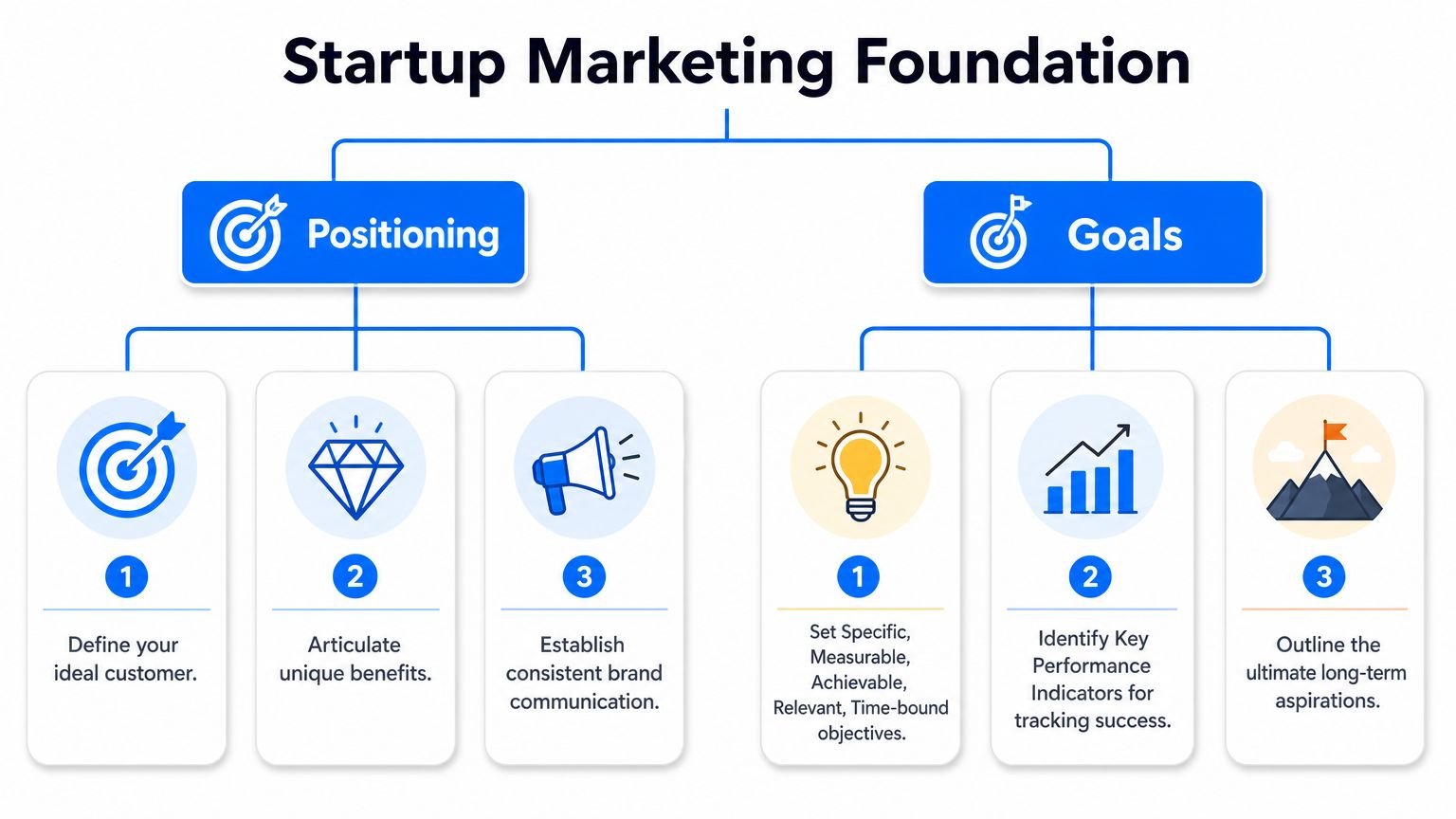
Marketing gets expensive when the company can't answer a basic question in one sentence: who is this for, and why should they care right now?
Start with positioning before channels
Positioning doesn't need a workshop deck. It needs clarity. A founder should be able to say:
We help [specific customer] solve [specific problem] by [specific mechanism], unlike [common alternative].
That statement forces useful choices. It narrows the audience, sharpens the promise, and gives your homepage, ad copy, onboarding, and sales narrative one center of gravity.
If your team is still describing the product in broad category language, fix that before launching campaigns. Generic messaging kills performance across every channel. Search snippets underperform, paid ads attract weak-fit clicks, and outbound emails sound interchangeable.
A simple positioning checklist:
- Customer first. Name the buyer or user with enough specificity that your team can picture them.
- Pain second. Focus on the job that feels urgent, costly, annoying, or risky.
- Mechanism third. Explain how your product solves the problem in a way competitors don't.
- Proof fourth. Add one believable reason the claim holds up, such as workflow simplicity, implementation speed, deeper reporting, or tighter integrations.
For search visibility, this is also the groundwork for your information architecture. If you need a solid primer on how pages, topics, and search intent fit together, this guide to understanding search engine optimization is worth bookmarking.
Turn positioning into operating goals
Once the message is clear, goals should connect marketing activity to business movement. Avoid soft goals like “build awareness.” That language gives nobody a decision framework.
Use a basic startup-friendly structure:
| Goal layer | What it should answer |
|---|---|
| Objective | What business outcome matters now |
| Signal | What user action proves progress |
| Constraint | What cost, speed, or quality boundary matters |
| Owner | Who makes the metric move each week |
That turns vague ambition into something operational. “Generate demand” becomes “increase qualified demo requests from the ICP while keeping sales feedback positive.” “Grow organic traffic” becomes “publish a focused set of pages that attract the right search intent and support conversion.”
One more point matters here. Your channels shouldn't operate as separate mini-programs. A scalable model maps messaging and offers across the customer journey using an IMC/PESO structure: Awareness through ads, blogs, social, video, and email; Interest through SEO, FAQs, webinars, and targeted ads; Desire through free trials, demos, testimonials, and value-based pricing; and Action through smooth payment, feedback capture, and referrals, as outlined in this startup marketing study. The same study flags weak channel consistency as a core reason marketing fails to compound.
If your ad promises one thing, your homepage says another, and your sales call emphasizes a third, the market doesn't get smarter. It just gets confused.
Prioritizing Your First Marketing Channels
Two startups can sell the same product and need completely different channel plans.
One has a founder with audience credibility, a few design hours a week, and almost no ad budget. The other has funding, a sales team, and a market already searching for the category. If both teams copy the same “top startup marketing channels” list, one of them wastes a quarter. Channel choice is a sequencing problem first. Pick the wrong first channel, and every later test gets harder to read.
Start with a simple rule. Build one compounding engine before you feed acceleration channels.
Start with compounding channels, then add speed
Compounding channels keep producing value after the first push. For early-stage startups, that usually means:
- Website and conversion paths
- SEO pages built around high-intent searches
- Email capture, nurture, and lifecycle flows
- Case studies, proof assets, and comparison pages
- Referral loops and repeatable partnerships
Acceleration channels buy speed, but they rarely keep working once spend stops:
- Paid search
- Paid social
- Sponsorships
- Short-term creator campaigns
- Higher-volume cold outbound
Both channel types matter. The order matters more.
A startup with thin budget, low brand recognition, and an unproven funnel should usually put early effort into owned assets first. Fix the destination, define the offer, and make follow-up reliable. Paid acquisition gets more expensive when traffic lands on weak pages or unclear CTAs. I have seen teams blame channel performance when the problem was the page, the message, or the handoff after conversion.
Match the first channel to stage, budget, and team shape
The fastest way to prioritize is to match channels to constraints, not preferences.
Pre-PMF startup
Focus on customer conversations, sharp landing pages, founder-led distribution, and email capture. SEO can start here, but only around narrow, commercial-intent topics. Broad content programs usually create work without revenue.
Early PMF startup
Invest in pages that convert existing demand. Add paid search if buyers already know the problem and search for solutions. Build a small content system around use cases, comparisons, and buyer questions. This is also the point where a realistic breakdown of SEO service costs for startups helps decide whether to build in-house, use a freelancer, or hire an agency.
Growth-stage startup
Add more paid distribution, structured lifecycle email, retargeting, partnership motion, and deeper content coverage. At this point, the team usually has enough signal to expand without guessing.
That sequence sounds conservative. It is. Conservative beats random.
A focused SEO system for startups
Early SEO works best when it stays narrow. A new domain rarely wins by publishing dozens of generic articles and waiting for traffic.
Helpware's startup marketing guidance recommends defining a clear job-to-be-done, grouping a focused set of keywords around that problem, and publishing a small cluster of pages instead of chasing volume. The same guidance also calls out page speed and mobile usability because weak site performance undercuts rankings and conversion.
A practical workflow looks like this:
- Choose one painful, high-value customer problem.
- Group closely related search queries around that problem.
- Publish a small page cluster with distinct intent.
- Track conversions and pipeline impact at the page level.
- Update pages when rankings slip or buyer intent changes.
The page types that usually earn their place early are:
- Problem pages for pain-aware searches
- Solution pages for category and product understanding
- Comparison pages for active evaluation
- Use case pages tied to specific roles or workflows
- Conversion pages for demos, trials, or contact
What usually fails is broad top-of-funnel publishing on a site that has little authority, weak internal linking, and no proof.
Startup Marketing Channel Prioritization Matrix
| Channel | Typical Cost | Time to Impact | Scalability | Best For |
|---|---|---|---|---|
| SEO content | Lower cash cost, higher time cost | Slower | High | Startups with clear search intent and patience to build owned traffic |
| Landing pages and site CRO | Moderate | Medium | High | Teams already getting some traffic but leaking conversions |
| Email lifecycle | Lower | Medium | High | Products with trials, demos, waitlists, or repeat engagement |
| Paid search | Moderate to high | Fast | Medium | Capturing high-intent demand when conversion paths are ready |
| Paid social | Moderate to high | Fast | Medium | Testing messages, retargeting, and creating initial reach |
| Partnerships | Lower to moderate | Medium | Medium to high | Niche markets with overlapping audiences |
| Referral programs | Lower to moderate | Medium | High | Products with satisfied early users and shareable value |
| Social organic | Lower cash cost, ongoing effort | Variable | Medium | Founder-led brands and categories where trust drives conversion |
How AI changes channel selection
AI has changed search behavior, but it has not changed the logic of prioritization. Start with channels that create reusable assets and direct buyer relationships.
That means content still matters, but weak content matters less than it used to. Summary pages get absorbed by AI results and ignored by buyers. Decision-support content still pulls its weight. Publish implementation detail, comparison logic, integration specifics, proof, and pages that help a prospect move from interest to action.
Owned audience matters more too. Email lists, branded search, direct traffic, community access, and customer referrals are more durable than depending on one discovery source.
Build pages and programs that help a buyer choose, not pages that just repeat what they already read elsewhere.
Budgeting and Staffing Your Growth Engine
A startup doesn't need a big marketing org early. It needs enough coverage to build assets, run tests, and measure outcomes without dropping work between teams.

What to fund first
If budget is tight, fund the things that reduce wasted spend later:
- Messaging and page clarity. Homepage, product pages, demo or trial pages, and core use case pages.
- Analytics setup. GA4, event tracking, CRM attribution fields, and a clean conversion definition.
- Core content assets. A small set of pages tied to clear commercial intent.
- Creative production. Paid channels stall when the team can't generate new hooks, visuals, and angles.
- Email infrastructure. Capture, nurture, onboarding, and reactivation flows.
Don't sink early budget into broad awareness programs unless you already know what message converts. Startups often think they have a traffic problem when they really have a clarity problem.
A useful budgeting lens is simple: separate build budget from test budget. Build budget covers site, content, analytics, and core assets. Test budget covers paid experiments, partnerships, and distribution. If you blur those together, tests fail because the foundation was weak.
If you're comparing cost structures for organic acquisition support, this overview of the average cost for SEO services can help frame trade-offs between in-house work, freelancers, and agencies.
Who your first marketing hire should be
Most startups shouldn't hire a narrow specialist first. They should hire a T-shaped marketer who can own messaging, ship pages, coordinate freelancers, and run basic tests across channels.
That person usually needs to be comfortable with:
- writing landing page copy
- briefing designers
- using GA4 and CRM data
- publishing content in a CMS
- running small paid experiments
- talking to sales and product without translation layers
A specialist first hire makes sense when the bottleneck is already obvious. If the startup has strong product marketing but weak search visibility, an SEO lead can work. If paid search is already showing promise and budgets are growing, a performance marketer can be the right first addition. But that's rarely the first move.
A lean stack that covers the basics
You don't need a bloated stack. You need coverage for four jobs:
| Job | Practical options |
|---|---|
| Analytics | GA4, CRM reporting, spreadsheet model |
| Site and pages | Webflow, WordPress, HubSpot CMS |
| Email and automation | HubSpot, Customer.io, Mailchimp |
| Creative and collaboration | Figma, Notion, Airtable, Loom |
The stack should match team speed. A fancy setup that nobody uses is worse than a simple one the team updates every week.
One hiring rule I've seen hold up: if your first marketer can't explain which activities are compounding and which are rented, they're likely to overspend on speed and underinvest in durability.
Building an Experiment Roadmap
A startup team launches three campaigns in a month, sees a bump in traffic, and still cannot answer a basic question: what should we do again next month? That usually means the team is running activity, not an experiment roadmap.
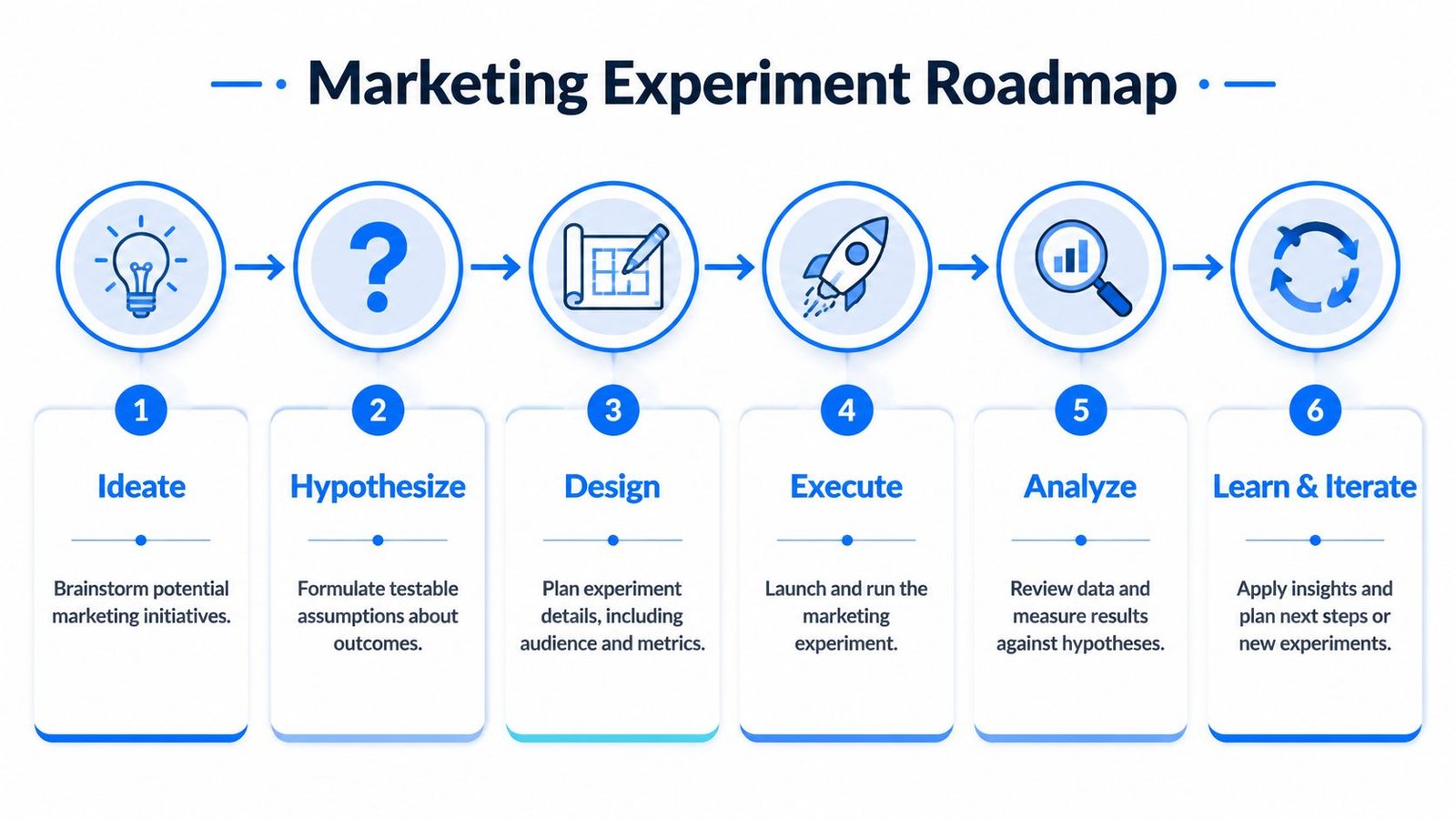
The roadmap matters because early-stage marketing is a sequencing problem. You do not need a long backlog of ideas. You need an ordered list of tests tied to the current bottleneck, the team you have, and the channels that can compound if they work.
Build the roadmap around one bottleneck at a time
Start with the constraint that is slowing growth right now. Low click-through from ads. Weak conversion on high-intent pages. Trial signups that never activate. Pick one.
Then score experiment ideas against three filters:
Expected impact
If the test works, does it improve a meaningful step in the funnel?Speed to learn
Can the team get a read quickly, or will it take months to collect enough signal?Compounding potential
Does the win carry forward into future months, such as stronger messaging, better conversion paths, or a reusable audience?
This keeps teams from spending four weeks on a polished campaign that teaches very little.
Use a tight test cycle
A useful experiment loop has four steps:
Write the hypothesis
Use one sentence. Example: a page for finance leaders will convert better than a generic product page because the risk and ROI language matches buyer intent.Define the test
Keep the scope narrow. One audience, one variable, one window for review.Set the decision rule
Decide in advance what result means ship it, revise it, or stop it. This prevents post-test rationalizing.Record the learning
Save the result, the context, and the next action. A test that ends without a decision is wasted work.
I usually want a roadmap with a mix of quick reads and slower bets. Quick reads sharpen messaging and offers. Slower bets build assets that keep paying back.
Prioritize experiments by startup stage
The right roadmap changes with stage.
Pre-PMF or early traction
Focus on message-market fit. Test audience framing, headline angles, offers, and onboarding entry points. Do not spread effort across five channels if the core pitch is still unstable.
Post-PMF with an early repeatable channel
Work on conversion efficiency and intent quality. Tighten landing pages, improve lead capture, and test follow-up sequences before adding more spend.
Growth stage with budget and team support
Add channel expansion only after the primary engine is measured and reasonably predictable. At this stage, experiments can branch into adjacent audiences, partner programs, SEO clusters, or paid social variations.
That sequencing is what keeps a roadmap useful. Teams that skip ahead often buy traffic before they know what message or offer converts.
High-value experiments for lean teams
Good startup experiments usually sit close to buyer intent and revenue movement:
- Landing page message test. Compare two value propositions for the same audience.
- Offer test. Demo request versus free trial versus consultation.
- Paid creative test. Hold audience constant and change the problem framing.
- Lead form test. Short form versus qualification-first form on high-intent pages.
- Email nurture test. Educational sequence versus proof-led sequence.
- Activation test. Different onboarding prompts, templates, or next-step guidance after signup.
- Partner webinar test. Useful when trust from an adjacent brand shortens the sales cycle.
Each of these can answer a real budget question. Keep investing here. Fix this before scaling. Cut this idea.
Run experiments that show where durable demand comes from, not just where cheap clicks come from.
A good roadmap should make trade-offs obvious. If a test gives a fast result but no lasting advantage, treat it like rented reach. If a test improves positioning, conversion, or owned audience quality, it deserves more attention because the learning carries into every future campaign.
Measuring What Matters and Adapting to Change
A lot of startups claim to be data-driven while steering on the wrong metrics.
Traffic goes up, everybody celebrates. Social engagement spikes, the team posts screenshots. Email opens improve, someone updates the board slide. Meanwhile, pipeline quality is flat and activation is weak.
Stop leading with vanity metrics
Vanity metrics aren't useless. They're just incomplete. They tell you something happened, not whether it mattered.
What matters more is whether marketing is producing efficient revenue movement. Businesses should have a working view of:
- Customer Acquisition Cost
- Lifetime Value
- Payback Period
- Qualified pipeline created
- Activation or trial-to-paid movement
- Channel contribution by intent quality
You don't need perfect finance-grade modeling on day one. You do need shared definitions. If marketing says a lead is good and sales says it's junk, the reporting system isn't helping anyone.
Build measurement around decisions
Measurement should answer budget questions. Keep or cut a channel. Scale a campaign. Refresh a page. Hire for a capability. Tighten audience targeting. Shift spend from one offer to another.
A practical startup dashboard usually needs three layers:
| Layer | What to track |
|---|---|
| Channel | Spend, traffic quality, conversion events |
| Funnel | Visit to lead, lead to demo, demo to customer |
| Economics | CAC direction, payback trend, revenue contribution |
When teams skip the funnel layer, they optimize for cheap traffic. When they skip the economics layer, they overvalue channels that look busy but don't pay back.
How to handle attribution when tracking gets messy
Attribution is getting noisier. That's not a future problem. It's already changing how startup teams should measure.
A frequently under-answered question is how startups should adapt to signal loss from third-party cookie deprecation. The practical answer is that marketers increasingly need first-party data, stronger analytics, and blended measurement models rather than last-click reporting, as noted in Stripe's guidance on startup marketing tactics.
So don't build your system around one perfect dashboard. Build around a mix of signals:
- Product and CRM data for actual business outcomes
- GA4 behavior data for directional patterns
- Self-reported attribution on demo forms or sales calls
- Campaign-level trend analysis over time
- Customer interviews that explain why buyers converted
Last-click reporting feels precise right up until it starts hiding the channels that actually create demand.
The strongest startup teams treat attribution as decision support, not courtroom evidence. If paid retargeting closes demand that content created, both matter. If branded search captures demand after a webinar and a referral, the dashboard won't tell the full story on its own.
Your First 12 Months A Sample Timeline
A startup marketing plan should tighten over time. Early months are for clarity and signal gathering. Later months are for concentration.
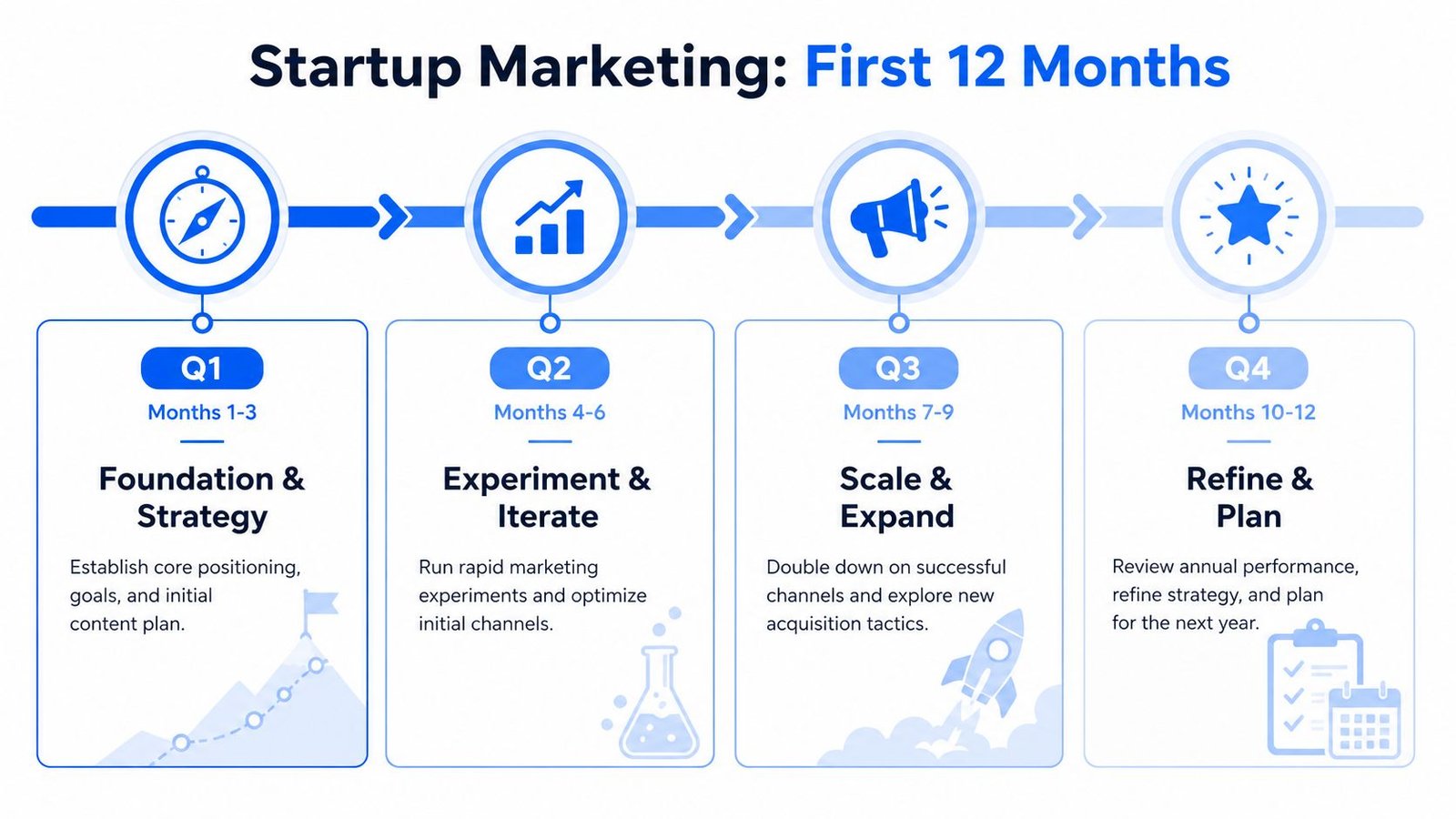
Quarter 1 foundation and message fit
Use the first quarter to get the basics right.
Lock positioning. Rewrite the homepage if needed. Build or fix your main conversion pages. Set up analytics, CRM routing, and a simple reporting rhythm. Publish the first focused content cluster around one high-value problem, not a broad editorial calendar.
The output from this quarter should be clarity, not volume.
Quarter 2 early traction and feedback loops
Start testing. Launch a small set of paid experiments only after the pages and message are in shape. Build email capture and follow-up sequences. Watch where users hesitate, what pages hold attention, and which messages attract the best-fit leads.
This is also where founder insight matters. Sales calls, onboarding friction, and objections should feed content and landing page revisions every week.
Quarter 3 double down or pivot
By this point, some channels will show real promise and others will look busy without helping revenue.
Double down on the pages, campaigns, and offers that bring qualified demand. Cut weak channels faster than feels comfortable. Add one adjacent growth motion only if the first one is operationally under control. That might be partnerships, referrals, role-specific pages, or a stronger lifecycle email program.
Quarter 4 systemize what works
Turn repeatable wins into systems. Document page templates, content briefs, reporting views, experiment logs, and campaign review habits. If a channel has proven durable, then staffing or agency support starts to make sense.
The first year of digital marketing for startups shouldn't produce a scattered pile of tactics. It should produce a working growth system with clear priorities, clean feedback loops, and at least one channel that compounds.
If you want help building the compounding side of growth, SaasSky is worth a look. They focus on link building for SaaS and eCommerce brands, with transparent pricing, practitioner-led execution, and case-study-driven playbooks that fit startups trying to build durable search visibility instead of renting attention forever.