If keyword difficulty tells you a keyword is “hard,” why do Ahrefs and Semrush often disagree on the same term, and why do some supposedly difficult keywords still end up being realistic targets for the right site?
That gap trips up a lot of new SaaS marketing managers. They treat keyword difficulty like a routing app that tells them exactly where to go next. It isn't. It's closer to a compass. It points toward competitive pressure, but it doesn't tell you the full route, the obstacles on the road, or whether your site is equipped to make the trip.
For SEO planning, that distinction matters. A bad read on KD can push you into two expensive mistakes. You either avoid valuable keywords because the score looks intimidating, or you waste time on “easy” terms that still won't move because the intent is wrong, the SERP is crowded with stronger brands, or your page isn't built to compete.
Table of Contents
- Why Keyword Difficulty Scores Are So Confusing
- Understanding Keyword Difficulty as a Concept
- How SEO Tools Calculate Keyword Difficulty
- The Limitations and Blind Spots of Keyword Difficulty
- Keyword Difficulty Benchmarks for SaaS and eCommerce
- A Strategic Playbook for Using Keyword Difficulty
- Frequently Asked Questions About Keyword Difficulty
Why Keyword Difficulty Scores Are So Confusing
Most confusion starts with one simple experience. You check a keyword in Ahrefs, then check the same keyword in Semrush, and the scores don't match. Newer marketers often assume one tool is wrong.
Usually, neither tool is wrong. They're just modeling the same SERP in different ways.
Keyword difficulty is an estimate of ranking effort, not a universal fact stored somewhere inside Google. Tools are trying to answer a practical question: how competitive does this search result look right now? Because they use different formulas, they produce different estimates.
That's why the same keyword can look manageable in one platform and intimidating in another. One tool may weigh backlink patterns more heavily. Another may blend in more variables tied to authority and SERP conditions. Both are describing the market, but from different angles.
The mistake most teams make
The wrong way to use KD is to treat it like a pass or fail filter.
Teams do this all the time:
- They reject anything high: Valuable product terms get dropped because the score looks too competitive.
- They chase anything low: Editorial calendars fill up with low-KD topics that have weak commercial relevance.
- They budget blindly: Content and link acquisition plans get set without checking whether the site has any real chance to compete.
That's why I push the compass idea. A compass helps you orient. It doesn't replace judgment.
Practical rule: Don't ask, “Is this keyword hard?” Ask, “Hard for whom, with what page, and with what authority?”
For a new SaaS site, KD is a warning label about likely effort. For an established brand with strong topical coverage and links, that same number may signal a strategic opportunity worth pursuing. The score matters, but the interpretation matters more.
Understanding Keyword Difficulty as a Concept
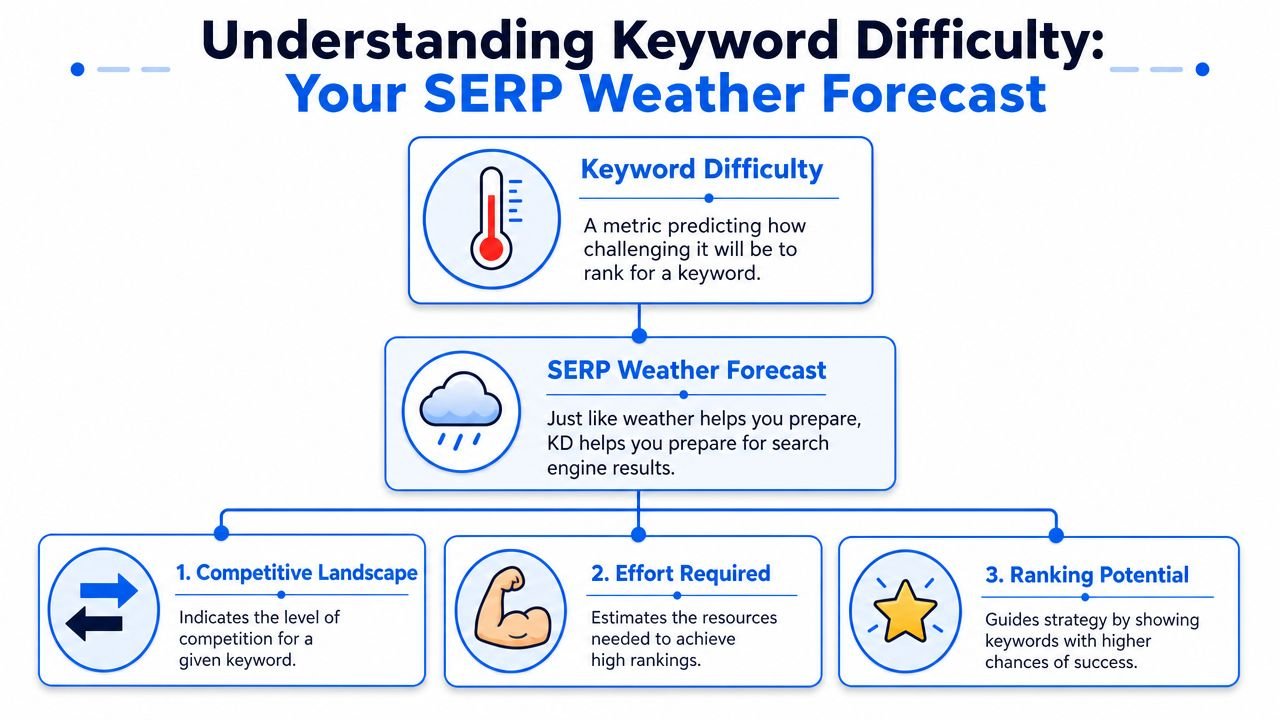
Keyword difficulty is easiest to understand when you stop thinking about it as a promise and start thinking about it as a forecast.
It's a SERP weather forecast. If the reading says clear skies, you can move faster. If it says storms, you should expect more effort, stronger competitors, and a longer path to results. But like weather, it's still a model. It helps you prepare. It doesn't guarantee the outcome.
Why the score exists
Keyword difficulty became widely operationalized through third-party SEO tools, not by Google itself. Modern platforms usually show it on a 0 to 100 or similar 1 to 100 scale, where higher scores mean stronger competition and harder rankings, as explained in Semrush's keyword overview documentation.
That point matters more than most guides admit. KD is not a Google ranking factor. Google doesn't publish an official keyword difficulty number. SEO tools created the metric because marketers needed a practical shortcut for judging organic competition before investing in content and links.
So when someone asks, “What is keyword difficulty?” the most useful answer is this: it's a third-party estimate of how difficult it may be to break into the top organic results for a query.
How to read the scale without overtrusting it
The scale looks precise, but you should read it as competitive intensity, not as a guaranteed level of success or failure.
A lower score usually signals a SERP where top pages have less competitive strength. A higher score usually means the current winners are harder to displace. In practical terms, marketers often use the scale like this:
| KD range | What it usually suggests |
|---|---|
| Lower end | Lighter competition, often better for newer sites or narrow intent topics |
| Middle range | Moderate competition, usually requiring stronger content and some authority support |
| Higher end | Crowded SERPs, where stronger sites, stronger links, or both often shape the top results |
That still doesn't mean a high score is “bad.” Some of the best keywords in SaaS are difficult because they matter. Buyers, competitors, and publishers all want visibility there.
KD is useful when it changes your expectations about effort. It becomes dangerous when you use it as a substitute for SERP analysis.
If you remember one thing from this section, remember this: keyword difficulty tells you what the competitive environment looks like from the outside. It does not tell you whether your page can satisfy intent better, whether your product page deserves to rank, or whether your site has a hidden edge in that topic cluster.
How SEO Tools Calculate Keyword Difficulty
When marketers ask why keyword difficulty scores differ, the answer sits inside the formulas.
Most major tools use a 0 to 100 scoring model, but they don't build that score the same way. The common thread is backlinks. The difference is how much else gets layered on top.
Ahrefs leans heavily on backlinks
Ahrefs gives one of the clearest definitions. Its keyword difficulty score is based on the backlink profiles of the current top 10 ranking pages, and the scale runs from 0 to 100. Ahrefs also explains that KD 0 to 5 reflects top-ranking pages with very few backlinks, around 50 reflects a few hundred backlinks, and 90+ reflects thousands of backlinks, as described in Ahrefs' guide to keyword difficulty.
That makes Ahrefs especially useful if you want a clean read on link pressure. If the score is high, Ahrefs is effectively telling you that the pages already winning tend to have much stronger referring domain profiles.
This is also why KD often gets tangled up with authority conversations. If your team needs a refresher on how authority metrics relate to link strength, it helps to understand what domain rating means in practice.
Semrush uses a broader model
Semrush approaches KD more like a blended competitiveness model. Historical commentary around the metric notes a move from simpler backlink counting toward formulas that combine weighted variables such as median referring domains, authority signals, search volume, dofollow and nofollow ratios, and SERP features, as discussed in WordStream's breakdown of keyword difficulty.
That's why Semrush can sometimes produce a different number for the same query. It's not looking only at the same thing Ahrefs emphasizes. It's using a broader lens.
Why this changes strategy and budget
For a SaaS marketing manager, the practical takeaway is straightforward:
- If Ahrefs shows a hard keyword, expect link acquisition to be a major part of the plan.
- If Semrush also shows strong difficulty, the challenge may involve both authority and a more complex SERP environment.
- If the tools disagree, don't average the numbers and move on. Inspect the SERP and figure out what each score is seeing.
That last point matters for budget. A backlink-heavy SERP often requires patience and off-page investment. A mixed SERP may reward better intent targeting, better content structure, and stronger internal linking before you even think about aggressive outreach.
Different tools are not giving you conflicting truths. They're giving you different models of the same battlefield.
The Limitations and Blind Spots of Keyword Difficulty
Keyword difficulty is useful because it simplifies a messy problem. It's limited for the same reason.
The score can help you judge competitive pressure. It can't tell you whether the ranking pages are good, whether they meet search intent cleanly, or whether your site has enough topical credibility to win with a better page. That's where many teams overtrust the metric.
What KD does not measure
KD doesn't directly measure several things that decide whether a page ranks:
- Intent fit: A strong article can still fail if searchers want a product page, template, tool, or category page instead.
- Content quality: Thin content can rank on authority, and well-researched content can underperform if it misses the query.
- Topical authority: A site with deep coverage around a topic often has an easier time expanding into adjacent terms.
- Internal linking strength: Page-level support from an established content cluster can change how competitive a keyword feels.
- User experience and page usefulness: Structure, clarity, and usefulness still shape whether your page deserves attention.
A lot of ranking opportunities sit in this gap. You'll sometimes find a SERP that looks hard on paper but weak in practice because the top pages are outdated, broad, or mismatched to what the searcher seeks.
For a broader view of the signals Google uses beyond a third-party KD score, review these Google page rank factors in SEO.
A high KD keyword can still be workable if the current winners are strong on links but weak on intent.
Why modern SERPs make KD less complete
Traditional KD models also struggle to capture what the search results page now looks like for many queries.
Standard definitions describe keyword difficulty as a proxy for ranking difficulty in organic search, but they often don't account for emerging elements such as AI Overviews and other SERP features. That gap matters because Google has said AI Overviews help users ask more complex questions and has also reported that some users are visiting a wider range of websites after using them, as summarized in SpyFu's discussion of keyword difficulty and modern SERPs.
That doesn't mean KD is obsolete. It means the metric is incomplete.
A keyword might be “easy” to rank for compared with other terms, yet still deliver weaker traffic potential because the page layout absorbs attention before organic listings get the click. Another keyword might look difficult, but the actual click environment could still be attractive if searchers want specialist answers and the current pages aren't satisfying them well.
Use KD to estimate effort. Don't use it to predict the full business outcome.
Keyword Difficulty Benchmarks for SaaS and eCommerce
What should a SaaS or eCommerce team treat as a "good" keyword difficulty score?
The honest answer depends on the site that is trying to rank. A KD 35 term can be a sensible target for an established store with strong category pages and link equity. The same term can burn months of content and outreach budget for a newer SaaS site that has little authority and no real topical depth yet.
That is why KD works better as a compass than a GPS. It points to likely effort. It does not tell you exactly which keywords your site can win right now.
A practical benchmark table
Use the table below as a planning range tied to site strength. If your team is still building authority, these ranges become more realistic once you have a deliberate plan for improving domain authority with stronger links and site trust.
Keyword Difficulty Benchmarks by Website Profile
| KD Score Range | Meaning for a New Website (DA < 20) | Meaning for a Growth-Stage Site (DA 20-50) | Meaning for an Authoritative Site (DA 50+) |
|---|---|---|---|
| Low | Usually the best place to build early traction, especially with narrow intent and strong relevance | Often a realistic source of steady wins if the page closely matches intent | Often accessible, but may not be the best use of resources unless commercially valuable |
| Medium | Selective targets only. Works better when the topic is tightly aligned with your product or niche | Often the core working range for editorial and commercial content | Usually realistic if the site already has topical coverage |
| High | Usually a stretch unless the SERP has obvious weaknesses or your page fills a clear gap | Strategic targets, but not ideal for volume-heavy publishing without link support | Often worth pursuing if the keyword matters to revenue or category leadership |
| Very high | Usually long-term only | Requires strong authority, serious patience, and deliberate off-page support | Often still competitive, but realistic when the term is central to the business |
How SaaS and eCommerce should read these ranges
SaaS and eCommerce teams should not read the same KD number the same way.
For SaaS, the primary question is often whether your product has enough authority in that topic cluster to compete with software review sites, vendor roundups, and established brands. A lower-volume keyword with cleaner product intent can be far more valuable than a broader term with a higher search count and a harder SERP.
eCommerce has a different advantage set. Strong category architecture, internal links, product inventory, and existing brand demand can make medium-to-high KD terms more practical than they would be for a younger SaaS company. If the site already owns adjacent category terms, a harder keyword is often an expansion play, not a cold start.
Ahrefs explains that keyword difficulty is largely based on the link profiles of pages already ranking, which is useful context for interpreting these ranges because it shows why the same score can mean different levels of effort for different sites (Ahrefs' guide to keyword difficulty).
The budget implication is straightforward. Newer SaaS teams usually get better returns by concentrating on low-to-medium KD terms with tight intent and clear product relevance. Larger eCommerce brands can justify spending on harder category and commercial terms because they often have the authority, merchandising support, and internal linking structure to compete.
Use the benchmark to pressure-test effort against reality. Then review the actual SERP, your site strength, and the revenue value of winning.
A Strategic Playbook for Using Keyword Difficulty
If you use KD as a filter, you'll miss opportunities. If you use it as a planning input, it becomes much more valuable.
The strongest teams don't ask whether a keyword is easy or hard in the abstract. They ask whether it's worth the effort for their site now, and what would need to change to make a harder term realistic later.
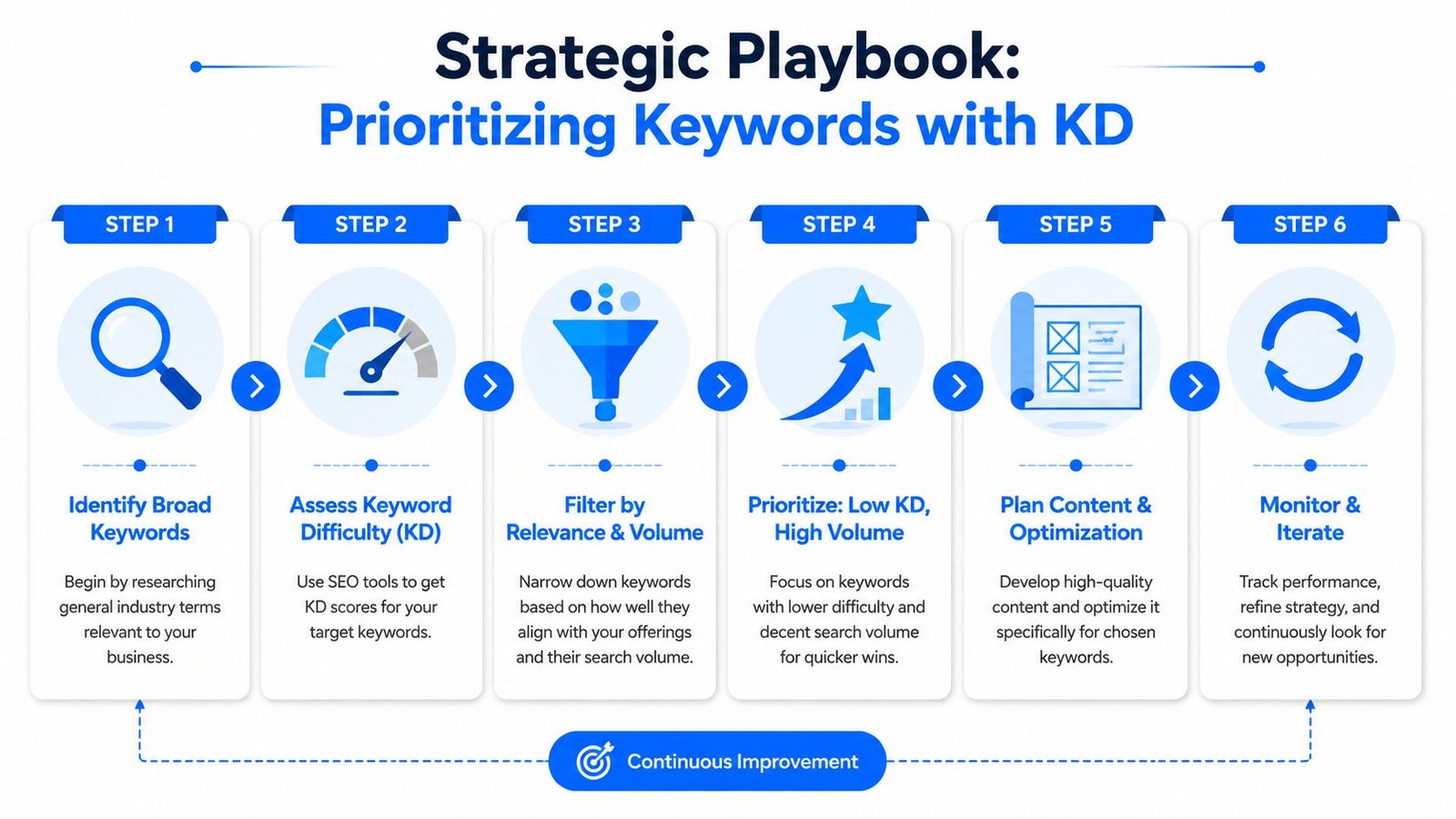
Build two keyword lists, not one
Most SaaS teams should separate targets into two buckets.
The first is the momentum list. These are lower-difficulty, highly relevant terms that can help you build topical coverage, internal links, and early search visibility. They're often long-tail, comparison-driven, use-case-specific, or tied to a narrow product problem.
The second is the pillar list. These are harder, more competitive keywords that matter because they shape category visibility, demo intent, or commercial discovery. You may not win them quickly, but ignoring them entirely creates a strategic hole.
A workable process looks like this:
- Start with product-adjacent topics. Build around jobs to be done, pain points, integrations, alternatives, and use cases.
- Check KD in your primary tool. Use it to estimate how much authority pressure you're likely to face.
- Inspect the SERP manually. Look for weak pages, mixed intent, outdated results, or irrelevant publisher content.
- Assign the keyword to momentum or pillar. This keeps your roadmap balanced instead of overly cautious.
Working rule: Lower-KD keywords build your footing. Higher-KD keywords build your future position.
Use relative difficulty, not just market difficulty
At this point, many teams level up.
Semrush makes the idea explicit by distinguishing general KD% from Personal KD%, which adjusts difficulty based on your site's authority and backlink profile. That framing matters because it treats difficulty as a relative competitiveness signal, not a universal ranking guarantee, as explained in Semrush's guide to keyword difficulty and Personal KD.
That's the compass idea in concrete form. A market may be hard overall, but the keyword may still be realistic for your site if you already have supporting authority.
Here's how to apply that thinking even if you aren't relying on one specific tool feature:
- Look at your existing topic footprint. If you already rank for adjacent terms, the effective difficulty may be lower than the raw score suggests.
- Compare your site to the actual ranking domains. A big-name publisher in the SERP matters. So does the presence of smaller specialist sites.
- Check whether you already have support pages. Existing cluster content and internal links reduce the lift needed for new pages.
If your authority is weak, the opposite is also true. A middling KD score may still be too expensive right now.
Where link building changes the math
At some point, content quality and intent alignment stop being enough on their own. You need stronger authority to compete for tougher SERPs.
That's why link building usually becomes the main lever for moving upmarket in keyword targeting. If you want to expand from easier editorial wins into high-value software terms, category terms, and competitive comparison queries, you often need more trust and more page-level support.
Teams working on that transition usually benefit from a clearer plan for how to improve domain authority over time.
The budget implication is simple. Don't spread your effort evenly across every target keyword. Put lighter resources behind momentum terms. Put deliberate content, internal linking, and off-page investment behind pillar terms that justify the cost.
Frequently Asked Questions About Keyword Difficulty
Can you rank for a high-difficulty keyword with few backlinks
Yes, sometimes. But you usually need another clear advantage.
That advantage might be stronger intent alignment, deeper topical relevance, a better page type for the query, or a SERP where some ranking pages aren't satisfying searchers well. The higher the link pressure in the SERP, the less room you have for error.
Does on-page SEO help overcome keyword difficulty
Yes, but within limits.
On-page work helps search engines understand your page and helps users get what they came for. Strong structure, clear headings, useful copy, and clean internal linking all matter. But on-page SEO doesn't erase a major authority gap if the SERP is dominated by stronger sites with equally strong content.
Is a zero KD keyword always easy
No.
A very low score often means lighter backlink competition, not automatic rankings. The query may still have unclear intent, poor business value, or SERP features that limit clicks. You can also fail on a low-KD term if your page type is wrong or your content doesn't answer the actual question.
Should you ignore high KD keywords completely
No, especially not if they're important to your category.
High-KD terms often represent the biggest strategic opportunities. The smarter move is to classify them correctly. Some should wait until your site has more authority. Others deserve early investment because they support revenue, positioning, or long-term organic growth.
If you want a team that treats keyword difficulty as a strategic planning tool instead of a vanity metric, SaasSky helps SaaS and eCommerce brands build the authority needed to compete for the keywords that actually matter. Their link building work is designed for teams that want transparent execution, realistic planning, and SEO campaigns tied to business goals.