A referring domain is a unique website that links to your site, and one site still counts as just one referring domain whether it links to you once or from 1,000 pages. That's different from backlinks, which count every individual hyperlink, and the distinction is one of the first things SaaS and eCommerce teams need to get right when reading an SEO report.
If you're staring at Ahrefs, Semrush, or Google Search Console and wondering why your site has a pile of backlinks but far fewer referring domains, you're looking at a common reporting trap. The bigger backlink number often feels better, but it can hide a weak link profile if most of those links come from the same small group of sites.
That's where the core business question starts. Not “how many links do we have?” but “how many unique sites trust us enough to link to us, and which of those sites matter?” In 2026, that second question matters more because low-value link noise is easier to produce than ever. A strong referring-domain profile isn't built from repetition. It's built from breadth, relevance, and editorial trust.
Table of Contents
- Your SEO Report Is Lying to You (Sort Of)
- What Are Referring Domains vs Backlinks
- Why Referring Domains Are a Core SEO Authority Signal
- Separating High-Impact Domains from Digital Noise
- How to Earn High-Quality Referring Domains
- The Playbook in Action A SaaS Growth Story
- Start Building Your Referring Domain Playbook Today
Your SEO Report Is Lying to You (Sort Of)
A founder opens an SEO dashboard and sees two numbers side by side: backlinks and referring domains. Backlinks look healthy. Referring domains look underwhelming. The first reaction is usually confusion, followed by the wrong question: “Why is the referring domain count so low?”
The better question is whether the backlink count is inflated by repetition. If one partner site links to your homepage, blog, docs, and five integration pages, your backlink count rises fast. Your authority footprint across the web doesn't rise at the same pace.
I see this a lot with SaaS companies that have launch coverage, app directory listings, affiliate placements, or sitewide footer links. eCommerce brands run into the same issue with coupon sites, reseller pages, or product widgets that create many links from the same source. The report isn't exactly lying. It's just showing two metrics that mean very different things.
A backlink-heavy profile can still be narrow. A smaller backlink count with broader domain diversity is often the healthier signal.
That's why referring domains deserve more attention than they usually get. They tell you how many distinct websites are citing your brand, product, or content. That gives you a much cleaner read on whether your site is earning trust across the web or just getting repeated mentions from the same places.
Why this matters in practice
For a SaaS company, this affects how you judge PR, partner marketing, thought leadership, and content campaigns. For an eCommerce brand, it changes how you evaluate review outreach, gift guides, creator mentions, and digital PR. If new links keep coming from the same sources, your report may look active while your authority profile stays stagnant.
A useful SEO report should help you answer three practical questions:
- Are new sites linking to us: This shows whether your brand is expanding its reach.
- Are the right sites linking to us: Relevance matters more than raw volume.
- Are we earning editorial trust: Directory clutter and duplicate placements don't signal the same value as genuine mentions.
Once you read the report this way, the metric stops being jargon. It becomes a filter for quality.
What Are Referring Domains vs Backlinks
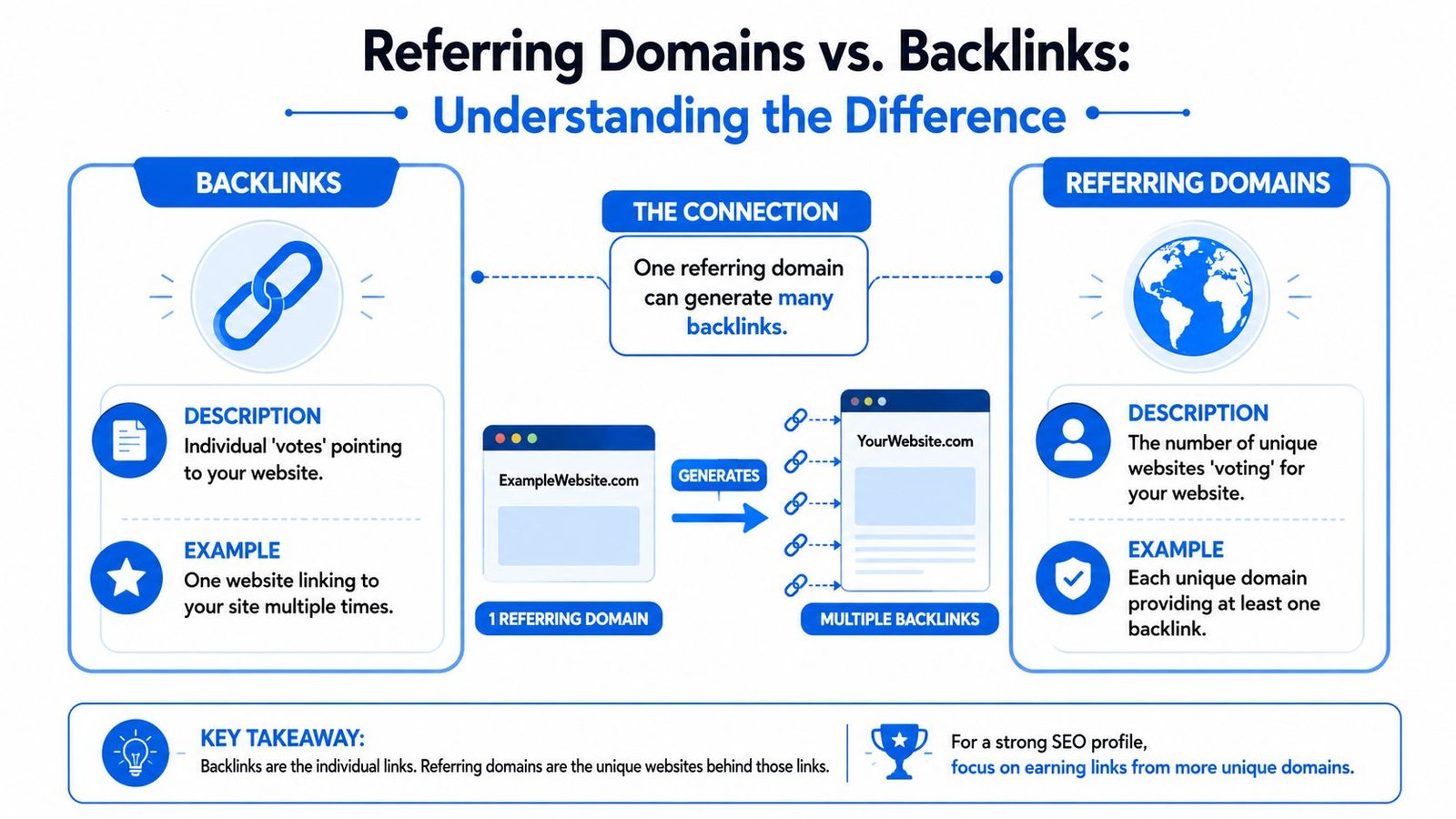
If backlinks are votes, referring domains are the unique voters.
That analogy sticks because it explains the core difference without tool jargon. A single website can vote for you many times by linking to multiple pages, but it's still one unique supporter in your profile.
The simplest way to think about it
A backlink is one individual link from another page to your site.
A referring domain is the unique website that link came from. Major SEO tools treat this at the domain level, so one external site can send many backlinks but still count as only one referring domain, as explained in Majestic's referring domains documentation.
Here's the practical difference:
| Situation | Backlinks | Referring domains |
|---|---|---|
| One blog links to you in five articles | 5 | 1 |
| Five separate blogs each link once | 5 | 5 |
That second scenario is usually stronger because it shows broader endorsement.
If you're still getting familiar with basic link terminology, this breakdown of what a backlink is helps frame the individual-link side of the equation.
Why the root domain matters
SEO tools don't count every page on a site as a separate referring domain. They count at the root-domain level, which means one site linking from one page or many pages still contributes a single referring domain, as Ahrefs explains in its guide to referring domains and backlinks.
That matters because it keeps teams from overvaluing duplicate link sources. If your campaign adds more links from websites that already link to you, you may improve visibility in some cases, but you're not expanding your endorsement base nearly as efficiently as you would by earning links from new domains.
Practical rule: If two tactics produce the same number of backlinks, the tactic that earns links from more unique, relevant domains is usually the better long-term play.
Many outreach programs go off track by celebrating total links without separating new linking sites from repeat placements. For reporting, I'd rather see fewer links from strong, new domains than a larger pile from familiar sites that already endorse the brand.
Why Referring Domains Are a Core SEO Authority Signal
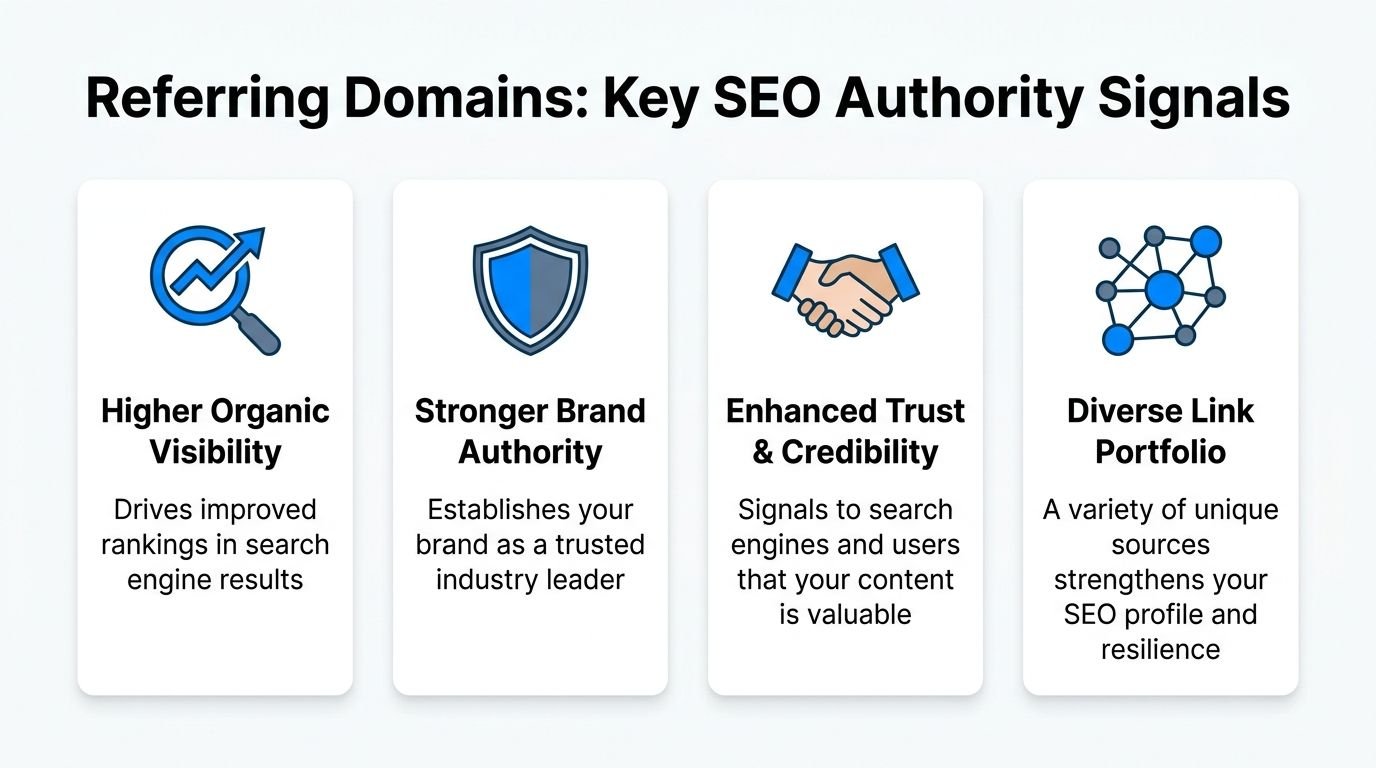
Search engines need ways to estimate whether a site is trusted beyond its own claims. Referring domains help with that because they show how broadly a site is being cited across the web.
That's why this metric sits closer to authority than many teams realize. A brand that earns links from a range of relevant sites looks more credible than a brand with the same total backlink count concentrated in a few sources.
Breadth of endorsement beats repetition
Referring domains have become a core SEO signal because pages that rank higher tend to attract more new followed referring domains. Ahrefs says this relationship was observed across 10,000 SERPs in its 2026 SEO statistics report, and the same report notes that higher-ranking pages accumulate more new followed referring domains over time.
That doesn't mean every new domain helps equally. It means broader endorsement tends to align with stronger search performance. When many different sites choose to link to a page, search engines get a clearer signal that the page is worth surfacing.
You can think of this as a web-scale trust pattern:
- One site linking repeatedly suggests familiarity.
- Many sites linking independently suggests recognition.
- Relevant sites linking editorially suggests authority.
The third pattern is what serious teams want.
What this means for SaaS and eCommerce teams
For SaaS, a strong referring-domain profile often comes from product-led mentions, integration pages, expert commentary, research content, and category-level resources. Those links don't just support rankings. They also reinforce brand legitimacy when buyers, investors, and partners vet your company.
For eCommerce, the dynamic is slightly different. Review sites, niche publishers, gift guides, comparison content, and creator-led product roundups can all contribute. The strongest ones tend to sit close to the buyer journey and topic area.
A broad profile also makes your authority less dependent on one relationship channel. If all your links come from affiliate partners, app marketplaces, or syndicated placements, your profile is fragile. If links come from a wider set of editorially distinct sources, it's harder to replicate and more defensible.
A good companion metric here is overall site strength. This guide on how to improve domain authority is useful if you want to connect link diversity with broader authority-building work.
Search visibility gets more durable when recognition comes from many relevant places, not just one loud corner of the internet.
Separating High-Impact Domains from Digital Noise
A SaaS team can open Ahrefs or Semrush, see 300 new referring domains, and assume authority is rising. Then pipeline stays flat, rankings barely move, and the link report still looks impressive. That gap usually comes down to domain quality, not domain count.
By 2026, the practical job is not defining a referring domain. It is deciding which domains deserve outreach, which ones are safe to ignore, and which ones can subtly weaken your link profile if you chase them too aggressively.
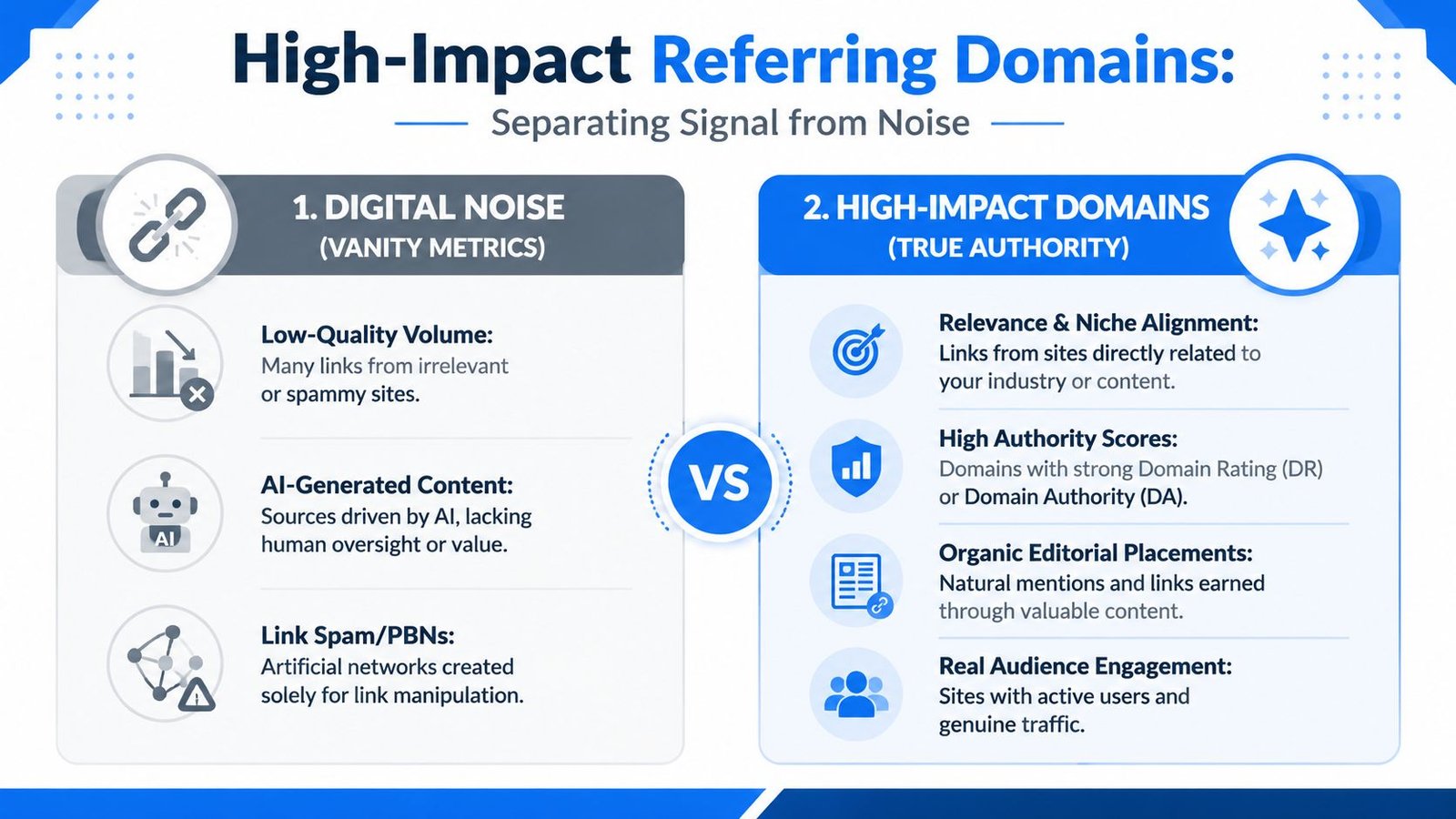
Low-value domains are easy to manufacture at scale. They often look acceptable on first review. Clean template, indexed pages, maybe even some traffic estimates. But once you inspect them, the pattern shows up fast. Thin articles, vague authors, unnatural outbound linking, recycled topics, and no sign that real people read or share the content.
That is why referring domains become a misleading KPI when teams treat every new domain as equal.
Keyweo's referring domain guide gets the basic principle right. Diversity matters, but the gains usually come from sites that are relevant, credible, and closely tied to the topics you want to rank for.
Three filters I use before I value a domain
Relevance
Topical fit comes first because it affects both SEO value and business value.
If you sell finance software, a link from an accounting publication or CFO newsletter can support rankings and put your brand in front of actual buyers. A mention on a generic site that publishes casino reviews, diet tips, and “best SaaS tools” lists on the same domain usually adds far less. The page may technically link to you, but it does not strengthen your position in a category that search engines and customers recognize.
For eCommerce brands, the same rule applies. A skincare brand wants beauty editors, dermatology voices, ingredient explainers, and trusted product reviewers. Broad coupon sites and thin gift guides rarely do much beyond padding a report.
Authority
Authority is not a DR score by itself. It is the quality of the publication behind the metric.
Check whether the site has a clear editorial focus, real contributors, updated content, and pages that rank for topics related to its niche. Look at how it links out. Strong sites cite selectively. Weak sites link out constantly because selling or stuffing placements is the business model.
A simple test helps here. If a prospect, investor, or partner clicked that domain and saw your brand there, would it help credibility or raise questions?
Intent
Intent explains why the link exists, and that tells you a lot about how much trust to assign it.
Editorial intent is what you want. The writer included your brand because it improved the article, supported a claim, or gave readers a useful option. Commercial intent needs a closer review. Some sponsorships and partner placements are fine. Some are obvious pay-to-link inventory dressed up as content. Manipulative intent is the clearest pass. If the whole site exists to place outbound links, the risk-reward equation is poor.
If the domain would disappear from your target list the moment its SEO metric dropped, it probably was not a strong prospect to begin with.
A practical triage model for live campaigns
On a real prospect list, I sort domains into three buckets.
- Prioritize: niche publishers, category blogs, respected trade media, legitimate software directories, integration partners, trusted review sites, active community hubs
- Review manually: broad business publications, contributor networks, multi-topic blogs, sites with mixed editorial quality
- Avoid: empty directories, obvious PBN patterns, AI-heavy sites with no audience signals, domains built to sell placements at volume
This is also where process matters. Teams that follow a white hat link building process for earning editorial links usually waste less time on noisy domains because the qualification standard is higher from the start.
For SaaS and eCommerce brands, the payoff is straightforward. Fewer domains can drive more authority if those domains are trusted in your market, close to your topic, and editorially selective. That is the difference between a link profile that looks busy and one that actually improves search visibility and brand trust.
How to Earn High-Quality Referring Domains
A SaaS team can publish ten blog posts, send a few hundred outreach emails, and still end the quarter with links that do nothing for pipeline or rankings. That usually happens when the plan is built around link volume instead of citation value.
The better question is simpler. What would a respected site in your market want to reference?
High-quality referring domains come from assets, relationships, and expertise that fit the publisher's audience. For SaaS and eCommerce brands in 2026, the job is not just getting mentioned. It is earning citations from domains that shape buying decisions, industry trust, and topical authority.
If you want sustainable acquisition, prioritize channels that can produce both relevance and editorial intent.
For SaaS brands
Publish something worth citing
Original research still works. So do benchmark reports, product usage trends, implementation studies, and expert commentary tied to a narrow problem your buyers care about.
Specificity decides whether the asset travels. “AI trends” is vague and easy to ignore. “Where multi-team onboarding breaks inside mid-market HR software” gives an editor, analyst, or partner something concrete to cite. The strongest assets sit where customer pain, proprietary insight, and market interest overlap.
One well-framed asset can earn links from different domain types if you adjust the angle for each audience.
Turn product partnerships into editorial opportunities
Integrations are not just a product page and a logo grid. They can lead to partner directory links, co-authored guides, webinar recaps, migration resources, and solution pages that sit inside a relevant ecosystem.
That does not mean every partner page is valuable. Some partner sections are thin and exist only to list tools. Others are thoroughly crawled, trusted, and used by real buyers comparing options. The trade-off is straightforward. A smaller set of active partner domains usually helps more than a long tail of low-traffic integration pages.
Contribute operator insight
Founders, product marketers, implementation leads, and customer success leaders often have practical knowledge that niche publications want. That is a better starting point than recycling generic guest post ideas.
A disciplined white hat link building approach keeps the focus on editorial fit, original expertise, and topics your company can speak on credibly. That approach scales slower than buying placements. It also tends to produce domains you will still want in your profile two years from now.
For eCommerce brands
eCommerce has a different advantage. The product can be tested, photographed, compared, gifted, reviewed, and discussed in real use cases.
That creates several reliable paths:
- Niche reviewer outreach: Start with publishers and creators who already cover your category with depth. A category-specific site with real audience trust often beats a broad lifestyle publication with weak purchase intent.
- Digital PR tied to real product hooks: Seasonality, founder expertise, sourcing decisions, design details, and category data can all create editorial interest when the angle is genuine.
- Reference content that supports purchase decisions: Size guides, care instructions, ingredient explainers, material comparisons, and buying guides can earn citations because they help other sites explain the category accurately.
The best outreach usually improves the publisher's content. It gives them a better example, better data, a better product experience, or a stronger expert source.
What usually underperforms
Low-value link tactics are appealing because they look efficient in a spreadsheet. They rarely hold up under manual review.
| Tactic | Why it underperforms |
|---|---|
| Mass guest post outreach | Produces repeatable placements on sites with weak editorial standards |
| Paid placement marketplaces | Skews toward domains built to sell links rather than serve readers |
| Generic skyscraper pitches | Gives publishers little reason to replace or cite what they already have |
| Sitewide partnership links | Increases backlink totals more than it improves domain diversity or trust |
Choose credibility over speed. Reporting will look slower at first. The profile you build will be harder for competitors to copy, and far more likely to move the terms that matter.
The Playbook in Action A SaaS Growth Story
Formify is a fictional B2B SaaS startup, but the pattern is real.
Where Formify started
The company had links, but not the kind that changed perception. Most of its referring domains came from startup directories, old listing pages, and a few low-context software roundups. The backlink report looked decent on first glance because some of those sites linked from multiple pages.
The problem was quality concentration. The profile looked active but shallow. There wasn't much evidence that respected sites in collaboration software, HR, or productivity cited the brand.
What changed
Instead of buying more placements or sending broad guest post pitches, the team built a survey-led content asset around remote collaboration habits. They packaged the findings with clear charts, a concise narrative, and commentary from the founder on what the data meant for distributed teams.
That single asset gave outreach a real angle.
A tech journalist could reference the trend. An HR publication could use the workplace implications. A productivity blog could cite the workflow habits. A partner could mention the report in a webinar recap or integration resource page. The team didn't ask every target for the same thing. They matched the angle to the audience.
One strong asset can unlock several categories of referring domains if the framing changes by outlet.
The result wasn't just more links. It was a better-shaped profile. New referring domains came from publications that buyers and partners would recognize, and that changed how the brand showed up in search, in conversations, and in due diligence. That's the primary aim of a referring-domain strategy. It improves rankings, but it also improves who vouches for you in public.
Start Building Your Referring Domain Playbook Today
Many marketers don't need a bigger backlink spreadsheet. They need a better filter for trust.
If you've been asking what is referring domains, the practical answer is simple. It's the count of unique websites linking to you, and it matters because it shows how widely your brand is endorsed. The strategic answer is more important. Not every referring domain deserves equal weight, and the value comes from relevance, authority, and editorial intent.
Start with a compact playbook:
- Benchmark your current profile: Pull your referring domains in Ahrefs, Semrush, or Google Search Console. Mark which ones are relevant.
- Define your ideal domains: Write down the sites you'd want customers, partners, and investors to see you on.
- Choose one acquisition path: Data-led content, partner-led content, expert commentary, reviewer outreach, or product-led digital PR.
- Measure the right outcome: Track new high-quality referring domains, not just total backlinks.
Strong SEO programs separate from noisy ones. They don't collect links for the sake of reporting. They earn endorsements that compound.
If you want help building that kind of link profile, SaasSky works with SaaS and eCommerce brands on practitioner-led link building that prioritizes relevant, trustworthy referring domains over vanity metrics.