Most advice on tiered link building is too simple to be useful. One camp calls it spam and stops there. The other treats it like a ranking shortcut. Both miss the core question a marketing director has to answer, which is whether the upside justifies the operational drag, the compliance risk, and the budget.
That question matters more now because links are not cheap side projects anymore. In 2026 survey data, 46% of SEO teams reported spending $10,000+ per year on link building, and costs had risen 20–35% since 2022, which helps explain why teams still look at layered structures that try to preserve the value of expensive Tier 1 placements instead of buying more direct links blindly (2026 link building cost data).
For SaaS and eCommerce brands, tiered link building isn't a default tactic. It's a specialist tactic. Used carefully, it can help extract more value from editorial placements, digital PR mentions, and hard-won guest posts. Used carelessly, it can turn a clean link program into a messy risk surface.
Table of Contents
- Is Tiered Link Building a Relic or a Hidden Gem
- The Evolution from Link Pyramids to Authority Stacks
- Anatomy of a Modern Tiered Link Building Structure
- What Strategic SEO Objectives Does Tiering Achieve
- Weighing the Significant Risks Against Potential Rewards
- The SaaS and eCommerce Implementation Playbook
- A Go or No-Go Checklist Before You Start
Is Tiered Link Building a Relic or a Hidden Gem
Tiered link building is neither dead nor universally smart. It's a tool that sits in an uncomfortable middle ground. That makes it easy to misjudge.
The outdated view says anything multi-layered is automatically manipulative. The equally flawed growth-hacker view says every expensive editorial link should be "powered up" with supporting links. In practice, both positions ignore context. A clean direct link program is usually the safer bet. But some brands reach a point where each additional Tier 1 placement is expensive enough that reinforcement becomes a serious strategic option.
That doesn't make the tactic safe. It makes it economically understandable.
The real issue is allocation, not ideology
A modern team isn't deciding between "white hat" and "black hat" in the abstract. It's deciding how to allocate a finite link budget. If you've already secured strong placements on reputable sites, you may derive more value from strengthening those assets than from scattering effort across weaker direct placements.
Practical rule: If your Tier 1 placements are mediocre, tiering won't rescue the campaign. It amplifies assets. It doesn't create quality from nothing.
The best marketers treat tiered link building as a strategic advantage. This advantage works when the underlying asset is strong and the operator is disciplined. It breaks things when used to compensate for poor fundamentals.
Why the tactic still survives
It survives because some link assets are too expensive to leave unsupported. SaaS brands often invest in thought-leadership pieces, comparison pages, free tools, and founder commentary to win editorial links. eCommerce brands do the same with gift guides, buying guides, original photography, category education, and seasonal campaigns.
If those Tier 1 pages never earn links themselves, their impact can flatten. That's the gap tiering tries to address. Not by sending junk at the money page, but by helping strong supporting assets hold and transfer more value over time.
The hidden gem angle is real, but only for teams that can tolerate ambiguity, police quality hard, and kill the campaign the moment it starts drifting toward lazy execution.
The Evolution from Link Pyramids to Authority Stacks
The old model was the link pyramid. Lower-quality, higher-volume links were built to strengthen pages that linked to the target site, rather than the target site itself. The logic was simple. Search engines were understood to pass equity through links, so indirect reinforcement became a way to amplify authority without pointing every manufactured link at the main domain.
That historical logic hasn't disappeared. What changed is the acceptable operating standard.
By 2026, 91% of SEOs set a minimum DR before placing links, with 52% requiring DR 50+, according to tiered link building analysis from Loganix. That shift matters because it shows the modern version isn't primarily about volume. Serious teams now start with stronger Tier 1 placements and tighter filters.
What the old pyramid got wrong
The classic pyramid mindset assumed distance from the money site made low-quality links acceptable. That belief produced bloated campaigns built on weak directories, spun content, comment spam, and disposable publishing platforms.
Those setups failed for a predictable reason. They optimized for link count instead of asset quality. Once the lower layers became obviously synthetic, the whole system became fragile.
The lesson still holds. If the support layer looks manufactured, the structure becomes a liability.
What the authority stack gets right
A better modern framing is an authority stack. That term is more useful because it forces the operator to think in terms of asset quality, crawl paths, relevance, and durability instead of just "tiers."
An authority stack usually starts with pages that are worth defending:
- Editorial placements: Industry publications, digital PR mentions, contributed articles
- Controlled assets: Founder bylines, partner content, profiles, media mentions
- Link-worthy commercial support pages: Tools, studies, glossaries, comparison content, buying guides
Then the team supports those assets selectively. Not every Tier 1 page deserves reinforcement. Some placements are weak, off-topic, or placed on pages unlikely to matter. A disciplined campaign leaves those alone.
Good tiering today looks less like stacking cheap links and more like managing a portfolio of link assets.
That is why the old argument about whether tiered link building "works" is too blunt. The relevant question is whether a given Tier 1 asset is strong enough to justify a support layer, and whether the team running it has the judgment to keep that layer clean.
Anatomy of a Modern Tiered Link Building Structure
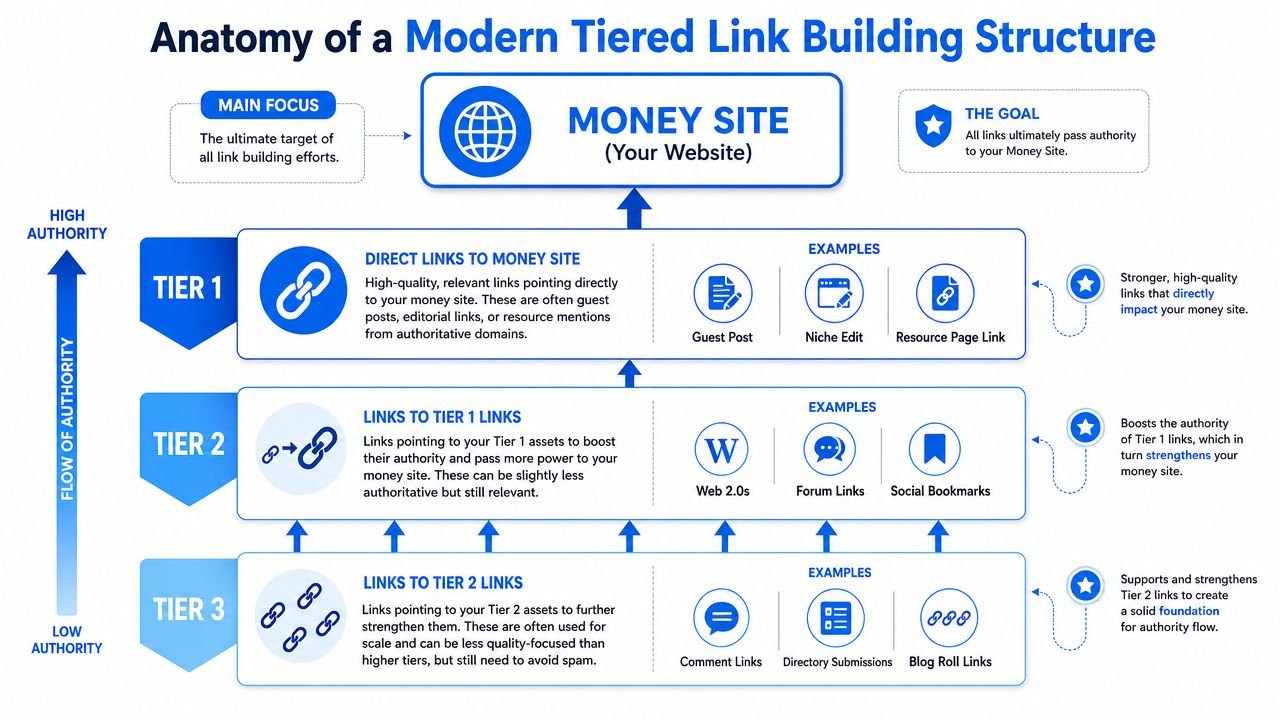
A modern tiered setup is easiest to understand if you think about it like an organizational chart. The money site is the executive layer. Tier 1 is senior leadership. Tier 2 is middle management. Tier 3, if you use it at all, is operational support.
The structure works only when each level serves the one above it. That's the core architecture behind Dinorank's explanation of tiered link building, which describes it as a multi-layer system where Tier 1 points to the money site, Tier 2 points to Tier 1 assets, and Tier 3+ can reinforce Tier 2 so authority is concentrated upward and supporting pages are easier to get indexed and pass value efficiently.
How authority moves through the stack
Tier 1 links point directly to the page you want to rank. For SaaS, that may be a product page, feature page, integration page, or a commercial-intent comparison article. For eCommerce, it's often a category page, high-margin collection, or a buying guide that supports purchase intent.
Tier 2 links point to the pages containing those Tier 1 links. The job here isn't prestige. It's reinforcement. You want those Tier 1 pages to be discoverable, contextually supported, and more capable of passing authority.
Tier 3 sits one level further away and only exists to support Tier 2. In many modern campaigns, this layer is skipped because it creates a lot of operational noise for uncertain payoff.
The safest version of tiered link building is usually a two-tier model. The moment someone insists that scale matters more than review, risk jumps.
What each tier should actually contain
The biggest mistake I see is using one quality standard across all layers. That's backwards. Each tier has a different job.
| Tier | Link Target | Typical Source | Quality Metric Example | Anchor Text Strategy |
|---|---|---|---|---|
| Tier 1 | Money site page | Editorial placement, guest post, resource mention | Strong DR/DA and topical relevance | Mostly branded, partial-match, natural contextual anchors |
| Tier 2 | Tier 1 page | Smaller niche blogs, contextual profiles, relevant resource pages | Moderate authority, indexable, relevant page context | Mostly branded, URL, generic, selective partial-match |
| Tier 3 | Tier 2 page | Low-stakes support assets, only if reviewed manually | Basic indexability and no obvious spam footprint | Natural anchors, naked URLs, minimal optimization |
Anchor policy matters at every level. If you need a refresher on how link attributes affect risk and interpretation, this guide on follow and nofollow links is worth revisiting before you set your mix.
A workable structure usually follows these principles:
- Tier 1 must be defensible: If a journalist, client, or internal stakeholder reviewed it, you'd still stand by it.
- Tier 2 must be relevant: Not elite, but topically coherent and placed on pages that can be crawled and understood.
- Tier 3 must be optional: If the campaign only works because of Tier 3, the design is already weak.
What doesn't work is treating lower tiers as a dumping ground. Search systems don't need every signal to be direct to identify an artificial footprint. If the support layer is filled with junk, you've built a traceable pattern, not a moat.
What Strategic SEO Objectives Does Tiering Achieve
Tiered link building is useful when you need to amplify an asset, not when you're trying to "build more links." That's the distinction that keeps a campaign strategic instead of chaotic.
For SaaS and eCommerce teams, the strongest use case is support for assets that were expensive to earn in the first place. That includes digital PR wins, founder commentary placements, expert roundups, product-led resources, buying guides, and category-support content that already earned a credible direct link.
Where it can outperform more direct outreach
Sometimes the next direct link isn't the best use of budget or effort. If you've landed a strong Tier 1 placement on a highly relevant page, supporting that page can be more rational than buying another average placement on a weaker site.
Good use cases include:
- Protecting premium placements: A strong editorial mention can fade if the page gets no attention. Tier 2 support can help keep the asset visible and useful in the link graph.
- Supporting commercial pages indirectly: Some money pages attract fewer natural links on their own. Tiered support lets you strengthen the editorial assets pointing at those pages instead of forcing unnatural direct acquisition.
- Improving discoverability of support assets: Press coverage, contributed articles, and niche writeups sometimes need reinforcement before they carry full value upward.
- Extending the life of hero content: SaaS calculators, migration guides, benchmark hubs, and eCommerce buying guides often deserve more support than a one-off outreach burst gives them.
If your larger SEO goal is authority growth rather than isolated rankings, it's also worth understanding how teams think about improving domain authority at the portfolio level, not just at the single-link level.
Where it usually doesn't belong
Tiering is usually the wrong move when the core issue is weak content, poor internal linking, sloppy site architecture, or low conversion quality on the target page. It also doesn't fix low-relevance outreach. If nobody credible wants to link to your assets directly, layering support on top won't solve the root problem.
A few warning signs:
- The target page isn't worth ranking yet
- Your direct links are low-quality already
- The team can't review placements manually
- You need clean attribution and low compliance risk
- You're using tiering to avoid fixing technical or content issues
This tactic works best as a force multiplier. It performs badly as a substitute for strategy.
Weighing the Significant Risks Against Potential Rewards
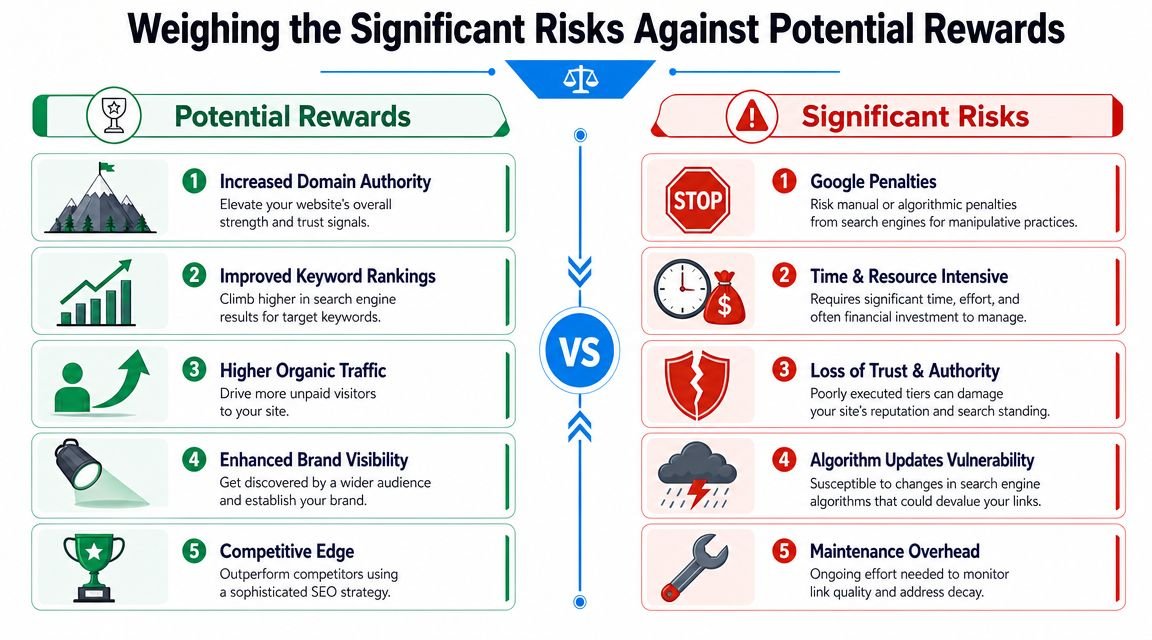
The honest business case for tiered link building starts with one uncomfortable fact. You are adding complexity to an area Google already treats with suspicion. The ROI question isn't "can this help rankings?" It can. The primary question is whether the expected gain is worth the extra failure modes.
That framing aligns with the risk discussion in PRNEWS.IO's coverage of tiered link building, which notes that Google's policies target "link spam" and "manipulative link schemes", making the payoff conditional rather than automatic.
The reward side of the argument
When teams run this well, the payoff usually comes from concentration. Instead of spreading effort thinly across many direct placements, they reinforce the pages already carrying strategic value.
Potential upside includes:
- Stronger support for high-intent pages: Useful when direct links to product or category pages are hard to earn naturally.
- More value from editorial wins: A strong placement can become more than a one-time citation if the surrounding support is thoughtful.
- Better use of expensive link assets: Especially relevant when your best placements came from digital PR or niche publications with real editorial standards.
- A more resilient asset mix: Your domain isn't relying on a handful of isolated direct links with no support behind them.
That doesn't mean every campaign produces a clear business win. It means the upside is plausible when the inputs are strong.
The risk side is where most plans fail
Most failures are operational, not theoretical. Teams overestimate their ability to keep the support layers clean. Agencies hand lower tiers to cheap vendors. Reporting focuses on activity instead of asset quality. The campaign expands before anyone proves the first set of links deserves reinforcement.
Here are the main risk buckets:
- Compliance risk: If lower tiers become manipulative or obviously coordinated, you're in territory Google explicitly dislikes.
- Reputation risk: A premium SaaS brand doesn't benefit from having its link ecosystem propped up by junk pages.
- Measurement risk: It's hard to isolate whether support links beat the alternative use of budget, which might have been stronger Tier 1 acquisition.
- Maintenance risk: Supporting pages decay, disappear, get edited, or lose relevance. Someone has to monitor the stack.
- Vendor risk: The lower the tier, the more tempting it becomes for providers to cut corners.
If your benchmark is a strict white hat link building program, tiering is a step away from the safest interpretation of the rules. That doesn't automatically make it reckless, but it does mean your margin for sloppiness gets much smaller.
If leadership can't define the maximum acceptable downside before launch, the campaign shouldn't launch.
This is why I rarely recommend tiered link building as an always-on channel. It's better treated as a selective deployment model for specific pages and specific assets. The reward can be meaningful. The penalty for weak execution can also be meaningful. Both things are true at the same time.
The SaaS and eCommerce Implementation Playbook
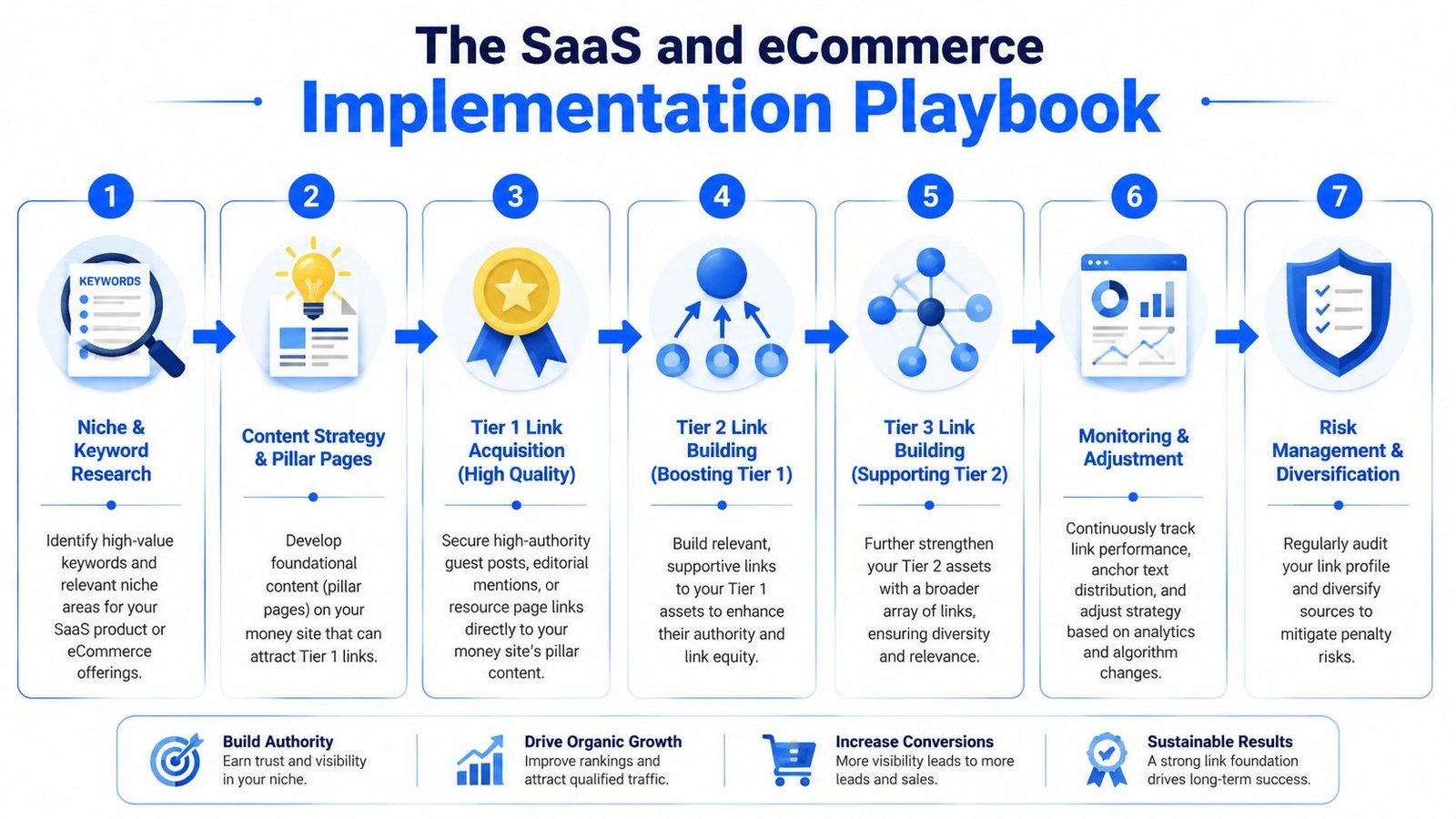
A workable campaign starts with restraint. Most brands should support a small number of important pages and only a subset of the Tier 1 assets pointing to them. If the first instinct is to build a huge pyramid, stop there.
Choose pages and assets that deserve support
Start with money pages that already convert or sit close to conversion. For SaaS, that often means:
- Feature pages: Especially for features with clear category demand
- Comparison pages: Alternative and versus pages that influence bottom-funnel research
- Solution pages: Industry or role-based pages with real pipeline relevance
- High-intent educational assets: Templates, calculators, benchmark pages, integration hubs
For eCommerce, good targets are usually:
- Category pages: Not random product URLs with fragile inventory status
- Collection pages: Seasonal or high-margin collections with staying power
- Commercial buying guides: Pages that blend search intent and conversion support
- Brand or subcategory hubs: Assets that can realistically accumulate authority over time
The Tier 1 assets pointing to those pages need their own review. Keep only the ones that pass a basic test:
- The referring page is topically relevant.
- The link placement is contextual and natural.
- The page is indexable and worth a crawler's time.
- You'd be comfortable showing it to a client or investor.
If a Tier 1 placement feels disposable, don't build support under it.
Build the structure with strict quality gates
The next step is asset design. Tier 1 acquisition should focus on pages that can justify editorial outreach. For SaaS, that may be proprietary research, benchmark summaries, migration content, template libraries, or free tools. For eCommerce, it may be category explainers, materials guides, fit guides, care guides, gift roundups, or trend-led content with original presentation.
Then build support in layers, but only with clear rules.
Tier 1 rules
Use high-quality placements that can stand alone. Think contributed articles on relevant sites, earned mentions, resource page inclusions, and editorial references. Every link should make sense without the support layer behind it.
Anchor handling should stay conservative. Branded, URL, and partial-match anchors usually fit best. Exact-match anchors need a very short leash.
Tier 2 rules
Tier 2 should support specific Tier 1 URLs, not every link you've ever earned. Good sources include smaller niche blogs, industry resource pages, contextual profiles on credible platforms, and manually created assets that add context rather than noise.
Don't chase volume. Chase coherence. A small number of relevant supporting links is easier to defend and easier to evaluate.
Tier 3 rules
Use Tier 3 only if the niche is competitive enough to justify the extra review burden. If you can't audit it manually, skip it.
The only sane purpose of Tier 3 is to help support Tier 2 pages. Not to flood the system. Not to manufacture scale. Not to impress a dashboard.
Key takeaway: The campaign gets safer when each lower tier is smaller and better than you first planned.
Track the campaign like a performance channel
Teams often fail here. They build the stack, admire the diagram, and then report on link count. That isn't enough.
Use a benchmark sheet before launch. For the target pages and the Tier 1 URLs you're supporting, track:
- Domain-level strength signals: DR or DA trend at the site level
- Referring-domain growth: For the target page and for important Tier 1 assets
- Organic traffic trend: Especially to the money page and adjacent supporting pages
- Indexation status: Are the supported pages discoverable and stable?
- Ranking movement: Focus on the commercial query set, not vanity terms
The neutral benchmark guidance in the earlier source material is sensible here. Establish the baseline before the campaign, then review monthly or quarterly rather than making emotional decisions from short-term fluctuations.
For execution, use practical tools. Ahrefs or Semrush for backlink discovery and page-level review. Google Search Console for indexation and query movement. Screaming Frog for crawl checks on your own properties. Airtable, Notion, or a simple spreadsheet for asset tracking. The point isn't the exact stack. The point is operational visibility.
A disciplined rollout usually looks like this:
- Phase one: Build or secure Tier 1 assets worth supporting
- Phase two: Wait for placement, indexation, and basic validation
- Phase three: Add selective Tier 2 support to the best assets only
- Phase four: Review whether the supported pages show better traction than unsupported peers
- Phase five: Expand carefully or stop
That last option matters. Stopping is a valid outcome. If the early wave doesn't justify more support, preserving capital is better than forcing scale.
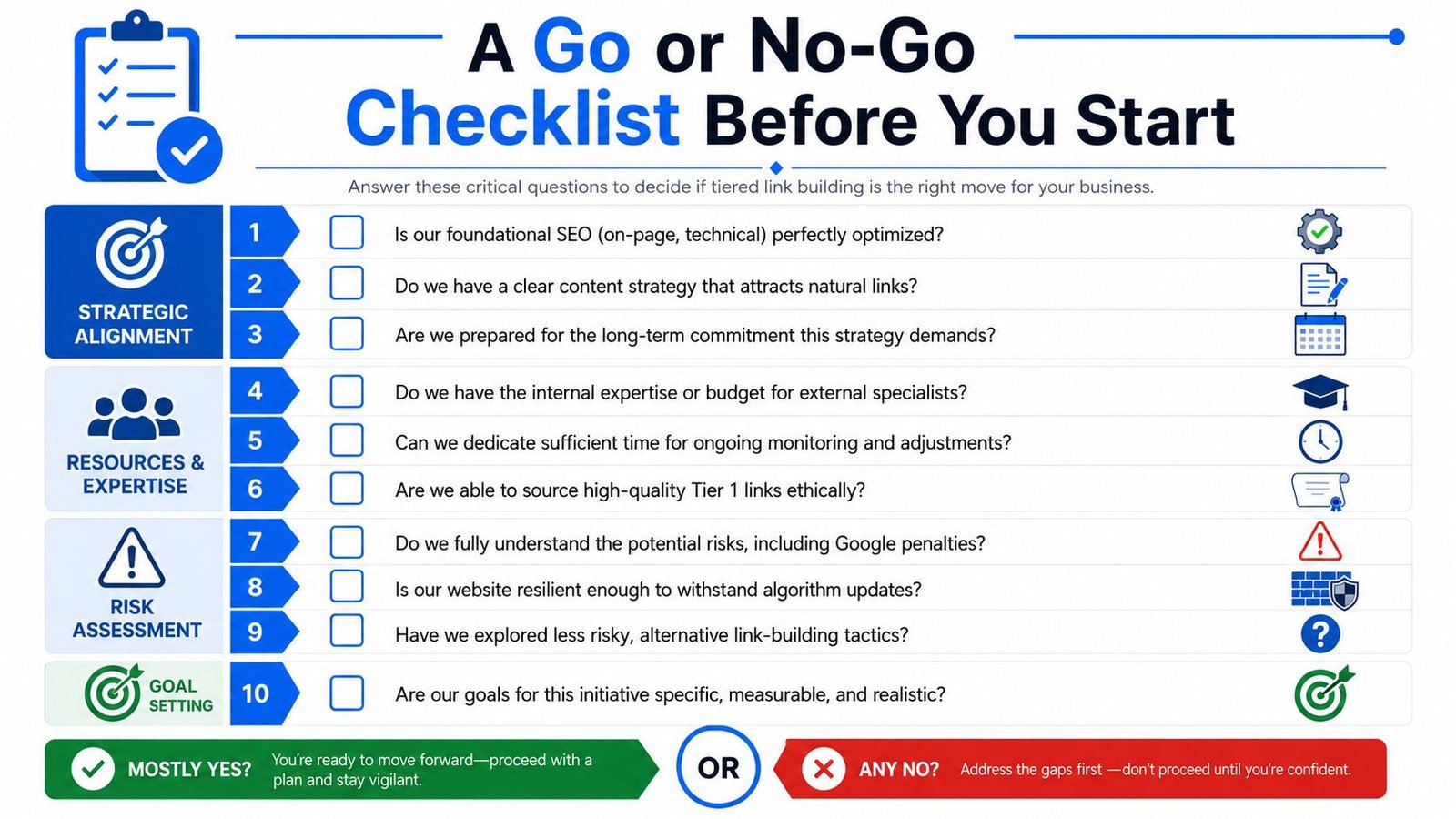
A Go or No-Go Checklist Before You Start
By the time a team reaches this stage, the mechanical question is solved. The business question remains. Should you do this?
The answer gets much clearer when you stop treating tiered link building as an SEO technique and start treating it as an operating model with risk controls.
When the answer is go
A cautious go decision usually means most of these statements are true:
- Your technical SEO is already solid: You're not trying to compensate for crawl, rendering, or internal linking issues.
- Your target pages are commercially important: Better visibility there would matter to pipeline or revenue.
- You already have strong Tier 1 assets: Not hypothetical assets. Real placements worth reinforcing.
- You can review every layer manually: No black-box vendors, no mystery fulfillment.
- Leadership accepts the gray area: Not casually, but knowingly.
- You have patience: The team can let the process run without manufacturing activity to satisfy a weekly report.
This is the profile of a brand that can test tiering without immediately turning it into a mess.
When the answer is no-go
A no-go call is usually the right one if any of the following are true:
- Your direct link acquisition is still weak
- Your content assets don't earn credible placements yet
- Your team needs guaranteed clean compliance boundaries
- You can't monitor supported pages after launch
- You're tempted by cheap lower-tier fulfillment
- The campaign only works on paper if you assume lots of scale
The brands that get hurt by tiered link building are usually the ones that needed better fundamentals, not more layers.
If you're uncertain, the safer alternative is simple. Put the same effort into stronger Tier 1 acquisition, better on-site assets, tighter internal linking, and pages that deserve links in the first place. That path is slower, but it's easier to defend and easier to explain internally.
Tiered link building can still be worth it for a modern SaaS or eCommerce brand. But only when the target pages matter, the Tier 1 assets are strong, and the people running the campaign are comfortable saying no to scale.
If you're weighing whether tiered link building fits your growth model, SaasSky helps SaaS and eCommerce teams plan link acquisition with clearer quality standards, transparent execution, and measurable reporting. If you want a second opinion before committing budget to a higher-risk structure, their team is a sensible place to start.