
Most advice on link building for startups is backwards. It starts with a bag of tactics and skips the only question that matters: what should your company do right now, with the team, product maturity, and budget you have.
That's why founders waste months on activities that look productive but don't compound. They publish guest posts on random sites, buy placements they can't defend, or run broad outreach before they've built anything worth citing. The result is a messy backlink profile, weak referral traffic, and very little authority in the places that influence buying decisions.
The better approach is staged. Pre-seed startups need trust signals and foundational citations. Seed-stage teams need a small set of linkable assets and relationships. Series A companies need repeatable campaigns that turn product knowledge, customer insight, and market data into editorial coverage. That's the playbook that creates an advantage.
Table of Contents
- Why Most Startup Link Building Advice Is Wrong
- The Startup Link Building Flywheel
- Your First 90 Days A Foundational Link Roadmap
- High-Leverage Tactics for Lean Teams
- Scalable Outreach Without Being a Spammer
- Measuring Real Impact and Scaling Your Program
- Startup Link Building FAQs
- Should a pre-seed startup do link building before product-market fit
- Is guest posting still worth doing
- What should a seed-stage SaaS company prioritize first
- When should a startup invest in digital PR
- Are free tools worth building for links
- Should founders handle outreach themselves
- What's the biggest waste of time in startup link building
Why Most Startup Link Building Advice Is Wrong
Most startup SEO advice treats link building like a buffet. Guest posting, broken link building, niche edits, digital PR, directories, podcasts, unlinked mentions. The implication is that more tactics means a better strategy.
It doesn't.
A key problem is prioritization. Recent guidance has pointed out that public advice rarely answers the practical question founders typically ask: what should a pre-seed startup do first versus a Series A SaaS with limited content bandwidth. The stronger playbook emphasizes compounding assets such as founder-led thought leadership, product-led content, expert quotes, digital PR, original data, and a few authoritative foundational citations, rather than volume tactics, as noted in Outreach Desk's startup link-building guidance.
Generic checklists ignore stage and constraints
A pre-seed company with a half-finished product should not copy the outreach motion of a funded startup with a content team, customer data, and a founder already doing podcasts. Yet that's exactly what happens.
Founders read a generic SEO post and start doing everything at once:
- Mass guest posting: They spend weeks pitching articles to sites that don't send qualified traffic.
- Broken link building at the wrong time: They hunt for dead links before they have replacement content worth sending.
- Directory overkill: They submit to every directory they can find, including low-value pages nobody visits.
- Spray-and-pray outreach: They contact anyone with a blog instead of building a list of publishers, partners, and communities that overlap with their buyers.
That activity creates motion, not momentum.
Practical rule: If a tactic doesn't strengthen authority, referral traffic, or market credibility, it probably belongs lower on your list.
Volume is the wrong target
The phrase “more links is better” has hurt a lot of startups. It pushes teams toward whatever is easiest to count instead of what's hardest to replace.
A startup doesn't need fifty forgettable mentions. It needs a small portfolio of links that do one of three jobs well:
| Job | What the link should do | Good examples |
|---|---|---|
| Trust | Validate that the company is real and relevant | Industry platforms, software marketplaces, founder profiles |
| Distribution | Put the brand in front of the right audience | Partner pages, podcasts, niche publications |
| Authority | Help search engines and buyers associate the brand with the topic | Editorial mentions, research citations, product-led resources |
The better mental model
Think of link building for startups as asset creation plus selective distribution.
The asset might be original research, a free tool, a strong founder point of view, an integration page, a benchmark page, or a useful industry resource. Distribution might mean outreach to editors, partners, communities, podcasts, or existing brand mentions. The link is a byproduct of doing those two things well.
That mindset changes what you ignore. You stop asking, “How do we get more backlinks this month?” and start asking, “What can we publish or package that earns repeated citations from the right people?”
The Startup Link Building Flywheel
Links matter because they compound beyond rankings. They shape how prospects discover you, how other publishers evaluate you, and how much friction your team faces the next time it pitches something worth covering.
Backlinks have remained one of Google's core ranking signals since its early years, and they can compound across referral traffic, branded search demand, and perceived authority. They also require recurring investment, not one-off effort. One industry survey found that 47% of link builders spend more than £600 per month, and another 14% spend over £1,500 per month, according to this roundup of link-building statistics.
Links are not the output
The flywheel starts earlier than many realize.
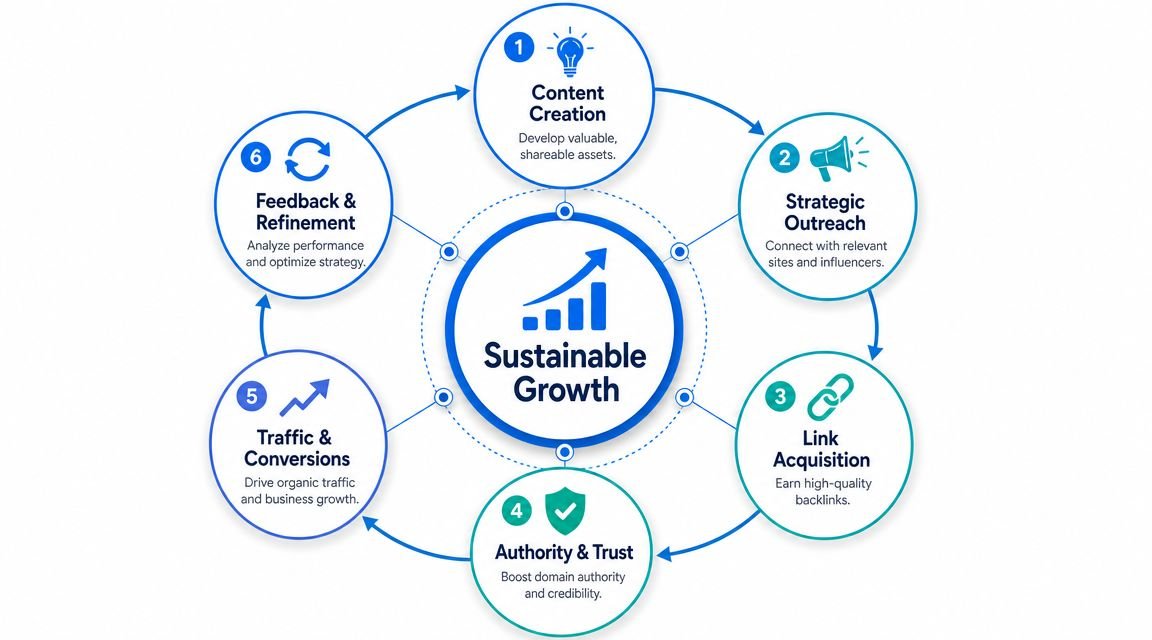
A useful asset gets published. Someone with audience or authority sees it. That creates a mention or link. The mention sends referral visitors and validates the brand. More people search for you by name, recognize the company, or cite you later. Future outreach gets easier because the brand is no longer unknown.
That's the loop:
- Create something cite-worthy
- Put it in front of relevant people
- Earn a link or mention
- Build authority and trust
- Generate referral traffic and brand signals
- Use that proof to earn the next placement
This is why weak links are so disappointing. They may inflate a spreadsheet, but they don't strengthen the loop. Strong links keep helping after the placement goes live.
Good link building lowers friction for future link building.
What to measure inside the flywheel
Most startup teams still track the wrong KPIs. They obsess over domain-level vanity metrics, total links, and whether a publisher “looks big.” Those signals can be useful for filtering prospects, but they shouldn't be the scoreboard.
Track outcomes that connect to growth:
- Referral traffic quality: Did visitors from the placement engage, sign up, or visit key pages?
- Branded search behavior: Are more people searching for the company by name after campaigns and mentions?
- Pipeline support: Did partner pages, integrations, or editorial mentions influence demos or trials?
- Publisher quality: Did the placement sit on a site your buyers read?
- Repeatability: Can the team turn the same process into another strong placement next month?
A simple way to think about link ROI is to score every campaign against three questions:
| Question | Weak answer | Strong answer |
|---|---|---|
| Did it help rankings? | Link on a low-relevance site | Link from a trusted niche publication |
| Did it send real visitors? | Almost no referral traffic | Relevant readers reached a useful page |
| Did it help the brand? | Generic placement with no context | Clear association with your category or expertise |
A startup flywheel works when each win makes the next win easier. If your current process doesn't create that effect, it's probably a treadmill.
Your First 90 Days A Foundational Link Roadmap
Early-stage startups should earn the links that make the company look real before they chase splashy PR. That means entity consistency, trusted profiles, relevant citations, and a small number of pages worth linking to.
Practitioner guidance consistently recommends prioritizing a handful of links from trusted, niche-relevant sites over dozens of low-quality placements. The early-stage playbook focuses on foundational citations from industry publications, complementary tools, and community content before raw link counts, as outlined in this startup link-building guide.
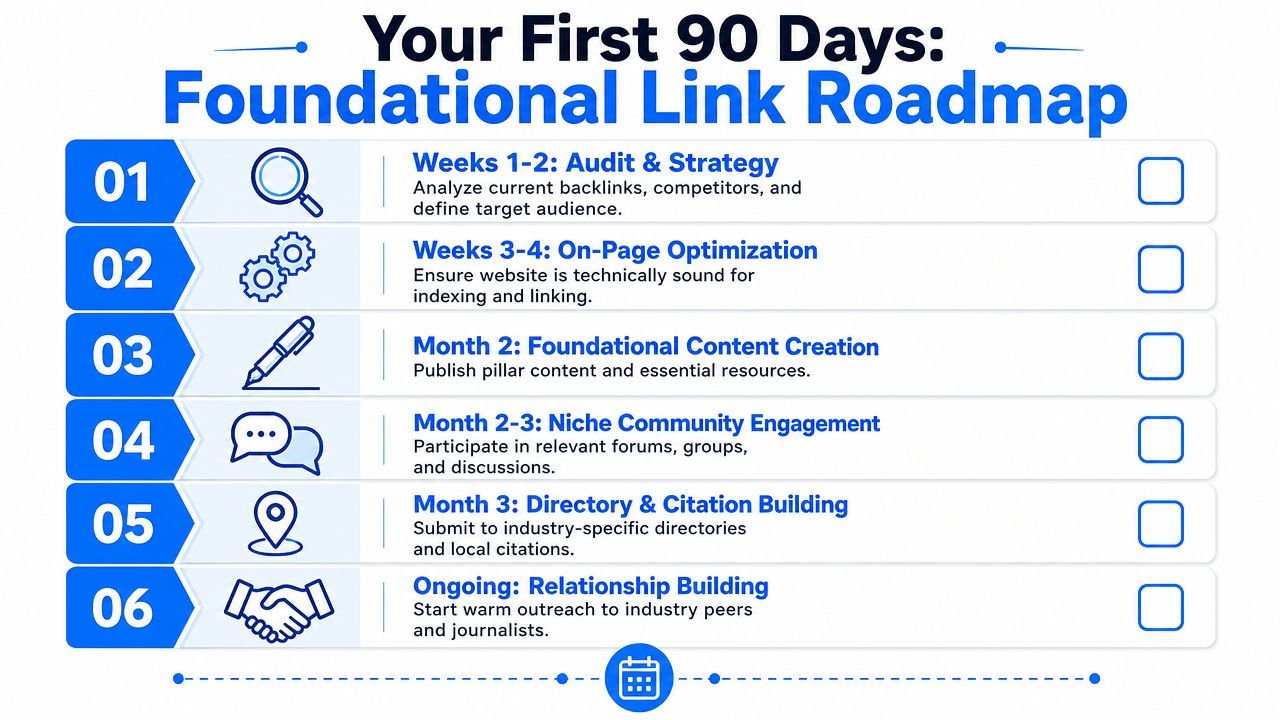
Weeks 1 to 2 clean up what blocks trust
Before outreach, make sure the site deserves the attention.
Create a short audit checklist and fix the basics:
- Company identity: Use the same brand name, description, and positioning on your site, LinkedIn company page, founder bios, and startup profiles.
- Core pages: Tighten your homepage, product page, pricing page, and about page so a publisher can understand what you do fast.
- Founders and team: Add real people to the site. Anonymous startups get ignored.
- Linkable destinations: Publish at least one page you'd feel comfortable sharing with a journalist, partner, or resource curator.
If someone on the team still asks “what is a backlink,” send them a quick primer like this backlink explainer and get everyone aligned on the same vocabulary.
Weeks 3 to 6 build the citations that make you look real
At this point, don't overcomplicate it. Build the profiles and citations a real software company should already have.
Focus on places that buyers, publishers, and search engines use to validate a company:
- Software marketplaces: G2, Capterra, Product Hunt, or the niche equivalent in your category
- Startup platforms: Crunchbase and other startup databases relevant to your market
- Partner ecosystems: Integration directories, app marketplaces, and technology partner pages
- Founder profiles: LinkedIn, personal sites, podcast bios, conference speaker pages
- Community references: Slack groups, subreddit resource threads, curated “best tools” pages when relevant
This is also the stage to ask for the easiest real links you have access to. Vendors, agencies, implementation partners, and integration partners often maintain partner pages, customer directories, or blog roundups.
Days 45 to 90 earn the first relevant editorial links
Once the base is in place, target a small number of editorial opportunities that fit your current maturity.
For most startups, the first wave should come from:
- Selective guest contributions on niche sites your buyers already trust
- Unlinked mention reclamation when the company or founder has already been referenced
- Partner-led content such as integration pages, co-marketing posts, comparison pages, or webinar recaps
- Community contributions where your team is helpful, not promotional
Don't pitch your homepage to everyone. Match the target page to the context. A resource page should get a resource. A partner page should get a partner asset. A publication should get a strong angle.
A lot of startups miss this because they want “big links” too early. But the first 90 days aren't about prestige. They're about making the company easy to trust, easy to cite, and easy to place.
High-Leverage Tactics for Lean Teams
Once the foundation is done, the next question is efficiency. Which tactics keep paying you back after the first placement, and which ones eat your time one email at a time?
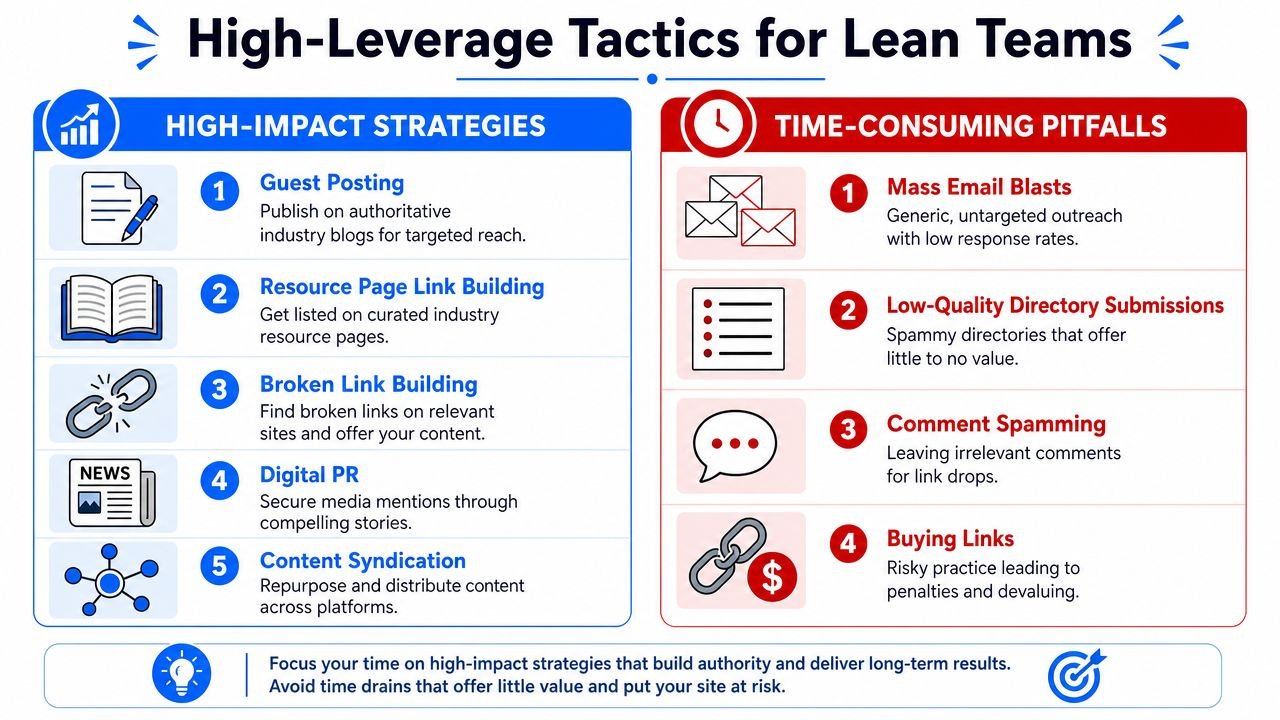
The strongest workflow puts digital PR or original research assets first. Expert surveys rank digital PR as the most effective tactic at 48.6% of SEO professionals, and long-form content of 1,500+ words generates 77.2% more links than short-form content, based on these link-building statistics and benchmarks.
The tactics worth real effort
Lean teams should bias toward assets that can attract links more than once.
Digital PR built on real data
If your startup has usage patterns, survey input, customer benchmarks, market observations, or founder expertise that can be turned into a story, digital PR deserves attention first. Journalists rarely need another generic opinion piece. They need a fresh angle with evidence or a clear point of view.
Good startup angles usually come from:
- Original research: Survey results, trend summaries, benchmark pages
- Product insight: Aggregated usage patterns or workflow analysis
- Market commentary: A founder with credible expertise reacting to a timely shift
- Regional or niche data: Breakouts by industry, role, or use case
The best part is that these assets don't only help PR. Sales can use them. Partnerships can use them. Social can use them.
Product-led link building
A free tool, calculator, template, checklist, or public mini-resource can become a durable citation target. This works best when the asset sits close to the product's actual value, not when it's bolted on for SEO.
Examples that usually make sense:
- A pricing calculator for procurement-heavy software
- A template library for operations workflows
- A benchmark page for SaaS metrics by category
- A small diagnostic tool tied to a pain point your product solves
Strategic partnerships
Partnerships are one of the most underused link sources in startups because they already align with business goals. Integration partners, agencies, consultants, marketplaces, affiliate partners, and co-sell relationships can all produce relevant links with referral value.
These placements also tend to age well. They're context-rich, tied to a real relationship, and easier to update over time.
For teams trying to improve existing assets before outreach, the Skyscraper Technique for SEO is still useful as a quality filter. If your page isn't materially better than what people already cite, outreach won't rescue it.
A startup with one strong data asset and five real relationships will usually outperform a startup with twenty weak guest posts.
The tactics that look cheap and get expensive
Some tactics aren't bad. They're just easy to misuse.
| Tactic | When it works | When it wastes time |
|---|---|---|
| Guest posting | Narrowly targeted, strong site, relevant audience | Writing generic posts for any site that says yes |
| Broken link building | You already have the right replacement asset | You create weak substitute pages just to pitch them |
| Directories | Trusted niche listings and software platforms | Bulk submission to low-quality directories |
| Niche edits | Relevant page, clear contextual fit, defensible mention | Paying for random insertions with no topical relevance |
The pattern is simple. High-impact tactics create assets, proof, or relationships that can be reused. Low-impact tactics create one-off links that need constant manual replacement.
Scalable Outreach Without Being a Spammer
Outreach fails when the list is bad, the ask is lazy, or the sender clearly wants something without offering value. Most startup teams struggle with all three.

Channel choice matters more than people think. In B2B niches, LinkedIn outreach has been reported to achieve a 31% higher response rate than cold email, and the cost side is real too. Managed agency campaigns often price at $150 to $500 per link, while in-house execution can cost about $4,500 to $8,000 per month, according to these link-building benchmarks.
Prospecting that doesn't waste your week
Don't build a prospect list from “sites with blogs.” Build it from places that already influence your buyers.
A practical startup outreach list usually includes four buckets:
- Publishers: Niche blogs, trade media, newsletters, podcasts
- Partners: Integrations, consultants, service partners, marketplaces
- Curators: Resource pages, tool directories, comparison pages
- Mentions: Existing references to your company, founder, or product category
Use simple filters:
- Does this site cover our category?
- Would our buyers visit it?
- Is there a clear editorial or commercial reason for them to mention us?
- Do we have a page that fits their audience?
If the answer is no, skip it. A smaller list with strong fit beats a giant spreadsheet every time.
Simple outreach scripts that sound like a person
Bad outreach tries to simulate warmth. Good outreach gets to relevance fast.
For a partner page
We've noticed your integrations page doesn't yet include a setup for [category/use case]. We've built that workflow with mutual customers in mind. If useful, I can send a short blurb, logo, and destination URL your team can review.
For a resource page
I saw your resource list for [audience/use case]. We recently published a piece that covers [specific gap]. It includes [brief proof of usefulness]. If you think it strengthens the page, I'm happy to send the exact section most relevant to your readers.
For an unlinked mention
Thanks for mentioning [brand/founder] in your piece on [topic]. If you're open to it, would you mind linking the mention to our site so readers can find the product directly?
For digital PR
We've compiled new data on [topic], including [most interesting angle]. Since you cover [beat], I thought this might be relevant for your upcoming coverage. Happy to send the summary or the full dataset.
A few rules keep outreach clean:
- Lead with fit, not flattery
- Mention one specific reason the asset belongs
- Reduce effort for the recipient
- Don't fake familiarity
- Stop following up when there's no clear match
When LinkedIn should beat email
For B2B startups, LinkedIn often works better when the ask is relational, not transactional. Editors, founders, partner managers, and consultants are easier to warm up there because context is visible. They can see your role, company, mutuals, and recent activity before deciding whether to answer.
Use LinkedIn when:
- You're reaching out to a founder, editor, or partner lead
- The relationship may matter more than the immediate ask
- You have a credible profile and shared context
- The ask is short and easy to review
Use email when:
- You need to send a full pitch, dataset, or asset package
- You're contacting editorial inboxes
- The recipient is operationally easier to reach via site contact methods
The main mistake is trying to automate what should stay selective. Scalable outreach doesn't mean impersonal outreach. It means the team uses a repeatable process to send relevant asks to the right people.
Measuring Real Impact and Scaling Your Program
If your report on link building for startups ends with “we got twelve links,” you're reporting activity, not impact.
The links that matter should show up somewhere else in the business. You should see better referral engagement, stronger brand recognition, and clearer support for pages that influence pipeline. That's the difference between an SEO task and a growth program.
What to track instead of raw link count
Start with a campaign view, not a backlink export. For each link or mention, ask what business outcome it could reasonably influence, then track that path.
A simple operating view looks like this:
| Metric | Why it matters | What to check |
|---|---|---|
| Referral sessions | Shows whether placements attract real visitors | Traffic from the linking domain |
| Assisted conversions | Reveals influence beyond last click | Demo, trial, or lead assist paths |
| Landing page engagement | Separates curiosity from actual fit | Time on page, downstream pageviews |
| Brand demand | Indicates market recognition is improving | Branded search trends and direct interest |
| Link quality by relevance | Keeps the team from chasing vanity placements | Category fit, audience fit, page context |
This also helps when stakeholders ask whether in-house work is worth it or whether outside help makes more sense. Teams comparing those options should understand the cost structure before deciding. A pricing breakdown like this guide to link-building pricing is useful because it frames the operational trade-offs clearly.
The best link isn't the one that looks impressive in a slide. It's the one that improves discovery, trust, and revenue paths at the same time.
Why maintenance matters as much as acquisition
A lot of founders treat link building like a launch sprint. They push hard for a quarter, collect some wins, and move on.
That's a mistake because links decay. Pages get updated, websites shut down, editors change old URLs, product pages disappear, and partner directories get restructured. If you don't monitor what you've earned, your strongest placements slowly weaken or vanish.
Build a maintenance loop into your program:
- Audit live links regularly: Make sure key placements still resolve correctly.
- Watch destination pages: Don't let earned links point to redirected, thin, or outdated pages.
- Refresh important assets: Update research, templates, and benchmark pages so publishers keep citing them.
- Replace lost coverage: If a useful link disappears, reclaim it or earn a new equivalent.
- Track by asset type: Research pages, partner pages, and guest contributions decay for different reasons.
A scalable program has two motions running at the same time. One earns new links. The other protects and upgrades the links you already fought to get.
Startup Link Building FAQs
Should a pre-seed startup do link building before product-market fit
Yes, but the scope should be narrow. Pre-seed link building should focus on foundational trust signals, founder visibility, startup profiles, partner mentions, and a small number of relevant citations. Heavy outreach before you have a clear product story usually creates wasted effort.
Is guest posting still worth doing
Yes, selectively. Guest posting works when the publication is relevant, the article says something useful, and the placement helps you reach the right audience. It fails when teams treat it like a volume channel and publish on any site that accepts content.
What should a seed-stage SaaS company prioritize first
Usually three things. Foundational citations that make the company easy to validate, one or two linkable assets, and relationship-driven placements through partners, communities, and niche publishers. That combination creates better compounding value than trying to run every tactic at once.
When should a startup invest in digital PR
When it has something worth packaging. That could be original data, a strong founder point of view, a product insight, a market trend, or a timely announcement. Digital PR without a sharp angle turns into expensive outreach with weak pickup.
Are free tools worth building for links
Only when the tool is close to your product and solves a real pain point. A throwaway calculator built for SEO rarely becomes an asset. A useful tool that supports your category can attract links, assist sales, and reinforce positioning.
Should founders handle outreach themselves
Often at the beginning, yes. Founders usually have the best understanding of the product, the market, and the relationships that can turn into first links. Later, execution can move to marketing or SEO, but founder involvement still helps with partnerships, PR, and expert commentary.
What's the biggest waste of time in startup link building
Running generic outreach to irrelevant sites. It burns time, hurts morale, and teaches the team the wrong lesson. If the target doesn't overlap with your buyers or category, the link usually won't justify the effort.
If you want a team that treats link building like a growth system instead of a spreadsheet exercise, SaasSky is worth a look. They focus on SaaS and eCommerce link building with transparent pricing, practitioner-led execution, and a service model built around accountability and measurable impact.