Link equity is the ranking power one webpage passes to another through a link, and the idea traces back to 1998, when Google introduced PageRank and made links a core signal for search visibility. For any company trying to rank product, pricing, or category pages, that matters because link equity isn't about raw link count alone. It's about how much value flows to the pages that drive pipeline and revenue.
If you're leading marketing at a SaaS or eCommerce company, you've probably seen the frustrating version of this problem already. You publish content, earn a few backlinks, maybe even watch your blog gain traction, but the pages that matter most to the business still sit below competitors. The issue often isn't effort. It's distribution.
A lot of teams treat backlinks like trophies. The better operators treat them like infrastructure. If authority flows like water through pipes, then your website architecture determines whether that water reaches your revenue-critical pages or leaks into corners of the site that don't convert.
Search has also become less simple than a list of ten blue links. Search Engine Land frames link equity in an AI environment, which changes the practical question from "does link equity exist?" to "where should we direct it so the business benefits?" That's the right question now, especially if you're accountable for qualified traffic, demo requests, and sales, not just a prettier SEO dashboard.
Table of Contents
- Why Your Backlinks Arent Improving Your Rankings
- Deconstructing Link Equity Beyond The Buzzword
- How Link Equity Flows Through Your Website
- The Technical Levers That Control Equity Flow
- Measuring Link Equity Without a Magic Number
- The SaaS and eCommerce Link Equity Playbook
- Common Mistakes That Erode Link Equity
Why Your Backlinks Arent Improving Your Rankings
The most common SEO complaint I hear from SaaS teams sounds like this. “We've built links. We've published content. Why is the pricing page still invisible?”
Usually, the backlinks went to blog posts, reports, or homepage-level assets. Those pages may have picked up authority, but the pages that influence pipeline never received enough of that value. The result is a familiar mismatch: marketing celebrates link growth while revenue pages stay weak.
That's where link equity stops being a buzzword and becomes an operating model. A backlink isn't the finish line. It's the entry point for authority. If your site doesn't route that authority toward feature pages, integration pages, comparison pages, pricing, or category pages, you're letting value pool in the wrong places.
Practical rule: If the pages earning links are different from the pages expected to convert, internal linking has to bridge the gap.
This is also why teams often confuse backlinks with results. A backlink is an input. If you need a clearer primer on that distinction, this guide on what a backlink is is useful context. Rankings improve when the authority from those links reaches the pages competing for commercial terms.
Search Engine Land's guidance matters here because it frames link equity inside an AI-shaped search environment, where businesses need to think less about raw backlink volume and more about how they allocate effort toward business-critical pages in a more diversified results environment. See their perspective in this link equity guide in an AI search context.
Three patterns usually separate winning teams from stalled ones:
- They map authority to revenue pages. They know which URLs support demos, trials, signups, or transactions.
- They build content with distribution in mind. Blog posts are not dead ends. They are feeders.
- They audit flow, not just acquisition. They ask where value lands after a link is earned.
If your backlinks aren't improving rankings, the problem often isn't that you need more links. It's that your site isn't built to use the ones you already have.
Deconstructing Link Equity Beyond The Buzzword
A simple definition that actually helps
Link equity is the value a webpage passes to another page through a hyperlink. The easiest way to think about it is as a reputational endorsement. One page is effectively saying, “this other page is worth visiting,” and search engines use that signal as part of how they judge importance and relevance.
That idea isn't new. It sits directly in Google's original architecture. Ahrefs notes that link equity is tied to Google's PageRank system, introduced in 1998, which made links a core signal for search visibility. The same explanation also highlights that link equity isn't about raw link count alone. It depends on factors like the authority of the linking page, topical relevance, and anchor text, which is why one strong link can matter more than a pile of weak ones. You can see that framing in Ahrefs' explanation of link equity and PageRank.
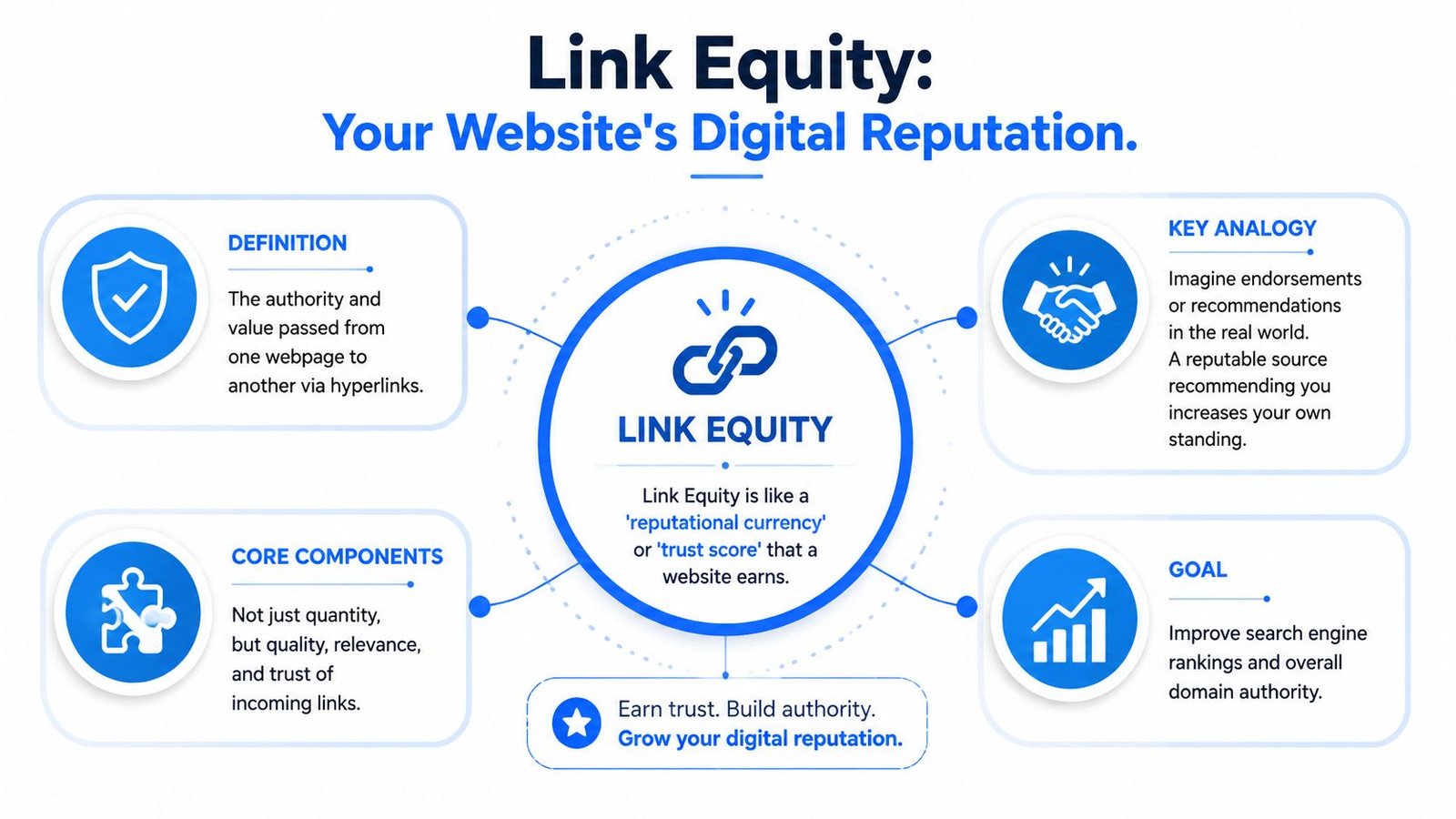
A useful mental model for non-SEOs is this: not every recommendation carries the same weight. A referral from a respected buyer in your industry means more than a random mention from someone who doesn't understand your product. Links work similarly.
What makes one link stronger than another
Several variables shape how much value a link is likely to pass.
- Authority of the linking page: A trusted page tends to pass more value than a weak page with little standing.
- Topical relevance: A link from a closely related page usually means more than one from an unrelated topic.
- Anchor text: The words used in the link help clarify what the destination page is about.
- Context and placement: A naturally placed link inside the main body content tends to carry more weight than a tucked-away footer mention.
That last point changes how you should think about outreach. A link isn't automatically “good” because it exists. Placement, page quality, and context all matter.
Link equity is less like counting business cards and more like tracking who is willing to recommend you, in what context, and on which topic.
This is also where teams get tripped up by third-party scores. Domain Authority, Domain Rating, and similar metrics can be useful directional tools, but they are not link equity itself. They're approximations created by SEO software, not Google's own number.
For a SaaS marketer, the practical takeaway is simple. When someone asks, “what is link equity,” the right answer isn't “it's an SEO score.” It's “it's ranking value passed through links, and the quality of that value depends on who is linking, why they're linking, and what page they're sending that authority to.”
How Link Equity Flows Through Your Website
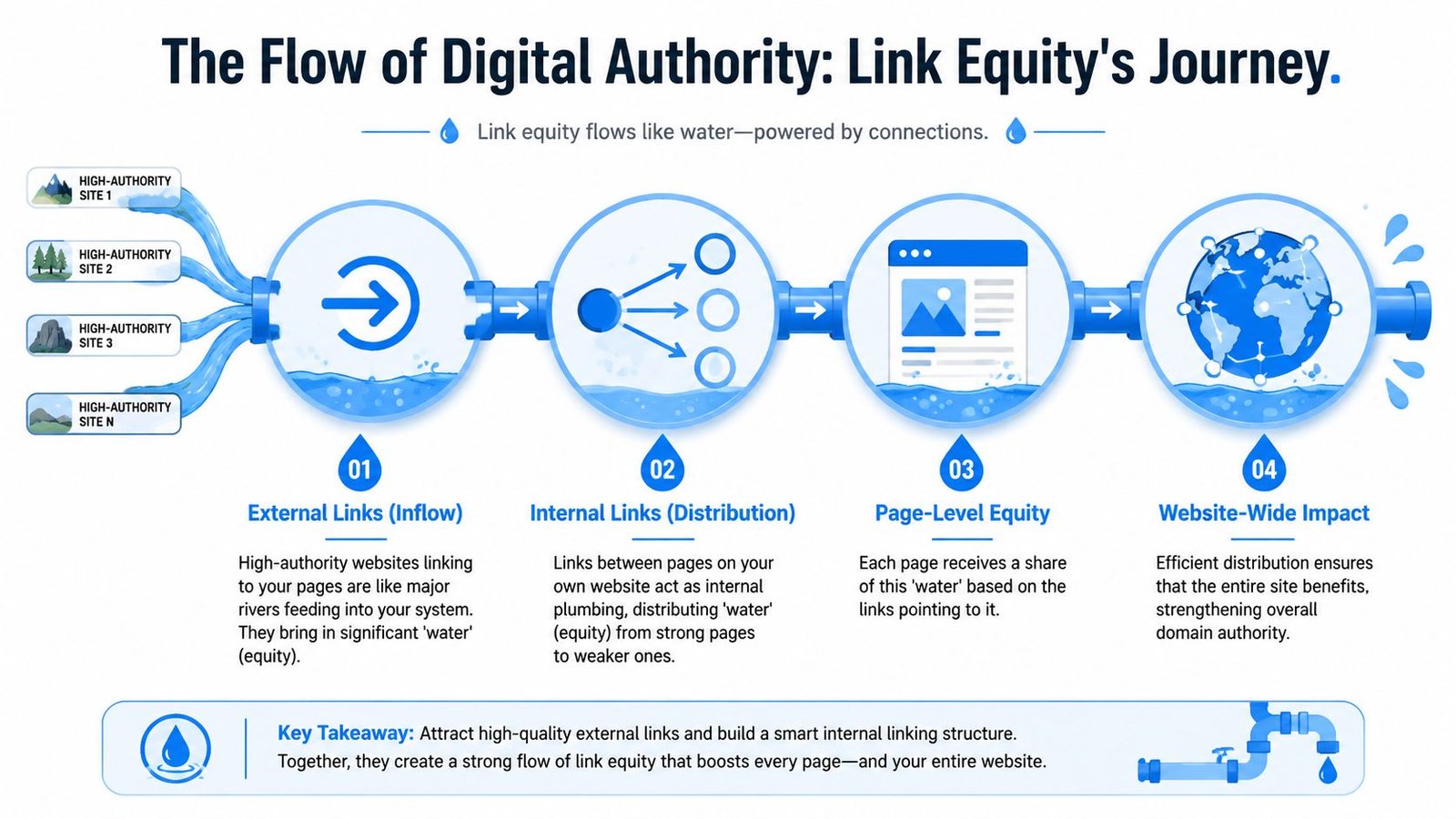
A website with strong SEO architecture behaves like a plumbing system. Backlinks are the water source. Internal links are the pipes. If the source is strong but the pipes are badly laid out, the rooms that need water still stay dry.
External links bring authority in
Many first encounter link equity through backlinks. That makes sense. An external link from another site introduces authority into your domain.
But external links usually don't land where you most want them. Journalists, bloggers, and industry publications tend to link to educational assets, not your pricing page. They'll cite a guide, a benchmark article, a glossary entry, or a helpful comparison piece. That's normal.
The mistake is assuming the value stops there.
If a strong blog post earns links and then sits isolated from the rest of your site, the authority mostly benefits that one URL. If that same page links contextually to your product pages, solution pages, or commercial landing pages, it can become a distribution hub.
Internal links decide where it goes
Architecture plays a strategic role. Modern SEO guidance emphasizes that internal links also pass equity, not just external backlinks. It also notes that content clusters and pillar pages are used to concentrate authority on priority pages instead of spreading it thinly, turning link equity into something teams can engineer through site structure. That framing is well summarized in this explanation of how internal links pass link equity.
For SaaS sites, a hub-and-spoke model usually works well:
| Page type | Role in the structure | Typical goal |
|---|---|---|
| Pillar page | Broad topic authority hub | Rank for major informational themes |
| Supporting blog post | Earn links and capture long-tail demand | Bring in traffic and authority |
| Feature page | Explain product capability | Move buyers toward evaluation |
| Pricing or demo page | Conversion endpoint | Generate pipeline |
A practical flow looks like this:
- A guide on “CRM automation workflows” earns editorial backlinks.
- That guide links naturally to your workflow builder feature page.
- The feature page links to your pricing or demo page.
- Authority and users both move deeper into the funnel.
That's much better than publishing isolated content that ranks, gets traffic, and never supports revenue pages.
Here's what usually works best inside the site:
- Contextual links in body content: These tend to be more meaningful than generic sitewide links.
- Topic clusters: Group related content around a central commercial or strategic page.
- Clear hierarchy: Important pages should not be buried under too many clicks.
- Intent alignment: Links should feel natural to users, not forced for SEO.
A strong site doesn't just earn authority. It routes authority.
If you run eCommerce, the same logic applies. A buying guide or comparison article can channel value to a category page. A category page can reinforce priority product collections. The architecture changes by business model, but the principle stays the same: earn authority high in the funnel, then direct it toward URLs that influence revenue.
The Technical Levers That Control Equity Flow
Marketers don't need to write code to understand this part, but they do need to know which switches affect authority flow. A lot of link equity gets lost during redesigns, migrations, CMS changes, and content cleanups because no one asked the technical questions early enough.
Link attributes as valves
Some link attributes affect whether a link is intended to pass value.
rel="nofollow"tells search engines the link shouldn't be treated as a standard endorsement.rel="sponsored"marks paid or sponsorship-based links.rel="ugc"is meant for user-generated content such as forum posts or comments.
These matter most in external link contexts, but they can also show up internally in messy implementations. If someone adds nofollow to internal navigation or key in-content links, they may be blocking flow inside their own site.
A simplified example:
<a href="/pricing">Pricing</a>
This is a normal internal link.
<a href="/pricing" rel="nofollow">Pricing</a>
This introduces a constraint on how that link is treated.
If you need a clean breakdown of the difference, this guide on follow and nofollow links covers the practical distinctions.
What tends to work:
- Use standard internal links for important pages. Let key navigation, relevant body links, and conversion paths remain crawlable and pass value.
- Use sponsored or UGC attributes where appropriate externally. Keep paid placements and community content labeled correctly.
- Avoid “sculpting” with nofollow on core internal pages. In most cases, this creates more confusion than benefit.
Redirects and canonicals as control points
URL changes are where many teams accidentally erase authority.
A 301 redirect is the standard permanent redirect used when a page has moved for good. SEO teams generally use it to preserve continuity from the old URL to the new one. A 302 redirect signals a temporary move, which can create ambiguity if used for permanent changes.
Example:
/old-feature-page → 301 → /new-feature-page
That is usually the clean version during a migration.
The same principle applies to expired campaign URLs, retired blog posts, and merged product pages. If backlinks point to an old page and you let it return a dead end, you're wasting earned authority.
Canonical tags help in a different way. They consolidate signals when multiple pages are substantially similar and you want one preferred version to stand as the main URL.
Example:
<link rel="canonical" href="https://example.com/main-page/" />
Common use cases include:
- Duplicate product variants
- URL parameter versions
- Near-identical landing pages
- Syndicated or repeated content structures
A good way to explain this to a dev team is simple. Redirects handle moved pages. Canonicals handle duplicate or competing versions. Both reduce dilution when implemented correctly.
If your site has gone through redesigns, content pruning, or platform migrations, these technical details aren't optional. They're where a lot of “we built links but rankings dropped” stories begin.
Measuring Link Equity Without a Magic Number
There isn't a public Google metric called “link equity score.” That's why this topic feels abstract to many teams. But abstract doesn't mean unmanageable.

SEOptimer puts it plainly: link equity isn't directly measurable, but SEO tools approximate it with page- or domain-level authority scores, and because internal links also distribute that value, site architecture matters for concentrating equity on product, service, or conversion pages that matter most to revenue. Their overview of measuring link equity with authority proxies is a solid practical reference.
Use proxy metrics carefully
Tools like Ahrefs and Moz give you directional signals, not hard truth.
A few useful examples:
- Ahrefs DR and UR: Helpful for comparing domain-level and page-level backlink strength.
- Moz DA and Page Authority: Useful for directional review of authority patterns across sites and URLs.
- Google Search Console Links report: Useful for seeing which pages attract internal and external links.
The trap is treating any one of these as the KPI. They are best used like gauges on a dashboard. They tell you whether pressure is rising or falling. They do not tell you revenue by themselves.
Don't ask, “Did our authority metric go up?” Ask, “Did authority move toward pages that influence pipeline?”
Tie proxies back to business outcomes
A more useful measurement process looks like this:
| What to track | Why it matters | What to look for |
|---|---|---|
| New backlinks to key content | Indicates external authority inflow | Which content assets attract strong links |
| Internal links added to commercial pages | Shows deliberate equity routing | Whether money pages gain stronger support |
| Ranking movement on targeted URLs | Measures search visibility impact | Improvement on feature, pricing, or category terms |
| Organic sessions to commercial pages | Shows demand capture | Growth in qualified traffic, not just blog visits |
| Conversions from organic landing pages | Connects SEO to business | Demo requests, trials, purchases, signups |
Smart teams distinguish SEO theater from actual performance. If a blog post earns links but no commercial page improves, the play isn't finished. If a feature page gains internal support and begins showing stronger visibility for high-intent terms, that's much closer to business value.
When people ask how to measure link equity, the honest answer is that you don't measure it directly. You measure the signals around it and the business effects that follow.
The SaaS and eCommerce Link Equity Playbook
The best link equity strategy is rarely flashy. It's disciplined. You earn authority where links are realistic, then route that authority where revenue happens.
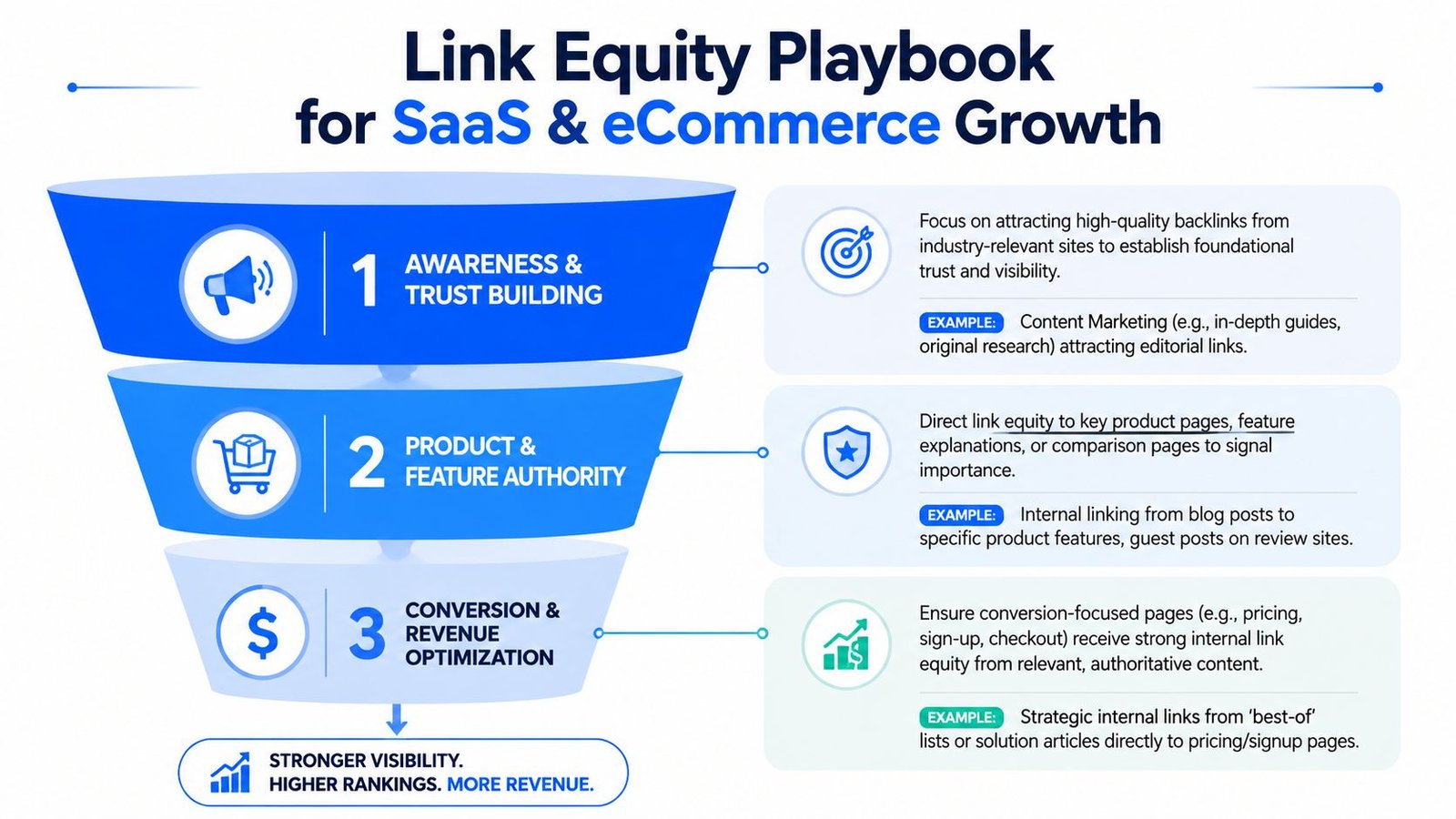
A practical flow for money pages
For a SaaS company, the playbook often starts with one strong educational asset. That could be a guide, a comparison page, a workflow template, or a valuable industry resource. The job of that asset is twofold: attract relevant backlinks and create natural paths toward product pages.
Three tactics usually pull the most weight.
First, funnel equity to money pages. If a blog post about a painful problem ranks and earns links, add contextual links to the feature page that solves that problem. From there, link to the pricing or demo page where buyers act.
Second, build links to pages beyond the homepage. Many campaigns over-focus on homepage links because they're easy to request. But if your feature page or category page is commercially important and link-worthy enough, those URLs deserve direct support too.
Third, reclaim lost equity. When a site has old URLs with backlinks pointing at them, broken pages and weak redirect logic waste authority. Redirecting retired but linked URLs to the closest relevant live page can recover value you already earned.
A good outreach and content engine supports all three. If your team needs a framework for earning those links without drifting into spam, this guide to white hat link building is a practical reference.
A mini playbook in action
Take a hypothetical B2B SaaS product that sells customer support software.
The company publishes a detailed article on reducing ticket backlog. That article is naturally linkable because it solves a common operational problem. Over time, it earns relevant mentions from industry blogs and operations-focused publications.
Inside that article, the team adds contextual links to:
- The shared inbox feature page, because it directly addresses ticket routing and resolution workflows
- A help desk comparison page, for buyers evaluating software options
- The demo page, for readers who are ready to see the product
That's the first layer.
The second layer is structural. The shared inbox feature page also links to adjacent pages like automation rules, analytics, and pricing. The company is building a web of related relevance, not a single isolated path.
The third layer is cleanup. During an audit, the team finds an old “customer service metrics template” URL that still has backlinks but no longer serves a live page. Instead of leaving it broken, they redirect it to the most relevant updated resource.
This kind of system works because each piece has a distinct role:
| Asset | Primary role | Secondary role |
|---|---|---|
| Linkable blog content | Earn backlinks | Feed authority deeper |
| Feature page | Capture commercial intent | Support product understanding |
| Comparison page | Help evaluation | Qualify buyers |
| Pricing or demo page | Convert demand | Turn visibility into pipeline |
For eCommerce, swap feature pages for category pages and product collections. A gift guide, product tutorial, or comparison article can earn links at the top and support transaction pages lower down.
The underlying principle doesn't change. Treat link equity like a controllable asset. Acquire it deliberately, route it intentionally, and judge success by whether revenue pages become more competitive.
Common Mistakes That Erode Link Equity
Most link equity problems aren't caused by a total lack of links. They're caused by waste.
A site redesign launches and old URLs vanish. A content team publishes articles that never link to product pages. Navigation gets cluttered. Important pages become orphaned. Outreach brings in irrelevant links that look nice in a report but don't help rankings where it counts.
Here's a practical audit table to keep teams honest.
Link Equity Best Practices
| Do This | Avoid This |
|---|---|
| Use 301 redirects when permanently changing URLs | Leaving old linked pages to return errors or redirecting them carelessly |
| Add contextual internal links from strong content to commercial pages | Letting blog posts rank and earn links without supporting feature or pricing pages |
| Keep important pages well connected in site architecture | Creating orphaned pages that receive little or no internal support |
| Pursue relevant, high-quality links tied to your market | Chasing large volumes of low-quality or off-topic backlinks |
| Review canonicals and duplicate page patterns | Allowing near-identical pages to compete and dilute signals |
| Link naturally from hubs, pillars, and supporting content | Stuffing pages with random internal links that don't help users |
A few mistakes deserve special attention:
- URL changes without redirect planning: This is one of the fastest ways to burn accumulated authority.
- Using nofollow on key internal links: Teams sometimes do this by accident through templates or plugin settings.
- Ignoring page relevance: A strong but irrelevant link is usually less helpful than marketers hope.
- Over-prioritizing vanity metrics: If authority scores rise but money pages don't improve, the strategy needs fixing.
Good SEO architecture preserves value. Bad architecture makes every new backlink work harder than it should.
If you want one standard to use internally, use this: every link-building effort should have a plausible path to a revenue page. If that path doesn't exist, the campaign may still produce visibility, but it probably won't produce enough business impact.
If your team wants help turning backlinks into rankings for the pages that drive demos, signups, and sales, SaasSky works with SaaS and eCommerce brands on practitioner-led link building built around clear strategy, transparent execution, and measurable business impact.