Most advice on how to improve Domain Rating gets the priority backward. It treats DR as the goal, then prescribes generic tactics like “build more links” or “publish great content.” That's not how strong link profiles are built in practice.
The better model is simpler. Google ranks pages, not domains. If you build links to the pages that matter most, Domain Rating tends to rise as a byproduct. That shift matters for SaaS and eCommerce teams because it changes where you spend time, what content you publish, and which links you ignore.
A solid DR usually reflects a healthy backlink profile, but it doesn't tell you which page is earning links, which asset deserves promotion, or whether those links support revenue pages. That's why smart teams don't ask, “How do we make the score go up?” They ask, “Which page deserves links next, and why would anyone link to it?”
Table of Contents
- What Domain Rating Is and Why It Matters Less Than You Think
- Conduct a Baseline Link Profile Audit
- Create Content Assets That Attract Links Organically
- Strategic Link Acquisition and Outreach
- Technical and UX Fixes That Boost Linkability
- Your 90-Day Roadmap to Increase Domain Rating
What Domain Rating Is and Why It Matters Less Than You Think
Domain Rating is Ahrefs' proprietary metric for estimating the strength of a site's backlink profile. It runs on a logarithmic scale from 0 to 100, which means progress gets harder as you move up the scale. Moving from 20 to 30 requires significantly fewer new backlinks than moving from 70 to 80, and the strongest correlating factor is the number of unique referring domains, not the total number of links, as explained in this overview of Domain Rating and referring domain diversity.
That definition is useful. The common conclusion isn't.
If your whole SEO plan is “increase DR,” you're optimizing for a third-party score instead of business outcomes. DR is best treated as a lagging indicator of a strong backlink profile, not the primary KPI.

The real mistake founders make
A lot of teams assume site-wide authority is what they need most. In practice, they often need page-level authority on a short list of URLs:
- a commercial comparison page
- a category page
- a high-intent feature page
- a data asset designed to attract editorial links
That distinction changes the playbook. If a target page needs links, sending all outreach to the homepage is inefficient. If a stats post can attract editorial citations, that asset deserves promotion because it can lift both the page and the broader domain over time.
Practical rule: Treat DR as a scoreboard. Build links as if individual pages are the only thing that matter, because in search, they usually are.
What DR is good for
DR still has practical use. It helps you judge the relative strength of a site's backlink profile, qualify outreach prospects, and spot whether your link acquisition is moving in the right direction. It also helps explain why some sites need more effort to gain each additional point.
But if you want a grounded definition before chasing the metric, this guide on what Domain Rating means in SEO is the right starting point.
The main takeaway is simple. If you want to learn how to improve Domain Rating, stop treating the number as the campaign. Build links to the right pages, from relevant sites, for a reason that makes sense to the linker.
Conduct a Baseline Link Profile Audit
Before building anything new, look at the profile you already have. Most underperforming sites don't have a pure “not enough links” problem. They have a distribution problem, a quality problem, or both.
Open Ahrefs Site Explorer and export the backlink and referring domain reports. You're not looking for vanity totals. You're trying to answer operational questions:
- Which pages already attract links on their own?
- Which important pages have weak support?
- Are too many links coming from too few domains?
- Are there low-quality patterns worth cleaning up?
Start with source diversity, not raw link count
A healthy profile doesn't just have backlinks. It has backlinks from a broad set of sites. That's why referring domains deserve more attention than total links. If you need a quick refresher, this explainer on what referring domains are and why they matter covers the distinction cleanly.
Review your report with four lenses:
| Audit lens | What to check | Why it matters |
|---|---|---|
| Linked pages | Which URLs attract the most domains | These are your natural link magnets |
| Domain relevance | Whether linking sites operate in adjacent or relevant spaces | Relevant links tend to carry more strategic value |
| Anchor patterns | Whether anchors look natural or overly repeated | Repetition can signal manipulative acquisition |
| Link concentration | Whether too many links come from a narrow set of domains | Concentration limits authority growth |
A SaaS company might discover that its glossary pulls links while its product comparison pages get none. An eCommerce brand might find that a trend report attracts editors, while revenue-driving category pages stay isolated. That insight tells you where internal links, outreach, and new asset creation should go next.
Find liabilities before you chase growth
Some backlink profiles are being held back by links you wouldn't want in the first place. Failing to audit and disavow harmful or spammy backlinks can actively suppress DR, and using Ahrefs to identify low-quality connections alongside Google's disavow tool is part of maintaining a healthy profile, as noted in Ruler Analytics' guidance on improving Domain Rating.
Start a review bucket for links that look manufactured, irrelevant, or obviously low trust. Then separate them from links that are merely weak but harmless. Those are different problems.
Use this working process:
- Pull backlink exports and sort by referring domain.
- Tag suspicious domains that look spammy, off-topic, or auto-generated.
- Check broken target URLs on your own site. Reclaim what already exists before pitching for more.
- Map strong links to weak pages so you know where internal linking can help.
- Document patterns instead of reacting link by link.
A backlink audit should leave you with a hit list, not a spreadsheet graveyard.
The most useful output isn't a DR snapshot. It's a decision file. Which pages deserve links, which links need cleanup, and which assets already prove your site can earn citations.
Create Content Assets That Attract Links Organically
Publishing “good content” doesn't earn links by itself. Most content is useful to readers and invisible to publishers. If you want links, build assets with a clear reason to cite, reference, embed, or mention them.
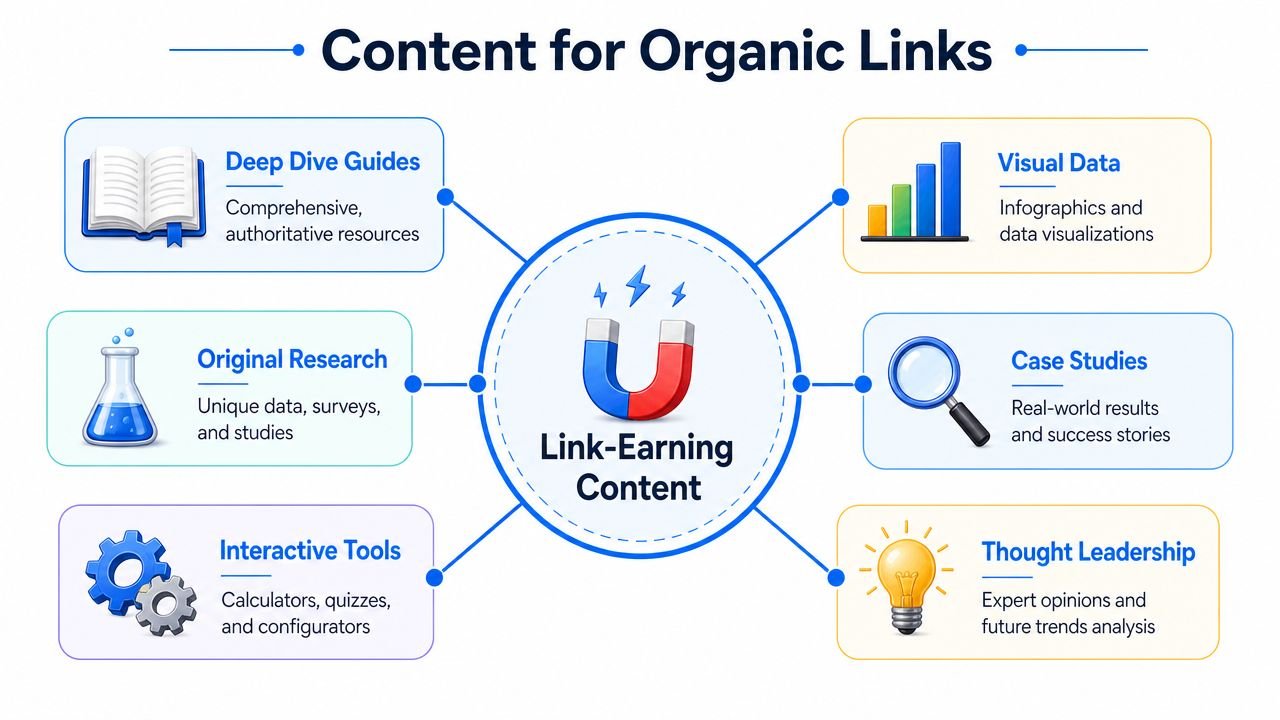
The strongest formats usually fall into two buckets. Utility and citability. Ahrefs' analysis found that content with high utility, such as calculators and free tools, or high citability, such as original statistics and studies, is the most viable path to improving DR. It also found that topics using terms like “stats” or “study” with a Keyword Difficulty score of 40+ have historically attracted the most backlinks, according to Ahrefs' website authority playbook.
Build for utility or citability
Utility assets solve a problem directly. Citability assets give writers something worth referencing.
A few formats consistently make sense:
Interactive tools
A SaaS company can publish a pricing estimator, ROI calculator, migration planner, or benchmark checker. These work because people use them, save them, and link to them as a resource.Original research
Run a survey, analyze proprietary product data, or compile an industry benchmark from internal usage patterns. Publishers need primary sources. If your page becomes one, links follow more naturally.Statistics pages
These can perform well when they're curated properly, refreshed, and organized by topic. Lazy “100 stats” roundups won't do much. A disciplined page with sourced, categorized, easy-to-quote data often will.Definitive guides
Not every guide earns links, but one that becomes the citation target for a narrow topic can still work. The key is depth, clarity, and a stronger framing than what's already ranking.
Match the asset to the business model
SaaS and eCommerce shouldn't build the same assets.
For SaaS, the best linkable pages often sit close to workflows. Cost calculators, implementation checklists, integration directories, and benchmark reports fit naturally into the buying cycle. For eCommerce, editorial assets usually work better when they support trends, comparisons, care guides, sizing resources, or market data tied to the category.
Here's a practical way to choose:
| Business type | Better asset type | Why it attracts links |
|---|---|---|
| Early-stage SaaS | Calculator or industry benchmark | Editors and partners can cite or reference it |
| Growth SaaS | Original study or data hub | Supports digital PR and thought leadership |
| Niche eCommerce | Trend report or visual buying guide | Useful to publishers covering the category |
| Large catalog eCommerce | Category resource page or tool | Creates linkable value beyond product listings |
Build one asset that deserves links before you produce ten blog posts that don't.
The page-level mindset matters here too. Don't publish an asset because “content marketing needs content.” Publish it because a specific audience of editors, bloggers, analysts, or partners can use it. That's the difference between a blog post and a link magnet.
Strategic Link Acquisition and Outreach
DR usually rises after the right pages earn the right links. Treating DR as the target leads teams into homepage campaigns, loose prospecting, and placements that look good in a tool but do little for rankings. Google ranks pages. Outreach should support the pages that can win search demand, assist conversion, or strengthen topical authority.
That changes how links are judged. A contextual link to a commercial-adjacent resource page often matters more than a random mention to the homepage, even if the second site has a bigger authority score.
The practical question is simple. Which page is worth promoting, and which sites can credibly cite it?
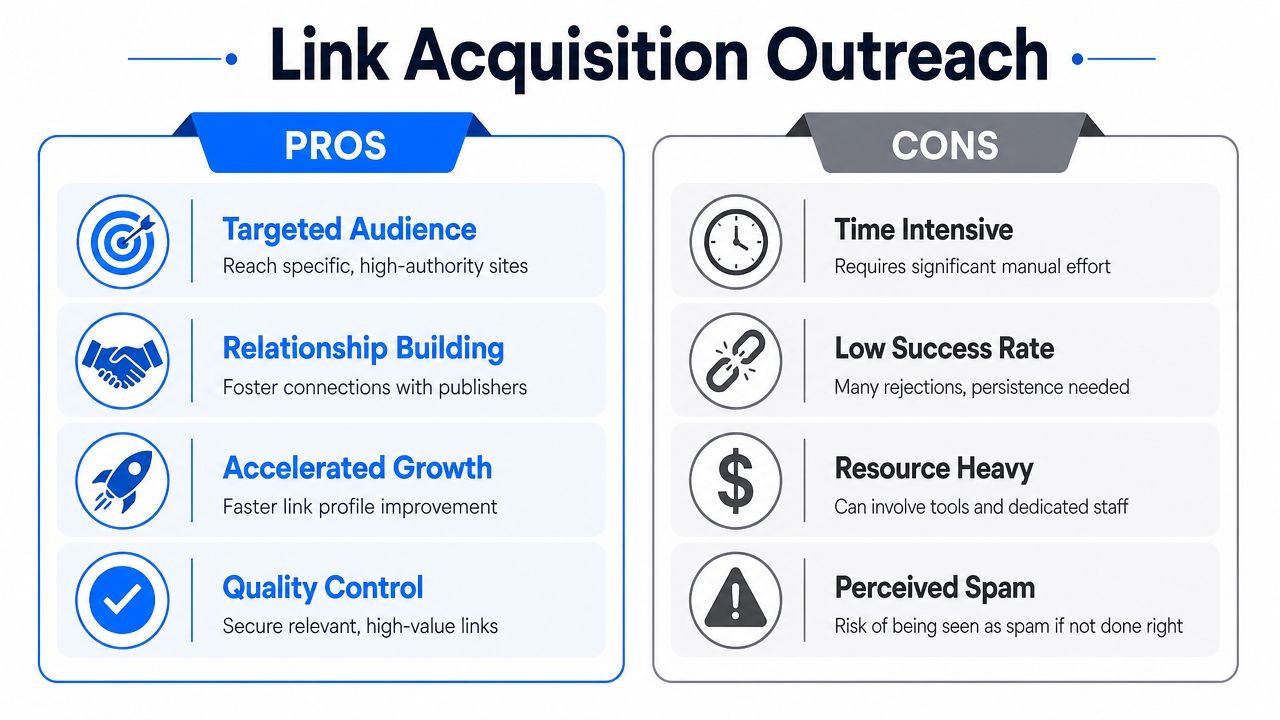
Choose tactics by business stage
Tactics should match both the company stage and the page type you need to support.
New SaaS brands usually get the best return from guest posts, partner content, and niche editorial placements tied to product categories, integrations, or use cases. The goal is to place links on relevant pages that can pass context to pages on your site that need help ranking.
Brands with a strong resource or tool can push harder on resource page outreach and broken link building. These campaigns work best when the destination page solves a clear problem better than the dead or outdated page already being linked.
Companies publishing original data should bias toward digital PR. That route is slower and less controllable, but it can produce the strongest citations because journalists and editors have a concrete reason to reference the page.
Use this trade-off table to choose:
| Tactic | Best use case | Upside | Trade-off |
|---|---|---|---|
| Guest posting | Newer brands building relevance in a niche | Strong contextual links to targeted pages | Requires pitching, writing, and editorial fit |
| Resource page outreach | Guides, tools, calculators, reference content | Good match when the page is clearly useful | Prospect quality is inconsistent |
| Broken link building | Sites with close replacements for outdated resources | High relevance when the replacement is strong | Research and validation take time |
| Digital PR | Studies, benchmarks, and proprietary data | Can earn strong editorial links and brand mentions | Needs a real hook and tighter timing |
A page-level campaign also makes internal reporting cleaner. Instead of saying “we built 12 links,” say “we built 12 relevant links into the pricing guide cluster and rankings improved on three commercial terms.” That is easier to defend to a SaaS CMO or an eCommerce head of growth.
Outreach that earns replies
Weak outreach usually fails before the recipient reads the second line. The problem is poor fit, not just poor copy. Editors ignore messages that ask for a link without showing why the page helps their readers or improves an existing article.
Good outreach does three things fast:
- Identifies the exact page being pitched
- Explains why it belongs on the prospect's page
- Keeps the ask small and easy to review
Examples:
Saw your resource page on [topic]. We published a [tool/study/guide] for [specific audience] dealing with [specific problem]. It could fit alongside the section covering [related resource].
I noticed a dead link in your article on [topic]. We have an updated resource on the same issue with a [tool/research/practical] angle if you're refreshing the page.
That format works because it matches how editors evaluate updates. They care about whether the page improves. They do not care about your company story.
Execution matters as much as copy. The teams that get consistent results qualify prospects tightly, map each prospect to a specific destination page, and follow up with restraint. This guide to SEO outreach systems and execution covers that process in more detail.
What to avoid
A lot of link budget gets wasted on activity that creates reports, not results.
Skip these unless there is a clear strategic reason:
Low-quality directories
They rarely help the pages you need to rank.Homepage-first campaigns
These often inflate authority metrics without strengthening the pages competing in search.Mass templates with light personalization
Site owners spot them immediately, and reply rates collapse.Irrelevant placements
A link can register in a tool and still have little ranking or referral value.
One strong placement on the right page can outperform a batch of weak ones.
The operating model I use is straightforward. Pick the page that deserves links, build a prospect list made up of sites that could realistically cite that page, and judge every placement by relevance, context, and likely ranking impact. If DR rises, that is a useful side effect. It should not be the campaign objective.
Technical and UX Fixes That Boost Linkability
A weak site experience makes link building harder. Editors might still link to a useful study on a slow or clunky site, but they're less likely to. Users are less likely to share it. Crawlers are less likely to move through it efficiently.
Technical work doesn't replace outreach or content. It raises the floor under both.
Fix the trust leaks
Start with the problems that make a page feel unreliable:
- Slow load times that delay access to the main content
- Broken layouts on mobile that make charts, tables, or tools hard to use
- 404s and redirect chains that interrupt the linking experience
- Thin author or company context on pages asking to be cited
- Cluttered templates that bury the value under pop-ups and friction
These issues don't show up in backlink reports as a neat label, but they affect whether a page feels safe to reference. That matters more when you're asking publishers to link to a tool, dataset, or resource page.
A clean page earns trust faster. A messy page creates hesitation.
Use internal links like a distribution system
Internal linking is one of the few levers fully under your control. When a page starts earning links, don't leave that authority trapped there. Route users and crawlers from that asset to the pages that support rankings, conversions, or product discovery.
The strongest internal link structures usually have these traits:
| Internal linking element | What good looks like |
|---|---|
| Hub pages | Link naturally to supporting pages and commercial pages |
| Contextual links | Appear inside body copy, not only in nav or footer |
| Relevant anchors | Describe destination pages clearly without forcing exact matches |
| Orphan prevention | Important pages are reachable through multiple logical paths |
Page-level strategy yields results. A benchmark report can earn links from publishers. Then internal links can point readers toward comparison pages, category hubs, or product use-case pages. That doesn't mean stuffing links everywhere. It means treating authority like something you intentionally distribute.
A site becomes more linkable when the page experience feels publishable, quotable, and easy to navigate.
Your 90-Day Roadmap to Increase Domain Rating
Teams need a sequence, not more theory. The fastest way to stall is to start outreach before the audit is finished, or publish assets before deciding which pages deserve support.
Keep the plan tight. One audit, one core asset, one outreach motion, then refine.
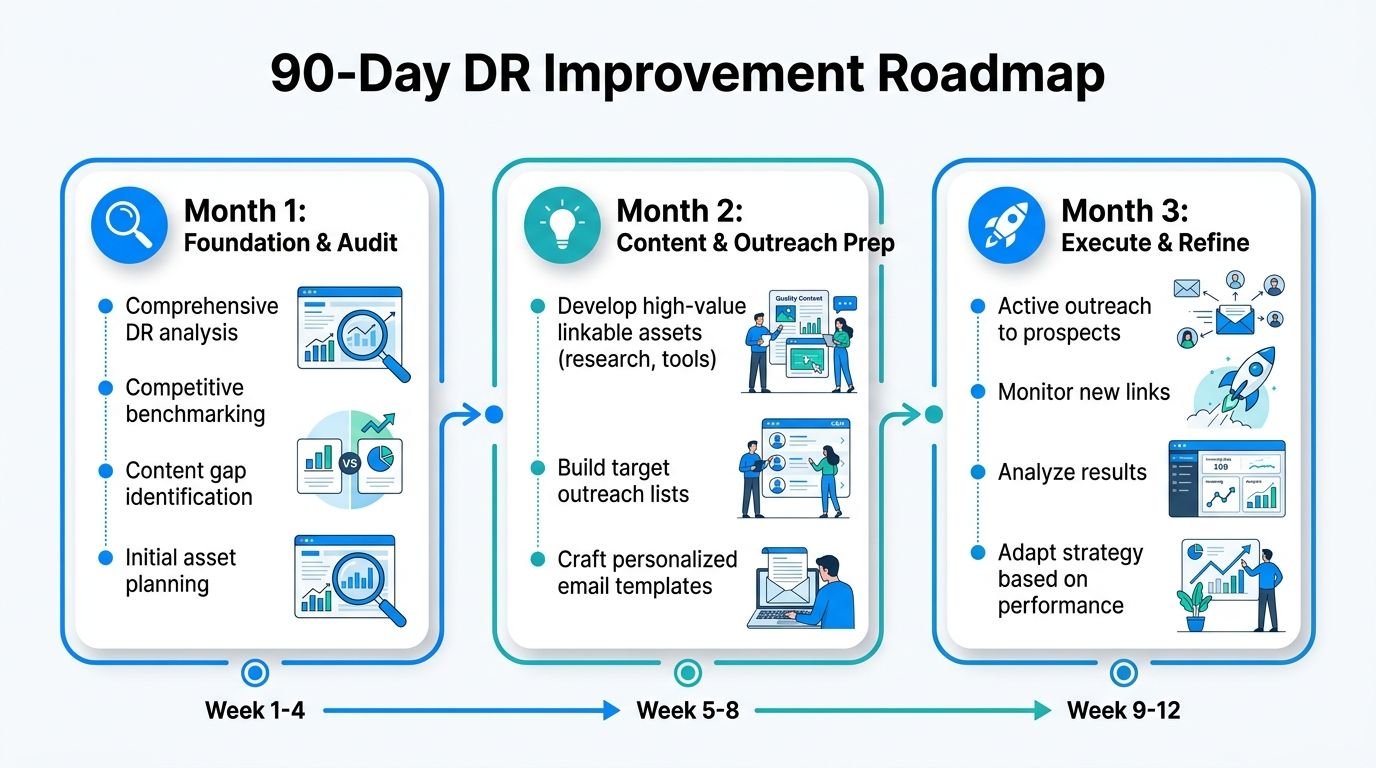
Days 1 to 30
Use the first month to establish your starting point and remove obvious blockers.
Focus on:
Audit the profile
Export backlinks, referring domains, and top-linked pages. Flag spam risks, broken target pages, and overconcentration from a small set of sources.Fix technical friction
Clean up broken pages, improve page speed where it's clearly poor, and make sure your best linkable pages work well on mobile.Pick target pages
Choose the pages that deserve links now. Usually that's one asset page and one or two strategic commercial pages supported by internal links.Choose one linkable asset
Don't launch four ideas at once. Commit to a single tool, study, stats page, or resource that fits your business model.
A founder-led team can do this in a focused sprint. A larger marketing team should assign clear owners for audit, content, and outreach ops.
Days 31 to 60
This is the build phase. Publish the asset and prepare the distribution engine around it.
Your priorities should be:
Create the asset properly
If it's research, make the methodology clear. If it's a tool, make it usable without friction. If it's a guide, make it reference-worthy.Build outreach lists
Separate prospects by type: editors, resource pages, partners, bloggers, and sites linking to outdated alternatives.Write templates that can be personalized
Keep them short. Tie every pitch to a real page and a real reason.Strengthen internal links
Add contextual links from the new asset into the pages you want to support.
Track leading indicators here. Number of qualified prospects, emails sent, replies, positive responses, and newly earned referring domains tell you more than the DR number this early.
Days 61 to 90
The third month is execution and refinement.
Run outreach in waves instead of one blast. Update the asset if prospects ask the same questions. Test subject lines and value framing. Review which placements send relevant referral traffic and which only look good in a report.
Set expectations correctly. New domains often go through a trust decay period, and legitimate tactics like digital PR and guest posting can take 3 to 6 months to fully show up in DR because tools need time to re-crawl and validate link quality, as noted in Name.com's discussion of Domain Authority improvement timelines.
That delay is why disciplined teams don't judge the campaign too early.
Use a practical scorecard:
| Leading indicator | What to watch |
|---|---|
| Qualified prospects | Are you targeting the right sites |
| Reply quality | Are editors engaging with the pitch seriously |
| New referring domains | Are unique sites linking, not just repeat placements |
| Referral visits | Are the links bringing the right audience |
| Supported page movement | Are target pages gaining traction over time |
If you're serious about how to improve Domain Rating, this is the core answer. Build one strong asset, earn relevant page-level links, distribute authority internally, and give the profile time to mature.
If you want help executing that playbook, SaasSky works with SaaS and eCommerce teams on contextual link building, page-level outreach, and editorial link acquisition tied to real growth goals rather than just a vanity score.