Your content team is publishing strong articles. Your product is solid. Demand gen wants more organic pipeline. But your backlink profile still grows too slowly to matter.
That's usually the point where a SaaS or eCommerce marketing lead starts looking at paid guest posting services. Manual outreach eats time, editors ignore cold pitches, and the few wins you get rarely arrive on the sites you want. So the market starts to look tempting. Agencies promise placements, authority, and scale.
Some of those services are useful. Some are a budget sink. A few can create long-term problems that don't show up until an algorithm update exposes how weak the placements really were.
The difference isn't whether a link was paid for. The difference is whether the placement earns trust, relevant traffic, and brand lift in a niche that makes sense for your company.
Table of Contents
- The Scaling Challenge for SaaS and eCommerce Link Building
- What Are Paid Guest Posting Services Really
- Benefits and Hidden Risks for Your Brand
- Common Pricing Models and What You Get
- Your Practitioner-Led Vendor Evaluation Checklist
- A Simple Playbook for Measuring Guest Post ROI
The Scaling Challenge for SaaS and eCommerce Link Building
A common pattern shows up around the same stage of growth.
The marketing team has already done the obvious things. They've built comparison pages, product-led content, a few integration pages, maybe some original thought leadership. Rankings improve on easier terms, then stall. The next set of keywords is more competitive, and the gap is no longer content quality. It's authority.
For SaaS, this usually shows up when category pages and solution pages can't break through because competitors have stronger topical link profiles. For eCommerce, it happens when collection pages and high-intent guides sit just outside the positions that drive meaningful revenue. The business doesn't need random backlinks. It needs relevant mentions from sites that search engines and actual buyers take seriously.
That's where paid guest posting services enter the picture. They offer a shortcut to scale, but not always a shortcut to results.
Practical rule: If a service helps you place content on sites your buyers already read, it can support growth. If it only helps you accumulate links on sites no buyer would ever visit, it's vanity wrapped in SEO language.
The operational appeal is obvious:
- Speed over manual outreach: Your team doesn't have to spend weeks building prospect lists, writing pitch emails, and following up with editors.
- Access to existing relationships: Good providers already know which publishers accept contributed content and what those publishers will reject.
- Consistent production: Campaigns don't stop because one content marketer got pulled into a launch or a product update.
Still, scale creates a new problem. Once money is involved, weak incentives show up fast. Some vendors optimize for placements delivered, not outcomes created. That's why paid guest posting services should be treated like any other acquisition channel. You don't buy activity. You buy qualified distribution.
What Are Paid Guest Posting Services Really
A SaaS team usually reaches this question after a few frustrating quarters. Rankings improve a bit, links go up on the report, and pipeline barely moves. The issue is not whether links were built. The issue is what was purchased.
Paid guest posting services are a distribution and placement service. In good hands, they help your brand publish relevant articles on sites that already have an audience, editorial standards, and topical alignment with the pages you need to support. In bad hands, they sell access to a spreadsheet of sites that exist to monetize outbound links.
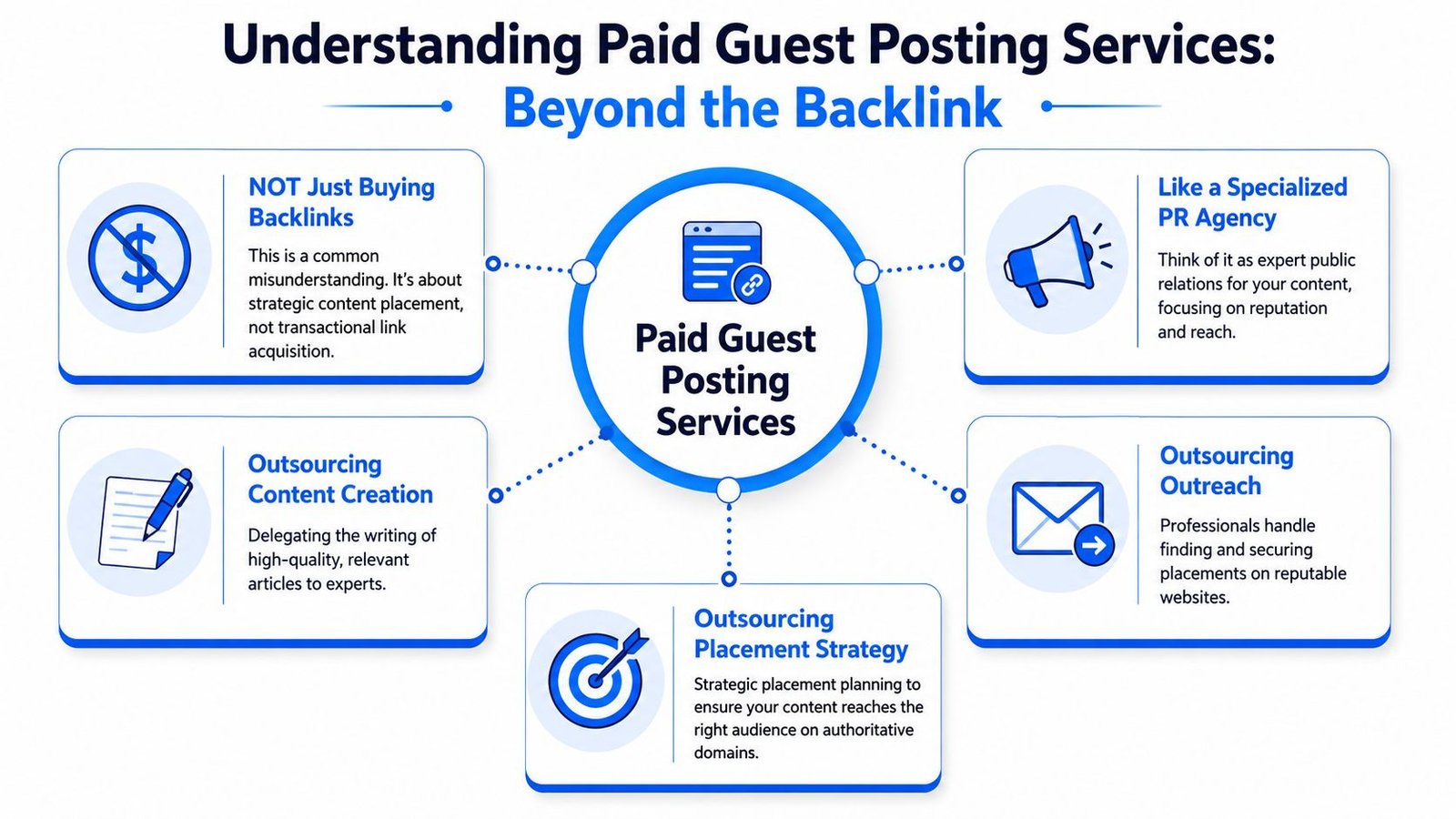
What you are outsourcing
You are paying a vendor to handle a chain of work that is slow, relationship-driven, and easy to get wrong.
That usually includes site qualification, topic selection, outreach to editors, content production, revisions, placement coordination, and link insertion that fits the article instead of interrupting it. Good vendors also understand link attributes and placement constraints, which matters if your team is weighing follow vs nofollow links in SEO and trying to build a profile that looks earned rather than manufactured.
The strongest providers do one more thing. They map placements to business goals.
For SaaS, that can mean supporting comparison pages, integration pages, or bottom-funnel use case content with placements on publications your buyers trust. For eCommerce, it often means backing category pages and commercial guides with placements on niche publications, review sites, and expert blogs that influence purchase decisions. That is a different service from bulk link selling. One is built around relevance, audience fit, and conversion paths. The other is built around output volume.
Distinguishing a real service from a link farm
The gap shows up fast once you ask better questions.
A credible provider can explain why a site is a fit for your market, what kind of content gets accepted there, where your link will sit in the article, and whether the publication has any chance of sending qualified readers. A weak provider keeps the conversation at DR, DA, traffic screenshots, and turnaround time because that is easier to package and sell.
There are also process clues:
- Credible providers screen sites hard: They avoid publications packed with casino, crypto, payday loan, or unrelated B2B links.
- Weak providers sell inventory: If the same vendor can place a fintech startup, a pet brand, and an HR SaaS company on the same set of sites, relevance is probably thin.
- Credible providers care about editorial fit: They pitch topics that make sense for the publication and for your target customer.
- Weak providers force anchors into generic articles: The link gets delivered, but the post has no audience value and little brand value.
Web 2.0 Ranker's review of whether guest posting works makes the useful point here. Guest posting holds up when the placement is relevant, the site has standards, and the article has value beyond the link itself.
That is the practical lens to use. Paid guest posting is not just outsourced link acquisition. It is outsourced publisher access, editorial execution, and brand placement. If the vendor cannot connect a placement to qualified traffic, topical authority, or customer acquisition potential, the service is buying SEO activity, not business impact.
Benefits and Hidden Risks for Your Brand
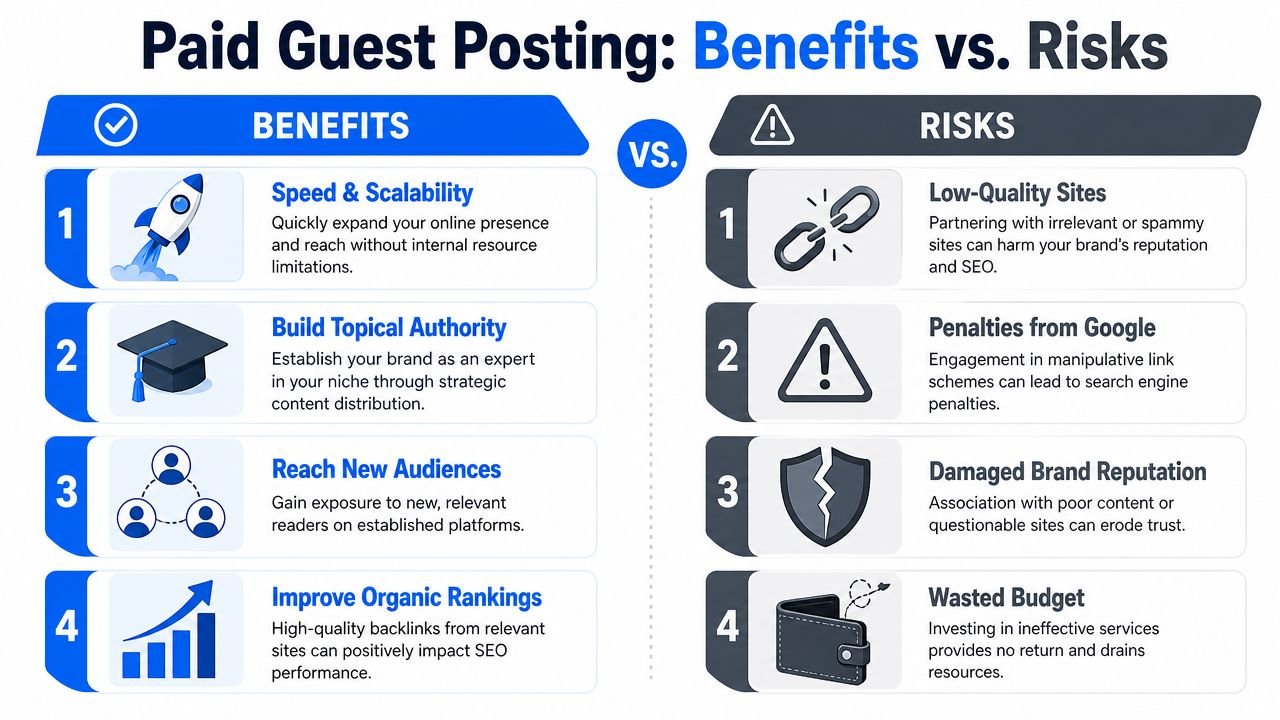
Paid guest posting usually looks good in a monthly report before it proves anything in the business.
A SaaS team buys ten placements to support a product page cluster. Rankings inch up. A few links come from sites with decent authority scores. Three months later, pipeline is flat, referral traffic is negligible, and sales has never heard a prospect mention any of the publications. The campaign produced activity, not much commercial impact.
Where paid placements help
The upside is speed with direction.
If your team already knows which categories, use cases, and commercial pages matter, paid guest posting can support those themes faster than an in-house program built from scratch. For SaaS, that often means strengthening product terms, competitor comparison angles, integration topics, and pain points tied to buying intent. For eCommerce, it usually means placing buying guides, expert commentary, and category-adjacent content on sites that influence purchase decisions.
The best placements create value in more than one channel. They can help search visibility, earn qualified referral visits, and put your brand in front of readers who may be evaluating solutions long before they request a demo or buy.
That is where teams miss the ROI case.
A placement should support one of three outcomes: better visibility for pages that drive revenue, traffic from the right audience, or stronger brand trust in the markets you want to win. If it does none of those, it is hard to justify no matter how good the domain metrics look.
A good guest post can contribute across several layers:
- Search support: The link reinforces topical relevance around a revenue-driving page or content cluster.
- Referral traffic: Readers click when the topic matches their problem and the next step is clear.
- Brand authority: Your company appears on publications your buyers recognize or at least respect.
- Sales support: Reps can use credible third-party mentions as trust assets in deals, outbound, and follow-up.
Execution matters here. Context around the link, topic fit, headline quality, and CTA strength all shape whether a post earns attention or just sits indexed with no business effect. If your team needs a quick refresher on link attributes, this guide to follow and nofollow links helps when reviewing placement quality.
Where brands get burned
The risk starts when procurement logic replaces marketing judgment.
A vendor shows a large inventory list. The sites have respectable-looking DR or DA. Turnaround is fast. Unit economics look clean on paper. Then you review the live domains and find broad, unfocused publications linking to cybersecurity, supplements, crypto, gambling, and HR software in the same week.
Those placements often fail in the ways that matter:
- Weak audience fit: The site may never send a relevant visitor or influence a real buyer.
- Brand dilution: Your company appears beside industries and offers that undercut trust.
- Content drag: Generic articles make your brand look replaceable, especially in competitive SaaS categories.
- Decay risk: If the publisher gets devalued, removed from search visibility, or turns into a link farm, the value disappears after you have already paid.
I use a simple filter with clients. If the placement would make your head of sales question your judgment, it is not a brand asset.
There is also a strategy risk that does not show up in SEO dashboards. Guest posting campaigns can drift away from commercial intent. Teams keep buying links because rankings move somewhere, but the supported pages are not tied to demos, trials, revenue categories, or meaningful customer acquisition paths. At that point, the campaign is serving reporting optics instead of growth.
The brands that get value from paid guest posting treat it as market visibility with measurable business goals. The brands that get burned treat it as a volume purchase.
Common Pricing Models and What You Get
A $250 placement and a $1,200 placement can both be sold as “guest posts.” That label tells you almost nothing about what you are buying.
Key variables include site quality, editorial standards, content depth, outreach difficulty, and who owns the risk if the placement disappears or underperforms. For SaaS and eCommerce teams, the right model depends less on link volume and more on whether the campaign supports pages that can influence pipeline, revenue, or category authority.
Pay per post
This model is straightforward. You buy a set number of placements, usually priced by niche, site authority metrics, traffic estimates, or publisher tier.
It works well for controlled tests. If you want to support a product page, comparison page, or a new category cluster without committing to a larger program, pay per post gives you a clean starting point.
The trade-off is that this model can reward speed over fit. Some vendors fill quotas from whatever inventory is easiest to place that week. That is how brands end up on sites that look acceptable in a spreadsheet but do nothing for qualified traffic, assisted conversions, or brand perception.
Check the scope before you buy:
- Site selection criteria: Ask how domains are vetted beyond DR or DA.
- Content production: Confirm whether writing, edits, subject matter input, and approvals are included.
- Placement terms: Ask what happens if the post is removed, noindexed, or changed after publication.
- Reporting: Make sure the vendor tracks live URLs, target pages, anchor usage, and referral or ranking impact.
Monthly retainer
A retainer makes sense when guest posting is one channel inside a larger authority-building program.
This is usually the better fit for SaaS companies with long sales cycles or eCommerce brands expanding across multiple revenue categories. You are paying for consistency, planning, and better coordination across target pages, internal linking, anchor text, and publishing cadence.
Retainers also create more room for strategy. A good partner can adjust topic angles based on product priorities, search movement, and what is influencing pipeline. A weak partner can turn the same retainer into a monthly delivery machine that keeps producing links with no clear connection to customer acquisition.
That is the core risk. Not overspend by itself. Ongoing spend with weak commercial alignment.
Project based packages
Project pricing sits between one-off placements and a long-term retainer.
This model works best when the business goal is specific. A product launch. A market expansion. A seasonal commerce push. A focused link campaign tied to a shortlist of pages is easier to scope, easier to approve internally, and easier to measure afterward.
It also forces better decisions upfront. You can agree on target pages, topical themes, content standards, publisher requirements, and success criteria before the first outreach email goes out.
That structure matters because pricing alone rarely tells you value. Two project packages at the same cost can produce very different outcomes if one includes strategic page mapping and publisher review, while the other is just bulk fulfillment.
One mistake shows up across every model. Buyers still overpay for metrics that look impressive in reports but have little connection to business results. A placement on a relevant publication with real readers can outperform a higher-DR site that has no audience, weak editorial control, and no chance of sending a buyer or influencing trust.
That is also why low-grade inventory becomes expensive fast. As noted in Cutting Edge PR's review of guest posting services in 2026, low-quality guest post sites were hit by algorithm updates, which is the kind of downside buyers ignore when they price links like commodities.
For budgeting, compare the full service model, not just the placement fee. This breakdown of link building pricing across agency models is useful for setting expectations. The question that matters is simple: what does this spend get your team in terms of qualified visibility, commercial page support, and revenue potential?
Your Practitioner-Led Vendor Evaluation Checklist
Losing money on paid guest posting isn't a result of a flawed tactic. Instead, it occurs because buyers choose vendors skilled at selling inventory but poor at building authority.
A reliable evaluation process fixes that.
Questions that expose weak vendors fast
Start with transparency. Ask for example domains before you buy, not after. If a vendor refuses to share site examples until payment, that's a control problem disguised as process.
Then ask how they qualify sites. Not what metrics they show in a dashboard. How they decide whether a placement belongs in a campaign. The answer should include relevance, editorial quality, traffic validation, outbound link patterns, and whether the publication has a real audience.
A few questions tend to surface the truth quickly:
- How do you validate traffic? You want third-party verification, not screenshots from the publisher.
- How do you reject placements? Good vendors have a clear exclusion process.
- Who writes the content? If they can't explain the writing workflow, expect filler copy.
- How do you choose anchor text? Random exact-match anchors are a warning sign.
- How do you report impact? If the report stops at “link acquired,” the vendor isn't thinking like a growth partner.
This matters even more for software companies. Most content in this space still talks about link metrics and skips business outcomes. Semrush data cited by Serpstat says 70% of B2B marketers prioritize content that drives traffic and conversions, yet only 15% of guest post service reviews include conversion or pipeline metrics, which leaves SaaS teams with an ROI gap when they need to justify spend against revenue, as summarized in Serpstat's article on paid guest posting.
A vendor that can't discuss pipeline impact will usually retreat to DR, DA, and link count. That tells you what they're built to optimize.
If your internal team is debating whether to keep this work in-house or hand it off, this guide on outsource link building can help frame the trade-off.
Vendor Evaluation Checklist
| Category | Green Flag (Look for This) | Red Flag (Avoid This) |
|---|---|---|
| Site quality | Vendor screens for niche relevance, real traffic, and clean outbound link patterns | Vendor leads with DR/DA alone and avoids site-level scrutiny |
| Transparency | Sample sites, process details, and content standards are shared before commitment | “Proprietary network” language with no preview of placements |
| Content | Articles are written for the publication's audience and edited to match site tone | Generic SEO copy with your link inserted as an afterthought |
| Strategy | Topics map to product pages, commercial themes, or audience pain points | No connection between placements and your funnel |
| Anchor text | Anchor selection is intentional and varied | Repetitive exact-match anchors across many placements |
| Reporting | Reports include referral traffic, engagement, and downstream business signals | Reports stop at published URLs and domain metrics |
| Risk control | Vendor is willing to reject weak sites and explain why | Vendor guarantees volume on demand across any niche |
| Brand fit | Placements would make sense to share with sales, leadership, or investors | Placements look embarrassing, irrelevant, or obviously paid |
A few red flags deserve immediate disqualification:
- Guaranteed rankings: No serious vendor can promise this.
- Instant scale in every niche: Real niche outreach has constraints.
- No editorial standards: If any topic can be published anywhere, quality isn't being managed.
- Cheap volume logic: Large placement counts with little discussion of fit usually mean low-grade inventory.
The best green flag is judgment. You want a vendor that says, “This site looks strong on paper, but it's wrong for your brand.” That's the behavior of someone protecting outcomes, not just chasing revenue.
A Simple Playbook for Measuring Guest Post ROI
If you only measure links acquired, you won't know whether the campaign worked.
The useful question is whether the placements influenced traffic, leads, customers, or brand strength in a way your team can defend. That's especially important in SaaS and eCommerce, where every recurring channel gets compared against pipeline or revenue sooner or later.
Start with business outcomes
Set goals before the first article is pitched.
For SaaS, that may mean qualified demo requests, trial sign-ups, influenced opportunities, or branded search lift around a category. For eCommerce, it may be assisted purchases, email captures, or stronger organic support for collection and product-adjacent pages.
Keep the scorecard simple. Teams often only need a few layers:
- Placement quality
- Referral traffic
- Conversions from referred visitors
- Pipeline or revenue influence
- Secondary brand signals
Secondary signals matter because paid guest posting services often create value that doesn't show up in last-click attribution. A buyer may read the article, remember your brand, return later through organic or direct, and convert after several touches. You need to watch that pattern, not just isolated referral sessions.
Track the path from click to revenue
The setup doesn't need to be complex, but it does need discipline.
Tag every guest post link with UTM parameters. Build landing pages that match the article's intent when possible. Define conversion events in your analytics platform before placements go live. If your CRM supports source tracking, push campaign identifiers into lead records so your sales team can see where qualified interest started.
A practical operating rhythm looks like this:
- Before launch: Assign target pages, CTAs, UTM rules, and conversion events.
- At publication: Confirm the link is live, indexed where appropriate, and pointing to the correct destination.
- After launch: Review referral quality, assisted conversions, and any lift in branded demand or influenced pipeline.
- Quarterly: Compare placements against each other, not just against aggregate channel totals.
The best-performing guest posts rarely win because they have the highest DR. They win because the audience, topic, CTA, and destination page all match.
Many companies discover that some placements produce no business value at all. That's useful. It tells you which niches, site types, and content angles deserve more investment and which ones should be removed from future buying criteria.
One final point matters for executives. A guest post doesn't need to be the last click to be worth funding. It needs to show evidence that it attracts relevant visitors, supports trust, and contributes to commercial momentum over time. That's a stronger standard than vanity SEO reporting, and it's the one serious teams should use.
If you want a partner that treats paid guest posting as a business growth channel instead of a link-count exercise, SaasSky is built for that kind of work. The team focuses on SaaS and eCommerce link building, transparent process, and measurable outcomes that go beyond DR screenshots and placement lists.