

Most advice on how to measure SEO ROI breaks down at the exact point a CMO cares about most. It stops at traffic, rankings, or first-touch conversions. That's not an ROI model. It's an activity report with nicer charts.
For SaaS and subscription eCommerce, the full value often shows up later. A blog post might start the journey, branded search might re-open it, a sales call might close it, and retention is where the economics are decided. If your model only credits the first form fill or the last click, you'll understate SEO when it matters most and overstate it when it's easiest to report.
A useful SEO ROI model has to do three things well. It needs clean conversion tracking, a defensible dollar value for organic outcomes, and an attribution approach that matches the way customers buy. Then, for subscription businesses, it needs one more layer: lifetime value.
Table of Contents
- Defining What to Measure Goals KPIs and Baselines
- Connecting SEO Metrics to Monetary Value
- Choosing the Right Attribution Model
- The ROI Calculation Formulas and Worked Examples
- Beyond the First Sale Measuring Long-Term Value and LTV
- How to Report SEO ROI to Your Stakeholders
Defining What to Measure Goals KPIs and Baselines
If you don't define the business outcome first, the rest of the model turns into noise. SEO teams often start with rankings because rankings are visible. Leadership starts with revenue because revenue is what funds the next quarter.
That's why the cleanest way to measure SEO ROI is to build the measurement hierarchy in reverse. Start with the commercial outcome, then map backward to the marketing goal, then the SEO goal, then the KPI that proves movement.
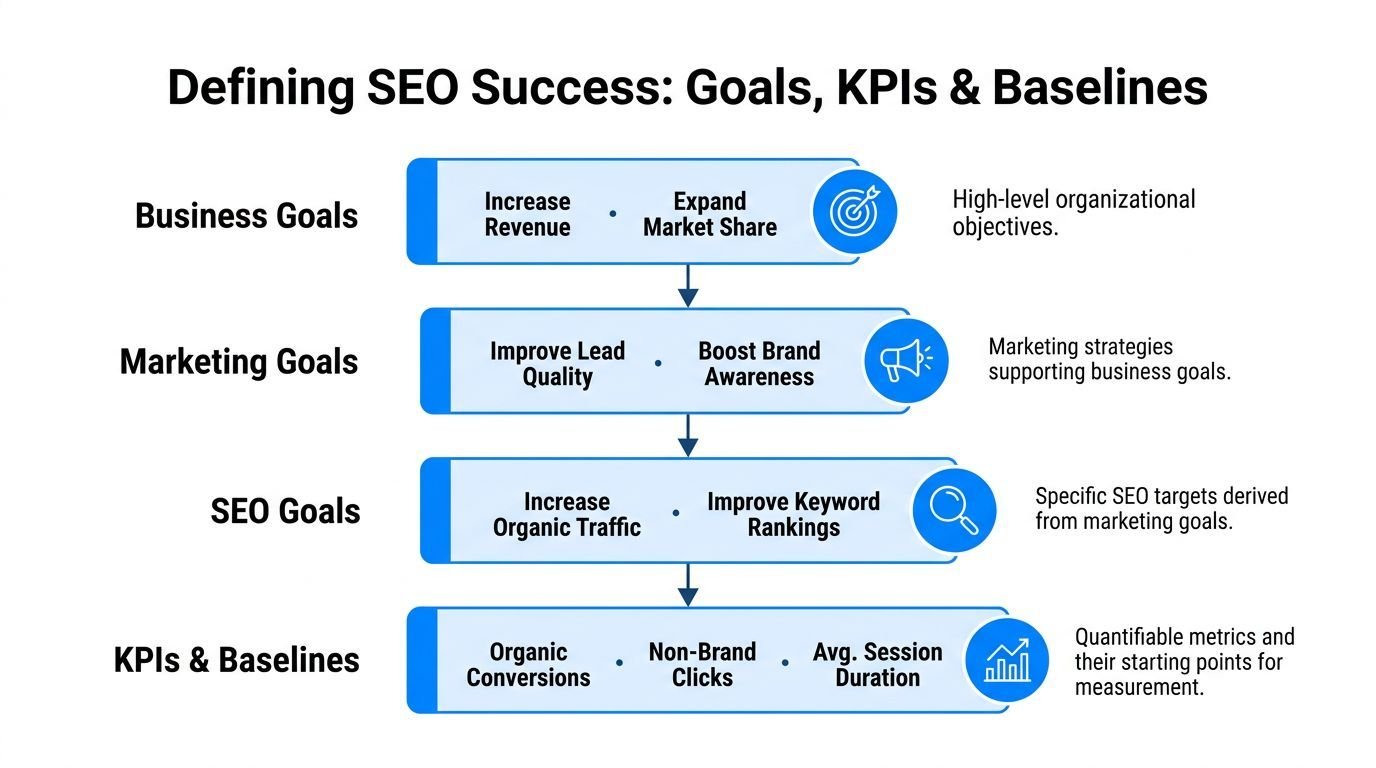
Start with revenue not rankings
For SaaS, the macro-conversions usually sit close to pipeline. Think demo requests, free trial starts, qualified contact forms, or sales calls booked. For eCommerce, it's simpler. Completed purchases are the main macro-conversion, while add-to-cart, checkout start, and email capture are supporting signals.
A practical setup inside GA4 looks like this:
- SaaS macro-conversions: Demo request submitted, trial started, sales-qualified form fill, booked call
- SaaS micro-conversions: Newsletter signup, webinar registration, template download, pricing page visit
- eCommerce macro-conversions: Purchase
- eCommerce micro-conversions: Add to cart, begin checkout, product alert signup, account creation
Every one of those events needs a value attached to it, even if it isn't direct revenue yet. That matters because a precise SEO ROI method requires trustworthy data, 3 to 6 months of historical conversion-rate data, and assigned monetary values for analytics goals. It also warns that underestimating SEO costs across freelancers, tools, and staff can skew ROI calculations by up to 40% in early-stage SaaS environments according to Precis on measuring SEO value.
Practical rule: If a conversion matters enough to celebrate in Slack, it matters enough to track and value in GA4.
In GA4, isolate organic traffic by using the source and medium filter for google/organic when you review conversion reports. For teams still cleaning up terminology, it helps to align internally on what organic traffic means in practice before you start assigning revenue.
Build the baseline before you forecast
A baseline prevents “SEO is improving” from becoming an opinion. Pull a clean pre-campaign snapshot and lock it before major work begins.
Track at least these baseline groups:
| Baseline area | SaaS example | eCommerce example |
|---|---|---|
| Commercial outcomes | Demo requests, trials, closed-won revenue tied to organic | Organic revenue, transactions |
| Assisted behaviors | Pricing page visits, case study downloads | Add-to-cart, checkout starts |
| Efficiency metrics | Conversion rate from organic landing pages | Conversion rate by organic landing page |
| Cost inputs | Agency fees, tools, internal headcount time | Agency fees, tools, content production |
A baseline also forces discipline around branded versus non-branded performance. If branded search is doing most of the work, your ROI story is different from a program that's expanding demand higher up the funnel.
The point isn't to collect more numbers. It's to make sure every number points back to money.
Connecting SEO Metrics to Monetary Value
Traffic doesn't have a business value by itself. It only becomes valuable when it produces an action worth money. That's where most SEO reports go soft. They show volume, not value.
The better approach is to assign a monetary value to every important organic conversion event, then roll those values into a revenue model. For direct-response eCommerce, the math is straightforward because a purchase already carries revenue. For SaaS, the lead value needs to be modeled.

What gets a dollar value
Start with the conversion events that tie most closely to revenue. Then work outward.
For eCommerce, use actual order value from GA4 or your commerce platform for purchases. For non-purchase actions, assign values only if you can defend them with downstream behavior. An email signup can be valuable, but not because it “feels important.” It has to connect to future purchases.
For SaaS, this is the usual hierarchy:
- Closed revenue from organic: Best signal if CRM and analytics are connected
- Sales-qualified leads from organic: Strong proxy when closed-won mapping lags
- Trials or demo requests: Useful if you know how often they convert into paying customers
- Micro-conversions: Helpful for optimization, but weak as primary ROI proof
According to SEO ROI statistics compiled by SEOProfy, the average SEO conversion rate is about 2.4%, while SEO leads close at 14.6% versus 1.7% for outbound marketing. The same source notes that 49% of marketers identify organic search as the top ROI-driving channel, and well-executed campaigns show a median ROI of 748%.
Those numbers matter because they justify building a value model around SEO-generated leads instead of dismissing them as “top-of-funnel traffic.”
How SaaS teams should value leads
A credible SaaS lead value model works backward from revenue. If organic brings in trials or demos, the event value should reflect what those actions are worth after qualification and sales conversion, not what a form submission “looks like” on a dashboard.
A simple decision framework:
- Use closed-won revenue first if your CRM captures original source.
- Use pipeline value next if you have reliable stage progression.
- Use benchmarked event value last if you're still building attribution discipline.
Don't give a demo request an arbitrary value just to make the spreadsheet work. Finance will spot that immediately.
Paid search can help as a reference point. If paid campaigns have stable conversion rates and known deal values, they can anchor an SEO estimate until your organic attribution becomes more mature. That's especially useful when content generates early-stage interest but not instant revenue.
One thing that consistently fails is treating all conversions as equal. A pricing-page visitor, a webinar signup, and a product-qualified demo request aren't interchangeable. If you flatten them into one “conversion” metric, the final ROI number becomes decorative rather than decision-grade.
Choosing the Right Attribution Model
Attribution decides who gets credit. Change the model and the ROI changes with it. That's why a last-click report can make SEO look weak in SaaS and unbeatable in branded eCommerce, even when the underlying business reality hasn't changed.
The right model depends on how people buy from you. Long sales cycles, multiple stakeholders, and repeated visits push you away from simplistic reporting. Short purchase journeys can tolerate a more direct approach.
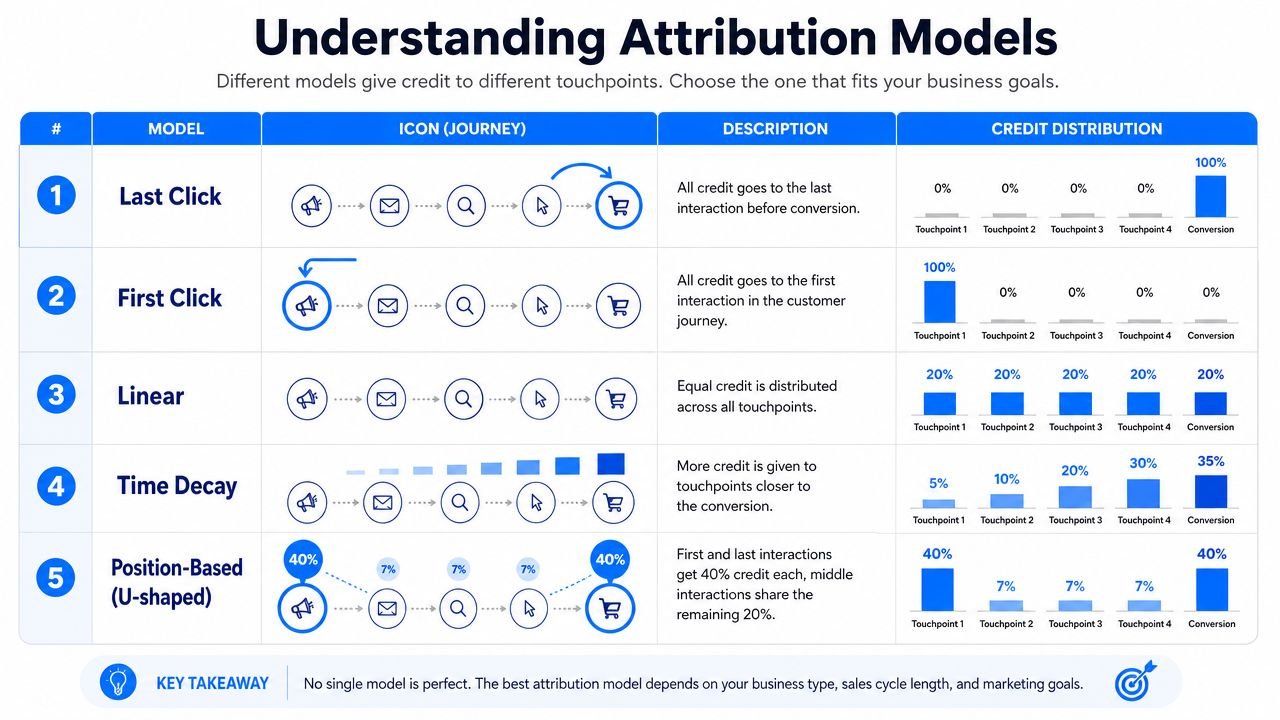
How the common models behave
Here's the practical difference between the models teams commonly consider:
| Model | What it does | Best fit | Main problem |
|---|---|---|---|
| First click | Gives all credit to the first touch | Demand generation, discovery content | Overstates early education and ignores closing channels |
| Last click | Gives all credit to the final touch | Short buying cycles, simple stores | Misses SEO's assisting role |
| Linear | Splits credit across touches | Mid-complexity journeys | Can flatten meaningful differences between channels |
| Time decay | Gives more credit to recent touches | Journeys with multiple late-stage nudges | Still tends to under-credit early SEO content |
| Position-based | Heavier credit to first and last touches | Businesses that want balance | Simplifies messy real journeys |
For SaaS, first-click and linear models usually reveal more about SEO's contribution to pipeline creation than last-click. For eCommerce, last-click can still be useful for operational reporting if purchase cycles are short, but it often undervalues category pages, buying guides, and comparison content that started the session path.
If your SEO content educates, not just closes, last-click reporting will undersell it almost every month.
A simple model selection guide
Use business reality, not platform default settings.
- Choose first click when SEO's main job is opening new demand and introducing buyers to the category.
- Choose last click when the path to purchase is compressed and channel overlap is limited.
- Choose linear when multiple touches matter and leadership wants shared credit.
- Choose position-based when opening and closing touches are both strategically important.
- Choose data-driven models if your stack and volume support them, and your team can explain the outputs clearly.
A SaaS company with a long consideration cycle shouldn't default to the same attribution logic as a store selling low-friction products. That sounds obvious, yet a surprising number of ROI decks still use the reporting view that happened to be enabled in GA4, not the one that best reflects the business.
The model doesn't have to be perfect. It has to be defendable, consistent, and aligned with how customers move from discovery to revenue.
The ROI Calculation Formulas and Worked Examples
A strong ROI model is boring in the best possible way. It's transparent, reproducible, and easy for finance or leadership to audit. If someone can't trace the number back to revenue and cost inputs, the report won't survive scrutiny.
The core formula
The standard formula is (Revenue from SEO − Cost of SEO) / Cost of SEO. A general benchmark for ROI is a 5:1 ratio, or 500%, while industry data shows a median SEO ROI of 748% according to Semrush on SEO ROI measurement.
That same guidance is useful for implementation, not just math. In GA4, filter for google/organic and assign monetary values to the conversion events you track. Without that step, you're not calculating ROI. You're estimating attention.
If you're pressure-testing spend assumptions, it also helps to compare your internal model against realistic SEO service cost ranges so the denominator in the formula includes the full program, not just agency retainer fees.
Worked example for SaaS
A SaaS example usually needs two versions. One based on closed revenue, which is ideal. Another based on modeled lead value, which is often necessary while attribution matures.
Use this workflow:
- Add total SEO cost. Include agency fees, freelance support, content production, software, and the internal team time dedicated to the program.
- Pull organic conversions from GA4. Filter to google/organic.
- Match conversions to CRM outcomes. Identify which demo requests or trials became opportunities and then customers.
- Calculate revenue attributed to SEO. Use closed-won revenue where possible.
- Apply the formula.
Example structure:
- SEO cost over the reporting period = your total SEO investment
- Organic demo requests = tracked in GA4
- Closed-won deals from those organic demos = verified in CRM
- SEO revenue = total closed-won revenue from that cohort
- ROI = (SEO revenue − SEO cost) / SEO cost
If CRM linkage is incomplete, use a fallback model. Assign a monetary value to organic demos or trials based on your historical conversion path. What matters is that the number comes from real sales behavior, not optimism.
Worked example for eCommerce
eCommerce is usually cleaner because revenue is captured at the transaction level.
The workflow looks like this:
- Pull organic purchase revenue from GA4 for google/organic
- Subtract returns or cancellations if your reporting process includes them
- Add the full SEO cost for the same period
- Apply the same formula
A simplified example in words:
| Step | What to use |
|---|---|
| Revenue input | Organic transaction revenue from GA4 |
| Cost input | SEO retainers, content, technical support, tools |
| Formula | (SEO revenue − SEO cost) / SEO cost |
| Output | ROI percentage |
Discipline is essential here. If paid social created demand, email closed repeat buyers, and branded search captured the last click, do not simply count all organic revenue as pure SEO lift. That's how teams end up reporting channel capture instead of channel impact.
The cleanest eCommerce ROI models separate direct organic revenue from assisted organic influence. One proves realized return. The other explains how the machine works.
Beyond the First Sale Measuring Long-Term Value and LTV
First-sale ROI is usually where subscription businesses start. It's rarely where they should stop.
For SaaS and subscription eCommerce, SEO often creates a customer relationship whose value compounds after the initial conversion. If you only count the first purchase or the first sign-up, you'll miss the economics that make SEO worth defending during slower ramp periods.
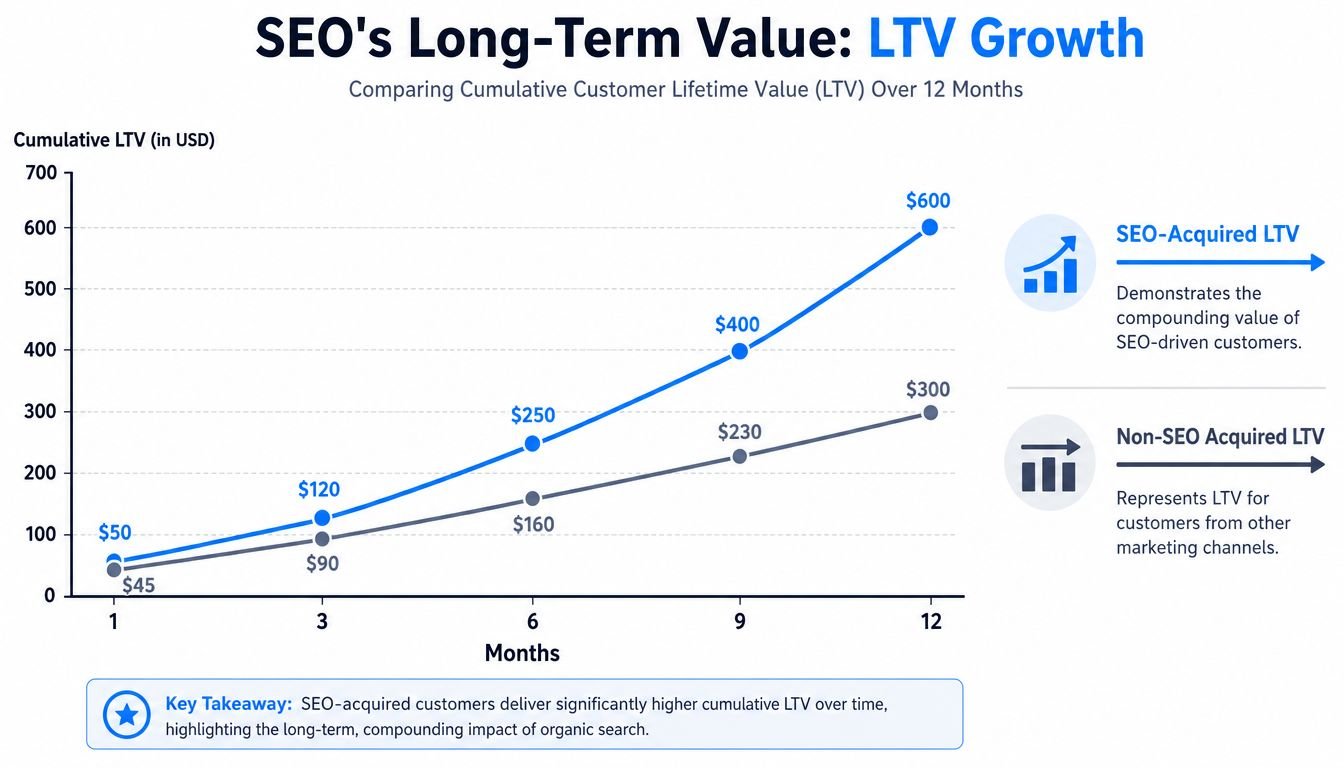
Why first-sale reporting misses the point
This gap is especially obvious in B2B SaaS. According to Singularity Digital on measuring SEO ROI, many ROI guides ignore long-term retention and lifecycle value, even though an SEO-driven trial signup in B2B SaaS can produce $12,000 over 3 years. The same source notes that measuring SEO inside a 30-day window can show negative ROI and push teams to cut budget before long-term value shows up.
That's the core issue. SEO is often evaluated on a short reporting cycle, while its value matures on a customer cycle.
How to bring LTV into the model
The practical fix is cohort reporting.
Group customers by acquisition source, then compare how organic-acquired customers behave over time against other channels. Look at expansion revenue, repeat purchases, retention patterns, and payback timing. If SEO-acquired users stay longer or buy more over time, that should change how you value the channel.
A workable framework:
- Track acquisition source at customer creation: Preserve original organic source in your CRM or data warehouse.
- Review cohorts over time: Monthly or quarterly cohorts are usually easier to interpret than single-campaign snapshots.
- Separate first-order ROI from lifetime ROI: Leadership needs both views.
- Align with your SEO strategy: Content built for category education, comparison, and solution awareness often creates the kind of customer journey that compounds over time, which is why a strong SaaS SEO strategy should be measured beyond the first conversion.
The best SEO ROI models don't ask only, “Did organic convert?” They ask, “What kind of customer did organic bring us?”
That shift turns SEO from a lead-generation line item into a revenue quality channel.
How to Report SEO ROI to Your Stakeholders
A good ROI model can still fail in the boardroom if the reporting is messy. Executives don't want a download of GA4. They want a decision-ready summary with clear assumptions, known limitations, and a number they can trust.
The reporting formula should be stated plainly as (SEO Revenue − SEO Costs) / SEO Costs × 100. It's also important not to confuse ROI with ROAS. According to Seer Interactive on calculating ROI, teams using more granular methods that account for position-based CTR and channel-specific conversion rates achieve 25% to 35% higher success in accurate SEO revenue attribution.
What a stakeholder-ready report should include
Use a tight structure:
- Top-line result: ROI percentage, SEO-attributed revenue, and total SEO cost
- Commercial context: What type of revenue is included, direct only or direct plus assisted
- Operating detail: Which conversions counted and how they were valued
- Attribution note: Which model you used and why it fits the business
- Decision layer: What should be scaled, fixed, or re-prioritized next quarter
What makes ROI reports lose credibility
Three things usually break trust:
- Soft cost accounting. Teams include agency fees but ignore internal labor, tools, or production support.
- Unclear attribution. The report gives SEO full credit without explaining the model.
- Vanity-led storytelling. Rankings and sessions dominate the slide, while revenue sits in the footnote.
Stakeholders will accept a conservative number faster than an inflated one they can't audit.
If you want a team that treats SEO like a revenue system instead of a traffic channel, SaasSky works with SaaS and eCommerce brands on measurable organic growth, link building, and reporting built for operators, not vanity dashboards.