

You're probably in one of two situations right now. Organic growth has flattened, or your team is about to invest in a major site rebuild and nobody wants SEO to break on launch day. In both cases, the risk looks small from the outside. Pages load. The product works. Demo requests still come in. But search visibility can stall because search engines can't crawl key pages properly, JavaScript hides content, internal linking is weak, or your audit report never turns into developer tickets.
That's why technical SEO audit services matter. Not as a box-checking exercise, and not as a vanity PDF full of crawler exports. For a SaaS company, a technical audit is a diagnostic that tells you why a site that “exists” in search still isn't compounding growth. It also tells you whether your current setup is built only for Google's classic results, or whether it's ready for AI-driven discovery too.
Table of Contents
- Why Your SaaS Growth Has Stalled
- The Anatomy of a Technical SEO Audit
- The Audit Process and Deliverables
- Pricing and Timelines for Technical Audits
- Measuring the ROI of Your Technical Audit
- How to Evaluate and Choose an Audit Partner
- Is Your Audit Ready for AI Search
Why Your SaaS Growth Has Stalled
A lot of SaaS teams hit the same wall. You publish content, improve product pages, invest in links, and still don't get the lift you expected. The usual assumption is that the keyword strategy is weak or the market got more competitive. Sometimes that's true. Often, the bigger problem sits underneath the strategy.
If search engines can't reliably crawl, render, and index the right pages, your content work won't compound. If internal links point poorly, important commercial pages stay buried. If your product templates are slow or unstable, users bounce before they convert. A site can look fine to your team and still underperform in search.
That's where technical SEO audit services earn their keep. A strong audit doesn't ask, “Are there errors?” It asks, “Which technical issues are blocking growth, which ones are cosmetic, and what should engineering fix first?” That's a very different conversation.
I've seen founders treat technical audits as cleanup work for “later,” usually after content production or paid acquisition. In practice, that sequence often wastes time. If the site's foundation is weak, you keep pouring traffic into a system that leaks performance.
A practical way to think about it is this:
- Traffic problem: Search engines may not be reaching or indexing the pages you expect.
- Conversion problem: Performance issues, broken journeys, or weak page architecture may be hurting trial starts and demo requests.
- Scale problem: Each product launch, feature page, and content update adds more complexity, which multiplies hidden technical debt.
A technical audit tells you whether your website merely exists, or whether it's structurally capable of growth.
For SaaS teams building a broader SaaS SEO strategy, this matters early. You don't want to discover six months from now that your best-intent pages never had a fair chance to rank.
The Anatomy of a Technical SEO Audit
A website audit is a building inspection
The easiest analogy is a building inspection. You don't inspect a building by glancing at the lobby. You check the foundation, structural integrity, access points, safety systems, and whether people can move through it without friction. Technical SEO audit services do the same for a website.
This visual captures the core pieces to expect in an audit:
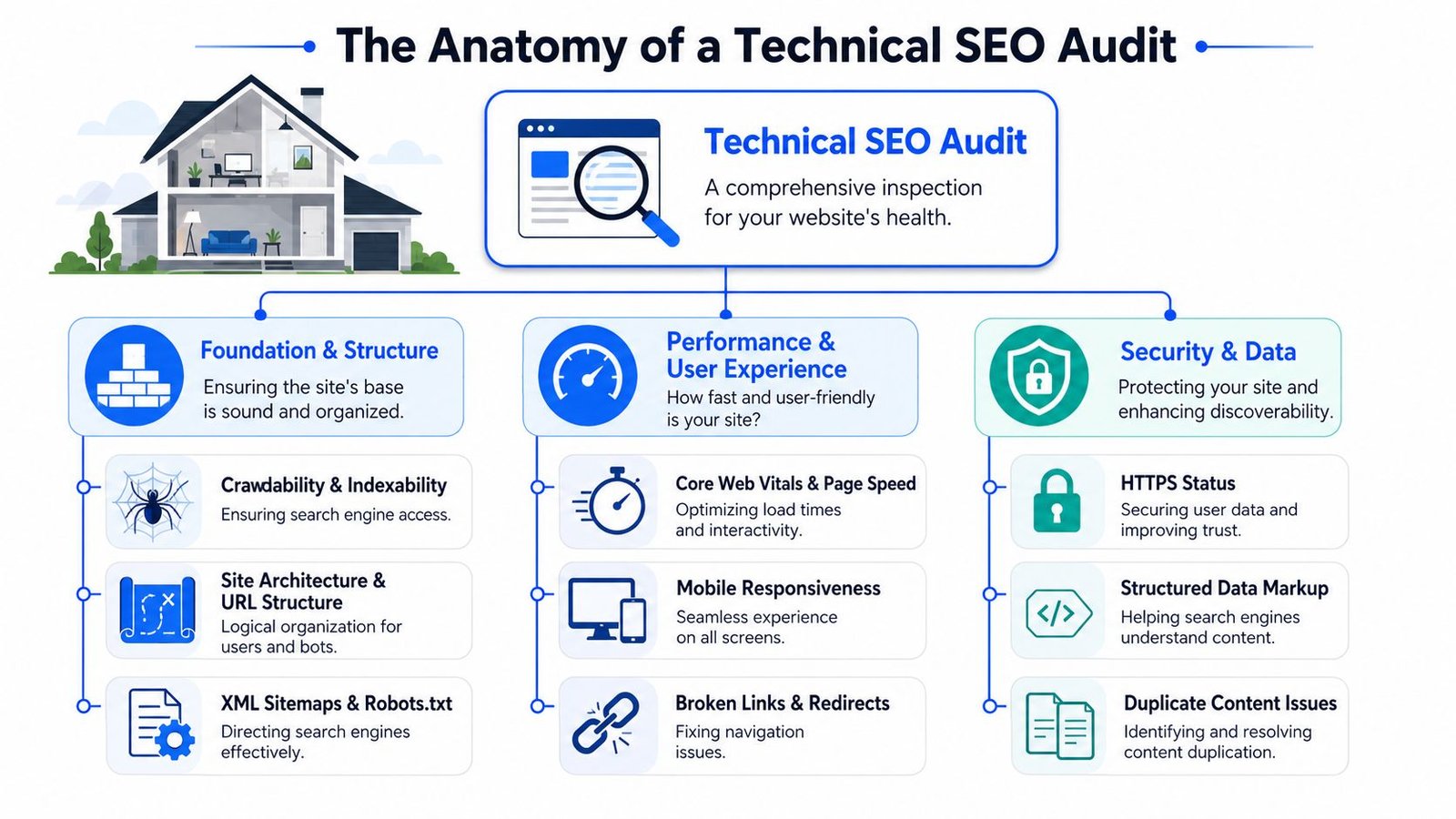
The first pillar is crawlability and indexability. That means checking whether search engines can access your pages, understand which pages matter, and avoid wasting effort on broken or blocked URLs. A verified description from Thrive's overview of technical SEO services is especially useful here: audits review robots.txt directives, XML sitemaps, and crawl error logs in Google Search Console because crawlability comes before indexation and visibility. If those basics are broken, later work on schema or content refinement won't do much.
That point gets missed constantly. Teams jump to content optimization while key pages are blocked, redirected badly, or returning errors.
What each pillar means for the business
Site performance is the second pillar, encompassing Core Web Vitals, rendering, image weight, server response, and front-end code quality. One benchmark often used in audits is the 2.5-second threshold for “good” loading performance, referenced in this technical audit discussion on Reddit. For a SaaS company, the business meaning is simple: if feature pages load slowly or interactive elements lag, users leave and rankings usually don't improve the way you hoped.
Then there's site architecture. This is less flashy, but it often has more strategic impact than teams expect. If your pricing, solution, integration, and feature pages are too deep in the site, crawlers take longer to discover them and internal authority doesn't flow where you want it. Good architecture helps users and bots reach important pages fast.
A reliable audit also checks:
- Mobile responsiveness: Your site has to work cleanly across screen sizes, not just pass a designer review.
- Redirects and broken links: These affect both discovery and user flow.
- Structured data: This helps search engines interpret what your pages represent.
- Duplicate content signals: These can confuse indexing and split ranking potential.
- HTTPS status and technical trust signals: Especially important on product, pricing, and form-heavy pages.
Practical rule: Fix access and rendering problems first. Leave cosmetic SEO improvements for later.
If you want a sanity check before hiring anyone, a detailed website auditing checklist helps you see whether a vendor is covering the basics or just selling a branded crawler export.
The Audit Process and Deliverables
What a real engagement looks like
A useful audit usually starts with a kickoff call that sounds less technical than people expect. The right questions are business questions first. Which pages drive demos? Which templates matter most? What changed before traffic stalled? What does the dev stack look like? Who owns implementation?
Then the consultant asks for access. Typically that includes Google Search Console, analytics, a crawler run, and sometimes staging access if a redesign or migration is involved. For SaaS sites, I also want to know whether content is server-rendered, hybrid-rendered, or heavily dependent on JavaScript. That changes the audit entirely.
This process flow is what a normal engagement should resemble:
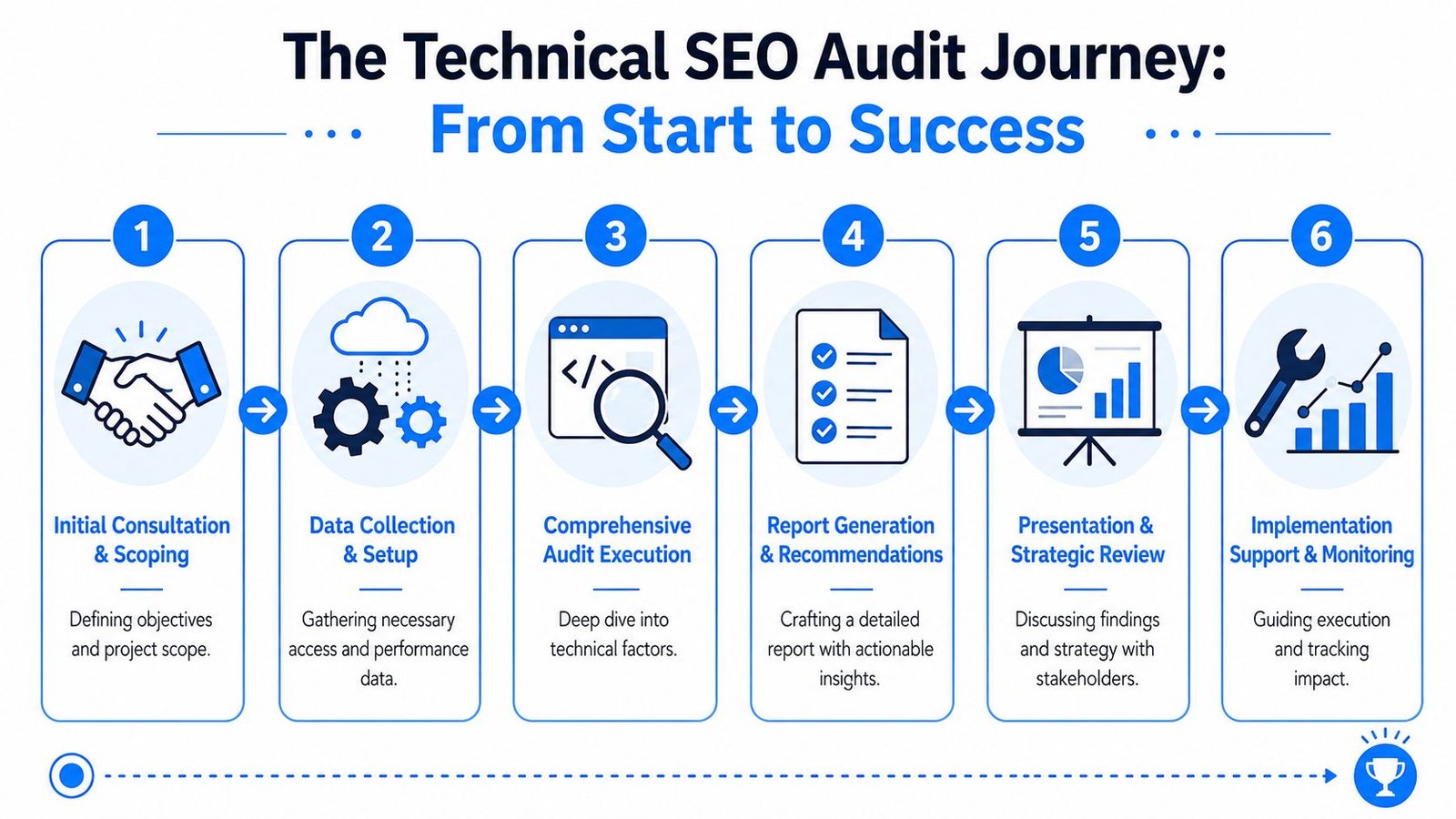
After access is set, the actual work begins. The consultant crawls the site, validates indexation signals, reviews templates, checks internal linking, inspects page speed and rendering behavior, and looks for patterns rather than isolated issues. That last point matters. A broken canonical on one page is a bug. The same bug across all feature pages is a growth blocker.
What good deliverables look like
The worst deliverable in technical SEO audit services is a giant data dump. You get a slide deck or spreadsheet with hundreds of rows, no sequencing, no business context, and no implementation path. Marketing can't prioritize it. Engineering won't touch it. The audit dies in a shared folder.
A strong deliverable looks more like a roadmap than a report.
It should include:
- A priority order: What needs fixing now, what can wait, and what isn't worth the sprint time.
- Business rationale: Why this issue matters for traffic, conversion flow, indexation, or launch risk.
- Affected templates or page groups: Engineers need patterns, not random page examples.
- Implementation guidance: Not generic warnings. Specific changes that map to code, templates, or CMS logic.
- Validation steps: How your team will confirm the fix worked.
If the final report can't be turned into developer tickets, it isn't finished.
I prefer deliverables that separate findings into three buckets. Immediate blockers, high-impact fixes, and cleanup items. That helps product and engineering allocate effort realistically. It also stops the common mistake of spending a sprint on minor issues while high-value templates remain unchanged.
Pricing and Timelines for Technical Audits
Technical SEO audit services vary a lot in cost because “audit” can mean anything from a small crawl review to a deep, enterprise-grade investigation with implementation support. Pricing gets more predictable once you tie it to site complexity, not vendor branding.
According to NAV43's breakdown of technical SEO audit pricing, basic audits for small sites typically cost between $500 and $1,500, mid-range audits run from $1,500 to $5,000, and enterprise audits range from $5,000 to $25,000+. The same source notes that developer work to fix issues often costs $100 to $200 per hour, ongoing monitoring often runs $500 to $1,500 monthly, and senior technical SEO specialists may charge $150 to $300 per hour.
What drives the price up
The biggest pricing variable is complexity. A marketing site with a few dozen pages and standard templates is one thing. A SaaS site with knowledge base content, gated resources, app subdomains, JavaScript-heavy UI components, multilingual sections, and a migration coming up is another.
Costs usually rise when the audit needs to account for:
- JavaScript rendering: More testing, more nuance, and more engineering coordination.
- Large URL sets: More crawl analysis and stronger prioritization needed.
- Ecommerce or hybrid catalog structures: Extra complexity around faceted pages, duplication, and template logic.
- International SEO: More room for indexation and localization mistakes.
- Implementation support: This is often the difference between a cheap report and an expensive but useful engagement.
Timelines depend on scope, but in practice, smaller audits move faster and complex environments take longer because more stakeholders get involved. The audit itself is only part of the timeline. Access, internal review, engineering planning, and QA usually take longer than founders expect.
Typical Technical SEO Audit Pricing Tiers 2026
| Audit Tier | Typical Client | Price Range | Scope |
|---|---|---|---|
| Basic | Small business or simple site | $500 to $1,500 | Basic crawl reports and surface-level analysis |
| Mid-range | Growing business with a moderately complex site | $1,500 to $5,000 | More comprehensive analysis, Core Web Vitals work, custom implementation guidance |
| Enterprise | Enterprise site, ecommerce platform, or technically complex environment | $5,000 to $25,000+ | Deep crawl analysis, advanced technical review, broader implementation support |
A cheap audit isn't always a bargain. If it doesn't give your team enough clarity to act, you'll end up paying twice. Once for the report, then again for someone else to reinterpret it.
Measuring the ROI of Your Technical Audit
A technical audit only has value when the fixes change business outcomes. That's the standard founders should use. Fewer errors in a crawler report don't matter by themselves. Better qualified traffic, stronger conversion performance, and fewer user drop-offs do.
The strongest benchmark in the verified data comes from SEOmator's statistical breakdown of SEO audits. It reports that websites conducting quarterly technical SEO audits see up to a 61% increase in organic traffic, a 32% rise in conversion rates, and a 50% reduction in bounce rates compared with sites that don't audit regularly. The same source also notes that 94% of webpages receive no traffic from Google and 79% of sites lack meta descriptions, which tells you how widespread basic technical and content gaps still are.
Track business baselines before fixes start
If you want to prove return, take a clean baseline before implementation starts. Don't wait until after the fixes go live. By then, causality gets blurry.
For a SaaS site, I'd baseline:
- Organic traffic to commercial pages: Pricing, feature, comparison, integration, and solution pages.
- Conversions from organic sessions: Trial starts, demo requests, or qualified leads.
- Bounce behavior on key landing pages: Especially templates affected by speed or UX fixes.
- Indexation health: Are important URLs eligible to rank?
- Share of traffic by template type: Helpful when technical issues affect one section more than another.
This turns the audit from “SEO work” into operational measurement. Leadership doesn't need to understand canonical tags or render paths. They need to see that fixing structural issues improved acquisition efficiency.
What leadership actually cares about
An audit is easier to justify when you frame it as risk reduction plus growth enablement. Risk reduction means avoiding lost visibility from crawl problems, broken redirects, or indexation mistakes. Growth enablement means your existing content, links, and product pages finally get a better chance to perform.
Quarterly audits are often treated as maintenance. In reality, they're quality control for your revenue pages.
If you need a clean reporting framework, this guide on how to measure SEO ROI is a useful model for tying technical improvements to business metrics without drowning stakeholders in SEO jargon.
How to Evaluate and Choose an Audit Partner
Why most audits die after delivery
Most buyers ask the wrong first question. They ask, “How detailed is your audit?” when they should ask, “How well does your audit survive contact with our dev team?”
That implementation gap is where technical SEO audit services usually fail. According to Internetzone I's technical SEO audit analysis, only 12% of SaaS and eCommerce brands report successfully implementing more than 60% of audit recommendations, largely because most audits deliver generic spreadsheets instead of prioritized, code-specific tasks.
That finding matches what many teams experience. The report looks impressive. The engineering manager reads it once, then asks for specifics. Which template? Which component? Which issue is a blocker? What's the acceptance criteria? If the audit can't answer those questions, implementation stalls.

Questions to ask before you hire
A good vendor interview should feel a bit uncomfortable for the provider. That's healthy. You're trying to figure out whether they solve problems or just document them.
Ask questions like these:
- Show me a sanitized final deliverable. You want to see the output, not the sales promise.
- How do you prioritize findings? If everything is “high priority,” nothing is usable.
- How do you convert recommendations into developer-ready tasks? This is the core question.
- What happens after presentation day? Some firms vanish right after the deck walkthrough.
- How do you handle JavaScript-heavy sites or complex SaaS architectures? General SEO experience isn't enough.
- How do you work with product and engineering teams? The best audit partner understands sprint realities.
“We found issues” is not a deliverable. “Here are the tickets, dependencies, and validation steps” is.
Also pay attention to how the vendor talks. If they spend the call naming tools but can't explain trade-offs, that's a warning sign. Tools like Screaming Frog, Google Search Console, PageSpeed Insights, and browser dev tools are useful. They don't replace judgment.
The right audit partner makes engineering's job easier. The wrong one creates another backlog nobody wants to own.
Is Your Audit Ready for AI Search
Why a Google-only audit is already dated
A lot of technical SEO audit services still act like the job ends with crawlability, indexation, and classic Google rankings. That's no longer enough for many SaaS companies. Buyers increasingly discover products through AI-generated answers, synthesis tools, and LLM-driven research workflows. If your site is hard to cite, hard to summarize, or poorly structured for machine interpretation, you can lose visibility even when your traditional SEO setup is decent.
That shift shows up clearly in Percepture's analysis of modern technical SEO audits. It says only 19% of audit providers include AI visibility metrics, while 63% of B2B SaaS brands report that AI-generated citations now drive more qualified traffic than organic Google results. That's a major gap between what buyers need and what many audit providers still sell.
The practical takeaway is simple. A 2026-ready audit can't be Google-only.
What AI readiness looks like in practice
AI readiness isn't a mystical new discipline. It's an extension of good technical structure, with a few different priorities. Your pages need to be easy to parse, quote, and trust.
That usually means checking for:
- Clear entity signals: Your company, product, category, and use cases should be easy to identify.
- Structured data quality: Not just present, but meaningful and consistent.
- Citable content formats: Definitions, comparisons, explanations, FAQs, and concise summaries help machines extract useful context.
- Page-level clarity: Pages should answer a topic cleanly instead of scattering context across vague copy blocks.
- LLM accessibility considerations: Some teams now review files and technical controls related to AI retrieval as part of audit scope.
A traditional audit might say, “Your schema is incomplete.” An AI-aware audit asks a better question: “Can an AI system confidently understand what this page is about, who it's for, and when it should cite it?”
That matters most for SaaS categories where buyers compare tools, evaluate workflows, and ask broad solution questions before they ever click a search result. If your audit ignores that layer, it's preparing you for yesterday's visibility model.
Your site doesn't need to chase every trend. It does need to be technically understandable across both search engines and emerging AI interfaces. That's the new baseline.
If you want a partner that understands both search visibility and the execution realities inside SaaS teams, SaasSky is worth a look. They work with SaaS and eCommerce brands on measurable growth, and that kind of operator mindset matters when technical findings need to turn into actual results, not just another report.