You launched the product. The site is live, the onboarding is clean, and the offer is solid. Then the traffic graph does nothing.
That's where most SaaS and eCommerce teams start with manual link building. Not with momentum. With silence. No brand searches, no inbound mentions, no editors discovering your content on their own, and no blog audience to amplify anything you publish.
The mistake is thinking the answer is “more outreach.” It usually isn't. New brands rarely have an outreach problem first. They have an asset problem, a targeting problem, and a credibility problem. Manual link building works when you solve those in the right order.
This is the playbook I'd use for a client starting from zero authority. It's built for founders and lean marketing teams that need links they can defend, track, and compound over time.
Table of Contents
- Beyond More Links The Goal of Manual Link Building
- The Foundation Prospecting and Quality Control
- Creating Your Linkable Asset From Scratch
- The Art of Outreach That Gets a Yes
- Measuring What Matters and Setting Timelines
- Real-World Playbooks for SaaS and eCommerce
Beyond More Links The Goal of Manual Link Building
A lot of founders come into this process asking the wrong question. They ask how many links they need. The better question is what kind of trust signals they need, and where those signals should come from.

Manual link building isn't a volume game when it's done well. It's the process of earning relevant editorial mentions from real sites by giving editors, writers, partners, and community operators a reason to reference your brand. Sometimes that reason is data. Sometimes it's a useful tool. Sometimes it's a founder who can explain a hard problem better than everyone else in the inbox.
That's why the strongest campaigns don't feel like bulk prospecting. They feel closer to business development and editorial pitching. You're building a small set of repeatable relationships around assets that deserve distribution.
Manual outreach also tends to outperform automation on link quality. One industry guide reports that manual outreach link building achieves an average acquired Domain Rating three times higher than automated methods, with a 10 to 15 percent response rate and a 2 to 5 percent link acquisition rate when the targeting is tight and the process is disciplined, according to Ranking Raccoon's manual outreach guide.
Practical rule: If your plan depends on strangers doing you a favor for a weak page, the campaign is already in trouble.
For early-stage brands, the goal isn't to stack random referring domains. The goal is to earn links that do three jobs at once:
- Build relevance: The linking page should make sense for your product category, use case, or customer problem.
- Build authority: The site should have editorial standards, an actual audience, and content you'd be comfortable showing an investor or customer.
- Build traffic paths: Some links help rankings over time. Some also send qualified visitors immediately. The best ones can do both.
This is also where a lot of white-hat advice gets watered down into slogans. “Create great content” isn't useful guidance if nobody knows you exist. A more honest starting point is this: if you're unknown, you need to create something small but referenceable, then pair it with deliberate outreach. That's the work.
If you want a broader look at how teams structure ethical campaigns, white-hat link building for SaaS is the right frame. The important distinction is that white-hat doesn't mean passive. It means your process can hold up under scrutiny.
The Foundation Prospecting and Quality Control
A new SaaS founder approves outreach, the team pulls 500 domains from a tool, and emails start going out by Friday. Two weeks later, reply rates are poor, placements are weak, and half the “opportunities” were never a fit in the first place. That pattern is common because the failure starts before outreach. It starts with a loose prospect list and no quality bar.
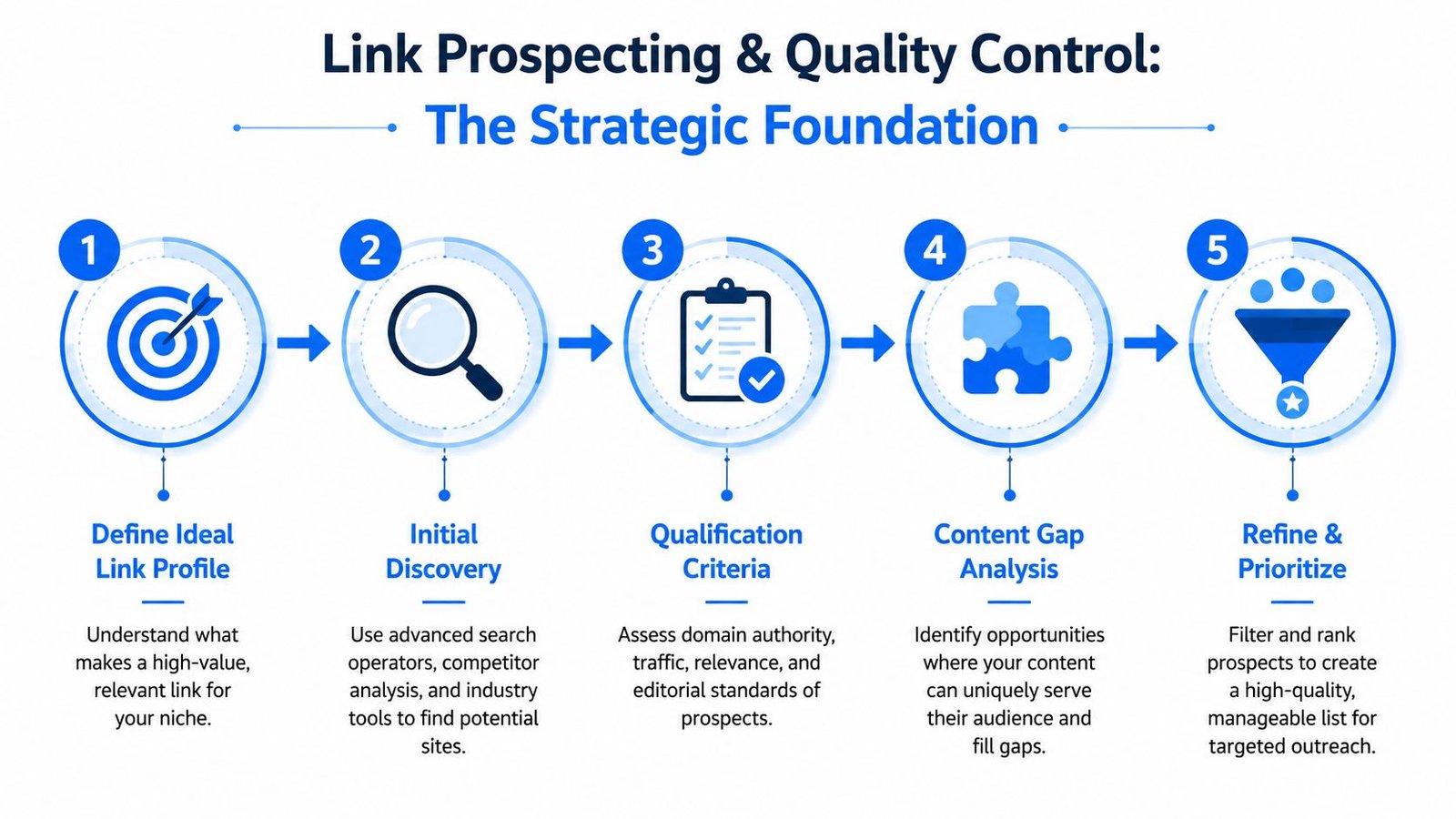
Define what a good link looks like
For SaaS, the best prospects usually sit close to product use cases. Software blogs, integration partners, consultants, niche publishers, workflow guides, and comparison pages tend to make sense because they already explain tools, processes, and buying decisions.
For eCommerce, the mix shifts. Category publishers, gift guides, reviewers, enthusiast communities, how-to content, and expert roundups usually produce better fits because they influence purchase decisions directly.
I use a short qualification sheet before I add any domain to a list. A prospect should clear most of these checks:
- Topical fit: Would your asset help their reader solve a problem, compare options, or make a purchase decision?
- Editorial standards: Does the site publish coherent articles with named authors, clear categories, and normal internal linking?
- Business reality: Does the site look like a real publisher, operator, or brand with something to protect?
- Placement logic: Can you point to a specific page where your asset belongs without forcing it?
Topical fit beats vanity metrics more often than new teams expect. A DR 35 site in your category can do more for rankings, referral traffic, and future relationship-building than a DR 75 site with no audience overlap.
Build a prospecting workflow you can repeat
Good prospecting is closer to account selection in sales than bulk list building in SEO. The goal is not a giant spreadsheet. The goal is a shortlist of pages where a link would make editorial sense even if you had no SEO agenda.
I'd start with four lanes:
- Search operators to find list posts, resource pages, niche guides, statistics pages, and tools roundups.
- Competitor backlink reviews to find publishers that already link to adjacent products or similar assets.
- Ecosystem research across partners, agencies, implementation firms, marketplaces, and integration directories.
- Community surfaces such as forums, association sites, curated newsletters, local organizations, and expert directories.
Then cut hard.
Remove domains with thin content, obvious paid-link clutter, recycled AI articles, or no realistic place for your page. Keep a short note beside every approved prospect. “Links out to templates.” “Maintains annual software lists.” “Mentions competitor's calculator.” Those notes save time later because they give your outreach angle a clear reason to exist.
For teams creating assets from zero, this is also the point where prospecting shapes the asset itself. If your research shows publishers keep linking to original data, templates, or niche calculators, build toward that demand instead of publishing a generic guide. A careful skyscraper SEO technique for new sites works best when it starts from proven link patterns, not from a guess about what people might cite.
Strong prospecting makes outreach feel specific before the first email is written.
Control pace before you scale
New domains rarely benefit from chasing volume early. They benefit from consistency, relevance, and a link profile that looks earned.
I would rather see an early-stage brand build a small set of clean, relevant placements every month than blast a huge list and pick up questionable links just to hit a quota. Aggressive link velocity is not automatically a problem, but on a young domain it often comes bundled with weak prospecting, forced placements, and inconsistent page quality. That mix creates more cleanup work later.
A safer operating model is a focused monthly pipeline. Fewer prospects. Better fit. More manual review. That approach also gives you room to learn which angles work before you scale outreach or hand parts of the process to a team member.
Quality control before outreach
Run one final review pass before any contact goes live. This catches the mistakes that hurt reply rates and waste founder time.
- Check the live page manually: Confirm the page still exists, still matches the topic, and still has room for your asset.
- Review outbound links: If the article is packed with exact-match commercial anchors or links to unrelated industries, skip it.
- Match the asset to the page type: A template belongs on a resources page. A data point belongs in an article. A product page rarely belongs in either unless the page is explicitly comparative.
- Check freshness: If the site has not published in a year, the chances of a useful reply usually drop.
- Tag relationship potential: Separate one-off placements from publishers, partners, and consultants you may want to work with again.
This part is slow. It should be. For SaaS and eCommerce brands starting without traffic or brand authority, disciplined prospecting is what makes founder-led outreach workable. If the list is right, the email has a fair chance. If the list is wrong, no copy tweak will save the campaign.
Creating Your Linkable Asset From Scratch
The hardest part of manual link building for a new brand isn't writing emails. It's showing up with something worth linking to.
A B2B SEO trend report found that 68 percent of new SaaS startups fail to get their first manual backlink via traditional outreach because they lack a “linkable asset,” yet only 12 percent of online guides provide a zero-traffic playbook, as referenced in this B2B SEO video discussion. That gap matters because most early-stage teams are trying to promote pages that are useful for conversion, not pages designed for citation.
Why most zero authority outreach fails
If you ask an editor to link to a product page, they'll usually ask themselves one question. Why this page?
“Because our product is good” isn't enough. Neither is “because we need authority.” Writers link to assets that improve their article. If you don't have blog traffic or a known brand, you need an asset that carries its own reason to exist.
Teams often misuse the Skyscraper SEO technique. They publish a longer version of a common article and expect links to follow. For a new domain, that usually underdelivers because length isn't the same as originality.
The fastest way to get ignored is to pitch a page that could have been written by any competitor.
Three asset types that work from zero
The strongest zero-authority assets are compact, opinionated, and easy to reference. I'd prioritize three.
Proprietary data built from what you already have
You don't need a giant audience to publish something original. SaaS teams can anonymize product usage patterns, onboarding friction themes, workflow trends, or support ticket patterns. eCommerce teams can analyze customer preferences, seasonal buying behavior, product comparison requests, or return-reason themes.
The key is to turn raw observations into a small report with clear takeaways:
- Pick a narrow question: Broad trend reports are hard to trust from unknown brands. Focus on one tight problem.
- Show method clearly: Explain what you analyzed in plain language without overselling it.
- Create citation hooks: Use named findings, charts, short summaries, and pull-out insights writers can lift into their own coverage.
- Support with expert commentary: Add the founder's interpretation so the asset works as both data and point of view.
This type of asset works well for SaaS because it gives editors something they can't get from a generic blog post.
Micro-tools that solve one annoying problem
A micro-tool is a simple utility, not a platform feature disguised as content. Think calculators, checklists, generators, estimators, selectors, or downloadable templates.
For SaaS, examples include naming validators, ROI worksheets, migration checklists, onboarding templates, or compliance prep tools. For eCommerce, think sizing helpers, care planners, buying checklists, bundle builders, or comparison templates.
A good micro-tool has three properties:
- Immediate use: Someone can benefit in under a minute.
- Niche specificity: It solves a problem for a very defined buyer.
- Easy embed into outreach: You can explain its value in one sentence.
These assets attract links because they reduce effort for the reader. Writers like linking to practical resources that complete their article without making them explain everything themselves.
Founder as expert
This is the most underused play for young brands. When the domain has no authority, the founder can lend borrowed authority through expertise.
That means packaging the founder into formats publishers can use:
- Sharp quotes for journalists, bloggers, and roundup writers
- Opinion responses in niche community threads
- Guest insights for podcasts, newsletters, and expert panels
- Tactical examples shared with consultants and service partners who publish educational content
This works especially well for technical SaaS, operational software, enthusiast eCommerce, and products built by people with clear domain knowledge. Editors may not know your brand, but they will use a strong expert comment if it helps their piece.
Linkable Asset Playbook Comparison
| Asset Type | Time Investment | Cost Investment | Typical Link Authority |
|---|---|---|---|
| Proprietary data report | Medium to high | Medium | Often strongest for editorial and industry publication links |
| Micro-tool or template | Medium | Medium to high | Strong for resource pages, communities, and practical guides |
| Founder-led expertise | Low to medium | Low | Strong for expert roundups, interviews, podcasts, and niche publications |
If you're choosing one starting point, pick the asset your team can maintain. A mediocre study, abandoned tool, or invisible founder profile won't carry outreach for long.
One practical note on tooling. Teams often manage this process with a mix of spreadsheets, Ahrefs, Hunter, Notion, and a lightweight CRM. Some also use agency support when the process needs dedicated execution. SaasSky is one option for SaaS and eCommerce brands that want a practitioner-led link building workflow after a backlink review and goal alignment.
The Art of Outreach That Gets a Yes
Outreach is where weak strategy gets exposed. If the list is sloppy or the asset is forgettable, the inbox tells the truth fast.

One common failure is lazy personalization. Another is asking for the wrong thing. A major pitfall is poor outreach. Generic “Hello Sir” emails yield near-zero engagement, and bad anchor text selection can erase much of the value in the link you do earn. At the same time, only 21.4 percent of marketers cite manual outreach as their primary strategy, according to Serpstat's link building statistics roundup. That gap exists because good outreach is a craft, not a template library.
What failed outreach looks like
Here's the kind of email that gets deleted:
Hi Sir,
I read your blog and found it very informative.
We have an amazing article that would be valuable for your readers.
Please add our link to your post.
Thanks
Everything is wrong here. The sender didn't mention a page, a reader problem, a reason for fit, or why this asset matters now. It also sounds like mass mail.
A slightly more advanced version still fails when it leads with your need instead of their article:
- Wrong opening: praise with no detail
- Wrong ask: “add our link” without context
- Wrong asset: generic blog post with no citation value
- Wrong recipient: sent to a catch-all inbox instead of the person who manages content
If your outreach sounds transferable to any website, the recipient knows it was.
What a good pitch does differently
Better outreach is specific, compact, and friction-light. It usually includes four parts:
- a real observation about the page
- a clear match between their article and your asset
- one sentence on why readers benefit
- a simple ask with no pressure
For example:
Hi [Name],
I liked how your article compared onboarding approaches for small teams, especially the section on setup friction.
We put together a short onboarding checklist for teams switching from spreadsheets to dedicated workflow software. It fits the exact gap between “why to switch” and “how to do it.”
If you're updating the piece, I think it could help readers looking for a practical next step.
Happy to send the exact section I had in mind.
This works because it respects the editor's time. It doesn't oversell. It points to one use case.
Outreach that gets replies usually reads like editorial assistance, not a favor request.
When teams need a process for finding contacts, shaping offers, and tightening copy, a practical reference is outreach for SEO. The core principle is simple. Every email should answer “why this page, why this asset, why now?”
Anchor text and the ask
Anchor text is where inexperienced campaigns lose relevance. Founders often want the exact money term. Editors often won't give it, and forcing it can make the link look unnatural.
The better approach is to propose an anchor that matches the sentence and the page intent. If the destination is a checklist, ask for an anchor that describes a checklist. If it's a data report, ask for a descriptive phrase tied to the finding.
A few working rules:
- Match language to the host page: The link should read naturally inside their paragraph.
- Prefer descriptive anchors over hard-sell phrasing: That keeps the placement editorial.
- Give one suggestion, not five: Too many choices create friction.
- Be comfortable with branded or partial-match anchors when the fit is strong: Relevance comes from context too.
There's also a relationship angle here. The best link builders don't chase one isolated yes. They track who replies, who updates content regularly, who asks smart questions, and who might be worth revisiting next quarter.
That matters because manual link building compounds when your contact list gets smarter. Your first link from a publisher is valuable. Your second conversation with that same publisher is usually where efficiency starts.
Measuring What Matters and Setting Timelines
A founder approves outreach in January, sees a few replies in February, and asks in March why rankings have not moved yet. That question is fair. Manual link building has a lag between effort, placement, indexing, and search impact, especially when you are starting with no traffic, no brand demand, and no publisher relationships.
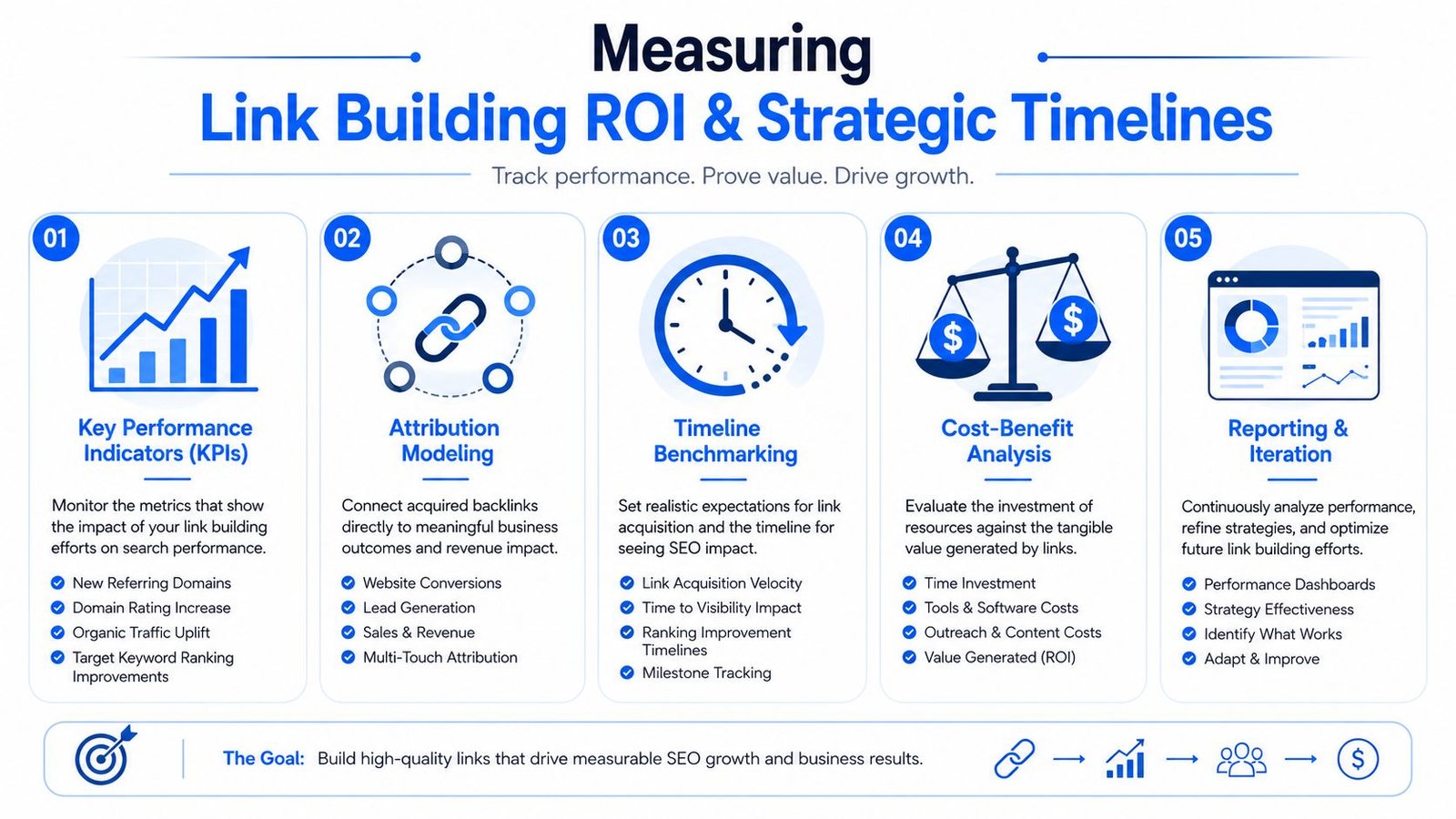
The right way to measure the campaign is page by page. For a SaaS company, that might mean a report, template, or glossary page built to earn links before the product pages are ready to compete. For eCommerce, it might mean a founder-led buying guide, materials reference, or original category resource. If those pages start earning relevant placements and later gain visibility, the campaign is doing its job.
The four metrics that matter
I track four numbers on every manual campaign because each one points to a different failure point.
- Response rate: Shows whether the list and pitch are credible.
- Link acquisition rate: Shows whether replies turn into published placements.
- Link quality: Use authority metrics as a rough filter, then sanity-check relevance, traffic, and editorial context.
- Organic movement on the target page: Track changes in rankings, impressions, clicks, and organic sessions to the page you were trying to strengthen.
Response rate matters first because it exposes bad targeting fast. If a new SaaS brand is pitching a useful data page and nobody replies, the problem is usually prospect fit, the angle, or the sender. If people reply but few links go live, the asset usually needs work. It may be too self-promotional, too thin, or too hard for an editor to cite.
Quality needs a stricter review than "high DR equals good link." A relevant mention on a real industry site often beats a stronger-looking metric from a general site that sends no traffic and has no topical fit. I would rather show a client ten links that clearly belong than thirty placements built for a report screenshot.
What to put in a simple dashboard
Early-stage teams do not need fancy reporting. They need a sheet that makes weak spots obvious.
Track campaigns at the target-page level, not just by referring domain. Include:
| Field | What to record |
|---|---|
| Target page | The exact page you want to strengthen |
| Prospect URL | The page you pitched |
| Contact | Editor, marketer, founder, or partner |
| Asset type | Data report, micro-tool, founder quote, template |
| Status | Pitched, replied, negotiating, live, declined |
| Link notes | Anchor used, surrounding context, publication date |
| Outcome notes | Referral traffic movement and ranking observations |
This structure keeps the work honest. You can see which assets earn replies, which pages attract the best placements, and where the process breaks.
Operator note: If the target page would not deserve a citation from a neutral publisher, fix the page before sending another email.
How to set timelines clients can actually work with
Set expectations in phases.
The first month usually goes into asset prep, list building, QA, inbox setup, and the first outreach wave. If you are building from zero, this stage takes longer than founders expect because the asset has to carry the pitch. You do not have existing traffic or brand recognition covering for a weak page.
Months two and three are usually where you learn what the market will accept. Some angles get replies but no placements. Some publisher segments ignore founder-led outreach and respond better to original data. Some assets need a rewrite after ten emails, not after a hundred.
Real search movement often takes longer because links need to go live, get crawled, and start reinforcing the right page. That delay does not mean nothing is working. It means manual link building behaves like compounding work, not paid distribution.
Review the campaign every month. Cut low-fit prospects. Tighten the pitch. Improve the asset where editors hesitate. Keep the pages that are earning relevant links, and stop forcing pages that are not good enough yet. That is the part many new teams miss. Success usually comes from improving the asset and prospecting process in parallel, not from sending a larger volume of the same email.
Real-World Playbooks for SaaS and eCommerce
A good strategy should survive contact with a real launch, a real inbox, and a real product category. These are the two playbooks I'd run first.
SaaS playbook using a data asset
An early-stage B2B SaaS company with no blog traction usually shouldn't begin by pitching feature pages. I'd start by identifying one operational question their product sees every day. Then I'd turn that into a compact data asset.
The process is straightforward. Pull anonymized internal observations, package them into a clear report page, add founder commentary, and create a short list of publishers and consultants who already write about that workflow. The pitch isn't “please link to our company.” It's “you cover this problem, and we have a useful original reference for this exact subsection.”
The outreach list stays narrow. Industry blogs, implementation partners, relevant newsletters, and software ecosystem publishers usually make more sense than broad marketing blogs. Once the first few placements go live, use those mentions as proof in later outreach. Unknown brands become easier to pitch when another editor has already referenced them.
eCommerce playbook using founder expertise
A niche eCommerce brand often has a different advantage. The founder knows the category better than most affiliates writing about it.
In that case, I'd package the founder as a source. Build a media page with concise expertise topics, create a bank of quotable insights, and identify review sites, gift guides, category educators, and niche publications that constantly need better commentary. This works especially well when the product solves a specific use-case problem and the founder can explain trade-offs buyers usually miss.
The ask stays light. Offer a sharp quote, product selection guidance, or practical commentary that improves the article. If the publication later wants a product recommendation, you've already earned trust. That's how product mentions and editorial links start to stack without making the brand look like it's forcing placements.
Both playbooks rely on the same discipline. Build a real asset, match it to a real publisher need, and keep the outreach credible enough that the next conversation is easier than the first.
If your team needs help building that process, SaasSky works with SaaS and eCommerce brands on manual link building campaigns built around transparent planning, measurable outcomes, and assets that can earn links without relying on existing brand authority.