You're publishing consistently. The site looks better than it did a quarter ago. A few pages even rank. But your Domain Authority barely moves, and every stakeholder meeting turns into the same question: why isn't the score going up?
That usually happens when teams confuse authority-building with content production. Publishing more blog posts isn't the same as earning trust from the sites that matter in your market. If your content doesn't attract relevant editorial links, the score often stays flat, even when the blog calendar is full.
For SaaS and eCommerce brands, the answer isn't another generic checklist. It's a playbook that starts with an honest audit, then builds assets people cite, promotes them with discipline, and makes sure your own site can absorb the value of every link you earn.
Table of Contents
- Why Domain Authority Is a Lagging Indicator of Trust
- Your Starting Point An Honest Authority Audit
- Creating Link-Worthy Assets for SaaS and eCommerce
- A Practical Guide to Link Building Outreach
- Strengthening Authority with Technical and On-Page SEO
- Measuring Growth and Setting Realistic Timelines
Why Domain Authority Is a Lagging Indicator of Trust
A founder checks DA every morning, sees no movement, and assumes the SEO program isn't working. That's the wrong read. Domain Authority is a trailing metric, not a daily operating signal.
What matters first is whether the market is showing signs of trust. Are relevant sites linking to your work? Are stronger pages getting crawled and indexed cleanly? Are your best assets starting to attract mentions from publishers, partners, analysts, or niche blogs? If those answers are yes, the score usually follows later.
Stop treating the score as the job
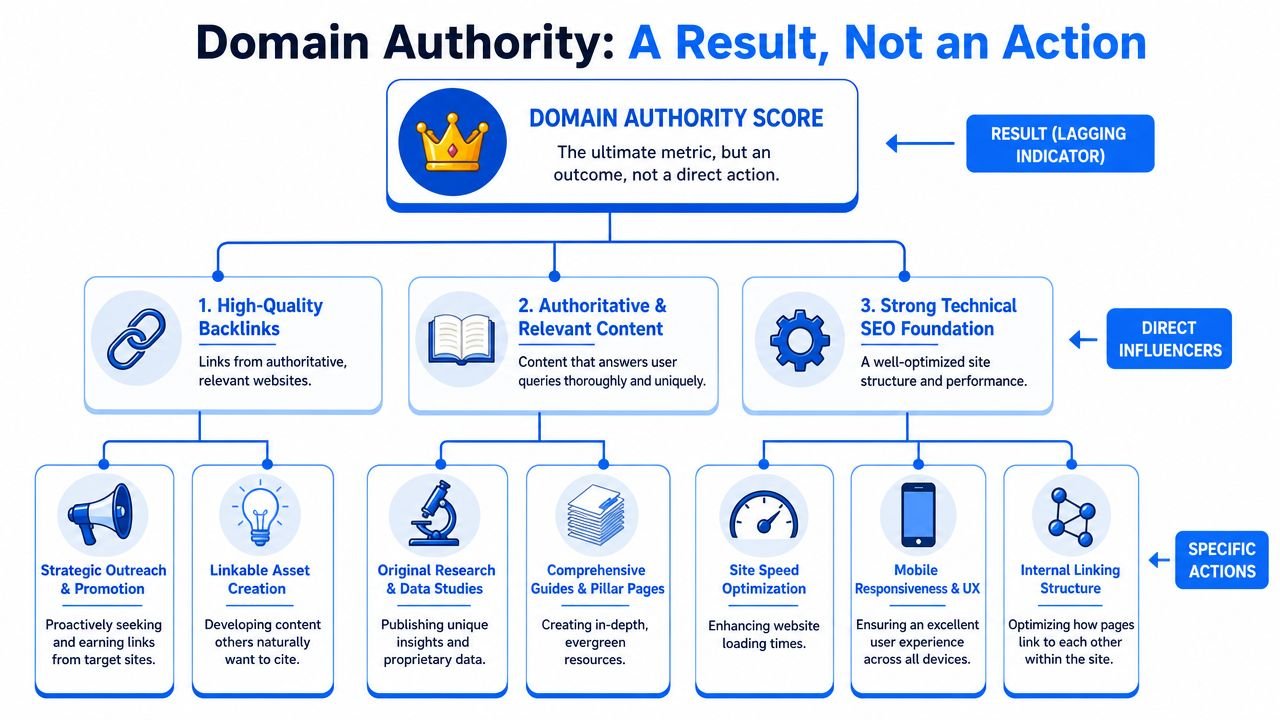
Organizations often get stuck because they try to improve DA directly. You can't. You can only improve the inputs behind it.
Moz's guidance is clear that earning “real links that drive traffic” is what improves both DA and rankings, and that spammy links are a poor bet because the model discounts bad links more effectively. That's why chasing raw volume usually disappoints, while trusted editorial links from relevant sites can change the picture much faster in practical terms, as explained in Moz's article on improving domain authority with real links that drive traffic.
Practical rule: If a tactic exists only to move a score and wouldn't survive manual scrutiny from a smart editor, don't build your strategy around it.
The more useful framing is this: authority is the byproduct of being cited. That means your SEO roadmap has to focus on assets worth citing, not just pages worth indexing.
A strong mental model for this comes from the relationship between links and ranking systems. If you want a deeper background on that logic, this guide to Google PageRank factors is a helpful companion.
What actually changes the score
The workflow that holds up in practice is simple. Build something worth linking to. Promote it to people who'd reference it. Distribute that earned authority through internal links. Clean up technical issues that block crawlers or waste link equity.
That sequence aligns with guidance summarized in Name.com's article on content, links, internal architecture, and technical cleanup, which points to link-worthy assets, clear heading structures, internal linking, and a fast mobile-friendly site.
Here's the trade-off that organizations generally need to accept:
- If you publish standard blog posts, you may rank for some long-tail terms, but you probably won't attract many editorial backlinks.
- If you publish reference assets, fewer pages can do more authority work because other sites have a reason to cite them.
- If you buy or spam links, you may see noise in reports, but not the kind of durable trust that compounds.
That last point matters most for early-stage SaaS and eCommerce brands. You usually don't need more pages first. You need better assets and stronger distribution behind them.
Your Starting Point An Honest Authority Audit
Before building anything new, look at the backlink profile you already have. Most sites aren't starting from zero. They're starting from a mix of useful links, irrelevant links, forgotten mentions, and pages that earned authority but don't pass much value to commercial URLs.
This audit isn't about collecting a giant spreadsheet. It's about answering three operating questions: what's helping, what's neutral, and what's dragging the profile down.
Audit your backlink profile by type not by total
Moz's documentation emphasizes that DA is driven primarily by aggregate link equity, so the priority is referring-domain quality over raw link volume, especially from authoritative and niche-relevant sites. It also points teams toward reducing spammy links rather than padding totals, as covered in Moz's guide to Domain Authority and link equity.
That means your first pass should sort links into buckets like these:
Editorial links from relevant sites
These are your best signals. They usually come from articles, resource pages, expert roundups, partner content, or product comparisons where the link makes contextual sense.Low-value noise
Think thin directories, scraper pages, syndicated junk, or auto-generated listings. These often add bulk without adding much trust.Potentially toxic or manipulative patterns
If you see strange networks, irrelevant foreign-language pages, spun content, or repeated anchor patterns, flag them for closer review.
Use tools like Ahrefs or Semrush to inspect referring domains, destination pages, anchor text, and link context. Then map links to the pages they support. You'll often find one research post attracting links while the money pages remain isolated.
A backlink profile can look big and still be weak. The question isn't how many rows are in the export. The question is whether credible sites in your category actually endorse your content.
A structured process helps. This website auditing checklist is a good framework for organizing technical and authority findings in one place.
Benchmark competitors by asset pattern
Don't benchmark competitors by DA alone. Benchmark them by what earned the links.
Open the backlink profiles of the sites that consistently outrank you. Then inspect their top-linked pages. You're looking for patterns such as:
- Original data assets that journalists and bloggers cite.
- Definitive guides that become the default reference in a niche.
- Comparison pages or calculators that solve a practical decision problem.
- Tool pages that attract recurring links because people keep using them.
Effective strategy emerges. If competitors attract links mainly to benchmark reports, and you keep publishing generic feature articles, the gap won't close through outreach alone. Your asset mix is wrong.
A useful audit output is a short decision sheet:
| Audit finding | What it means | What to do next |
|---|---|---|
| Competitors earn links to research pages | The market cites proprietary insight | Build a study, benchmark, or trend report |
| Competitors earn links to practical tools | Utility beats opinion in your niche | Create a calculator, grader, or template |
| Your strongest links point to blog posts only | Authority isn't reaching commercial pages | Improve internal linking from linked assets |
| Your profile has obvious junk | Noise may be diluting trust signals | Review and clean up harmful patterns |
If the audit is honest, your next content decisions get much easier.
Creating Link-Worthy Assets for SaaS and eCommerce
Most link building campaigns underperform for one simple reason. The outreach team is trying to sell an asset nobody needed in the first place.
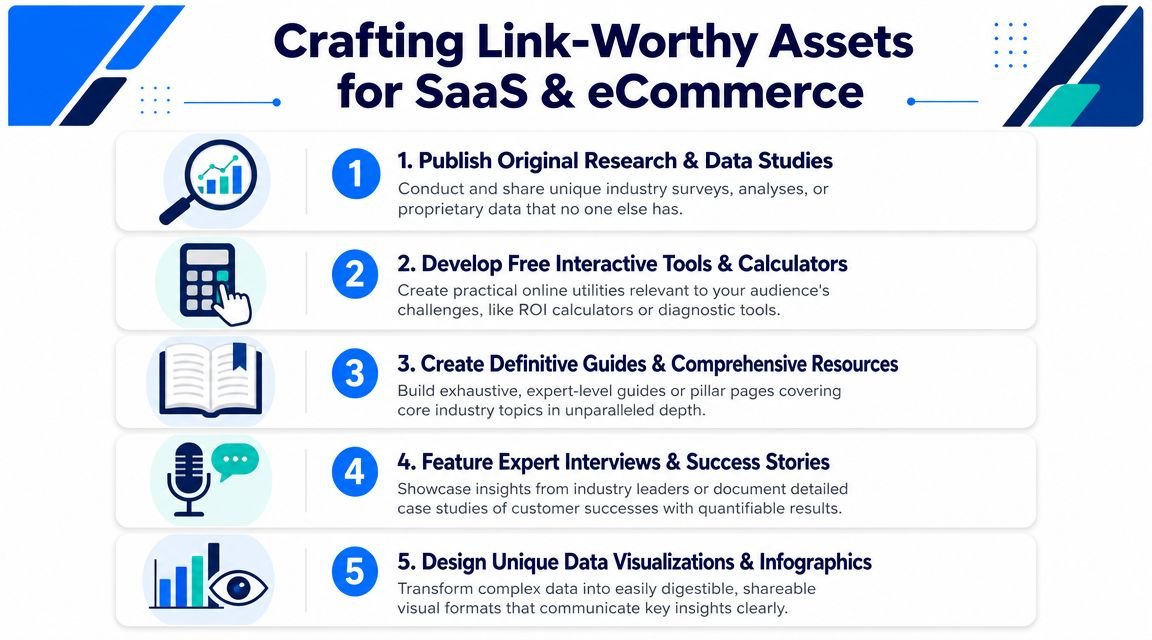
The strongest authority programs start upstream. They ask what type of page a busy editor, analyst, blogger, or partner would want to reference in their own work. That's how to improve domain authority in a way that lasts. You build citation targets, not just content inventory.
What earns links in SaaS
SaaS brands usually win links when they publish assets that reduce uncertainty for buyers or provide insight the market can't get elsewhere.
A few formats work repeatedly:
Original research
If your product touches workflow data, support trends, revenue operations, hiring, cybersecurity, finance, or usage patterns, package that insight into a report people can cite. The source of value is uniqueness.Free tools with a narrow use case
Broad tools are expensive. Narrow tools are often enough. A simple calculator, grader, checker, or template can attract links when it solves one recurring problem well.Expert guides tied to a hard problem
“Ultimate guide” is usually too broad. A guide built around a concrete implementation challenge performs better. Think migration planning, integration setup, procurement workflows, or compliance preparation.
Here's what that looks like in practice. A CRM startup shouldn't publish another vague article on “sales productivity tips” and expect links. It should publish a structured benchmark on pipeline hygiene, a calculator for rep capacity planning, or a field-by-field teardown of CRM implementation mistakes. Those are referenceable.
Operator view: If your asset can be replaced by a competent AI summary of existing content, it probably won't attract strong links.
What earns links in eCommerce
eCommerce needs a different angle. Product and category pages convert, but they rarely attract editorial citations on their own. The linkable assets usually sit one layer above the catalog.
The formats I'd prioritize are:
Buyer's guides with genuine expertise
Not thin affiliate-style content. Real decision guides that explain differences, trade-offs, fit, and usage context.Comparison resources
This can be a material comparison, feature matrix, size logic tool, care guide, compatibility explainer, or ingredient breakdown, depending on the category.Data-rich category explainers
If your team understands the market thoroughly, turn that into educational content with visuals, terminology help, and practical selection advice.
An example helps. If you sell standing desks, the linkable asset isn't “best standing desks for home office” rewritten for the hundredth time. It's a desk stability explainer, an ergonomics calculator, a materials guide, or a side-by-side comparison resource that reviewers and office publications can cite.
A good asset usually has three traits:
| Trait | Why it earns links | Typical format |
|---|---|---|
| Unique | It adds something new | Research, proprietary analysis, tool |
| Useful | It solves a recurring problem | Calculator, template, comparison |
| Durable | It stays relevant long enough to pitch repeatedly | Evergreen guide, glossary, benchmark hub |
The asset is the strategy. Outreach just reveals whether the strategy was strong enough.
A Practical Guide to Link Building Outreach
A common SaaS scenario looks like this. The team publishes a solid benchmark report, sends 150 emails, and gets almost nothing back. The problem usually is not volume. It is mismatch. The asset, the target list, and the pitch are aimed at different outcomes.
Outreach works best when it follows asset strategy. For SaaS and eCommerce, that means promoting pages with clear citation value, not trying to force links to product or category pages that were never built to earn them. The job is to put the right asset in front of the right editor with a reason to care now.
Here is the filter I use before any campaign goes live:
- If the asset contains original data, build a media and analyst list around the specific finding.
- If the asset solves a recurring problem, pitch resource pages, communities, and roundup posts that already link to tools or explainers.
- If the asset replaces something outdated, run broken link outreach against the exact pages citing the dead resource.
- If none of those are true, stop and improve the asset before scaling outreach.
That last point saves time. A weak page can still pick up a few links through persistence, but the cost per earned link rises fast, and link quality usually drops with it.
Match the outreach method to the asset
Different assets create different link patterns.
A SaaS security report is usually a digital PR asset. It has a news angle, a stat journalists can quote, and a reason for newsletters or industry blogs to cite it. An eCommerce sizing calculator behaves differently. It fits resource pages, buying guides, and forum threads where people need a practical reference. If you use the same pitch for both, reply rates fall because the editorial use case is different.
Three outreach motions cover most campaigns:
Broken link building
Find pages with dead citations that your asset can replace cleanly. This works best when the original source covered the same topic and your page is at least as useful.Resource page outreach
Pitch pages that curate tools, glossaries, guides, or reference materials. The standard is strict. Your asset needs to make that page better, not just give the site owner another outbound link.Digital PR for research assets
Lead with the finding and why it matters. Company-centric intros underperform here. Editors care about the angle, freshness, and whether the claim is easy to verify.
For teams building promotion around stronger versions of already-cited content, this guide to the Skyscraper SEO technique is a useful framework for choosing targets and positioning the replacement.
The email should answer one question
Why should this person care about this page?
Good outreach is specific. It references the page you are contacting, shows the fit in one or two lines, and makes a low-friction ask. Long intros, generic praise, and multiple link requests in one email hurt response rates.
The structure I use is simple:
Open with the exact context
Mention the article, resource page, or dead link you reviewed.Explain the fit
Show how the asset helps their readers, fills a gap, or replaces something outdated.Make one ask
Suggest one page. One edit. No extra asks.Leave room for a no
Editors protect quality. Respect that.
Keep the email short enough to scan on a phone. If the value is buried, the pitch is too long.
A lightweight template:
Subject: resource for your [topic] page
Hi [Name],
I was reading your piece on [specific topic] and noticed you referenced [related point or broken resource]. We recently published [asset type] covering [clear value].It might be useful for your readers here: [page context]. If it's a fit, happy for you to reference it.
Thanks,
[Name]
Choose tactics based on trade-offs, not habit
Every outreach motion has a different cost profile. The right choice depends on what you built, how defensible it is, and how much manual work your team can support.
| Tactic | Typical Effort | Potential Cost | Link Quality |
|---|---|---|---|
| Broken link building | Moderate research and personalized outreach | Low to moderate | Often strong if the replacement is relevant |
| Resource page outreach | Moderate | Low | Good when the asset is clearly useful |
| Digital PR for data content | High asset and targeting effort | Moderate to high | Highest upside for editorial links |
| Mass cold outreach to generic blog posts | Low personalization | Low to moderate | Usually weak |
| Paid link placements | Low effort operationally | Variable | Risky and often poor long-term value |
If a campaign feels harder than it should, treat that as feedback. Sometimes the list is wrong. Sometimes the pitch is weak. Often the asset does not give editors a strong enough reason to cite it.
Strengthening Authority with Technical and On-Page SEO
A strong backlink profile can still underperform if the site's structure is sloppy. Teams earn links to a report, a guide, or a tool, then forget to route that authority toward the pages that matter commercially.
That's fixable. You don't need a giant rebuild. You need deliberate internal architecture and a clean technical baseline.
Internal links decide where authority lands
Every high-authority asset should have a linking plan. If your benchmark report earns citations, it shouldn't sit as an isolated content island.
Connect it to:
- Commercial pages that are topically relevant
- Supporting cluster pages that deepen the theme
- Category or solution pages that benefit from stronger authority signals
The internal links need to make editorial sense. Don't jam pricing links into every article. Instead, move from topic authority to product relevance naturally. A SaaS security report can link to compliance pages. An eCommerce materials guide can link to collection pages that match the buying context.
Technical cleanup prevents wasted equity
Technical work doesn't usually create authority. It protects it.
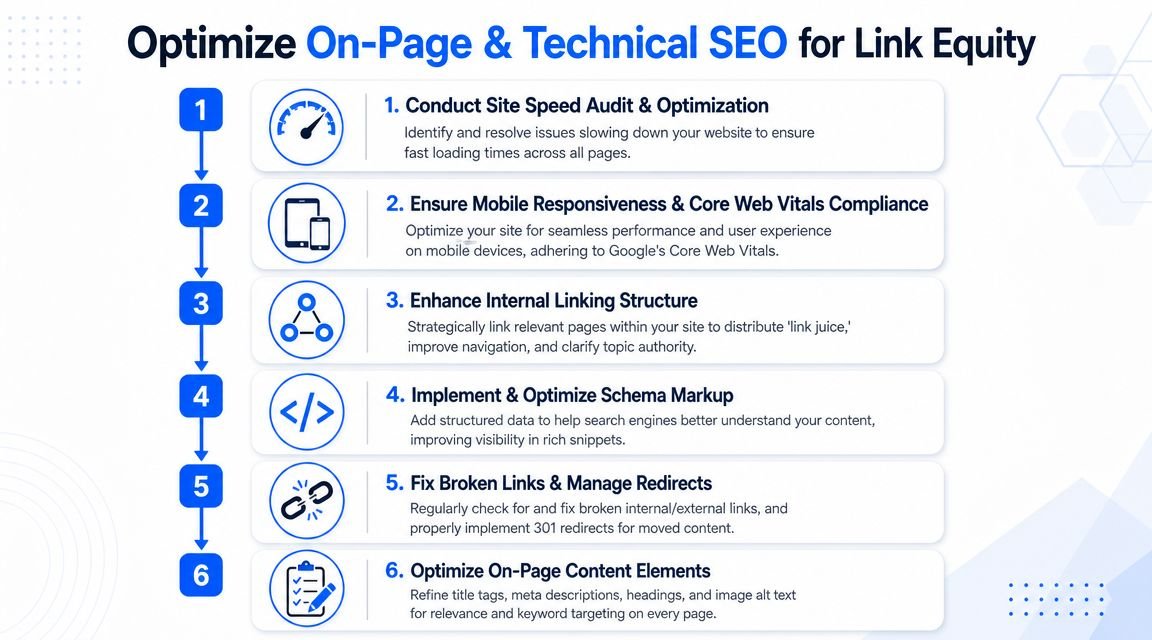
Use a recurring checklist focused on the basics:
Speed and mobile usability
Slow pages waste the value of good traffic and make linked assets less effective.Crawlability
Important pages should be easy for search engines to reach and understand.Broken links and redirect logic
If linked pages break, move, or redirect badly, you lose value and create friction for users and crawlers.Clear heading structures
Strong page structure helps both readability and topical clarity.
The simplest question to ask is this: if a high-quality publisher links to this page tomorrow, will my site make full use of that trust?
Teams often overcomplicate technical SEO. For authority-building, the fundamentals do most of the work.
Measuring Growth and Setting Realistic Timelines
The hardest part of authority work isn't execution. It's expectation management. People want a visible score increase fast, even when actual gains appear first in subtler signals.
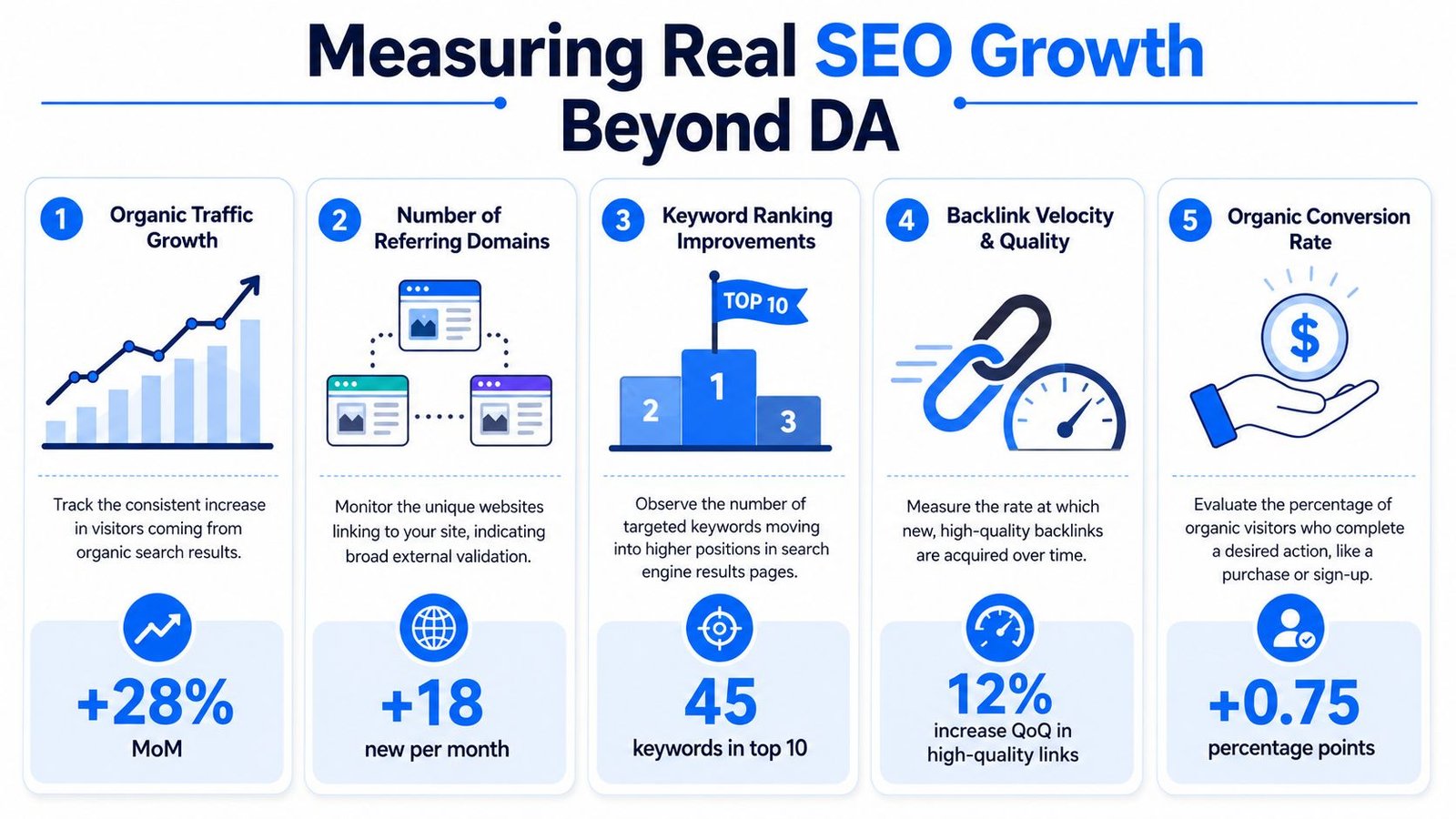
That's why reporting needs to focus on movement you can act on, not just a number you observe.
Track leading indicators before you celebrate score changes
A practical dashboard should include:
New referring domains
Not just quantity, but whether they're relevant and credible.Linked page performance
Watch whether pages that earn links gain visibility, traffic, and downstream page engagement.Target keyword movement
Especially for pages supported by stronger internal links from linked assets.Backlink quality pattern
Ask whether your recent links look stronger than your older links. Trend quality matters more than random accumulation.
A useful reporting habit is to separate leading indicators from lagging indicators. Leading indicators show whether the strategy is working now. Lagging indicators, like DA, confirm whether the market has recognized that work over time.
Set expectations like an operator
Authority growth is slow because trust is cumulative. A 2026 guide notes that new sites should expect 6 to 12 months for meaningful authority growth, which fits the reality that authority reflects accumulated trust rather than one successful campaign, as noted in Wellows' article on domain authority growth timelines.
That means your messaging to stakeholders should sound like this:
- If the site is new, expect foundational work first. Crawlability, internal linking, and asset production come before visible authority gains.
- If the site already has some traction, focus on better assets and better referring domains, not more content for the sake of volume.
- If the site has many links but weak outcomes, inspect quality, relevance, and internal distribution before investing in more outreach.
The teams that win at this treat authority like a compounding asset. They publish fewer disposable pages, invest more in citation-worthy assets, and keep refining the distribution system around them.
If you want to know how to improve domain authority, that's the answer. Build things worth citing. Earn links from sites that matter. Route that value carefully through your site. Then give it enough time to compound.
If your team wants a practitioner-led partner for SaaS and eCommerce link acquisition, SaasSky is built for exactly that. They focus on transparent execution, accountable strategy, and authority growth tied to assets that can earn relevant links.