Most advice about google page rank factors is still stuck in a dead framework. It treats PageRank like a standalone score, a relic from the toolbar era, or a simple numbers game where more backlinks automatically means better rankings.
That's not how strong SEO teams should think about it.
PageRank matters, but not as a single visible metric you can optimize in isolation. It matters as the foundational concept of link-based authority. Google started with that concept, then layered relevance, site quality, internal architecture, and many other systems on top of it. If you run SaaS or eCommerce SEO with that mental model, your decisions get better fast. You stop chasing random links and start building authority that supports pages that can rank, convert, and compound.
A lot of brands don't fail because they ignore links. They fail because they misunderstand what links are supposed to do.
Table of Contents
- From Myth to Modern Strategy The Truth About PageRank
- What Google PageRank Was A Simple Model of Authority
- The Evolution from PageRank to Complex Ranking Systems
- Today's Core Google Ranking Pillars
- The Undeniable Power of Link-Based Authority
- Link Building Playbooks for SaaS and eCommerce
- How to Measure the Real Impact of Your Link Building
- Frequently Asked Questions About Google Ranking
From Myth to Modern Strategy The Truth About PageRank
PageRank isn't dead. The public score is gone, but the underlying idea never disappeared.
Google's own documentation still identifies PageRank as one of the core ranking systems used when Google first launched, and also says its systems understand how pages link to each other to determine which pages may be most helpful, as described in Google's ranking systems guide. That matters because the actual legacy of PageRank isn't a badge. It's authority flowing through the web graph.
A better way to think about PageRank in 2026 is this. It's the base layer of off-page trust, not the whole ranking model. A strong backlink profile can push a page into contention. It can't rescue a weak page, a badly structured site, or content that doesn't deserve attention.
That distinction changes strategy.
For SaaS, this means links should support pages that explain products clearly, capture demand across comparison and use-case terms, and pass authority into bottom-funnel pages through internal links. For eCommerce, it means category architecture, crawlable collections, and editorial content often determine whether earned authority reaches revenue-driving URLs.
Practical rule: Don't ask whether PageRank still matters. Ask whether your site is structured to turn authority into rankings and revenue.
Teams that build links without that layer usually waste budget. Teams that pair link acquisition with strong site architecture usually make the gains stick.
If you want to understand how practitioner-led teams approach authority building, the positioning on SaasSky's About Us page reflects that more operational view.
What Google PageRank Was A Simple Model of Authority
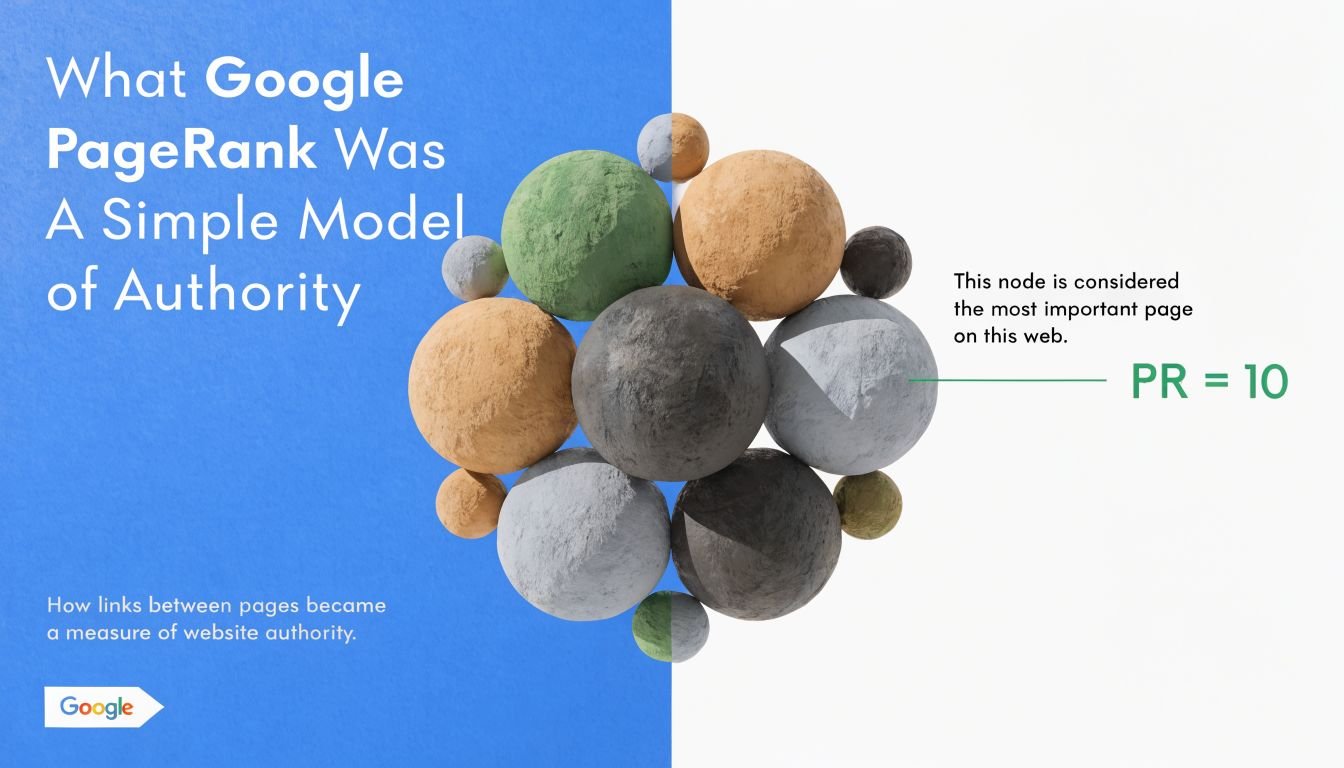
Google PageRank started with a simple idea. A link from one page to another can act like a citation.
In 1998, Google introduced PageRank as part of the original search engine. The classic formulation used a damping factor of around 0.85, meaning there was an 85% chance a random surfer would keep following links and a 15% chance of jumping to a random page, which helped prevent rank from getting trapped in loops, according to Stanford's PageRank algorithm handout.
Links were never all equal
The easiest analogy is academic publishing. If an unknown paper gets cited by a major journal, that citation carries more weight than one from an obscure source. PageRank worked in a similar way.
A page could gain authority from:
- More incoming links, because multiple citations suggested broader importance
- Stronger linking pages, because authority from respected pages carried more value
- Tighter outbound link profiles, because a page with fewer outgoing links diluted less authority
That last point still trips people up. A link from a page that points everywhere isn't the same as a link from a focused editorial page with a short set of references.
Why this model changed search
Before link-based ranking, search could lean too heavily on on-page text signals. PageRank added a second layer. It asked the web what it trusted.
Stanford's example also shows how the math worked in practice. In a simple link graph, page E receives weighted contributions from pages C and D and ends at about PR(E) = 0.17 after iteration in the handout linked above. You don't need to calculate that by hand today. You do need to understand the strategic implication.
A page's authority wasn't just about how many links it had. It depended on who linked to it, and how concentrated that authority remained.
That original model explains why old-school link spam was always a fragile tactic. It focused on quantity while ignoring quality and dilution. The core mechanics made that weakness visible from the beginning.
The Evolution from PageRank to Complex Ranking Systems
The original model was elegant, but it was blunt. It treated links more uniformly than modern search could afford to.
A major shift came with the reasonable surfer model. As summarized in SE Ranking's review of PageRank history, Google's updated thinking treated links as having different values based on how likely users were to click them. Links near the top of a page or links with more descriptive anchor text could pass more value than buried footer links, as outlined in this reasonable surfer summary.
That one shift changed how experienced SEO teams evaluate links.
Placement became part of quality
A contextual link inside the main body of a well-written article usually means more than a buried sitewide placement. Not because it looks nicer in a report, but because Google's model evolved toward probability and visibility.
That leads to practical filters when judging opportunities:
- Editorial context matters more than raw domain labels
- Anchor text clarity matters when it describes the destination naturally
- Page layout matters because prominent links are more likely to earn attention
- Link attributes matter because not every link passes value the same way
Many outreach campaigns fail at this specific stage. They secure placements that exist only for SEO, then wonder why rankings barely move.
PageRank became one system inside a much bigger stack
Modern Google doesn't rank pages with one formula. It uses many systems and signals across an enormous document set. Link-based authority still matters, but it now works alongside topical relevance, indexing, site quality, and query interpretation.
For marketers, that means two things are true at once. First, links still shape competitive ceilings. Second, links don't decide outcomes by themselves.
If the old question was “how many backlinks do we need,” the better question now is “which links strengthen the right pages in the right context?”
That's a stricter standard. It's also much closer to how useful SEO programs win.
Today's Core Google Ranking Pillars
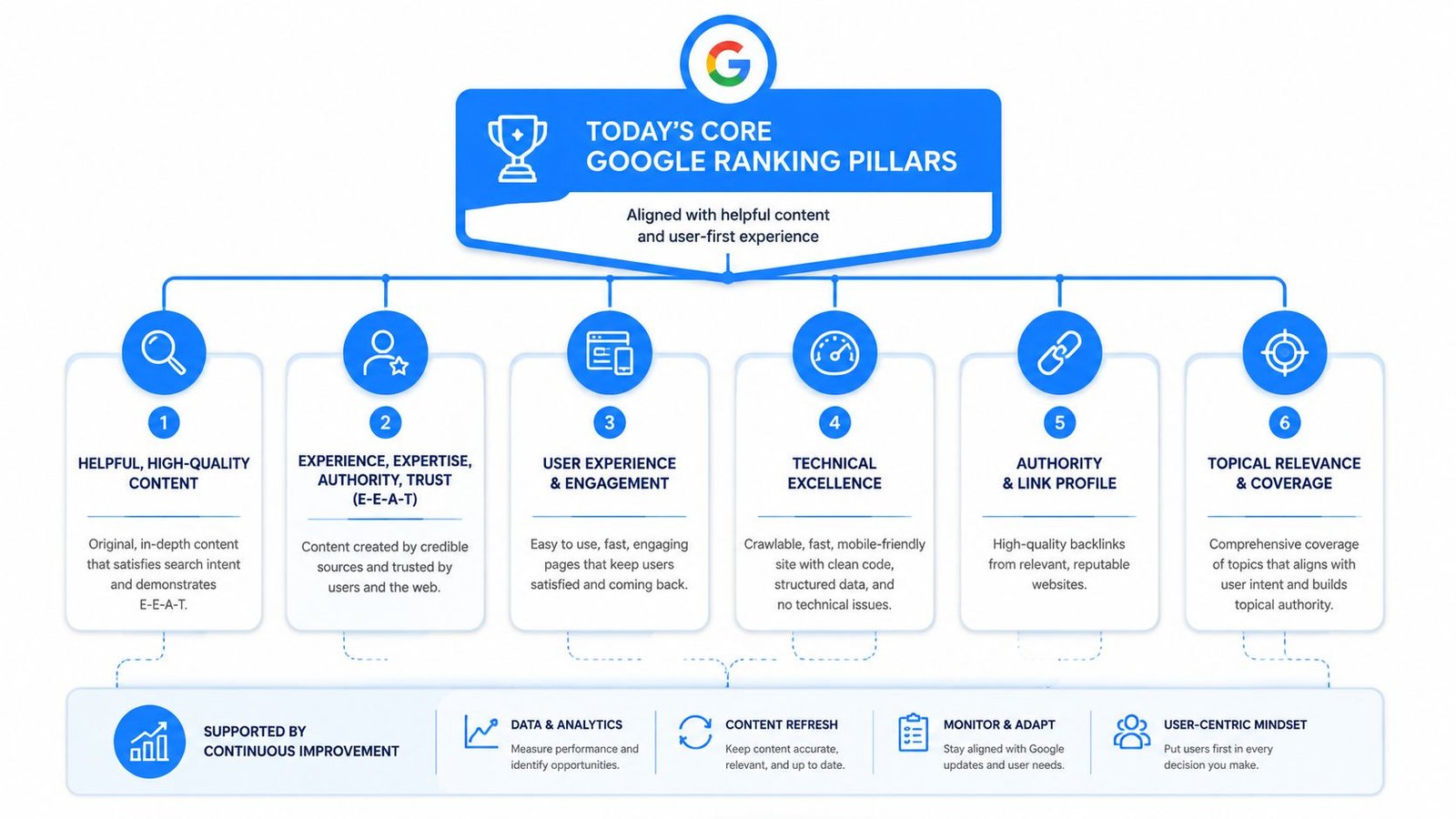
Ranking conversations get worse, not better, when teams obsess over giant lists of "factors." The useful view is simpler. Google evaluates pages through a mix of systems, and PageRank's legacy shows up inside one broader question: does this page deserve to win for this query on this site?
That matters because strong backlinks alone rarely rescue weak execution. A page can attract authority and still underperform if the content misses intent, the site structure blocks discovery, or the overall experience feels thin.
Link-based authority sets the ceiling
PageRank started as a model of link authority. That concept still matters because Google still needs ways to judge which pages and domains have earned trust beyond their own claims.
For SaaS brands, that usually means earning links to pages that shape category understanding and buyer evaluation: original research, product-led resources, comparison content, and strong commercial education pages. For eCommerce brands, the goal is often less glamorous and more profitable. Category pages, buying guides, and high-margin collections need authority too.
A common mistake is sending every hard-won link to the blog while revenue pages stay weak.
Relevance decides whether the page can convert authority into rankings
Authority gets a page into the race. Relevance decides whether it stays there.
If a page does not match the query, cover the topic well, or offer a better answer than the current results, more links will not solve the core problem. I see this often on SaaS comparison pages that read like feature dumps, and on eCommerce category pages that list products without helping the buyer choose.
Teams that treat links as the whole strategy usually end up funding content repairs later.
Technical SEO controls how signals flow
Google has to crawl the page, understand it, consolidate duplicates, and connect it to the rest of the site. If those basics break, authority and relevance lose value on the way in.
This pillar usually comes down to a few operational questions:
- Can important pages be crawled and indexed without friction?
- Does internal linking route authority to priority URLs?
- Does site architecture reflect how topics and categories relate?
- Are canonicals, faceted URLs, and duplicates under control?
For SaaS, this often shows up in documentation, template pages, and comparison hubs that sit too far from the pages that earn links. For eCommerce, it usually shows up in faceted navigation, duplicate category paths, and orphaned seasonal pages.
Trust and page quality shape competitive outcomes
Google does not need a page to look polished. It does need signals that the page is credible, useful, and built for the visitor rather than for an SEO checklist.
That standard is easy to miss. Thin product descriptions, copied manufacturer copy, weak author signals, cluttered layouts, and vague claims all reduce confidence. On the SaaS side, this often appears on solution pages with broad promises and little proof. On the eCommerce side, it appears on category and product pages with weak detail, poor filtering, and no real buying guidance.
A practical way to pressure-test these pillars is to review them together:
| Pillar | Main question | Common failure mode |
|---|---|---|
| Link-based authority | Does this page have enough external trust to compete? | Building links that never strengthen revenue-driving URLs |
| Content relevance | Does the page satisfy the query better than current results? | Publishing pages that target terms without meeting intent |
| Technical SEO | Can Google crawl, process, and connect the page correctly? | Letting internal linking and duplication waste authority |
| Trust and page quality | Does the page give users confidence to stay and act? | Thin templates, weak proof, and poor commercial usability |
The strategic point is balance. Strong SEO programs do not chase PageRank as if it were a standalone factor. They use link authority as one part of a system that has to support rankings, revenue, and site-wide credibility at the same time.
The Undeniable Power of Link-Based Authority
If every team can produce content faster than ever, authority becomes more valuable, not less.
AI has made content supply abundant. It hasn't made editorial trust abundant. That's why earned links still create separation. They're harder to fake at scale, harder to replicate quickly, and often tied to genuine usefulness or brand recognition.
According to the PageRank overview on Wikipedia's PageRank entry, the model is a link-graph propagation system where a page receives more value from high-authority pages and from pages with fewer outgoing links. That same source also notes that a graph with 322 million links converged in 52 iterations, which shows how efficiently the model could scale across very large networks.
Why a few strong links can outweigh many weak ones
This is the part many link vendors avoid explaining. Link equity doesn't move evenly.
A relevant editorial mention on a respected page can do far more than dozens of low-context placements because:
- Source page strength matters
- Outbound link dilution matters
- Context matters, especially when the link is embedded inside the main argument
- Destination fit matters, because authority landing on the wrong page leaks business value
That's why smart programs focus on link targets before outreach starts. If the destination page can't rank or convert, the link may still be “earned” but the campaign was poorly designed.
Strong link building is less about collecting backlinks and more about routing authority into pages that can produce revenue.
What usually doesn't work anymore
A lot of low-end SEO still sells the appearance of momentum. The reports look busy. The rankings don't hold.
Weak patterns usually include:
- Sitewide placements with little editorial logic
- Footer and directory links added because they're easy to get
- Untargeted homepage links when a category or feature page needed support
- Volume-first campaigns that ignore topical fit
For SaaS and eCommerce brands, the trade-off is simple. Fewer links with stronger context usually beat broad acquisition from pages nobody reads and search systems can discount.
Link Building Playbooks for SaaS and eCommerce
The strongest link campaigns don't start with outreach. They start with something worth citing.
Practitioner coverage increasingly argues that information gain and topical authority are being rewarded more directly, and that pages may need only a limited amount of link equity if they satisfy intent better and provide more unique value, as discussed in this practitioner video on information gain and topical authority.

SaaS playbook build assets people cite
SaaS teams often have a hidden advantage. They sit on product usage patterns, workflow insight, customer pain points, and implementation knowledge that generic publishers don't have.
That can become links when you turn it into assets such as:
- Original data stories drawn from product or market observations
- Deep comparison pages that explain trade-offs buyers care about
- Operational templates like checklists, calculators, and process frameworks
- Expert explainers tied to a product problem your team understands better than publishers do
The key is to make the asset useful on its own. Outreach works better when you're promoting something a writer would cite even if SEO didn't exist.
A practical reference point for how this can be packaged in a campaign is the Qodo case study from SaasSky.
eCommerce playbook earn links around products and categories
eCommerce brands often make a tactical mistake. They push all link activity toward the homepage because it feels safest.
In practice, better opportunities often sit around category education and product-led editorial content. Think buying guides, care guides, compatibility explainers, gift roundups, ingredient or material breakdowns, and expert commentary tied to shopping decisions.
Good eCommerce campaigns usually combine:
- Commercially adjacent editorial assets that can attract links naturally
- Digital PR angles tied to products, trends, seasonality, or expert input
- Internal links that push earned authority into category and product-cluster pages
A shared rule for both models
The best playbooks create a triangle between linkability, search intent, and commercial relevance.
If you only optimize for linkability, you earn links to pages that never help pipeline or revenue. If you only optimize for commercial relevance, you end up with pages nobody wants to reference. If you only optimize for intent coverage, you may rank briefly without building durable authority.
Build pages that deserve links, satisfy the query, and connect cleanly to money pages.
That's the version of link building that still works.
How to Measure the Real Impact of Your Link Building
The weakest way to measure link building is to count links. That tells you activity happened. It doesn't tell you whether the campaign moved the business.
A useful reporting model follows the path from authority to outcome. The sequence is simple. Did the linked page get stronger. Did rankings improve for the right queries. Did traffic increase. Did that traffic create leads, demos, sales, or assisted conversions.
If you want examples of how agencies package proof, the structure on SaasSky's case studies page is close to what internal teams should mirror in their own reporting.
What to track instead of raw link counts
Use a mixed dashboard. Pull from Google Search Console, Google Analytics, Ahrefs, Semrush, and your CRM.
Focus on signals like:
- Target keyword movement for the destination page and nearby pages in the same cluster
- Organic landing traffic to linked URLs
- Internal page uplift on pages that receive authority through internal links
- Referral traffic from placements that send actual visitors
- Conversion events tied to organic sessions on influenced pages
- Assisted revenue or pipeline when your attribution model supports it
The real question isn't whether a backlink was built. It's whether the backlink improved the earning power of a page or page group.
Sample Link Building Impact Dashboard
| Metric | Tool for Measurement | What It Measures | Why It Matters |
|---|---|---|---|
| Ranking position for target queries | Google Search Console, Ahrefs, Semrush | Visibility change on priority keywords | Shows whether authority is improving competitive reach |
| Organic sessions to linked pages | Google Analytics, Search Console | Traffic growth on destination URLs | Connects links to actual search demand capture |
| Referral visits from placements | Google Analytics | Direct visits from linking articles | Reveals whether the placement has audience value, not just SEO value |
| Indexed status of target pages | Google Search Console | Whether Google can use the page in search | Prevents authority from being wasted on inaccessible URLs |
| Internal traffic flow to money pages | Analytics, heatmapping, internal link audits | Whether users move from linked assets to commercial pages | Tests if authority and user attention support conversion paths |
| Leads, trials, purchases, assisted conversions | CRM, ecommerce platform, analytics | Business outcomes from influenced pages | Turns SEO reporting into revenue reporting |
A compact dashboard like this keeps teams honest. It also exposes where the bottleneck really is. Sometimes links aren't the problem. Sometimes the page, funnel, or internal linking system is.
Frequently Asked Questions About Google Ranking
PageRank still creates confusion because teams treat it like a live score they can optimize in isolation. In practice, the useful question is simpler. Does a link, or a link path inside your site, increase the odds that an important page earns visibility and revenue?
Are nofollow links completely useless
Nofollow links still have practical value. A mention in a respected industry publication can send qualified referral traffic, get a new page discovered faster, and put your brand beside topics Google already understands.
For SaaS, that often means review sites, community threads, and editorial roundups. For eCommerce, it can mean publisher gift guides, creator mentions, and marketplace profiles. I would not build a campaign around nofollow links alone, but I would absolutely keep them if they put the brand in front of the right audience and support a natural link profile.
How much do internal links contribute to authority
On large sites, internal links often decide whether external authority reaches pages that matter.
A common SaaS problem is earning links to research or blog content while trial, feature, and solution pages stay weak. A common eCommerce problem is sending authority into category pages but failing to pass enough of it to high-margin subcategories or product detail pages. The fix is usually structural, not promotional. Clean hub pages, sensible navigation, contextual links from strong editorial assets, and fewer orphaned URLs.
Teams that ignore internal linking usually end up paying twice. First to get the backlink, then again to fix the architecture that should have distributed that value in the first place.
How long does it take for a new backlink to have an effect
The honest answer is that it depends on crawl speed, indexation, target page quality, internal link support, and query competition.
Sometimes the effect shows up quickly on pages that were already close to page one. Sometimes nothing happens for weeks because the linking page is weak, the destination URL is poorly aligned with intent, or the rest of the site sends mixed signals. In client work, I look for early movement in impressions, query spread, and average position before expecting meaningful traffic gains. Rankings usually move before revenue does.
Do backlinks still matter if content is much better than competitors
Yes, especially in SERPs where several pages already satisfy intent well.
Better content can win without many links on low-competition topics or newer query spaces. Once you move into commercial SaaS terms or high-value eCommerce categories, authority usually becomes the separator. Two pages can be equally useful to a searcher. The one backed by stronger link signals, cleaner internal support, and better overall site trust tends to hold the advantage.
If your team wants a partner focused on authority that moves rankings and revenue, SaasSky is built for SaaS and eCommerce brands that care about transparent execution, measurable outcomes, and link building tied to real business goals.