You're probably in the middle of a budgeting conversation right now.
A founder asks for a serious SEO plan. One agency quotes a modest monthly retainer. Another prices every placement separately. A third promises a stack of links for less than the cost of one sales call. On paper, all three are selling “link building.” In practice, they're selling very different things, with very different odds of producing revenue.
That's why most articles about link building pricing leave buyers stuck. They answer the easy question, which is what a link costs. They skip the harder one, which is what a result costs. For SaaS and eCommerce teams, that second question matters more. A cheap link that never moves rankings, never earns trust, and never supports pipeline is expensive. A higher-cost placement that helps a commercial page climb, convert, and compound can be the better buy.
Table of Contents
- Why Is Link Building Pricing So Confusing
- The Three Core Link Building Pricing Models
- Typical Link Building Price Ranges in 2026
- Key Factors That Influence Link Cost
- How to Budget for Link Building and Calculate ROI
- Choosing the Right Partner and Spotting Red Flags
- Real-World Examples from SaasSky Campaigns
Why Is Link Building Pricing So Confusing
A SaaS founder gets three proposals in the same week.
The first offers a low fee and a fixed number of backlinks. The second pitches “editorial authority” but avoids firm deliverables. The third says it can secure placements fast if the brand is flexible on site quality. All three decks use the same vocabulary. None of them mean the same thing.
That's the root problem. Link building pricing looks inconsistent because the underlying product isn't standardized.
Strategy, inventory, and risk get mixed together
Some providers are pricing manual outreach, content creation, relationship building, prospect review, and campaign management. Others are pricing access to pre-existing publisher inventory. Others are bundling light outreach on top of sites that openly sell placements. To a buyer, these can all look similar because the output is still “a backlink.”
But the trade-offs aren't similar at all.
- Strategic outreach usually takes more time, more judgment, and better content.
- Inventory-driven placements are faster to quote because the supply is already known.
- Low-end offers often look efficient because they hide the downside in quality, replacement cost, or long-term risk.
Practical rule: If one proposal is dramatically cheaper than the others, don't start by asking how they cut cost. Start by asking what they removed.
Founders often compare line items instead of outcomes
Early SEO budgeting usually starts with the wrong comparison. Teams ask, “How much per link?” when they should ask questions like these:
- Which pages are we trying to move
- What kind of referring sites would help those pages
- How much internal time will this campaign consume
- How long will it take before we know whether the spend is working
A link is not a commodity in the same way cloud storage or ad impressions are. Relevance, editorial quality, placement context, and business fit all change the value. That's why two agencies can quote very different numbers and both be “correct” within their own model.
Confusion usually disappears once you stop pricing the artifact and start pricing the system that produces it.
The Three Core Link Building Pricing Models
Think of link building pricing like ordering from three different menus. One charges per item. One charges for a chef's tasting menu every month. One charges for a fixed event package. None is universally best. The right choice depends on your stage, your trust in the provider, and how tightly you need to control spend.
Why the same service gets priced three different ways
Pay-per-link is the easiest model to understand. You buy individual placements, usually with agreed quality parameters. Founders like it because the math feels clean. If a provider says a placement costs a certain amount, the budget looks predictable.
The problem is incentives. A strict per-link model can push providers toward what's easiest to close rather than what's hardest to win and most valuable to the business.
Monthly retainer shifts the conversation from transactions to ongoing work. You're paying for strategy, prospecting, outreach, follow-up, content coordination, quality control, and reporting. This model fits companies that want compounding results, not a sporadic batch of placements.
The downside is that retainers require trust. If reporting is weak or strategy is vague, a retainer can feel like paying for motion instead of progress.
Project-based pricing sits in the middle. It's common when a company needs a defined campaign around a product launch, a content asset, or a priority topic cluster. The scope is narrower than a retainer, but more strategic than ad hoc link purchases.
How to choose the right model
Here's the quick comparison most buyers need.
| Model | Best For | Pros | Cons |
|---|---|---|---|
| Pay-per-link | Teams testing a vendor or filling specific gaps | Clear unit pricing, easy to compare proposals, useful for narrow needs | Can reward quantity over fit, may ignore strategy, often weak for sustained growth |
| Monthly retainer | SaaS and eCommerce brands treating SEO as a growth channel | Supports planning, outreach systems, content coordination, and compounding authority | Needs trust, can feel opaque if deliverables and reporting aren't sharp |
| Project-based | Launches, linkable assets, or time-bound campaigns | Defined scope, easier internal approval, useful for one priority initiative | Less flexible if priorities change, may stop before momentum builds |
A simple way to choose:
- Use pay-per-link when you need to test quality before committing.
- Use a retainer when SEO is expected to influence pipeline or revenue over time.
- Use project pricing when you have a narrow window, a clear asset, and one business objective.
The wrong model creates friction even when the provider is competent. A founder wanting strict budget control will hate a vague retainer. A growth team needing sustained execution will outgrow one-off placements fast.
The pricing model should fit the operating style of the business, not just the procurement preference of the buyer.
Typical Link Building Price Ranges in 2026
A SaaS founder approves a $6,000 monthly SEO budget, then gets three link building proposals that look nothing alike. One promises 10 links. One promises 4 to 6 placements plus strategy. One avoids link counts and talks about authority growth. The price gap feels irrational until you stop asking what a link costs and start asking what outcome the spend is meant to buy.
The cleanest public benchmark still comes from BuzzStream's link building pricing benchmark. Their analysis found guest post links averaged $365 when bought directly from a site and $1,459.06 through a vendor, while high-quality placements averaged about $930 before vendor markup. They also note that buyers pursuing a high-quality, non-syndicated, dofollow link should expect to spend at least $1,500.
Those numbers are useful as budgeting guardrails, not shopping targets.
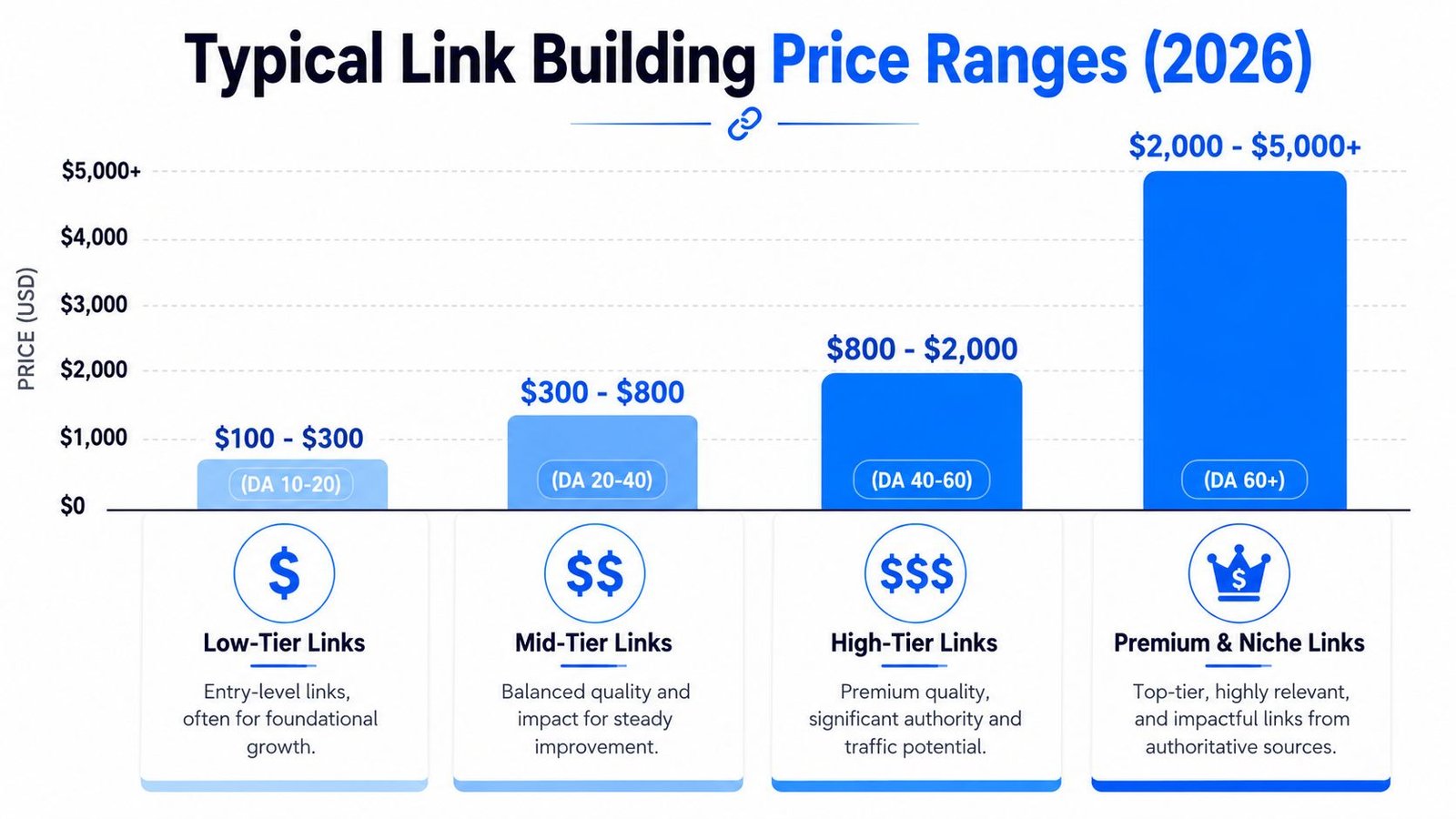
In practice, 2026 pricing usually falls into a few broad bands:
- Lower-cost placements often sit in the few-hundred-dollar range. These are usually easier to source, less selective editorially, or weaker on relevance.
- Mid-range editorial links tend to cost more because the site is stronger, the outreach is harder, and the content fit matters more.
- Premium placements can run into four figures when the referring site is trusted, niche-relevant, and difficult to access.
That price spread exists for a reason. A vendor is not only selling a URL on a site. You are paying for prospecting, vetting, outreach, relationship management, content coordination, editing, follow-up, and the risk that many targets say no before one says yes.
This is also why per-link comparisons often fail in board meetings. A $400 link that never influences rankings, demo signups, or assisted revenue is expensive. A $1,200 link that helps a commercial page move into the top results and produce qualified pipeline can be cheap.
If you need broader budget context, this breakdown of the average cost for SEO services is useful because link acquisition rarely works as a standalone line item for long. It usually sits inside a larger SEO program with content, technical work, and reporting.
Why averages can mislead buyers
Average pricing hides the part that matters to operators: total cost of ownership.
A direct publisher fee is only one layer of cost. Managed campaigns add strategy time, quality control, replacement risk, content production, account management, and reporting. Those costs are not waste if the campaign is producing rankings on pages that matter to revenue. They are waste if the links are pointed at the wrong pages, built on weak sites, or measured only by volume.
Three buyers can spend the same amount and get very different outcomes:
- One buys cheap placements in bulk and gets little ranking movement.
- One buys fewer, better-fit links to product and comparison pages and sees qualified traffic improve.
- One overpays for authority metrics that look good in a spreadsheet but have little business relevance.
The useful question is not “What is the average price per link?”
It is “What level of spend gives us a realistic shot at rankings, traffic, and revenue impact in our category?”
Key Factors That Influence Link Cost
A founder approves a link budget, sees a clean per-link number, and assumes the hard part is done. Three months later, rankings barely move because the links went to easy blog posts, the sites had weak topical fit, and nobody asked what those placements were supposed to accomplish for pipeline or revenue.
That is why link cost has to be judged in context. The invoice reflects more than access to a domain. It reflects how hard the placement is to earn, how relevant it is to the page you are trying to rank, and how likely it is to contribute to a result that matters.
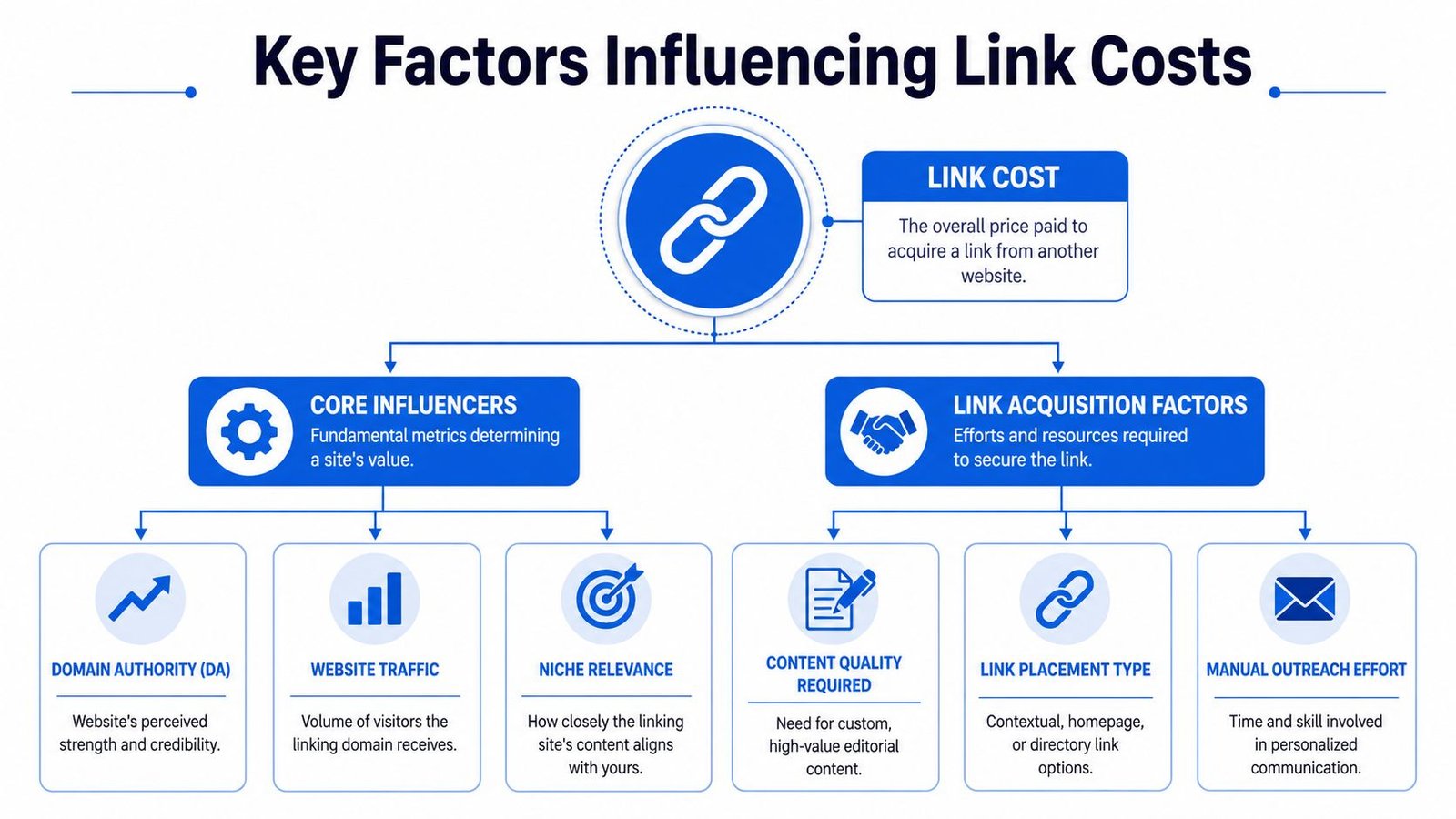
The biggest pricing variable is usually fit.
A link from a site your buyers actually read can outperform a stronger-looking metric from a generic publisher. SaaS companies feel this quickly. A homepage or feature page often needs links from adjacent software, operations, finance, HR, security, or developer publications, not random high-DR blogs that publish on everything. Relevance narrows your options, and narrower supply usually means higher cost.
Editorial standards also change the price. Some publishers will accept a contributed article if the topic is solid and the content meets their bar. Others require original research, a strong expert angle, multiple edits, or a relationship built over time. That extra work shows up somewhere in the quote, whether you buy links one-off or through a managed service.
The placement itself matters too:
- Context on the page. An in-content link inside the main argument is usually more useful than a link in an author bio, resource box, or lightly edited insert.
- Target page type. Supporting a commercial page, comparison page, or category page is often harder than building links to a top-of-funnel blog post.
- Traffic and site quality. Domains with real search visibility, active editorial upkeep, and stable pages tend to cost more because they are harder to fake and harder to access.
- Content requirements. Original writing, data pulls, subject-matter input, design support, and legal review all raise total campaign cost.
- Replacement risk. Cheap vendors often ignore link decay, noindex changes, content swaps, and silent removals. Fixing those later adds cost you did not budget for.
Buyers frequently overlook the total cost of ownership. The cheapest quote can become the expensive one if your team has to spend hours reviewing junk sites, rewriting weak content, replacing dead links, and explaining flat results in the next board meeting.
Operating model affects cost as much as site metrics. If you hire internally, you pay for sourcing, outreach, content coordination, QA, and management time. If you outsource, you are paying another team to run that system for you. Founders comparing those options should look at the full workload, not just publisher fees. This guide on when to outsource link building is useful if you are deciding whether to build the function in-house or buy execution.
A good provider should be able to explain the economics behind a quote in plain terms. Why this site. Why this page. Why this format. Why this target URL. How does this link support a ranking goal tied to qualified traffic or revenue potential.
If they cannot answer those questions, the per-link price is not your main risk. The main risk is paying for activity that looks efficient and produces very little.
How to Budget for Link Building and Calculate ROI
Link building is frequently budgeted in reverse. A common method involves picking a round number, asking what it buys, and then hoping the results justify the spend.
A better approach is to start with the business case. Which pages matter most. What would improved rankings on those pages be worth. How much authority lift is realistically required. That sequence won't produce perfect forecasting, but it creates a budget you can defend.

A 2025 pricing analysis says agencies commonly charge from $1,000 to $10,000+ per month, with enterprise campaigns starting at $10,000. The same analysis puts an in-house team at about $112,000 per year or $9,333 per month before overhead, according to Third Street Software's 2025 pricing breakdown.
Budget from business goals, not from a random link target
Those ranges are helpful because they force a more honest conversation. If a founder wants steady link acquisition, content support, outreach operations, and reporting, that work has to live somewhere. Either you hire internally, or you buy external execution.
The budgeting question becomes less emotional when framed this way:
- What pages are tied to signups, demos, or revenue
- How many of those pages need authority support
- What pace of execution can the team handle operationally
- Would an agency be cheaper than building the function in-house right now
For teams comparing outsourced execution with a clean, policy-safe process, this guide to white hat link building is a useful lens for setting expectations around effort and quality.
A simple ROI framework for founders
You don't need a perfect attribution model to make a smart decision. You need a credible one.
Use a simple framework:
Choose the target pages
Pick pages with clear business intent, such as product-led comparison pages, category pages, or solution pages.Estimate the value of better rankings
Use Google Search Console, CRM data, and your existing funnel to judge whether stronger visibility would likely create more qualified visits.Estimate conversion value
For SaaS, that might mean demo requests or trial signups. For eCommerce, it might mean product page sessions that convert at a known margin profile.Compare expected gain to campaign cost
If the upside from improved visibility on a small set of pages materially exceeds the monthly spend, the campaign is at least economically plausible.
A practical founder-level test is even simpler.
Budgeting lens: Don't ask whether each link “paid for itself.” Ask whether the campaign improved the output of revenue-driving pages enough to justify the total operating cost.
That framing catches costs buyers often miss: internal review cycles, content production, outreach delays, and the months required to reach useful momentum.
Choosing the Right Partner and Spotting Red Flags
The cheapest option in link building often becomes the most expensive option after enough time passes.
That's not because every budget provider is bad. It's because low prices usually have to come from somewhere. The provider cuts site quality, process quality, editorial standards, or strategic labor. Buyers don't always see that on day one because the deliverable still arrives as a list of live links.
The damage shows up later when rankings don't move, the sites look weak under review, or the campaign has to be replaced almost from scratch.
What to ask before signing
A serious provider should be able to answer practical questions without hiding behind jargon.
Ask things like:
- How do you qualify sites beyond one authority metric?
- What does your outreach process look like if a placement isn't pre-bought inventory?
- Who creates the content, and how much input will our team need to provide?
- How do you report outcomes at the page level, not just the link count?
- What happens if a placement drops, changes, or underdelivers?
If you're comparing outsourced providers, this breakdown on how to outsource link building is a good reference point for evaluating process transparency.
Red flags that usually cost more later
Independent guides consistently warn that links under about $100–$250 often involve lower-quality inventory or shortcuts, and they note that in-house specialists can cost roughly $40,000–$80,000 annually before tools and training, based on Bluenoda's guide to link building pricing.
That matters because bargain pricing doesn't remove cost. It usually relocates it.
Watch for these red flags:
- Guaranteed rankings. No provider controls the search results enough to promise this.
- No discussion of relevance. If the pitch is all DA, the strategy is probably thin.
- Very low per-link quotes. Cheap pricing often signals recycled inventory, weak review standards, or both.
- Opaque reporting. If the provider only reports live URLs and not target-page progress, they may be optimizing for delivery, not business impact.
- No clear replacement or retention policy. Some low-grade placements disappear or change with little warning.
Cheap links can create a second budget line you didn't plan for. Cleanup, replacement, and months of lost momentum.
The best partners don't just explain what they charge. They explain what they refuse to do, and why.
Real-World Examples from SaasSky Campaigns
The most useful real-world examples in link building aren't giant percentage claims. They're operating patterns.
What good campaigns usually look like
One common SaaS scenario is a company with decent content and weak authority on its commercial pages. The right campaign doesn't start by buying a pile of random placements. It starts by picking the pages closest to pipeline, tightening internal links, improving the content where needed, and earning placements from sites that make sense for the product category.
Another pattern shows up in eCommerce. Brands often over-invest in homepage authority and under-support category or collection pages. Better campaigns usually align links with pages that can influence buying behavior directly, not just vanity metrics.
A third pattern is what happens when teams stop chasing link volume. They become stricter about publisher fit, anchor use, and page intent. The campaign may look slower in a dashboard, but it usually becomes easier to defend internally because the work maps to business priorities.
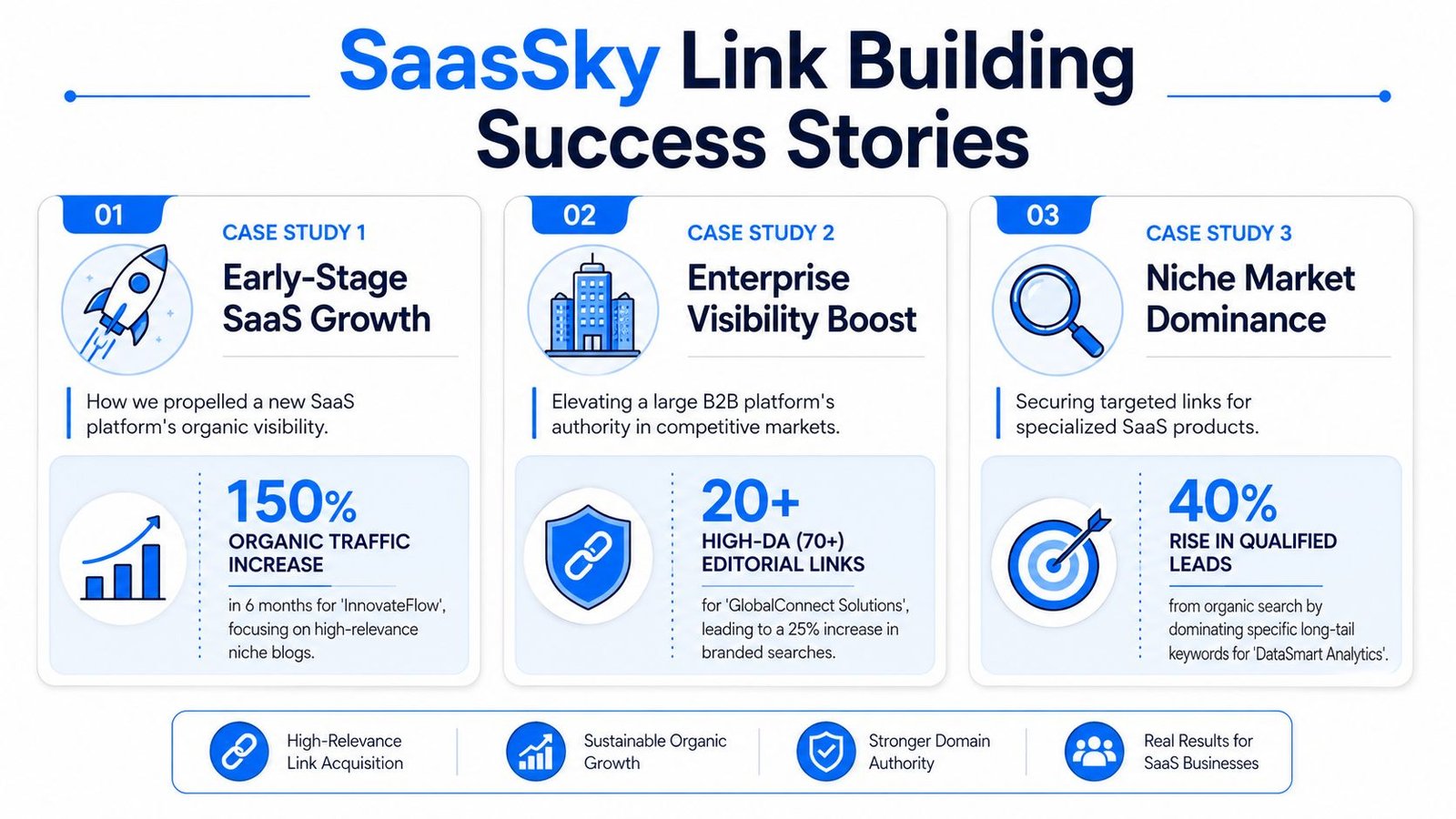
That's a key lesson from practitioner-led campaigns. Good link building rarely looks like a bargain bin. It looks like controlled investment, clear page-level intent, and steady execution over time.
If you want a clearer view of what link building should cost for your business, SaasSky helps SaaS and eCommerce teams plan around outcomes, not vanity deliverables. If you're weighing agency retainers, in-house hiring, or a first serious SEO budget, their team can help you pressure-test the economics before you spend.