Your team is shipping product updates, supporting customers, trying to keep paid acquisition efficient, and still expected to grow organic search. That's usually the point where link building starts to feel less like a marketing tactic and more like an operational bottleneck.
For many SaaS and eCommerce teams, the problem isn't knowing that authority matters. It's knowing that good link building takes consistent outreach, publisher judgment, content coordination, follow-up, QA, and reporting. That work rarely fits neatly into the week of a founder, demand gen lead, or solo SEO.
The right move often isn't to “do more SEO.” It's to decide what should stay in-house and what should be handed to a specialist partner. If you outsource link building well, you buy execution capacity without giving up strategic control. If you outsource it badly, you buy a spreadsheet full of placements that never influence pipeline, revenue, or customer acquisition cost.
Table of Contents
- The End of the Do-It-All Founder
- The Outsourcing Tipping Point for SaaS and eCommerce
- A Complete Framework for Evaluating Link Building Partners
- Onboarding Your Agency for Maximum Impact
- Setting Budgets and Measuring True ROI
- Common Pitfalls and Red Flags to Avoid
The End of the Do-It-All Founder
The first big outsourcing decision usually arrives after product-market fit starts to look real. You've got customers. Your positioning is sharper. You know which pages matter. But organic growth still feels capped because nobody on the team has the time to run link acquisition every week with discipline.
That's a normal stage, not a failure of execution.

A lot of founders assume outsourcing link building is what large SEO teams do once they've exhausted in-house options. The data points the other way. A 2026 link building industry roundup reports that 56% of SEO professionals outsource at least part of their link building, and another figure cited there shows 35% of businesses outsource link-building and SEO tasks overall. The same roundup also notes that many companies concentrate spend in modest monthly ranges, with about 38.4% in the $1,000–$5,000 band and about 46.5% in the $5,000–$10,000 band.
Why this happens earlier than founders expect
Link building is hard to do part-time. It requires repeatable research, qualified outreach, publisher communication, content coordination, and tracking. Most startup teams can do one or two of those well. Few can do all of them every month without dropping something more urgent.
For SaaS, the tension usually shows up when high-intent pages like pricing, alternatives, integrations, or use-case pages need authority, not just the blog. For eCommerce, it shows up when category pages, collections, and high-margin product clusters need stronger external signals than content marketing alone can provide.
Practical rule: If link building lives on a “when we have time” list, you don't have a link building function. You have occasional activity.
What outsourcing actually buys you
The best reason to outsource link building isn't convenience. It's operational focus.
You keep internal ownership of targets, positioning, and business priorities. A partner handles the labor-intensive execution that would otherwise require hiring, training, and managing a specialist function from scratch. That's why outsourcing works well for teams that already know where growth should come from but can't support the workload internally.
Done right, outsourcing turns link building into a managed capacity purchase. Done poorly, it turns it into a vanity purchase.
The difference starts with timing.
The Outsourcing Tipping Point for SaaS and eCommerce
There isn't a single perfect moment to outsource link building. There is a cluster of signals that usually show up together. When those signals appear, keeping everything in-house tends to slow growth more than it protects quality.
What usually changes first
The first signal is strategic clarity. You know which pages deserve authority, and you know why. Maybe your demo page converts. Maybe your comparison pages influence deals. Maybe a category page has strong margins but weak visibility.
The second signal is channel pressure. Paid acquisition starts getting more expensive or less predictable, so organic search has to carry more of the demand burden over time.
The third signal is team reality. Your marketer can write briefs and review targets, but they can't also prospect sites, send outreach, chase editors, review placements, and maintain reporting without letting other work slip.
A practical self-check looks like this:
- You know your commercial pages. You're not asking for “more backlinks.” You want authority pointed at pages tied to demos, trials, revenue-driving categories, or buyer comparison terms.
- Your site is no longer early-stage. You have enough content, product substance, and internal clarity to benefit from external authority.
- You need consistency. One-off outreach sprints haven't built momentum.
- You need specialist judgment. Publisher selection, outreach quality, anchor choices, and content fit now affect brand risk, not just rankings.
If your team can define priorities but can't execute outreach at a consistent level, that's usually the handoff point.
SaaS and eCommerce need different link targets
A lot of outsourced campaigns fail because the vendor uses the same playbook for every business model. That doesn't work.
For SaaS, links often need to support pages with commercial or evaluation intent. That can include pricing pages, integration pages, feature comparisons, alternatives pages, industry solution pages, and selected case studies. The aim isn't just domain authority. It's helping the pages that influence sales conversations win more trust in search.
For eCommerce, the target set is different. Category pages, collection pages, seasonal hubs, gift guides, and high-margin product clusters usually deserve more attention than generic blog posts. A vendor that only talks about guest posts to informational articles may never touch the pages that affect revenue most.
The strongest outsourcing brief is narrow
Before you start vendor conversations, define the actual business job you need done.
Some examples:
- SaaS brief: Build authority to comparison, pricing, and high-intent educational assets that assist demo conversions.
- eCommerce brief: Strengthen category and collection visibility for priority product lines while supporting selected editorial content that can earn natural references.
- Hybrid brief: Support product-led content and a small set of revenue pages instead of spreading links across the whole site.
That level of clarity changes the quality of every agency conversation. Weak providers will pull you back toward generic deliverables. Strong providers will ask sharper questions about page priorities, content readiness, approval workflows, and reporting.
If you can't describe what business outcome the campaign should influence, you're not ready to outsource link building yet. If you can, the next decision is partner selection.
A Complete Framework for Evaluating Link Building Partners
A SaaS founder usually hits the same wall at the same time. Revenue pages need authority, content is piling up, and the first few agency calls all sound good until you ask how their work will affect demos, pipeline, or CAC. That is where weak evaluation criteria get expensive.
Price and link volume are late-stage filters. Start by asking whether a partner can improve rankings for pages that influence revenue, report in a way your team can use, and operate with enough discipline that you are not cleaning up risky placements six months later.
I use three filters first: operating process, link strategy, and commercial fit.
1. Operating process
A polished sales deck proves very little. The useful question is whether the team can show how work moves from target page selection to prospecting, outreach, content, approval, placement, and reporting.
Ask for:
- A documented workflow. Who owns prospecting, outreach, writing, QA, and account strategy?
- A real reporting sample. You want to see target pages, live placements, links won or lost, anchor patterns, and notes on what changed.
- Examples of judgment calls. Why did they reject a site? Why did they push links to one page before another?
- Clear sourcing methods. They should explain how they get placements without hiding behind vague language.
Good operators separate themselves from link resellers. Resellers talk in packages. Operators talk in decisions.
2. Link strategy
A vendor can deliver links and still miss the business goal.
For SaaS, that usually shows up as links going to top-of-funnel blog posts while pricing, comparison, integration, or use-case pages stay weak. For eCommerce, it looks like authority flowing to editorial content while category and collection pages that drive revenue get ignored.
Ask direct questions:
- How do you choose target pages first?
- What mix of commercial, supporting, and editorial pages do you recommend for our site?
- What does a bad placement look like in our niche?
- How do you handle anchor text and link pacing?
Good answers are specific. If the agency cannot explain page prioritization, internal link support, and topical relevance, they are probably selling the same playbook to every client.
3. Commercial fit
This is the filter founders skip most often.
A partner may be able to build links. That does not mean they are the right fit for your stage, margins, approval speed, or growth model. A seed-stage SaaS company with one content marketer needs a different partner than a mature eCommerce brand managing multiple category lines and seasonal pushes.
Use this table to compare delivery models before you get pulled into sales calls:
| Model | Typical Cost Structure | Best For | Main Trade-off |
|---|---|---|---|
| Freelancer | Hourly or project-based | Small tests, overflow support, hands-on founders | Quality and process can vary a lot |
| Agency retainer | Monthly retainer | Teams that want strategy, execution, and reporting in one place | Easy to overpay for generic output |
| In-house specialist | Salary plus overhead | Brands with enough volume to justify dedicated ownership | Hiring and management load |
| Per-placement buying | Pay by link | Filling specific gaps to known pages | Incentives can drift toward volume over fit |
| Digital PR or editorial campaigns | Campaign or placement pricing | Brands that need stronger publications and broader brand lift | Slower output and higher asset requirements |
The right choice depends on what you need the program to produce. If you need a steady system tied to revenue pages, an accountable retainer often makes more sense than buying placements one by one. If you already have strategy in-house and just need execution help, a freelancer or specialist contractor can work.
A broad shortlist can save time, but it should only be a shortlist. Use roundups like this list of best link building agencies for SaaS brands to build an initial candidate set, then pressure-test each one against your own requirements.
Questions that expose weak partners fast
Founders get better answers when they stop asking, “How many links will we get?” and start asking questions that reveal judgment.
Use these:
- Which pages would you try to influence first, and why?
- What work should stay with our team instead of your team?
- What publisher types do you avoid for brands like ours?
- How do you handle content approvals and turnaround time?
- What would make you tell us not to build links to a page yet?
- How do you measure success beyond link count and DR?
That last question matters most. A serious partner should connect link building to outcomes your finance team and leadership team care about. For SaaS, that may be demo-qualified traffic, assisted pipeline, and lower CAC from organic acquisition. For eCommerce, it may be category visibility, revenue from non-brand search, and margin contribution by product line.
The right partner sounds like an operator who understands constraints, trade-offs, and revenue impact. That is the standard.
Onboarding Your Agency for Maximum Impact
A founder signs the retainer on Monday. By week three, the agency is pitching pages that do not influence revenue, waiting on scattered approvals, and reporting links that look fine in a dashboard but do nothing for pipeline. That failure usually starts in onboarding, not outreach.
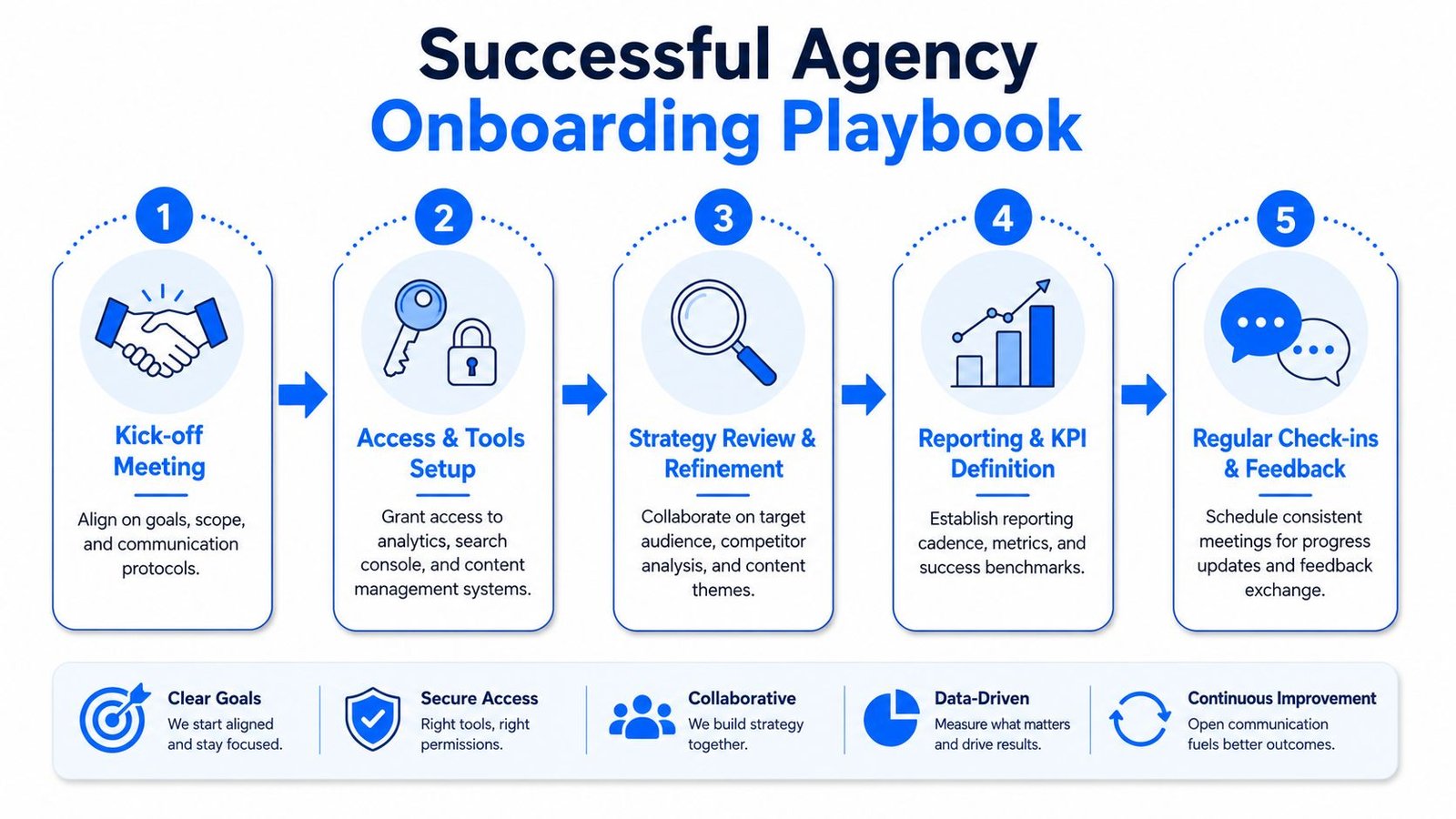
Good onboarding sets operating rules early. It tells the agency what business result the campaign should support, where judgment stays in-house, and what execution they own. For SaaS and eCommerce teams, that matters more than a polished kickoff deck because the wrong pages, weak publisher filters, or slow approvals can burn a full quarter.
What to cover in the kickoff
Run the kickoff like an operating session. The goal is to remove ambiguity.
Start with business priorities. Map the pages that matter commercially, not just the pages that are easy to pitch. For SaaS, that usually means pricing, comparison, solution, integration, and high-intent use-case pages. For eCommerce, it is often category pages, collection pages, seasonal hubs, and product clusters with strong margin or inventory priority.
Then define link quality in plain terms. Spell out what counts as relevant, which publisher types are acceptable, what content standards apply, and whether the campaign should favor editorial placements, relationship-based outreach, digital PR, or a mix. If you skip this step, the agency will fill the gap with its default process, and that process may optimize for output instead of commercial impact.
Brand boundaries come next. Share competitor exclusions, categories you will not appear beside, legal review requirements, and claims that need compliance sign-off. This protects the brand and saves time later.
Approval flow is where many campaigns stall. Decide who approves target lists, outreach angles, content drafts, and live placements. Set deadlines for each stage. If the founder is reviewing every article and every site, the agency will spend the month waiting instead of building.
Keep approvals focused on brand risk, messaging, and page priorities. Do not turn routine execution into a founder bottleneck.
What your agency needs from you
Even strong agencies make weak decisions when context is missing. Give them enough information to act like an extension of the team, not a vendor guessing from the homepage.
Share these inputs early:
- Brand guidelines so outreach and contributed content sound like your company
- Product positioning including who you sell to, why buyers choose you, and which language matches your sales process
- Target personas with pain points, objections, and buying triggers
- Page priorities ranked by revenue potential, not just current traffic
- Existing assets such as customer stories, original data, product visuals, integration pages, comparison pages, and category content
- Reporting inputs such as analytics exports, CRM views, or shared dashboards that connect organic growth to pipeline or revenue
If budgeting questions are still being sorted during onboarding, use a realistic average cost for SEO services benchmark to frame scope before the agency starts planning around assumptions.
Set the split of responsibilities early
The cleanest model for first-time outsourcing is usually a hybrid one. Keep strategy, page prioritization, messaging control, and KPI ownership in-house. Let the agency handle prospecting, outreach execution, publisher follow-up, content coordination, and link tracking.
That split protects the work that requires product knowledge and commercial judgment. It also removes the repetitive tasks that drain internal teams.
For SaaS, this keeps the company in control of pages tied to demos, opportunities, and sales cycles. For eCommerce, it helps the internal team direct effort toward categories and products that affect margin, inventory movement, or seasonal demand. The agency still does the heavy lifting, but your team decides what success should influence.
What a good first month looks like
By the end of month one, you should have a working system and clear evidence that the agency understands the business.
You should be able to answer these questions without hesitation:
- Which pages are being prioritized first, and why?
- What standards are being used to accept or reject opportunities?
- Who approves each stage of work, and how fast?
- What metrics will be reviewed each month beyond link count?
- Who makes the call when brand safety, speed, and opportunity quality conflict?
If those answers are still vague after onboarding, expect execution problems next. In link building, fuzzy ownership turns into slow approvals, weak placements, and reports that look active while business impact stays flat.
Setting Budgets and Measuring True ROI
A founder signs a $6,000 monthly retainer, gets a report with eight new links, and still cannot answer the only question that matters in the board update. Did this reduce paid acquisition pressure or create more pipeline?
That is where link building budgets go wrong. Teams buy output before they define the business result the output is supposed to influence.
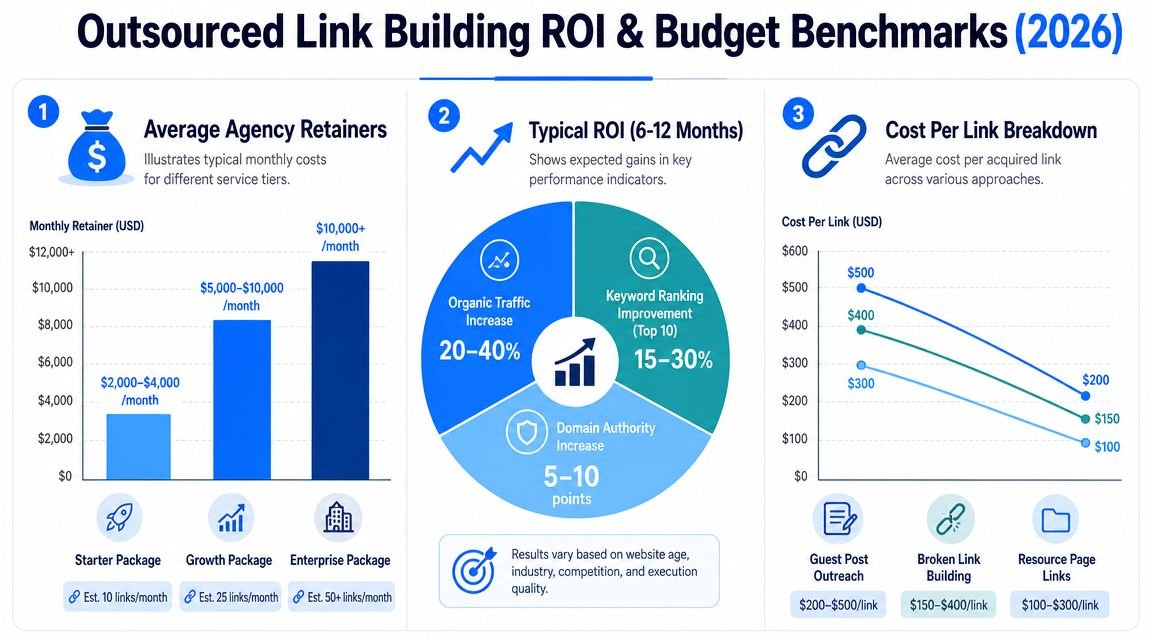
What the market looks like
As noted earlier, the market spans very different pricing models. Some vendors sell hours. Some sell placements. Others package strategy, outreach, content coordination, and reporting into a retainer. The budget question is not which option looks cheapest on paper. It is which model gives your team enough control, quality, and accountability to affect revenue.
If you need a broader planning reference, this guide to the average cost for SEO services helps frame link building spend inside the larger search budget.
A retainer should buy more than links. It should cover the work that makes links worth having:
- prospecting and qualification
- outreach execution
- content coordination
- publisher communication
- placement review
- reporting against agreed business KPIs
If a proposal reduces everything to cost per link, expect shortcuts. Those shortcuts usually show up as weak relevance, thin quality control, and reports that look efficient while target pages fail to move.
How to measure impact beyond rankings
Referring domains, rankings, and link counts are operating metrics. Keep them. They help diagnose campaign health.
They are not enough for budget decisions.
For SaaS and eCommerce teams, outsourced link building should be judged the same way other acquisition channels are judged. Did it create qualified demand at an acceptable acquisition cost? Did it support revenue on pages that matter commercially? Did it reduce reliance on paid traffic for the same intent?
For SaaS, the practical ROI view is:
- Assisted conversions: Are linked pages contributing to demo requests, free trials, or contact form submissions?
- Pipeline influence: Are priority pages showing up more often in CRM paths tied to opportunities?
- CAC pressure: Is stronger organic acquisition helping the team buy fewer expensive paid clicks for high-intent terms?
For eCommerce, use a tighter commercial lens:
- Category revenue: Are priority collections or category pages gaining qualified organic traffic that converts?
- Assisted purchase paths: Are linked buying guides, comparison pages, or collection pages appearing in conversion journeys?
- Margin impact: Is authority growth helping the business sell more of the product lines that matter most to margin, not just the pages that attract top-of-funnel visits?
Rankings show visibility. ROI shows whether visibility changed buying behavior.
A reporting stack founders can use
Ask for reporting that moves from activity to outcomes, without stopping at vanity metrics.
| Layer | What to review |
|---|---|
| Execution | Placements won, targets in progress, pages supported |
| Quality | Relevance, topical fit, anchor mix, page type distribution |
| Search movement | Visibility changes on target pages and query groups |
| Business impact | Assisted conversions, pipeline touches, revenue influence, or CAC trend context |
This format changes the conversation. Instead of asking whether the agency built enough links, you can ask whether the work improved the pages tied to demos, purchases, and customer acquisition efficiency.
That is the standard worth paying for.
Common Pitfalls and Red Flags to Avoid
Some link building mistakes are obvious. Others only become visible after you've paid for a few months of work and realized the reporting looks healthier than the business.
The biggest mistake is treating outsourcing as a procurement decision instead of a risk-managed growth decision.
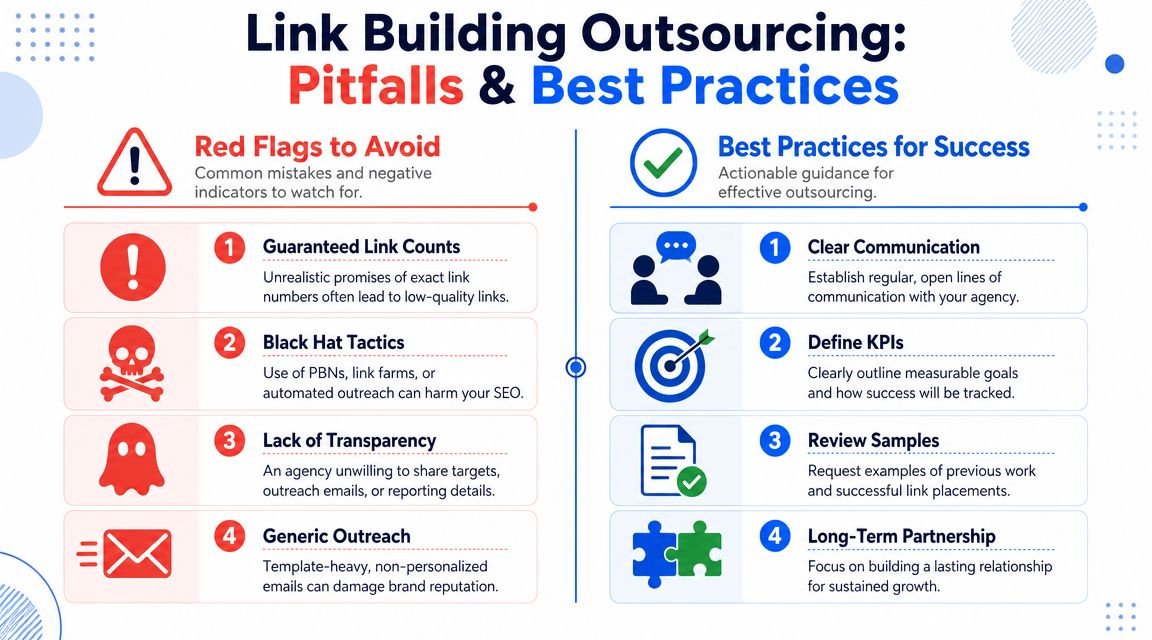
Agency red flags
The current environment has made this more important, not less. As noted in The HOTH's discussion of outsourced link building models, the better question for many teams isn't whether to outsource but which model is safest and most durable, especially because search quality systems and spam policies have increasingly targeted scaled or low-value tactics. That's one reason PR-led and editorial approaches often deserve more consideration than pure per-link buying.
Watch for these warning signs:
- Guaranteed volume promises that sound detached from your niche, assets, or goals
- Opaque sourcing where the agency won't explain how placements are found or vetted
- Generic outreach that would embarrass your brand if a prospect forwarded it internally
- Reporting without decisions where you receive a list of links but no analysis of what's working
- Tactic-first sales language focused on “DR,” “fast wins,” or inventory instead of business fit
A safer long-term path usually sits inside white hat link building principles, where editorial judgment, relevance, and defensible placements matter more than volume.
Fewer defensible links beat a larger batch of placements you'd never want a buyer, journalist, or future investor to inspect.
Client-side mistakes
Clients create failure modes too.
The first is micromanaging execution while under-defining strategy. If you insist on approving every outreach email but can't rank target pages by business value, the agency won't have room to execute and won't have enough direction to prioritize well.
The second is expecting immediate commercial payoff from every placement. Link building supports authority and discoverability over time. You should absolutely measure business outcomes, but you shouldn't expect every single link to map cleanly to a deal.
The third is confusing activity with fit. A full monthly report can still hide weak page targeting, thin editorial value, or poor alignment with your real funnel.
Use this quick checklist before and during an engagement:
- Define business-critical pages early
- Approve a reporting framework before campaign launch
- Set clear no-go categories and competitor exclusions
- Review sample outreach for tone and brand safety
- Ask what the agency rejects, not just what it accepts
- Favor durable methods over aggressive volume
The goal isn't to buy links. It's to build authority in places that strengthen revenue-producing pages and support a brand you'll still be proud of later.
If you want a partner that treats outsourced link building like a measurable growth function instead of a monthly deliverable list, SaasSky is built for that. Their work is geared toward SaaS and eCommerce teams that need transparent pricing, clear process, and reporting tied to real business impact.