
You're probably in one of two situations right now. Either your team has hit the ceiling of content-led SEO without enough authority to move commercial pages, or a board member, founder, or investor has asked a hard question: who's going to own off-page growth, and how will you know the agency you hire isn't buying polished junk?
That's the fundamental problem with choosing a link building service in the UK. Most providers know how to sell outcomes. Fewer know how to prove process. Fewer still will let you inspect the machinery before you sign.
If you're making your first serious hire in this channel, don't start with vendor decks. Start with verification. Good link building improves search visibility, supports pipeline pages, and compounds over time. Bad link building leaves you with vague reports, recycled site lists, and a clean-up project six months later.
Table of Contents
- Defining Your Link Building Goals and Scope
- Vetting UK Providers and Their Methodologies
- Benchmarking Link Building Costs in the UK
- Deconstructing Case Studies and Running a Pilot
- Structuring the Contract and Onboarding Process
- Measuring Real ROI from Your Link Building Investment
Defining Your Link Building Goals and Scope
The fastest way to waste money on a link building service UK provider is to brief them with one sentence: “We need more backlinks.” That brief creates bad incentives. It pushes the agency toward volume, not outcomes.
A better starting point is internal clarity. Before you talk to any vendor, you need a baseline view of your current backlink profile, your target pages, and the business reason this channel matters now.
Start with your baseline, not an agency pitch
Run a backlink audit in Ahrefs or SEMrush. Pull your referring domains, anchor text distribution, top-linked pages, and any obviously toxic patterns. Compare those findings with two or three real search competitors, not just brands you admire.
White Hat SEO's UK guidance on backlink audits and goal setting is right on the sequence: effective UK link building starts with a full backlink audit and clear goals, and content marketing tactics account for 22.9% of all link success, ahead of guest posting at 15.2%.
Use that audit to answer four questions:
- Where are rankings being blocked: Are your money pages under-linked, or is the site weak at the domain level?
- What already attracts links: If research, templates, guides, or opinion pieces pull links naturally, that's a clue about what an agency should amplify.
- What needs protecting: If your anchor text profile already looks tight, you don't want an aggressive provider distorting it.
- Which pages matter commercially: Product, feature, integration, and high-intent comparison pages should be mapped before outreach starts.
Practical rule: If you can't name the pages and themes that should benefit from links, you're not ready to hire.
A useful internal checklist looks like this:
Primary business objective
More demo requests from organic search, stronger rankings for category terms, support for a new product line, or broader topical authority.Target page set
Separate pages into commercial, supporting editorial, and linkable assets. Agencies need to know where links can point directly and where support content has to do the heavy lifting.Acceptable risk level
In regulated or reputation-sensitive markets, you may reject any tactic that depends on paid placements or thin publisher vetting.
Write a brief that ties links to revenue
Your brief should read like a business document, not an SEO wishlist. Include target geography, audience, product margins, internal review constraints, and what “success” means after a few months.
Don't ask an agency for a guaranteed number of links. Ask for a proposed strategy built around relevance, authority, and the ability to influence pages that matter to pipeline.
Include these essential elements in your brief:
- Budget range: Give a real range, even if broad. Serious providers will shape tactics around it.
- Approval model: State whether you want pre-approval on prospects, content angles, or placements.
- Internal resources: Be honest about who can support data studies, founder commentary, or expert quotes.
- Reporting expectations: Require visibility into outreach activity, not just live links.
Founders often make a sharp strategic choice. If your team can produce proprietary insights, original research and data-led content usually create better long-term link equity than chasing one-off placement opportunities. UK B2B and SaaS campaigns also benefit from a phased approach with repeated campaigns through the year rather than a single burst of activity. That's consistent with practitioner guidance that prioritises digital PR and linkable assets over lower-value tactics, especially when you want durable editorial mentions rather than rented-looking placements.
Vetting UK Providers and Their Methodologies
Most agencies don't fail in the sales process. They fail in the gap between what they imply and what they'll do once the contract starts.
That's why vendor vetting shouldn't revolve around “Do I like the team?” It should revolve around methodology, quality control, and what they'll disclose before they touch your domain.
What works at scale and what usually wastes budget
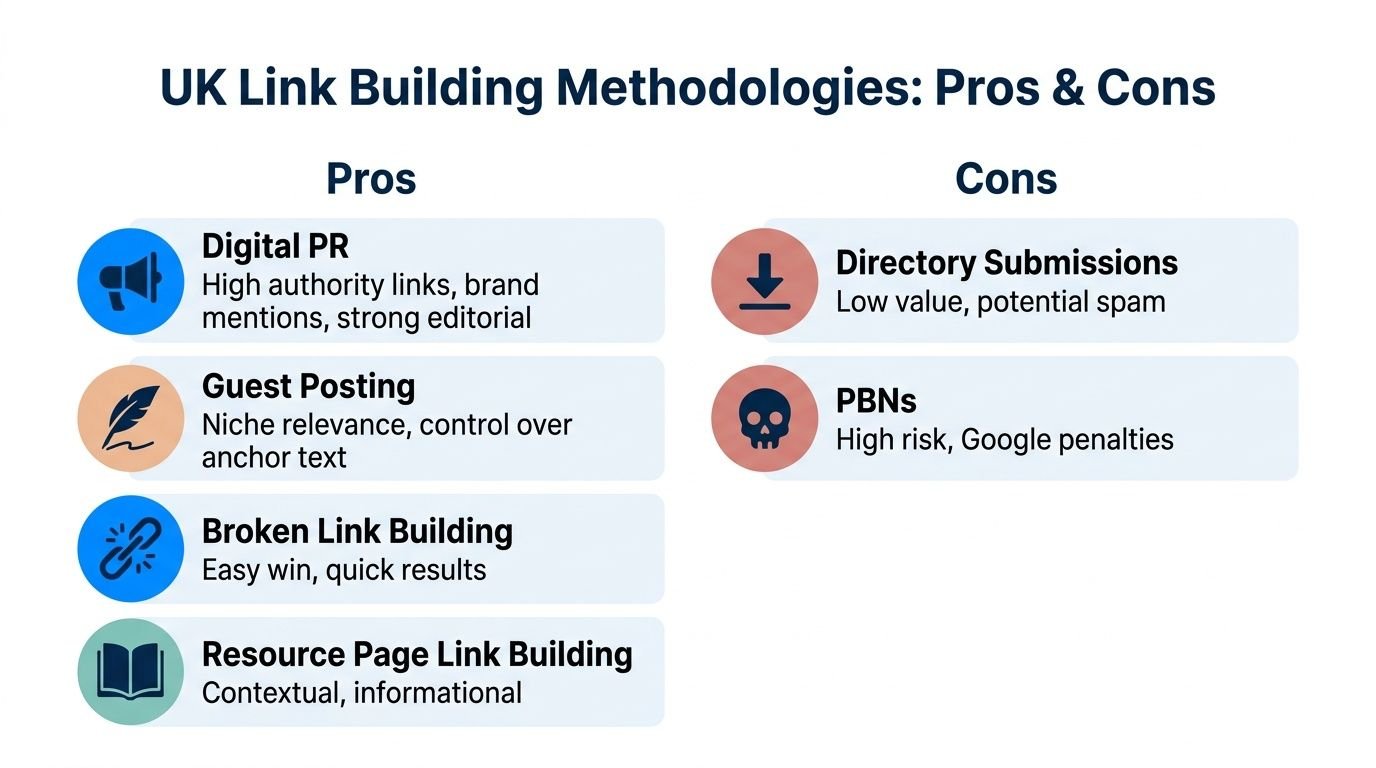
The easiest way to assess a provider is to ask what they do repeatedly, not what they can do occasionally. In SaaS and B2B, scalable quality tends to come from digital PR and linkable assets, not from pumping out generic guest posts.
LinkQuest's SaaS link building analysis makes that distinction clearly. It identifies Digital PR and Linkable Assets as the only scalable, high-quality options for SaaS, while flagging PBNs, Fiverr links, and mass article directories as major pitfalls that can trigger penalties or produce negligible authority. It also notes an 8.5% average success rate, with 200 targeted emails per month yielding about 17 links when outreach quality is high.
That doesn't mean every guest post is worthless. It means the default guest post assembly line is often low impact. You get limited editorial value, thin brand impact, and weak differentiation from the dozens of other clients placed on similar sites.
If you want a practical outside view of when brands decide to outsource link building, the important question isn't whether outsourcing works. It's whether the provider's process creates links that a real editor would stand behind.
A simple methodology screen helps:
| Tactic | Usually worth considering | Usually a warning sign |
|---|---|---|
| Digital PR | Strong editorial value, brand mentions, higher trust | Weak if the agency can't explain the story angle |
| Linkable assets | Good for compounding link acquisition over time | Weak if there's no promotion plan |
| Resource page outreach | Useful when relevance is tight | Weak if used as the whole strategy |
| Broken link building | Can produce selective wins | Weak when sold as a scalable core channel |
| Guest posting | Can work when highly selective | Weak when volume is the pitch |
| PBNs and directories | Rarely defensible | High risk |
Questions that expose weak providers fast
A competent provider won't be annoyed by scrutiny. They'll expect it.
Ask these questions in writing:
- How do you source prospects: Manual research, owned lists, marketplaces, or publisher relationships?
- Can we pre-approve sites: If not every site, can we approve categories, metrics, and exclusions?
- How do you prevent list recycling across clients: This is one of the biggest hidden quality issues.
- What is your policy on paid placements: If payment is involved anywhere, ask how they manage disclosure and risk.
- Do you track topical relevance, not just authority metrics: A strong domain in the wrong niche can still be a weak business result.
- What gets reported before links go live: Outreach logs, site lists, email examples, content drafts, and placement context all matter.
One verification question matters more than most. Buried Agency's piece on provider accountability highlights a serious transparency gap: 68% of UK agencies fail to disclose their outbound-to-inbound link ratio, even though that ratio can indicate penalty risk and reveal whether a site looks like it exists mainly to sell links.
Ask for sample prospect rows that include outbound link patterns, not just DR or traffic screenshots.
If the agency says their process is proprietary and can't be shown, treat that as a commercial risk. You're not asking for their full playbook. You're asking for evidence that your money won't be spent on recycled inventory.
Red flags are usually obvious when you know where to look:
- Fixed link quotas regardless of niche
- No visibility into prospecting
- Heavy reliance on directories, article farms, or anonymous blogger networks
- No mention of trust flow, spam checks, or outbound link behaviour
- Pitch language that focuses on DR while ignoring audience and relevance
Benchmarking Link Building Costs in the UK
Pricing gets distorted quickly in this market because agencies often sell the same thing under different names. One provider calls it editorial outreach. Another calls it digital PR. A third folds content production, prospecting, and placement into a monthly retainer that's hard to compare line by line.
You don't need perfect price transparency to buy well. You need enough context to spot the wrong deal.
What UK pricing usually looks like
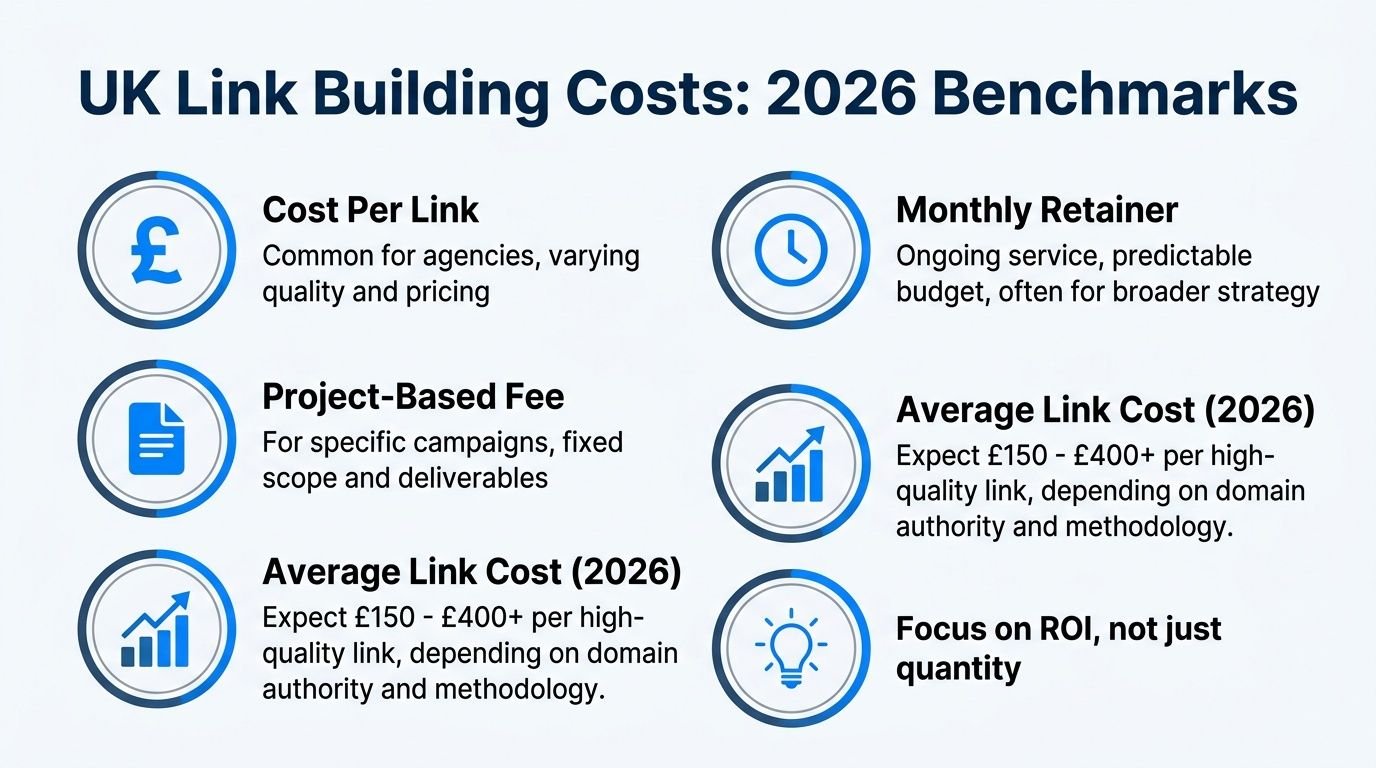
MeasureMinds Group's UK pricing overview gives a useful benchmark. In the UK, monthly retainers for link building typically range from £2,000 to £100,000+. A full digital PR campaign might cost £3,500 to £8,500, while individual high-authority editorial placements often cost $300 to $600 (£240-£480) or more.
The same pricing source also notes a broad spread by channel. Niche edits tend to sit lower, guest posts in the middle, and high-authority editorial placements at the top end. That's what you should expect. Different tactics carry different labour, relationship, and content demands.
If you want a useful reference point for link building pricing models, compare providers on what's included, not just the headline number.
How to judge whether a quote is sensible
Cheap quotes often hide one of three problems. The agency is using low-value inventory. They've stripped out strategy and content. Or they're overpromising production they can't sustain without sacrificing quality.
Use this framework when reviewing proposals:
Per-link pricing
This model is simple to understand, but it can create the wrong incentives. If the vendor only gets paid when a link goes live, they may prioritise what's easy to place over what helps your business.
Good fit when:
- You have a clear quality checklist.
- You can review placements.
- Your team already knows the types of sites worth buying into.
Watch for:
- Very broad quality bands.
- Weak niche relevance.
- No control over anchor planning.
Monthly retainer
This is usually better for campaigns that need strategy, creative assets, iterative outreach, and reporting discipline. It's also easier to tie to broader SEO goals.
Good fit when:
- You need ongoing ideation and relationship building.
- Internal stakeholders want predictable spend.
- The campaign depends on content, PR angles, or multiple target themes.
Watch for:
- Vague deliverables.
- Reports full of activity but light on outcomes.
- Contracts that make it hard to exit.
Project-based campaign
This works well for a defined push, such as launching research, supporting a product category, or testing a new market. It's often the cleanest format for a first engagement.
Good fit when:
- You want a contained test.
- The campaign has a clear asset and audience.
- You need an approval-heavy process.
A practical pricing review table helps keep everyone honest:
| Question | Healthy answer | Concerning answer |
|---|---|---|
| What's included? | Strategy, outreach, content, reporting, QA | “Placements” with little detail |
| How are sites vetted? | Relevance, traffic quality, spam checks, outbound patterns | Mostly DR or DA |
| What drives cost? | Publication quality, niche complexity, campaign scope | “Our standard package” |
| Can we inspect samples? | Yes, with enough context to evaluate | No, because it's confidential |
A quote isn't expensive because the number is high. It's expensive when the provider can't show why the work deserves the price.
Deconstructing Case Studies and Running a Pilot
Case studies are marketing assets. Treat them that way.
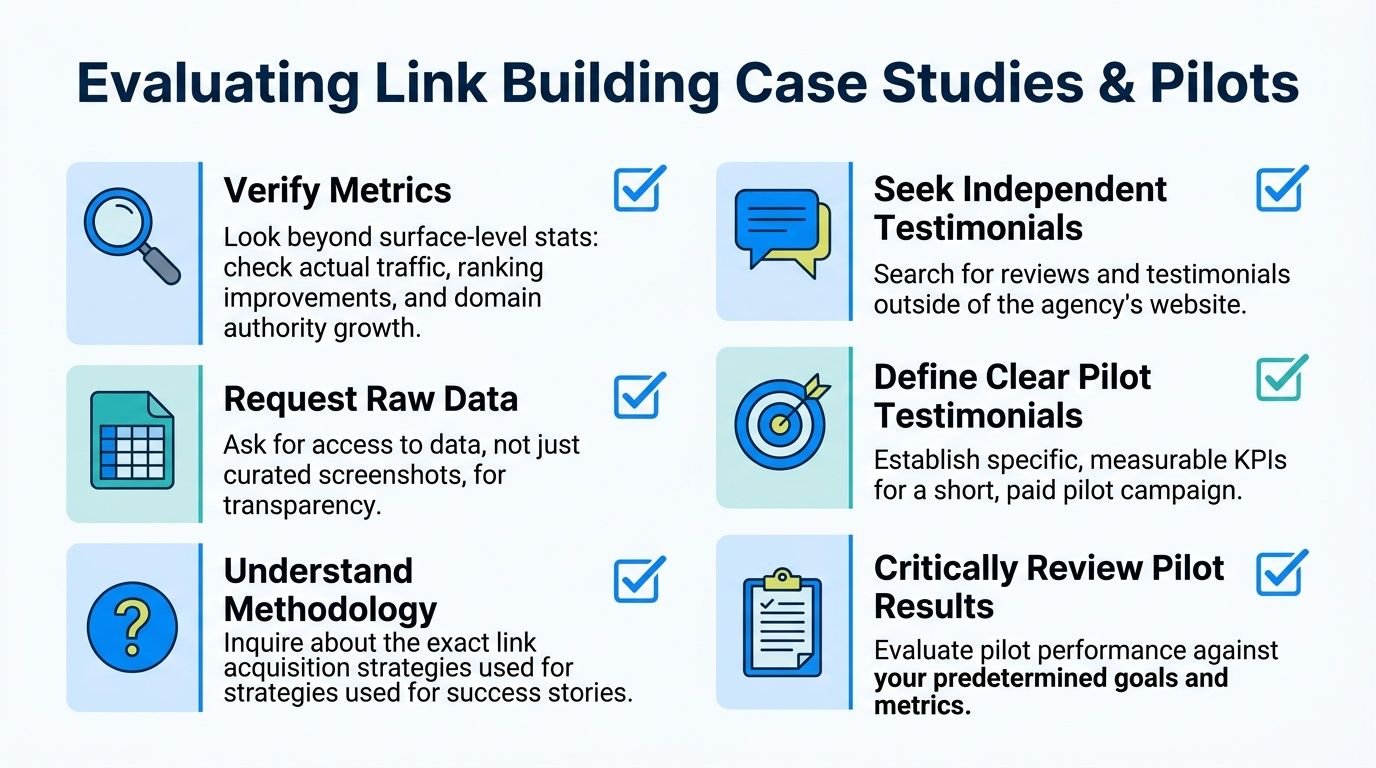
A polished PDF can hide weak causality, cherry-picked dates, and vanity metrics that say very little about pipeline impact. If you're hiring a link building service UK partner, your job isn't to be impressed. It's to verify.
How to read case studies like a buyer, not a prospect
Strong case studies should show modern methods, not nostalgia for bulk placements. LinkBuild Agency's market statistics page notes that 48.6% of SEO professionals identify digital PR as the single most effective link-building tactic for 2025, and the average price per quality backlink is $508.95 based on a survey of 518 industry experts. That cost context matters. If each quality placement is expensive, then the case study should show why the spend was justified.
If you want to compare what credible campaigns can look like in practice, reviewing real link building examples can help sharpen your eye for methodology versus presentation.
Here's what to ask for behind every case study:
Starting point
What did the site look like before work began? Was the domain already strong?Target pages
Which pages were the campaign trying to influence, and why those pages?Time horizon
When were links acquired, and when did business outcomes start to move?Method used
Was this digital PR, asset promotion, selective outreach, or a network-led placement model?Commercial effect
Did stronger visibility lead to more qualified traffic, leads, or conversions on target pages?
A weak case study usually leans on one of these shortcuts:
| Shortcut | Why it misleads |
|---|---|
| Link count headline | High volume can hide poor quality |
| DR average only | Authority without relevance can be useless |
| Screenshot-only reporting | You can't inspect methodology |
| No timeline | It obscures causality |
| No page-level context | You don't know what actually benefited |
If an agency can't explain how links supported a business objective, they're probably selling SEO theatre.
How to structure a pilot that tells you the truth
A pilot is your best defence against buying a long contract based on assumptions. Keep it paid, time-boxed, and specific.
Set the pilot up to evaluate four things:
Strategic thinking
Do they understand your product, market, and target pages? Or are they applying a generic playbook?Transparency
Will they show prospect rationale, outreach language, and content angles before asking for trust?Execution quality
Are targets relevant? Are pitches personalised? Does content read like something a publication would run?Reporting discipline
Can they separate activity, quality, and business effect without hiding behind jargon?
A useful pilot brief includes:
- one campaign theme
- a defined set of target pages
- a reporting format agreed in advance
- pre-approval rules for sites or site categories
- a short review window after first placements go live
Don't use the pilot to judge only link count. Use it to assess whether you'd trust this team with six months of budget and your domain reputation.
Structuring the Contract and Onboarding Process
Most problems in agency relationships aren't caused by malicious intent. They come from ambiguity. If the contract doesn't spell out what “quality” means, the vendor will define it for you later.
That's why the contract stage matters more than most founders think. It's where you convert sales promises into enforceable operating rules.
Non-negotiable clauses for accountability
Your agreement should protect budget, brand, and search risk. That means the document needs more than pricing and notice periods.
Include clauses for these points:
Placement approval rights
State clearly whether you can approve sites before outreach, before content submission, or before publication. If the provider refuses any approval mechanism, you're accepting blind inventory risk.
Quality definition
Don't define quality with one metric. Require relevance, editorial context, traffic quality checks, acceptable spam thresholds, and exclusions for risky site types. If your team uses Ahrefs, Majestic, or SEMrush internally, reference the metrics you already trust.
Tactic restrictions
Spell out what the agency cannot use without explicit written approval. That usually includes PBNs, mass directories, reciprocal schemes, and any tactic that would create a cleanup burden later.
Replacement and remediation terms
If a placement disappears, changes, or becomes risky, the contract should state what happens next. Replacement rights, investigation timelines, and responsibilities for link removal requests should be documented.
A short SLA checklist is often enough:
- Reporting cadence: Weekly activity snapshots or monthly strategic reporting
- Named contacts: One accountable owner on each side
- Response time expectations: Especially for approvals and issue escalation
- Data access: Prospect lists, live placement URLs, anchor text logs, and campaign notes
- Exit terms: How work, assets, and reporting are handed over if the engagement ends
Client-side protection: If a term matters operationally, put it in the contract. Don't leave it in email.
What strong onboarding looks like
The onboarding process tells you whether the provider is strategic or transactional. Good agencies ask difficult questions early. Weak ones ask for anchor text and a homepage URL.
A serious onboarding sequence usually includes:
- backlink and competitor review
- commercial page mapping
- audience and positioning review
- asset inventory, including research, product data, and internal experts
- sign-off on approval workflow and reporting format
Your team should be ready to provide:
- messaging guardrails
- pages that need support
- legal or compliance constraints
- founder or subject-matter expert availability
- examples of publications you value and ones you want excluded
If onboarding feels rushed, expect mediocre outreach. Agencies can't write credible pitches about a business they barely understand.
Measuring Real ROI from Your Link Building Investment
A live campaign creates activity fast. Outreach goes out. Replies come in. A few links land. That doesn't answer the only question leadership cares about: is this investment improving the business?
The cleanest way to answer that is to track link building in layers, not as a single vanity metric.
Track three layers of performance
For UK B2B and SaaS campaigns, practitioner guidance points to three measurement tiers: leading indicators, concurrent metrics, and business outcomes. That framework is useful because it stops teams from overreacting too early or celebrating too soon.
Build your dashboard around those layers.
Leading indicators
These tell you whether execution is happening at all. Track outreach volume, reply quality, approval turnaround, and how consistently the agency is moving campaigns forward.
If these numbers are weak, you have an operating problem before you have an SEO problem.
Concurrent metrics
These sit in the middle. Look at the topical relevance of new placements, the editorial context, the authority quality of linking pages, and whether links point to the right areas of the site.
Many campaigns lose focus. Links come in, but they don't support the themes and pages the business truly needs.
Business outcomes
This is the layer that justifies budget. Measure whether target pages gain stronger non-brand visibility, whether commercial organic traffic improves, and whether organic-sourced leads or sign-ups increase over time.
You don't need a fancy BI stack to do this. A simple reporting setup using Looker Studio, Google Search Console, GA4, and your CRM can show enough if the page grouping is clean.
Connect link acquisition to commercial outcomes
The mistake I see most often is separating off-page work from revenue review. SEO teams report links. Demand gen reports pipeline. Leadership gets two dashboards and no story.
Tie the campaign back to the goals you defined at the start:
- If the goal was category growth, review the pages tied to that category and the queries around them.
- If the goal was a new vertical, isolate the vertical content cluster and monitor how visibility and conversions develop.
- If the goal was brand authority, look for stronger organic entry points across high-intent educational and commercial pages.
Use a simple monthly review format:
| Layer | What to review | What decision it supports |
|---|---|---|
| Execution | Outreach activity, response quality, approvals | Is the agency operating well? |
| Quality | Relevance, page fit, editorial strength | Are we earning the right links? |
| Impact | Organic page growth, lead quality, sales influence | Should we continue, adjust, or scale? |
Don't expect direct causality from every single link. That's not how this works. Do expect a coherent pattern over time. Better pages, stronger mentions, improved visibility on commercially relevant themes, and a clearer path from search to pipeline.
A mature link building programme doesn't just increase authority signals. It gives leadership enough evidence to decide whether this channel deserves more capital, a tighter brief, or a different partner.
If you want a partner that treats link building like an accountable growth function rather than a black box, SaasSky is built for that conversation. The team focuses on SaaS and eCommerce, with transparent pricing, practitioner-led execution, clear case studies, and an open contact process that makes verification easier before you commit.