
You're probably looking at a DR number right now and trying to decide what it means.
Maybe a partner offered a placement on a DR 30 site and you're wondering if it's worth your team's time. Maybe you landed a link from a recognizable publication, checked Ahrefs the next morning, and your score barely moved. Or maybe an agency report keeps highlighting Domain Rating as if that number alone proves SEO progress.
That's where many teams get stuck. They know DR matters somehow, but they don't know how to use it to make better growth decisions.
The short version is this. Domain Rating is useful, but only when you treat it as a diagnostic tool. It helps you judge backlink profile strength, compare link opportunities, and allocate budget more intelligently. It becomes a problem when teams chase it like a trophy instead of using it to answer practical questions.
If you're new to link building, it also helps to understand what a backlink is before you obsess over authority metrics. DR sits on top of backlink data. It doesn't replace the underlying logic.
Table of Contents
- What Is Domain Rating and Why Should You Care
- Decoding Domain Rating How Ahrefs Calculates It
- The Hidden Traps What DR Does Not Tell You
- Domain Rating vs Other Authority Metrics
- Using DR for Smarter Link Building Decisions
- A Mini Playbook to Improve Your Domain Rating
- Tracking DR and Reporting Link Profile Strength
What Is Domain Rating and Why Should You Care
Domain Rating, usually shortened to DR, is Ahrefs' way of measuring the strength of a website's backlink profile.
For a founder or growth lead, that matters because links still influence how much authority your site can accumulate over time. If your competitors keep earning links from credible sites and you don't, the gap usually shows up in visibility, brand reach, and the ease with which new pages gain traction.
But DR only becomes useful when you stop treating it like a vanity score.
A smart SaaS team uses DR to answer questions like these:
- Prospecting: Is this site strong enough to justify outreach?
- Prioritization: Should we spend effort on this relationship or another one?
- Benchmarking: Are we materially behind direct search competitors?
- Budgeting: Are we buying placements that look impressive but pass little real value?
Practical rule: DR helps you judge link-profile strength. It doesn't tell you whether a page will rank, whether a link is contextually relevant, or whether a campaign will drive pipeline.
That distinction changes how you operate. A link builder chasing raw DR tends to overpay for flashy placements, accept weak relevance, and report success too early. A strategist uses DR as one signal among several. They still inspect the site, the topic fit, the outbound linking behavior, and the page where the link will live.
For SaaS and eCommerce brands, that's the difference between “we bought authority” and “we built a link profile that compounds.”
Decoding Domain Rating How Ahrefs Calculates It
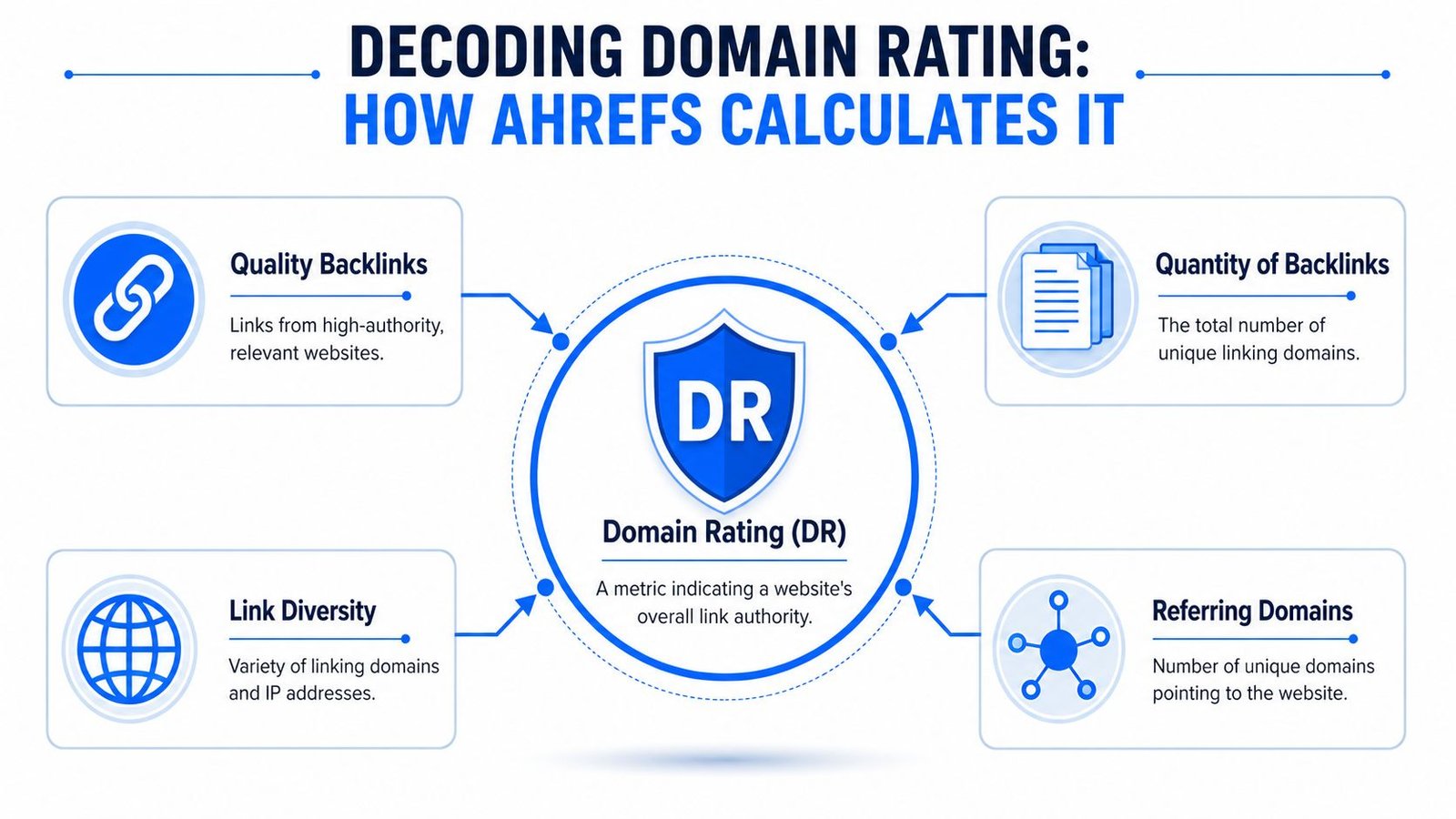
Ahrefs defines Domain Rating as a metric on a 0 to 100 scale that quantifies backlink strength, based mainly on the quantity and quality of external backlinks and the authority of linking domains, while explicitly excluding things like traffic, domain age, and spam signals from the score itself, as described in the Ahrefs Website Authority Checker documentation.
The simplest way to think about DR
The cleanest analogy is reputation transfer.
If respected websites link to your domain, some authority flows toward you. If those sites have stronger backlink profiles themselves, that tends to matter more. If you attract links from a broad set of worthwhile domains, your DR has a better chance of moving than if you keep getting repeated links from the same corners of the web.
That's why DR is popular in outreach and competitor analysis. It gives teams a quick directional read on domain-level link authority.
There's another nuance founders often miss. The scale is logarithmic, which Ahrefs also notes in that same documentation. In practice, that means a move from DR 20 to 30 is not equivalent to a move from DR 70 to 80. The higher you go, the harder each jump becomes.
What Ahrefs includes and excludes
If you want to use DR properly, focus on what the metric is designed to capture.
What feeds the score:
- External backlinks: Ahrefs is modeling backlink strength, not content quality.
- Referring domain authority: Links from stronger domains can influence DR more than links from weaker ones.
- Relative positioning: The score is measured against other websites in Ahrefs' database, not against an absolute standard of site quality.
What Ahrefs says it does not use in the score itself:
- Traffic
- Domain age
- Spam signals
That exclusion matters a lot. A site can have a respectable DR and little organic traction. Another can have strong traffic performance with a DR that looks modest for its category. Those are not contradictions. They're different measurements.
A practical takeaway for operators is simple:
- Use DR to evaluate backlink profile strength.
- Use ranking and traffic data to evaluate search performance.
- Use page-level review to judge whether a specific link opportunity is worth pursuing.
When teams confuse those three jobs, they usually misread both good opportunities and bad ones.
The Hidden Traps What DR Does Not Tell You
A lot of bad link buying starts with one assumption. Higher DR must mean better link value.
That assumption breaks quickly in actual situations.

A high DR link can still be a weak buy
Ahrefs explains that DR is a domain-level backlink authority metric on a 0 to 100 scale that models how much “link juice” a website receives from referring domains, and that this value is split equally among outgoing links. Ahrefs also notes that a lower-DR site with fewer outbound links can pass more relative value than a much higher-DR site that links to many destinations. That's why DR works best as a relative benchmark, especially within the same niche, as outlined in the Ahrefs help article on Domain Rating.
That one detail changes link evaluation completely.
If a high-DR publication links out aggressively across sponsored posts, contributor pages, partner directories, and thin articles, the link may look premium in a spreadsheet while being much less valuable than expected. Meanwhile, a tighter niche site with lower DR, strong editorial standards, and selective outbound linking can be a smarter acquisition.
This is one reason experienced teams also review follow and nofollow links before assigning value to placements. DR alone won't tell you whether the actual link treatment supports your goal.
A good prospect review usually checks:
- Topical fit: Does this site publish content your audience would trust?
- Outbound discipline: Does it link selectively, or to everyone with a budget?
- Page quality: Will your link sit inside a real article or inside template clutter?
- Editorial coherence: Does the site have a clear audience, or is it a generic inventory business?
DR is a market-relative signal
A second trap is using DR as an absolute score across unrelated industries.
A DR that looks ordinary in one search environment can be strong in another. For a young B2B software company, the meaningful comparison usually isn't against major media sites. It's against the handful of domains competing for the same high-intent queries, comparison pages, and category terms.
A DR number without niche context is like evaluating a salesperson without knowing the territory.
That's why professionals cluster prospects and competitors by market. They compare software review sites with review sites, integration partners with partners, founder-led blogs with similar editorial properties. Once you do that, DR becomes much more useful for deciding where effort should go.
The bigger lesson is simple. DR tells you about backlink-profile strength. It doesn't tell you whether the site is relevant, trusted by your buyers, or commercially worthwhile. Those judgments still require human review.
Domain Rating vs Other Authority Metrics
A SaaS founder opens Ahrefs, Semrush, and Moz, then asks why the same domain looks strong in one tool and average in another. The answer is simple. These metrics are not measuring a single objective truth. They are separate models built on different link indexes, update cycles, and scoring systems.
That matters because bad comparisons lead to bad budget decisions. If your team treats DR, DA, and Authority Score as interchangeable, you end up arguing about whose number is right instead of deciding which sites are worth outreach, partnerships, or content investment.
Authority Metrics Compared DR vs DA vs Authority Score
| Metric | Tool | Primary Calculation Factors | Key Nuance |
|---|---|---|---|
| DR | Ahrefs | Backlink-profile strength at the domain level | Best for comparing link equity potential across prospects inside the same tool |
| DA | Moz | Predictive domain authority model | Useful as a comparative estimate, but it is not the same thing as DR |
| Authority Score | Semrush | Blended authority-style scoring model | Helpful inside Semrush workflows, especially when teams also review traffic and spam signals there |
The practical takeaway is to compare like with like. DR vs DR works. DA vs DA works. Cross-tool comparisons get messy fast because each platform decides for itself which links to count, how much weight to assign, and how to compress that into a 0 to 100 scale.
Why the numbers rarely match
Different crawlers see different parts of the web. Different models also interpret the same backlink profile in different ways. One tool may pick up a fresh link sooner. Another may be better at discounting low-value links. A third may combine link signals with broader quality indicators.
So when someone asks, "Which score is the true one?" the useful answer is, "None of them are Google's score, and all of them can be useful if you stay consistent."
Here's how I use them in practice:
- Use DR for link acquisition decisions when the workflow lives in Ahrefs and the question is whether a domain has enough backlink strength to justify outreach.
- Use DA for continuity if leadership or an agency partner already reports in Moz and historical comparisons matter.
- Use Authority Score inside Semrush if your team is already qualifying sites there alongside traffic, keyword, and toxicity checks.
What matters is consistency inside a system, not agreement across systems.
What each metric is good at, and where teams misuse it
DR is usually the cleanest metric for link builders because it stays close to the job. It reflects the strength of a site's backlink profile at the domain level. That makes it useful for prospect segmentation, competitor benchmarking, and spotting whether a target sits above or below the market's typical authority band.
DA is often more useful in reporting environments where stakeholders already know the Moz scale. It can help frame domain-level strength over time, but it should not override the prospecting process.
Authority Score is convenient for teams running broader SEO operations in Semrush. The trade-off is that convenience can blur definitions. If the goal is pure link prospecting, a blended metric can be less precise than a metric designed mainly around backlink strength.
Three mistakes show up often:
- Treating any authority metric as a proxy for rankings
- Averaging multiple authority scores into one internal KPI
- Disqualifying a relevant prospect because one tool reports a weaker number than another
Operator view: Pick one primary authority metric for decision-making, then use the others as secondary context only if they fit your stack.
For link building, DR is usually the best primary filter because it helps answer a budget question. Is this domain strong enough, in this niche, to deserve time, money, or relationship capital? That is a much better use of authority metrics than watching three dashboards disagree.
Using DR for Smarter Link Building Decisions
A SaaS team approves a link budget, buys a handful of placements on big-looking sites, and watches DR tick up. Six months later, pipeline is flat, the linked pages still do not rank, and the only thing that improved was a dashboard screenshot.
That happens because DR gets treated like a goal instead of a filter.
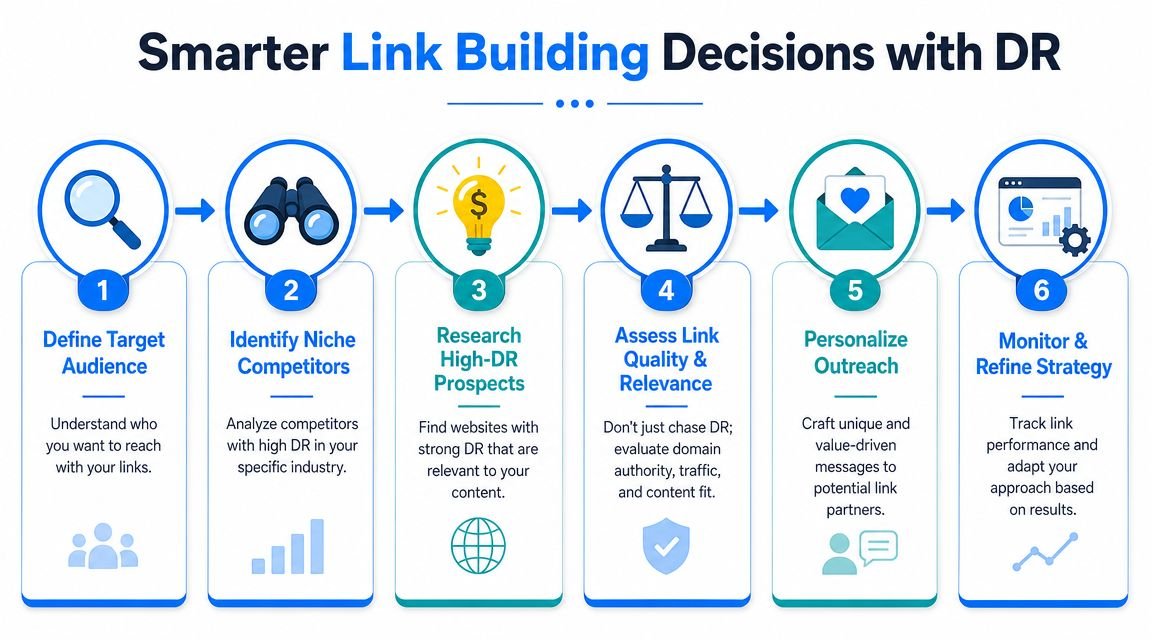
Used well, DR helps answer three practical questions. Is this prospect strong enough to matter? Is it relevant enough to influence the right audience? Is it worth the cost in cash, time, or relationship capital?
That is the professional use case. DR helps sort opportunities. It does not validate business impact on its own, and as noted earlier, it should never stand in for rankings, traffic, or conversions.
How to use DR in prospecting
Prospecting gets sharper when DR is used as a range, not a trophy.
I usually set a niche-relative floor first. In some SaaS categories, a DR 35 industry blog with an actual audience is a better target than a DR 75 general site that publishes anything for a fee. The first can send trust, referral traffic, and context. The second may only pass a diluted signal and leave you with a forgettable mention on a page nobody reads.
A practical review process looks like this:
- Set a floor based on the search results you want to win. Check the domains linking to pages already ranking for your commercial terms.
- Score topical fit before authority. Relevance changes the value of the same DR number.
- Review editorial quality. Look for original publishing, real bylines, consistent standards, and signs that the site rejects weak submissions.
- Check outbound link behavior. If every post links to casino, crypto, HR software, and payroll tools in the same week, treat it like inventory.
- Match the prospect to the page you want to strengthen. A homepage mention and a deep link to a commercial page do different jobs.
This is also where teams should separate brand-building placements from ranking-driven placements. Both can be useful. They should not come out of the same budget line without a clear reason.
If your team needs a broader framework for improving authority signals over time, this guide on how to improve domain authority for SEO growth complements the DR workflow well.
How to use DR in competitive analysis
Competitive analysis is where DR starts saving real money.
Pull a short list of search competitors. Use the ones taking traffic from the queries that matter, not the companies with the biggest logos. Then examine the domains linking to them and look for repeatable patterns in the middle of the market.
The interesting opportunities are rarely the glamorous ones. They are the partner directories, niche newsletters, product communities, association pages, comparison posts, founder interview series, and resource hubs that keep showing up across several competitors. If those domains sit in a healthy DR band and are topically close to your category, they often deserve more attention than a one-off publication with a flashy metric.
That pattern tells you where to invest outreach effort. It also tells you where not to overpay.
The best prospect list is usually the one with the clearest fit, not the highest average DR.
How to use DR in reporting
In reporting, DR works best as a directional signal for link profile strength.
Executives do not need a sermon on authority metrics. They need to know whether the campaign improved the pages tied to revenue. So keep DR in the report, but put it in the right place. Show it alongside referring domains to target pages, changes in rankings for commercial terms, qualified organic traffic, and downstream actions such as demos or signups.
That framing prevents a common reporting mistake. A campaign can raise domain-level authority while doing very little for the pages that drive pipeline. When that happens, the response is not celebration or panic. It is adjustment. Shift outreach toward pages, formats, and domains that support the commercial assets you need to rank.
A Mini Playbook to Improve Your Domain Rating
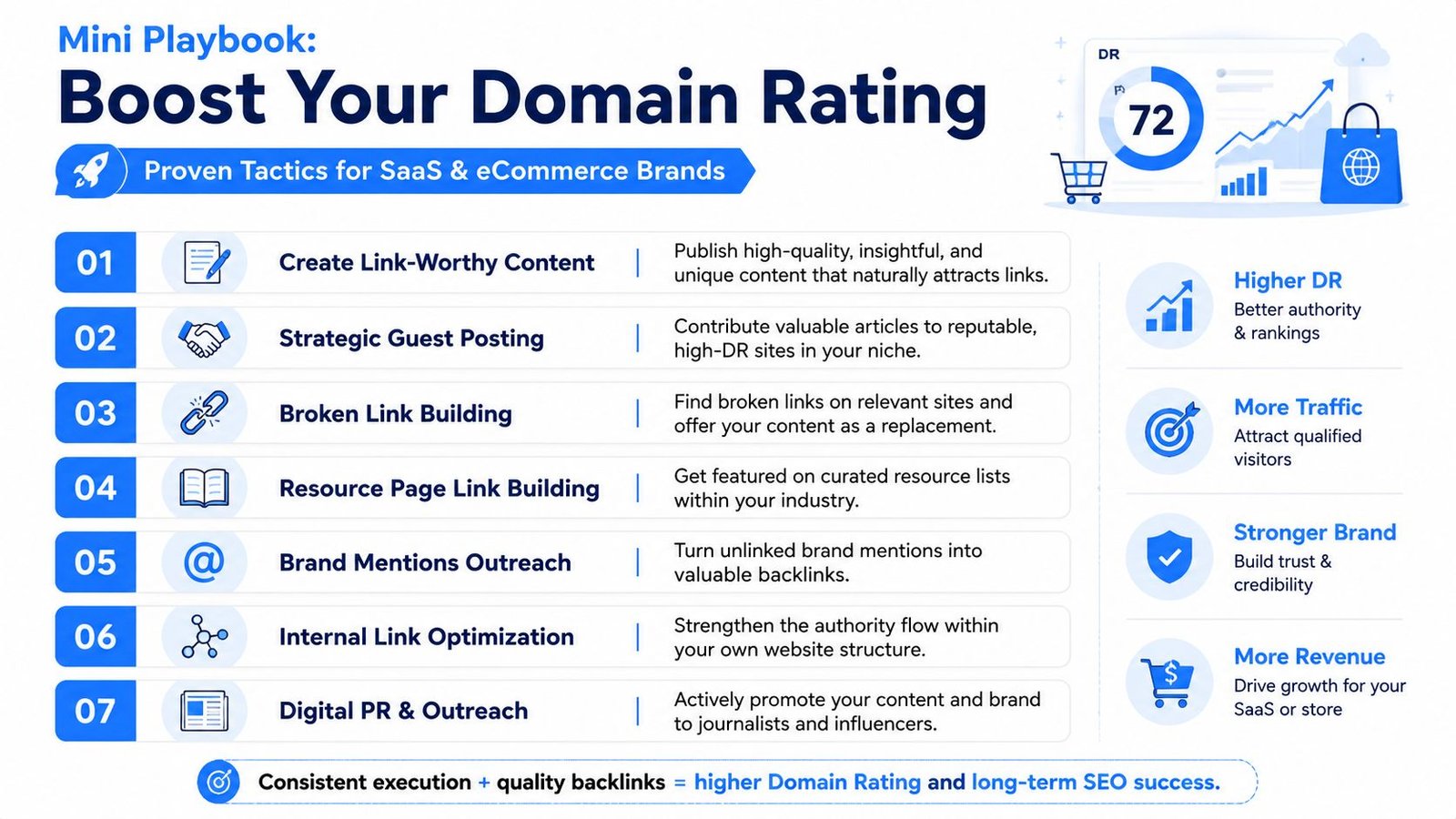
If you want to improve DR, the answer isn't “get more links” in the abstract. The answer is to earn better domain-level authority signals from places that are relevant, selective, and hard to fake.
That usually comes from assets and outreach formats with a clear reason to exist.
Teams that need a broader authority improvement roadmap can also compare these ideas with this guide on how to improve domain authority. The terminology differs by tool, but the operating discipline is similar.
Build assets people actually cite
The strongest linkable assets solve a problem for publishers, writers, or niche operators.
That can include:
- Free tools: Calculators, graders, generators, or simple utilities tied to your product category
- Original viewpoints: Strong expert commentary that journalists, newsletter writers, and bloggers can reference
- Reference content: Definitive guides, glossaries, templates, or comparison pages that deserve repeated citation
- Data-led resources: If your company has proprietary usage insight, package it carefully and make it easy to quote
Why this works for DR is straightforward. These assets can attract links from multiple unique domains over time, which is much more durable than one-off transactional placements.
Use outreach formats that create real authority
Not all link acquisition methods are equal. Some scale volume. Others build a profile that looks credible.
A few approaches consistently produce better strategic value:
- Digital PR: Newsworthy commentary, expert responses, and useful narratives can earn mentions from stronger publications than standard outreach can reach.
- Guest contributions: Done well, this still works. The key is contributing to sites with a real audience and editorial bar, not article farms.
- Partner ecosystem links: Integration pages, marketplace profiles, and co-marketing relationships can be highly relevant for SaaS.
- Unlinked mention reclamation: When people already know your brand, turning mentions into links is often one of the cleanest wins available.
The best DR gains usually come as a side effect of being cited in places your category already trusts.
One warning. Don't optimize purely for homepage DR. A mediocre article on a strong domain can still be a weak placement if the page is ignored, overloaded with commercial links, or poorly indexed in practice. Quality control still matters at the page level.
Tracking DR and Reporting Link Profile Strength
If you track DR monthly, it can tell you whether your domain-level authority is strengthening. That's useful. What it can't do by itself is prove SEO success.
What to show stakeholders
A serious report pairs DR with the metrics that reflect search performance and business impact.
That usually means showing:
- DR trend: Is overall link-profile strength moving in the right direction?
- Referring domain quality: Are you adding the kinds of domains you want?
- Target page movement: Are the pages tied to revenue or pipeline getting stronger links?
- Search outcomes: Are rankings, qualified visits, and conversions improving where it counts?
This prevents a common reporting failure. Teams celebrate a stronger domain metric while the pages responsible for demos, trials, or product signups remain unchanged.
What a healthy DR trend really means
A healthy DR trend says your link acquisition is adding enough quality and diversity to strengthen the domain over time. That's a good operational signal. It often means your outreach is landing in better places, your content is more cite-worthy, or your brand is entering more credible industry conversations.
It does not mean every campaign is working. And it doesn't mean Google is rewarding the number itself.
The best way to talk about DR internally is simple: it is evidence of link-profile progress, not a substitute for ranking, traffic, or revenue analysis. Once stakeholders understand that, the number becomes useful instead of distracting.
If your team wants a link building partner that treats DR as a decision tool instead of a vanity KPI, SaasSky is built for that kind of work. They focus on practical link acquisition for SaaS and eCommerce brands, with transparent planning, real execution context, and a model that ties authority growth back to outcomes that matter.