Your team needs links, but the usual options keep dragging. Guest posts take content briefs, drafts, edits, approvals, publication, then a wait for the new page to get crawled and trusted. If you run SaaS or eCommerce growth, that lag hurts. You're trying to influence pipeline, demos, signups, and product page visibility now, not months from now.
That's where niche edit links get interesting. They let you place a backlink inside content that already exists, already fits a topic, and often already has search visibility. The upside is speed. The danger is that many marketers buy the surface story, relevance plus authority, and skip the deeper review that determines whether the placement is worth the budget.
For SaaS and eCommerce teams, that gap matters. A link on a decaying comparison page or a bloated “resources” article can look strong in a spreadsheet and still do very little in practice. The useful question isn't whether niche edits work. It's how to tell a durable placement from a hollow one before you spend.
Table of Contents
- Beyond Guest Posts An Introduction to Niche Edits
- What Exactly Are Niche Edit Links
- Niche Edits Versus Other Link Building Tactics
- Weighing the Rewards and Risks
- A Framework for Assessing Niche Edit Quality
- The Niche Edit Playbook for SaaS and eCommerce
- Frequently Asked Questions About Niche Edits
Beyond Guest Posts An Introduction to Niche Edits
Guest posting still has a role, but many in-house teams hit the same wall. It asks for too much production work when what they really need is distribution. You end up managing article outlines, reviewing drafts, and chasing publishers, while your product and commercial pages still need authority.
Niche edits solve a different problem. They shorten the path between outreach and placement by working with existing pages instead of new ones. For a SaaS marketing manager, that usually means less content overhead. For an eCommerce team, it can mean getting a product category or collection page cited where buyers already compare solutions.
What makes niche edits valuable isn't just that they're faster. It's that they force you to think at the page level. You're not buying a domain metric. You're buying placement inside a specific asset with its own history, audience, and staying power.
Most explainers stop at relevance and authority, but the real decision is whether the host page is still a worthwhile investment over time, as noted in this guidance on evaluating niche edit links for long-term value.
The real operational problem
The biggest mistake I see is treating niche edits like interchangeable inventory. They aren't. A contextual link on a well-maintained article that still matches search intent is very different from a paid insertion on a page that gets edited every week to cram in new buyers.
For SaaS and eCommerce, the quality bar should be higher because the linked pages are often commercial. You're usually not trying to lift a broad educational blog post. You're trying to support a landing page, solution page, feature page, comparison page, or product collection. Those URLs need links that look editorially justified.
A good niche edit campaign works because it respects context. A bad one chases a metric and ignores page health, article quality, and publisher behavior. That's the difference between a link that compounds and one that gets buried, removed, or discounted.
What Exactly Are Niche Edit Links
Niche edit links, also called link insertions, are backlinks added to content that has already been published. Instead of writing a new guest article, you place your link into an existing page that's already live and already indexed.
The easiest way to think about it is a library citation. A guest post is like publishing a new book and waiting for people to discover it. A niche edit is like adding a relevant citation to a book that's already on the shelf, already cataloged, and already trusted by readers.
That distinction matters because the host URL has history. It may already rank, already attract traffic, and already carry backlinks. According to Page One Power's glossary on how niche edits fit modern link portfolios, some agencies report that roughly 30% of their backlinks come from this method. That doesn't make it a universal benchmark, but it does show the tactic is now a material part of many SEO programs.
If you need a refresher on link fundamentals before getting tactical, this guide on what a backlink is covers the basics.
Why existing pages matter
The page already has a track record. Search engines have seen it, indexed it, and formed some judgment about its trust and relevance. That's why teams often use niche edits when they want a faster route than publishing from scratch.
There's also a practical angle. Existing pages can already be earning impressions for terms your buyers search. If you place a link into a strong comparison article, software roundup, or product guide, you're not only getting SEO value. You may also earn qualified referral traffic from readers who are already in research mode.
Where they fit in a modern backlink mix
Niche edits aren't a replacement for every other tactic. They sit alongside guest posts, digital PR, broken link building, and brand mention reclamation.
They work best when the target page has a clear commercial purpose and the host content can mention it naturally. For SaaS, that might be a “best tools” list, an alternatives page, or a workflow guide. For eCommerce, it might be a buying guide, gift guide, or category-focused roundup.
What they don't fix is weak positioning. If your product doesn't fit the host page's topic or intent, the insertion will look forced. That usually shows up in awkward anchor text, thin surrounding copy, and a link that feels purchased instead of earned.
Niche Edits Versus Other Link Building Tactics
Not every campaign needs the same link type. If your team chooses the wrong tactic for the wrong page, you usually pay twice. Once for the link, and again for the opportunity cost.
The core trade-offs
Niche edits are usually strongest when speed and existing page authority matter more than content control. Guest posts are stronger when you need to shape the narrative, introduce a category, or explain a product in depth. Broken link building can work well when you have a useful replacement asset and enough outreach bandwidth.
Here's the practical comparison.
| Factor | Niche Edit (Link Insertion) | Guest Post (New Article) |
|---|---|---|
| Speed to placement | Usually faster because the page already exists | Usually slower because content must be created and approved |
| Content control | Lower control over surrounding copy | Higher control over message and structure |
| Page history | Benefits from an existing page's history | Starts from a new URL with no history |
| Best use case | Supporting commercial pages with contextual mentions | Building topical depth and branded thought leadership |
| Risk point | Weak host pages can look good on paper but underperform | New pages may take longer to show value |
Broken link building belongs in a separate bucket. It's outreach-led and can produce high-quality placements, but the starting trigger is different. You're identifying a dead resource and proposing your page as the replacement. With niche edits, there doesn't need to be a broken link at all.
Practical rule: Use niche edits when the host page already says most of what needs to be said. Use guest posts when you need to create the narrative yourself.
When each tactic wins
For a SaaS company launching a comparison page, niche edits can be a strong fit if you can secure placement inside articles that discuss the workflow category or list solution options. The context is already there. You're joining an existing conversation.
For an eCommerce brand trying to build links to a collection page, niche edits often work best in roundup content where buyers are already evaluating products. That's very different from writing a fresh guest post on a broad lifestyle blog and hoping the link still feels relevant.
Guest posts win when the product needs explanation. New categories, technical products, and complex B2B software often need room to educate. Broken link building wins when your team owns a useful resource that can replace outdated references at scale.
What doesn't work is using niche edits for everything. Some pages need editorial control. Some need original data or a new point of view. Some plainly don't belong inside someone else's old article.
Weighing the Rewards and Risks
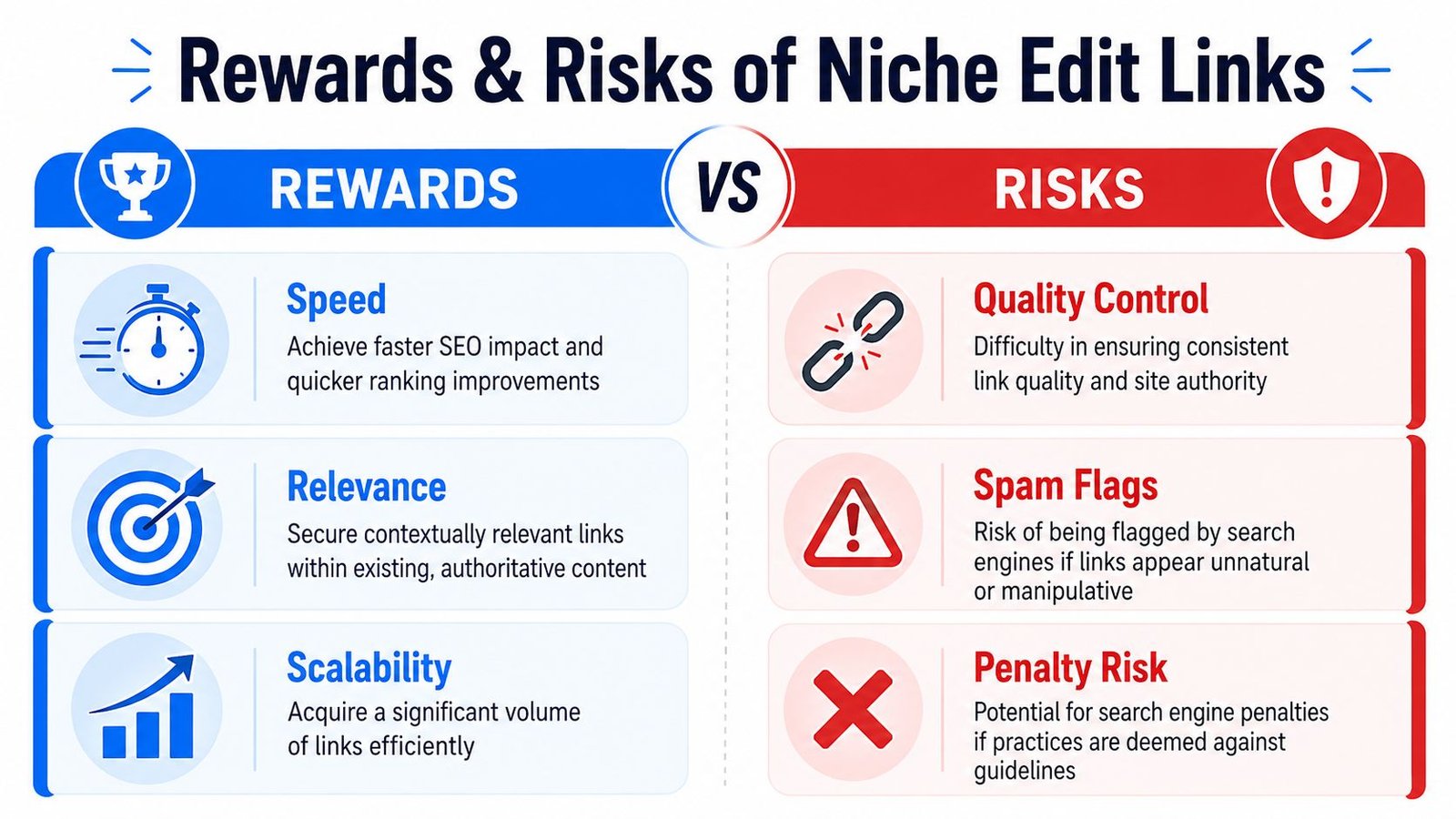
Niche edits are attractive because they compress a lot of the link building timeline. They can also go wrong quickly when buyers focus on surface metrics and ignore editorial reality.
Why teams buy niche edits
The main reward is speed. Because the host page already exists, you skip the content production cycle that slows guest posting. That's especially useful when a team is trying to support priority URLs tied to revenue, not just blog content.
The second reward is context. A strong niche edit sits inside copy that already discusses the problem space your product addresses. That can make the placement feel more natural than a standalone byline article written mainly to house a link.
The third reward is operational efficiency. If your team understands vetting, outreach, and anchor selection, niche edits can fit neatly into a repeatable process. They're often easier to scale than content-heavy tactics.
If you're comparing link attributes while reviewing placements, this breakdown of follow and nofollow links is useful background.
Where campaigns go wrong
The biggest risk is weak inventory dressed up as authority. A domain can look fine while the actual page is stale, off-topic, overloaded with external links, or constantly edited for advertisers. That's common in low-quality marketplaces.
Another risk is unnatural placement. If the surrounding paragraph doesn't genuinely need your link, the sentence feels inserted rather than edited. Readers notice that. Editors notice that. Search engines can also discount patterns that look manipulative.
There's also a governance problem. Once your link goes live, you don't control the page. The publisher can change wording, add competing links nearby, remove the article, or degrade the page over time.
A niche edit isn't just a purchased mention. It's a bet that the host page will stay relevant, live, and editorially credible long enough to matter.
Paid placements also sit in a gray area from a policy perspective. Execution matters. Real editorial review, relevant content, and selective placement are different from buying bulk links on sites that accept anything. The more your campaign resembles indiscriminate inventory buying, the more risk you take on.
A Framework for Assessing Niche Edit Quality
Professionals often over-index on domain metrics because they're easy to sort in a spreadsheet. That's not enough. The unit of value in a niche edit campaign is the page, the placement, and the publisher's editorial behavior.
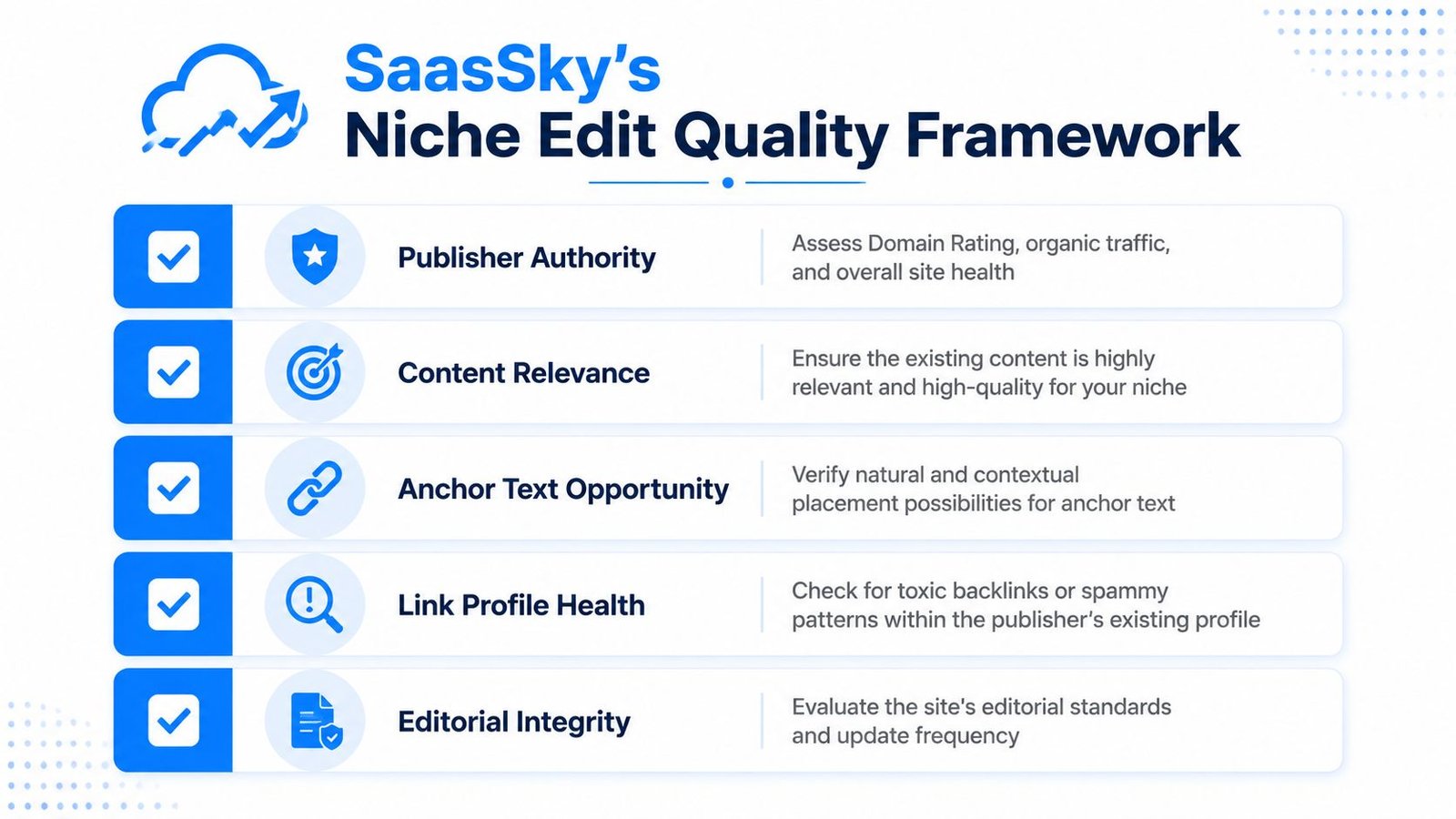
A useful baseline comes from Distribb's practical guide to filtering niche edit targets with traffic and authority signals, which recommends prioritizing pages with topical relevance and measurable authority, such as DA 30 or higher and monthly organic traffic above 1,000. That's a starting filter, not a final decision.
Page fit before metric checks
Start with intent match. Ask one question first: does the page naturally deserve to mention your target URL?
For SaaS, the cleanest placements are usually on pages comparing tools, explaining a workflow, reviewing platforms, or listing software resources. For eCommerce, strong candidates include buying guides, “best of” roundups, use-case collections, and category explainers.
Then review the paragraph-level fit:
- Topic alignment: The sentence around your link should discuss the same problem your page solves.
- Commercial logic: A product or service page should appear where a recommendation makes sense, not in a random definition paragraph.
- Anchor flexibility: If the only workable anchor is exact match and awkward, skip the opportunity.
Site health and page durability
Once the page fits, look at the host site like an operator, not a broker.
Check whether the site appears maintained. Read several recent articles. Look for signs of actual editorial standards, not just AI-generated filler with affiliate blocks and outbound links everywhere. Review whether the site publishes within a coherent niche or accepts content across unrelated verticals.
Then inspect page durability:
- Age matters: Guidance in the niche edit market commonly favors pages that are at least several months old and already indexed, not freshly published placeholders.
- Stability matters: Avoid pages that seem to change frequently for commercial reasons.
- Traffic consistency matters: A page on a declining URL can still show historic authority while offering little current value.
Good niche edits usually come from pages that feel boring in the best way. Stable, relevant, maintained, and not obviously built for selling links.
Outbound links and placement logic
Many unfavorable arrangements are often hidden. You want to know how crowded the page is and how your link will sit among other citations.
Industry guidance often uses fewer than 30 external links on the page as a practical filter, alongside signs of authority and traffic, according to Grow Resolve's overview of how the niche edit market screens pages and prices placements. That doesn't mean link number alone determines quality, but it's a useful warning sign when a page is packed with references.
Review these details manually:
- Link density: Too many outbound links can dilute attention and signal a sell-side page.
- Neighbor links: If your link will sit next to casinos, crypto, payday, or unrelated commercial pages, walk away.
- Edit style: The best placements require only a light sentence adjustment. If the publisher needs to bolt on a whole unnatural paragraph, the fit was weak from the start.
A good framework doesn't produce more “yes” decisions. It produces faster “no” decisions. That's how you protect budget.
The Niche Edit Playbook for SaaS and eCommerce
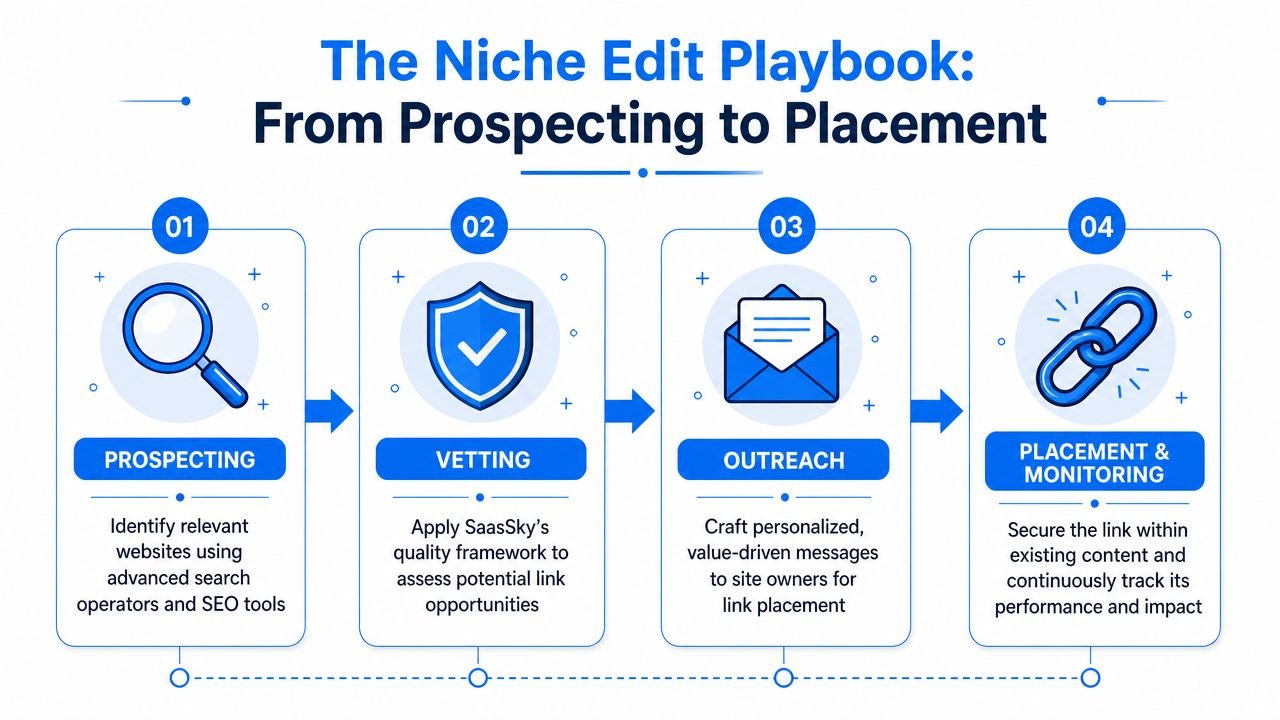
Once you know how to judge quality, the campaign becomes operational. The work breaks into four phases: finding candidates, validating them, pitching the edit, and checking what happens after placement.
If your team needs a managed version of this process, a link building program for SaaS and eCommerce brands can give you a benchmark for how structured fulfillment should look.
Phase one prospecting
Use Google search operators and SEO tools together. Search for pages that already discuss the exact category, use case, or problem your target page addresses.
For SaaS, good queries often look for software comparisons, alternatives pages, workflow guides, and curated resources. For eCommerce, search around buying guides, “best” pages, seasonal roundups, gift guides, and category recommendation articles.
Build a short list and tag each prospect by page type:
- Comparison pages for category and alternatives traffic
- Roundups for recommendation intent
- Educational guides for contextual problem-solution mentions
- Resource pages for evergreen references
Don't start outreach from domain lists alone. Start from specific URLs.
Phase two outreach
Outreach works when you make the editor's job easier. Don't send “can you add my link?” emails with no context. Show exactly where your page fits and why it improves the article.
A simple structure works well:
- Mention the exact article.
- Point to a gap, outdated reference, or missing example.
- Suggest the sentence where your resource fits.
- Explain why it helps their reader.
For a SaaS example:
Hi [Name], I was reading your article on customer onboarding tools and noticed the section on implementation workflows. We've published a page focused on onboarding checklists for product-led teams that could strengthen that paragraph. If helpful, I can suggest a sentence that fits your existing structure without changing the article's tone.
For an eCommerce example:
Hi [Name], your roundup on ergonomic desk accessories is strong, especially the section on workspace setup. We have a category page that matches the buyer intent in that section and could work as an additional reference if you're updating the guide this quarter.
This approach performs better than generic link asks because it gives a reason for the edit beyond your own SEO needs.
Phase three negotiation and placement
You should expect pricing variance because the market is mature and segmented. A 2026 industry roundup cited by Grow Resolve lists niche edit offerings from about $20 to $30 per link in marketplace models up to more than $375 per link for fully managed placements, with other providers quoted at $55, $83+, and $225 per link, depending on quality and service level.
That spread tells you something important. Price is often a proxy for vetting depth, publisher quality, and risk tolerance. Cheap placements can be valid, but low price alone isn't a bargain if the page is weak or unstable.
When negotiating, confirm:
- Exact URL: Don't approve “same site, different page” substitutions without review.
- Anchor treatment: Keep anchors natural. Brand, partial match, and descriptive anchors usually age better than aggressive exact match.
- Surrounding copy: Ask to review the insertion language if the sentence will be modified.
- Link permanence: Clarify whether the publisher considers the edit permanent.
Phase four monitoring
Once the link is live, record the URL, anchor text, target page, and publication context. Then monitor whether the page remains indexed, whether the insertion remains intact, and whether the host article changes meaningfully over time.
Measure impact in business terms, not just link counts. For SaaS, look at visibility movement for the linked commercial page, demo-related keyword coverage, and referral sessions from relevant publishers. For eCommerce, review category visibility, product discovery terms, and assisted traffic from buying-guide pages.
Good operators treat niche edits as assets under management, not one-time transactions.
Frequently Asked Questions About Niche Edits
Are niche edits white hat or gray hat
It depends on execution. Editorially sensible placements on relevant sites are very different from bulk paid insertions on pages that exist mainly to sell links. The closer the campaign gets to indiscriminate buying, the riskier it becomes.
How are niche edits different from broken link building
Broken link building starts with a dead link and a replacement suggestion. Niche edits don't require a broken link. You're proposing an addition or update to existing content.
What's a fair price to pay
There isn't one universal rate. The market ranges from low-cost marketplace inventory to premium managed placements. Fair pricing depends on page quality, publisher standards, and how much vetting and outreach work is included.
How should SaaS and eCommerce teams measure ROI
Track the linked page, not just the backlink. Look for stronger rankings on the target URL, referral traffic from the host page, and whether the link supports pages that influence demos, trials, purchases, or revenue-driving category visibility.
If you want a partner that treats niche edit links like investments instead of inventory, SaasSky works with SaaS and eCommerce teams on transparent, practitioner-led link building built around quality control, clear pricing, and measurable impact.