
Most advice on a link building program is stuck in an older search model. It still treats links like a monthly production target. Pick a quota, send enough emails, and report how many backlinks landed.
That approach breaks fast in AI search and zero-click SERPs. If fewer visits come directly from result pages, then a weak link profile doesn't just hurt rankings. It limits brand discovery, editorial trust, citation potential, and the chance that your company becomes the source people keep seeing across the web.
That's why a modern link building program has to work like an authority system, not a backlink vending machine.
Table of Contents
- Beyond Backlinks Defining Your Program's Core Objectives
- Assembling Your Team and Allocating a Realistic Budget
- The Modern Link Building Playbook Campaigns That Work in 2026
- Mastering the Outreach Workflow from Prospect to Placement
- Measuring True ROI and Scaling for Growth
Beyond Backlinks Defining Your Program's Core Objectives
Why links still matter when clicks are harder to win
A lot of teams ask the wrong first question. They ask whether link building still works.
The better question is what links are supposed to do now.
Search behavior has changed. Search Engine Land frames link building as a debated, ongoing practice, and its broader SEO coverage reflects the pressure created by zero-click search and AI-driven results. In that environment, links often matter less as a pure traffic lever and more as a signal of authority, discovery, and trust for SaaS and eCommerce teams that need ROI beyond simple clicks, as discussed in Search Engine Land's link building library.
Links still send visitors. But the stronger reason to invest is that reputable sites keep validating who deserves attention.
That changes the operating model. If your program is built only around “get links to blog posts,” it will underperform. If it's built around becoming the cited brand in your category, it gets harder for search shifts to wipe out the value.
This is also where many teams confuse organic traffic with total search value. Rankings and visits still matter, but they're only part of the picture. If you need a refresher on how search visibility turns into business impact, this guide on organic traffic for growth-focused teams is useful context.
Start with business outcomes, not link quotas
A serious link building program starts from company priorities.
If you're selling to enterprise buyers, your objective might be to increase trust in a narrow category. If you're in a crowded software market, the objective might be to own comparison and solution-aware searches. If your brand is known in one segment but invisible in another, the objective might be to earn mentions in the publications and communities that shape buyer perception there.
Bad objective:
- Get 20 links per month
Useful objectives:
- Earn placements in publications your buyers already read
- Strengthen authority around one product line or feature set
- Support commercial pages that influence pipeline
- Increase the share of relevant third-party mentions that include a link
- Build a stronger brand footprint for AI discovery and citation
The quota-first model fails because it rewards whatever is easiest to scale. That usually means weak placements, generic outreach, and links that look fine in a report but don't help the business.
A better planning sequence looks like this:
- Pick the business priority. Enterprise expansion, self-serve growth, new category creation, feature adoption, or geographic expansion.
- Map the pages and topics that support that priority. Commercial pages, integration pages, comparison pages, category explainers, data assets.
- Choose the publication types that can influence trust. Trade media, SaaS blogs, partner ecosystems, associations, curated resource pages, high-quality roundups.
- Set KPIs that reflect authority and business movement. Not just link counts.
The KPI stack that actually guides decisions
A link building program requires two KPI layers. One measures whether the campaign is producing credible authority signals. The other measures whether that authority is creating business lift.
Here's the framework we use.
| KPI Layer | What to Track | Why It Matters |
|---|---|---|
| Authority KPIs | new linking domains, relevance of placements, editorial context, share of earned mentions that become links | Shows whether the market is actually validating your brand |
| Engagement KPIs | referral traffic quality, assisted conversions, branded search interest, visits to commercial pages from placements | Shows whether placements attract the right audience |
| SEO KPIs | ranking movement for target pages, visibility of priority topics, internal authority flow to money pages | Shows whether links are helping search performance |
| Business KPIs | demo influence, signup influence, sales conversations sourced or assisted by earned media | Shows whether the program is tied to revenue work |
Notice what's missing. Raw backlink volume by itself.
Practical rule: If a KPI can improve while your placements get less relevant, it's a dangerous KPI to optimize.
A SaaS company can “hit target” on backlinks while missing every meaningful audience. That's how teams spend for months and still can't explain impact.
Objectives should also reflect the kind of authority you're trying to build. A cybersecurity platform and a Shopify app won't run the same program. One needs trust from technical and compliance-heavy publications. The other may need category pages, merchant communities, comparison articles, and integration ecosystems.
The core principle stays the same. Define success at the business level first. Then let links serve that mission.
Assembling Your Team and Allocating a Realistic Budget
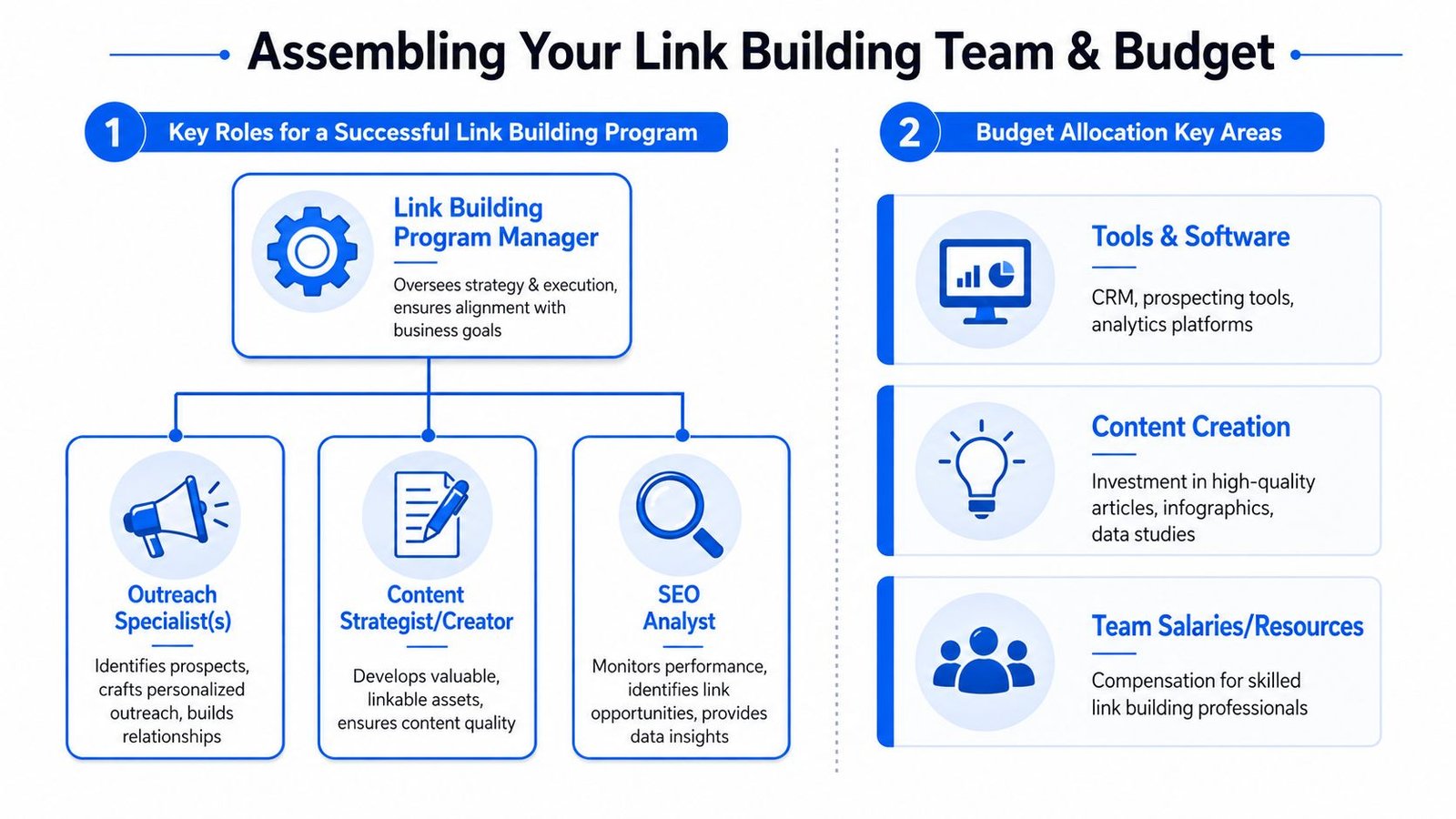
A link building program fails faster from weak staffing than from weak tactics. Most problems people call “strategy” are resource problems. No one owns campaign planning, content production gets delayed, outreach quality drops, and reporting turns into screenshots from Ahrefs.
The roles that make the program work
You can combine some of these roles in a small company, but the functions still have to exist.
Link Building Program Role Definitions
| Role | Core Responsibilities | Key Skills |
|---|---|---|
| Program Manager | sets targets, chooses campaigns, aligns link acquisition with business priorities, reviews quality | strategy, prioritization, publisher judgment, stakeholder management |
| Outreach Specialist | builds prospect lists, qualifies contacts, sends personalized outreach, manages follow-ups | research, copywriting, relationship building, CRM discipline |
| Content Strategist or Creator | develops assets worth citing, writes support content, shapes hooks for outreach | editorial planning, subject matter translation, UX writing |
| SEO Analyst | tracks rankings, referring domains, referral traffic, conversion paths, and page-level impact | analytics, keyword strategy, reporting, technical SEO awareness |
| Digital PR Lead | turns internal data or expertise into stories editors care about | media pitching, storytelling, news sense, brand positioning |
Teams often try to skip the content role. That's a mistake. Outreach without something worth referencing becomes a pure ask. Editors don't need more asks.
The same applies to analytics. If no one can tell you which placements influenced rankings, referral quality, or assisted conversions, your link building program becomes impossible to defend in budget reviews.
Choosing the right operating model
There are three practical models.
| Model | Best For | Pros | Cons |
|---|---|---|---|
| In-house | companies with steady demand, existing SEO leadership, and content resources | tighter product knowledge, faster collaboration, direct control | harder hiring, slower ramp, tool and process overhead |
| Hybrid | teams with internal SEO leadership but limited execution bandwidth | keeps strategy close to the business while outsourcing specialized tasks | requires strong coordination and clear ownership |
| Agency partner | lean teams that need execution, process, and reporting without building the whole function | faster deployment, broader publisher knowledge, repeatable systems | quality varies widely, requires vetting and accountability |
For early-stage SaaS, hybrid is often the cleanest option. Keep strategic direction close to the product and funnel. Outsource pieces that benefit from repetition and existing publisher relationships.
If you're evaluating that path, this overview of outsourced link building models is a practical starting point.
The right model isn't the one with the lowest monthly cost. It's the one that keeps quality stable month after month.
Why budget has to be recurring
Founders and finance leads often underestimate the category. Link building isn't a one-time sprint if you're in a competitive market. It behaves more like an operating program.
HubSpot's summary of industry survey data shows 46% of marketers spend $10,000 or more annually on link building, while 22% spend between $1,000 and $2,500. The same summary cites FatJoe survey data showing 47% of link builders spend more than £600 per month, 14% spend over £1,500 per month, and 62% of respondents working with legal clients spend more than £601 per month. Those figures make one point clear: serious teams treat link building as recurring spend, not a side experiment, as outlined in HubSpot's link building statistics roundup.
The reason is simple. Costs don't sit in one line item.
A functioning program usually includes:
- People costs for strategy, outreach, content, and analysis
- Tool costs for prospecting, CRM, reporting, and SEO research
- Asset creation costs for research pieces, expert commentary, landing page support, and editorial updates
- Management costs from coordination, QA, and publisher review
Budget also changes with the market you're in. Some sectors require tighter editorial standards, stronger expertise, and more selective prospecting. That raises the cost even if you build fewer links.
A realistic budget conversation should answer three questions:
- What business outcome are we buying toward
- What campaign mix supports that outcome
- What minimum staffing level keeps quality from collapsing
If leadership can't answer those, budget debates become emotional. If they can, the program becomes governable.
The Modern Link Building Playbook Campaigns That Work in 2026
The old playbook rewarded scale. The current one rewards credibility.
That shift is visible in the data. BuzzStream's 2025 compilation reports that 48.6% of respondents in Editorial.Link's State of Link Building study named digital PR the most effective tactic for 2025, while 94.8% said data-led content was a primary digital PR tactic. The same review also notes that 65% of users still click traditional blue links, which matters because links remain commercially relevant even as AI summaries expand. Taken together, that's a strong case for authority-building campaigns rather than volume-first outreach, as summarized in BuzzStream's link building statistics review.

Digital PR as the core growth engine
For most SaaS brands, digital PR should sit near the center of the campaign mix.
That doesn't mean chasing national headlines for vanity. It means creating assets and narratives that editors can use. Original datasets. Strong expert commentary. Trend explainers. Contrarian point-of-view pieces. Regional cuts of a bigger industry story. Topic-specific research that solves a journalist's sourcing problem.
Three formats work especially well:
- Data-led content that gives editors a statistic, comparison, or trend line they can cite
- Expert commentary tied to product knowledge, customer behavior, or market changes
- Reactive stories that let your brand speak into a live conversation quickly
This works because digital PR produces more than one outcome. It can earn links, brand mentions, topical association, and stronger perceived expertise at the same time.
A mature SaaS company might publish an annual benchmark report. A smaller team can still win with a well-scoped dataset, a sharp expert perspective, or a useful niche resource.
Supporting campaigns that strengthen the system
Digital PR shouldn't do all the work. The strongest link building program combines campaign types with different strengths.
Resource and reference page outreach
This is one of the cleanest fits for practical SaaS content. Think templates, calculators, glossaries, checklists, compliance guides, or integration references. The best targets are pages that already curate tools or educational resources for a defined audience.
What makes this work is utility. You're not asking someone to squeeze in a random product mention. You're helping them improve a page whose purpose is already curation.
Unlinked mention reclamation
This is operationally simple and often efficient. If a publisher, partner, or reviewer already mentioned your brand, the hurdle is lower. The ask is not “discover us.” It's “complete the citation.”
Use this as a recurring sweep, not your whole program. It captures value your brand already generated elsewhere.
Niche partnerships and associations
Many SaaS teams overlook ecosystem trust. Industry communities, professional associations, implementation partners, integration directories, and curated member resources often carry stronger relevance than generic guest-post inventory.
These links rarely come from a blast campaign. They come from joining the right conversations and having assets that deserve inclusion.
Bigger link counts often lose to a smaller set of placements from sites your buyers already trust.
Broken-link replacement, selectively used
This still has a place when the page is highly relevant and your replacement improves the experience. But it shouldn't dominate the playbook. The effort only makes sense when the target page is already valuable and your asset is clearly the right substitute.
How campaign selection changes by SaaS maturity
A startup with limited content and low brand recognition shouldn't copy the campaign mix of a larger category leader.
A practical maturity model looks like this:
| SaaS Stage | Best-Fit Campaigns | What to Avoid |
|---|---|---|
| Early stage | niche partnerships, list inclusion, resource page outreach, unlinked mention capture | broad media pushes without a story or asset |
| Growth stage | digital PR, expert commentary, comparison page support, editorial placements | over-reliance on generic guest-post production |
| Established | recurring data campaigns, category narrative building, partner ecosystem authority, high-trust media | chasing volume for its own sake |
There's also a quality filter that matters more now than it did a few years ago. Search quality systems have pushed teams to think harder about who is linking, why they're linking, and whether the context looks editorially earned. Coverage that sits inside a useful article on a relevant site is more durable than a forgettable placement built only to host outbound links.
That's the modern playbook. Not one tactic. A portfolio of campaigns that keep reinforcing the same market position.
Mastering the Outreach Workflow from Prospect to Placement
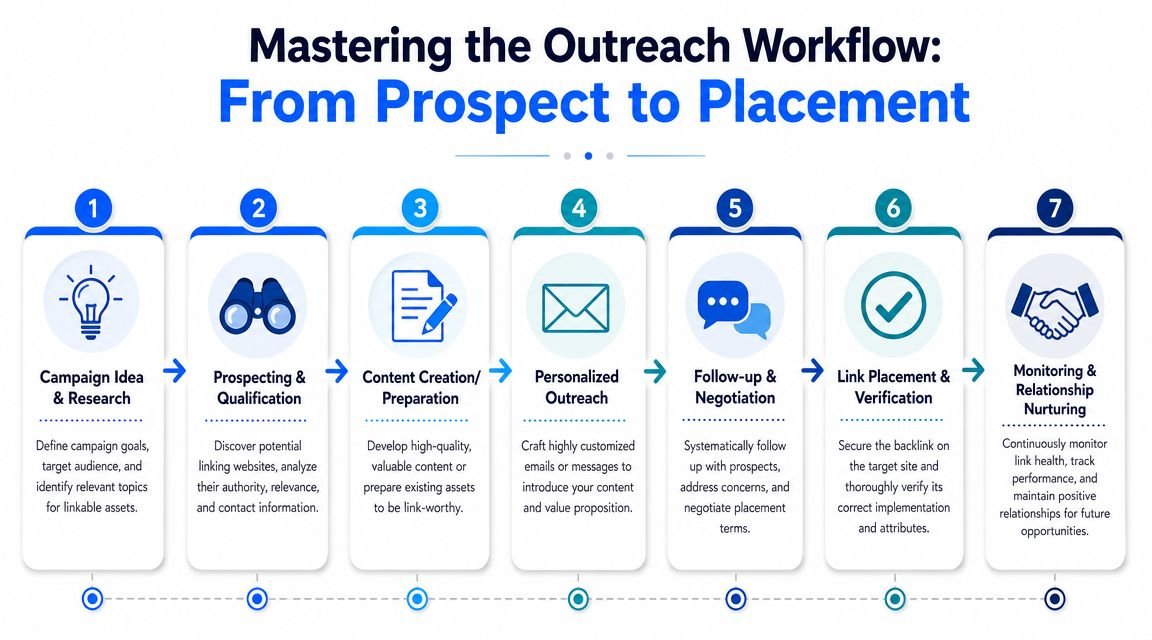
Execution is where good strategies go to die. Teams pick solid targets, build decent assets, then wreck the outcome with lazy prospecting and templated emails.
Outreach performance has useful benchmarks. Average link-building outreach response rates are around 8.5%, while personalized emails can reach 15% to 25%. Subject lines with the recipient's first name can increase opens by 30.5%. Research also suggests 100 to 200 words is the optimal email length, Tuesday and Thursday outperform Monday and Friday by 18%, and sending between 8:00 and 10:00 AM local time can produce 42% more responses than afternoon sends. The same benchmark set says 2 to 3 follow-ups are optimal, while more than 3 can reduce response rates and feel spammy. For anchor safety, it also recommends keeping keyword-rich anchor text below 10% of backlinks, according to Searchlab's link building statistics.
Prospecting with editorial judgment
The first outreach mistake is building lists from metrics alone.
DA and DR are useful shortcuts, but they don't answer the primary question. Would a buyer trust this site? If the answer is no, the placement is weak even if the metric looks fine.
We vet prospects in this order:
- Topical relevance. Does the site regularly cover the problem, category, or audience we serve?
- Editorial quality. Are articles coherent, maintained, and written for humans?
- Link context. Do outbound links appear selective, or does every page look monetized?
- Page fit. Is there a specific article or resource where our asset belongs naturally?
- Contact fit. Are we reaching a person who can edit or commission content?
Prospecting also works better at the page level than the domain level. A relevant article on a credible site is usually a better target than a “good domain” with no clear placement opportunity.
For teams still trying tired outreach plays, this is one reason the Skyscraper SEO technique often gets misunderstood. The issue isn't the concept of improving on existing content. The issue is sending generic outreach to pages where your addition doesn't materially improve the reader experience.
The outreach cadence that avoids spam patterns
Good outreach reads like a specific editorial suggestion, not a campaign artifact.
A practical workflow looks like this:
Email 1
Lead with the page you reviewed, the exact fit, and why your resource helps their readers.Follow-up 1
Add a new angle. Mention a data point, a missing section, or another relevant asset. Don't send “just bumping this.”Follow-up 2
Keep it short. Acknowledge timing may be off and ask whether someone else on the team handles the page.
That's enough for most campaigns. Past that point, you're usually teaching people to ignore your brand.
Personalization doesn't mean writing a novel. It means proving you understood the page, the audience, and the editor's standard.
You also need separation between automation and judgment. Use tools to track statuses, reminders, and contact history. Don't use them to remove thought from the process.
Simple templates that give structure, not scripts
Templates are useful when they preserve the parts that matter. They're harmful when they erase them.
Editorial addition outreach
Subject: Quick note on your [article topic]
Hi [Name],
I was reading your piece on [topic] and noticed you covered [specific point]. We recently published [resource] that adds [specific angle or utility] for readers trying to [job to be done]. If you think it fits, it could strengthen that section.
Best,
[Your name]
Unlinked mention reclaim
Subject: Small update to your [article title]
Hi [Name],
Thanks for mentioning [brand] in your article on [topic]. One small request. Would you be open to linking the mention to the relevant page so readers can find the resource directly?
Best,
[Your name]
Resource page pitch
Subject: Resource suggestion for your [page title]
Hi [Name],
Your resource page on [topic] is one of the better collections I've seen for [audience]. We have a [tool/guide/template] focused on [specific use case] that may be useful to include because it helps readers [outcome]. Happy to send the exact page if helpful.
Best,
[Your name]
Notice what's missing. Fake flattery, vague collaboration language, and over-explaining.
The workflow should stay simple:
- build a qualified list
- identify a real page fit
- send a short personalized email
- follow up with a reason
- verify the placement
- log the outcome
- keep the relationship if the site is worth revisiting
A disciplined outreach system beats a large one almost every time.
Measuring True ROI and Scaling for Growth
Too many reports still end with the weakest possible summary: “we built X links this month.”
That isn't ROI. It's activity.
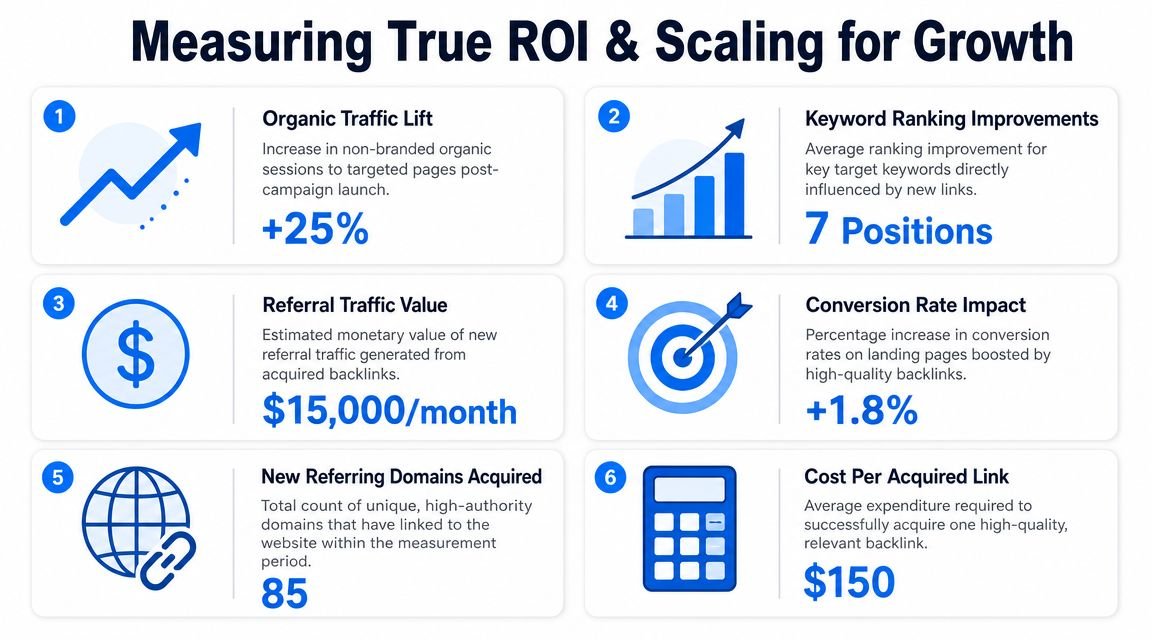
A proper link building program has to prove movement through a controlled funnel. Distinctly's guidance recommends establishing a baseline for keyword rankings, referral traffic, conversions, and referring domains before outreach begins, then measuring post-campaign deltas. It also stresses that steady month-over-month growth in new linking domains is a stronger signal than raw backlink totals, as explained in Distinctly's guide to measuring link building success and ROI.
Build measurement before launch
If the baseline is missing, attribution gets fuzzy fast.
Before a campaign starts, record:
- Target page rankings for the terms the campaign is supposed to support
- Referral traffic to the target pages and site sections
- Conversions and assisted conversions tied to referral and organic sessions
- Referring domains at the site level and page level
- Existing branded search patterns in your reporting environment
- Current share of links going to commercial pages vs informational content
This doesn't make attribution perfect. Search never works that cleanly. But it gives you a defendable before-and-after view.
What a serious monthly report should include
A useful report shows both leading and lagging indicators.
Leading indicators
These tell you whether the program is building durable authority.
- New linking domains earned during the period
- Relevance of placements by topic, audience, and page type
- Distribution of links across commercial, editorial, and supporting assets
- Editorial quality notes for standout wins and weak placements
- Mention-to-link conversion rate where relevant
Lagging indicators
These tell you whether authority is turning into business effect.
- Ranking movement for target pages
- Referral traffic quality from earned placements
- Assisted conversions from referral and organic pathways
- Growth in branded discovery signals
- Performance of the pages that received support
Measurement rule: report the delta from baseline, not just the latest snapshot.
That keeps teams honest. It also makes trend analysis possible. A single month can look flat while the quarter shows clear progress.
How to diagnose a program that stalls
When a link building program loses momentum, the issue usually sits in one of four places.
| Failure Point | What It Looks Like | What Usually Fixes It |
|---|---|---|
| Weak campaign premise | low reply rates, little editorial interest | improve the asset, hook, or story angle |
| Poor prospect quality | placements land but don't influence rankings or traffic | tighten relevance and page-level vetting |
| Broken attribution | links exist but no one can connect them to outcomes | rebuild reporting around baseline and target pages |
| Over-optimized execution | awkward anchors, low-trust placements, unstable gains | normalize anchor mix and raise editorial standards |
One common mistake is treating all links as equal after they go live. They aren't. Some are authority plays. Some are referral plays. Some strengthen category association. Some barely matter.
Teams should classify placements after acquisition and learn from them. The pages that influence outcomes deserve more of the budget. The ones that only pad reports should disappear from the mix.
Scaling without losing quality
Scaling a link building program isn't adding more outreach reps and doubling sends.
It's expanding what already works:
- turn one successful data asset into recurring research
- turn a strong publication relationship into repeat contributions
- repurpose expert commentary into several targeted pitches
- build internal linking support so earned authority reaches commercial pages
- create QA rules that reject weak placements before they hit the report
Growth also depends on what you stop doing. Cut prospect sources that repeatedly produce thin sites. Retire templates that generate polite replies but few placements. Drop asset types that attract links with no business relevance.
A resilient system gets better as it scales because each campaign teaches the next one what “worth winning” looks like.
If you want a team that treats link building like a measurable growth system instead of a backlink quota, SaasSky helps SaaS and eCommerce brands build authority through transparent, practitioner-led campaigns. You can review their approach, pricing, and contact options to see whether it fits the way your team wants to plan and measure SEO investment.