Most advice on the Skyscraper SEO technique is stuck in the past. It still treats the method like a writing contest where the longest post wins.
That isn't how strong campaigns work for SaaS and eCommerce brands anymore. In product-led markets, the pages that earn links often aren't standard blog posts at all. They're free tools, benchmark pages, templates, category hubs, migration guides, calculators, comparison resources, and data-led assets that solve a real job better than the current citation.
We use the skyscraper model as a commercial link-building system. The page has to attract editorial links, support rankings, and fit how the business makes money. For SaaS, that usually means assets that reduce evaluation friction or teach a workflow. For eCommerce, it often means assets that help buyers choose, compare, calculate, or plan.
Table of Contents
- Rethinking the Skyscraper Technique for 2026
- Finding Linkable Opportunities Beyond Blog Posts
- Creating an Asset That Truly Stands Out
- Executing a High-Precision Outreach Campaign
- Measuring and Scaling Your Skyscraper Program
- From Tactic to Flywheel Building Authority
Rethinking the Skyscraper Technique for 2026
The original Skyscraper playbook still works. The lazy version does not.
Plenty of teams still treat it like a content-length contest. They find a page with links, add a few thousand words, then send outreach asking editors to swap citations. That approach underperforms because editors are not rewarding effort. They are rewarding utility.
Search Engine Land's guide to the Skyscraper Technique reflects the shift well. Stronger campaigns now win by publishing original inputs, sharper framing, fresher evidence, or a better user experience. We see the same pattern across SaaS and eCommerce accounts. The asset that gets links is usually the one that saves the reader time, helps them make a decision, or gives them something usable right away.
For SaaS and eCommerce, this is especially important because the buyer journey is practical. A better citation is often a free tool, a benchmark page, a template, a calculator, or a product-adjacent resource that supports evaluation. If the page does not improve the reader's next step, outreach response rates drop and replacement links stay low.
Better doesn't mean bigger
We have replaced high-link pages with assets that were shorter than the incumbent. They won because they were easier to cite and more useful to the referring page's audience.
That is the standard.
Before we build anything, we pressure-test four questions:
- What weakness makes the current asset replaceable
- What does the linking page need from a citation
- What can this brand publish with real credibility
- What format gives the user a result faster
For SaaS, that often means product-led assets instead of another opinion post. A CRM brand may earn links with a sales capacity calculator. A cybersecurity company may win with a policy template library. A project management platform may outperform long-form content with benchmark data pulled from internal usage patterns.
For eCommerce, the same logic applies closer to the transaction than many teams expect. A mattress brand can attract citations with a firmness selector or care guide. A supplement brand can win with ingredient comparison tables. A hardware retailer can build a compatibility checker that publishers prefer over generic advice content.
One practical filter helps here. If the asset would not deserve inclusion in a curated list of web directories and citation sources, it usually will not deserve editorial replacement links either. Citation-worthy assets are clear, useful, and easy to reference.
Practical rule: If your asset does not give the publisher a stronger reason to cite your page, outreach turns into a volume game with weak returns.
Why the modern version is stronger
Brian Dean popularized the technique by formalizing a simple idea. Find pages that already attract links, publish something better, then contact sites linking to the original. That logic still holds. What changed is the threshold for "better."
In 2026, better usually means one of two things. Either the asset contains information competitors cannot easily copy, or it delivers the information in a format that solves the user's problem faster.
Today, the strongest Skyscraper assets usually fit one of these roles:
| Asset type | Why it earns links | Best fit |
|---|---|---|
| Free tool | Gives readers an output they can use immediately | SaaS, finance, ops, eCommerce planning |
| Data study | Gives writers statistics, trends, and source material | SaaS, martech, logistics, consumer trends |
| Template pack | Helps readers start with less friction | B2B SaaS, productivity, HR, legal-adjacent |
| Resource hub | Gives publishers one clean page to cite | Technical categories and complex products |
| Comparison asset | Supports evaluation and buying decisions | SaaS alternatives, product selection |
That is the core update to the Skyscraper SEO technique. We are no longer trying to publish the longest page in the SERP. We are building the asset another site would rather send its audience to.
Finding Linkable Opportunities Beyond Blog Posts
Strong Skyscraper targets usually sit closer to the product than the average content team expects. For SaaS and eCommerce, that changes the opportunity set completely.
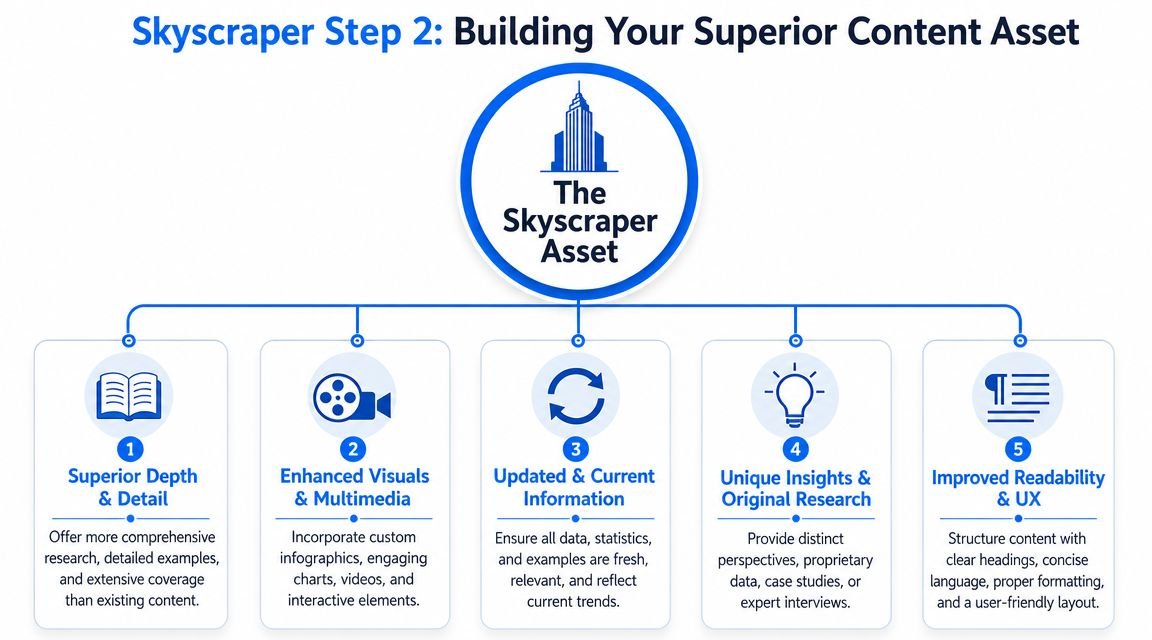
What linkable assets look like in SaaS and eCommerce
We start with pages that have already attracted meaningful editorial links. That tells us publishers have cited the topic before. It does not tell us the current asset deserves to keep winning those links.
That distinction matters.
A page can show a healthy referring domain count and still be a weak Skyscraper target if the links came from scraped roundups, low-quality resource pages, or placements nobody would replace manually. We screen for assets that earned links because they solved a real job for the reader.
In SaaS, the strongest opportunities usually come from product-adjacent assets, not generic education content:
- Free workflow tools such as calculators, generators, graders, and estimators
- Templates tied to operational pain points like onboarding plans, audit sheets, handoff docs, and campaign briefs
- Benchmark or trend pages built from internal product usage, customer surveys, or market data
- Alternative and comparison resources where the searcher is evaluating software with buying intent
In eCommerce, linkable assets often live even closer to revenue:
- Fit and sizing resources that reduce hesitation and returns
- Material, model, or product comparison guides that help buyers choose correctly
- Care, maintenance, or compatibility tools that support ownership after purchase
- Gift, bundle, or planning pages that stay useful beyond a single product page
These assets earn links for a practical reason. Publishers cite them because they improve the reader's next step.
We regularly see teams chase the wrong pages. A broad top-of-funnel post may drive impressions, but it is often a weak replacement target because it gives editors little reason to swap an existing citation. A sizing calculator, onboarding template, or benchmark dataset is easier to justify in outreach because the value is obvious on the page.
Low-grade directory links distort this analysis. If a target's backlink profile is packed with thin directories, that is noise, not proof of editorial demand. Teams still using those placements should review what a web directory is before treating directory-heavy pages as validation.
How we qualify a target before we build
We qualify targets with a manual review before we commit design, copy, or outreach hours. That protects budget.
First, review the SERP by hand. We want topics with stable link intent, not pages riding a short news cycle or a temporary product update. If the ranking set changes every few weeks, the outreach window is usually too short to justify a full Skyscraper build.
Second, inspect the backlink profile in Ahrefs, Semrush, or Majestic. We look for contextual links from relevant articles, newsletters, resource pages, and editorial roundups. We deprioritize pages whose links come mostly from forum profiles, syndicated copies, or obvious SEO placements.
Third, match the asset type to the business model. Generic advice often breaks down at this juncture. SaaS buyers often link to assets that help teams calculate, evaluate, or implement. eCommerce publishers link more often to assets that help shoppers compare, size, plan, or maintain a purchase.
A simple screen keeps the decision clear:
| Business model | Weak target | Strong target |
|---|---|---|
| SaaS | Broad thought leadership post | Tool, benchmark, implementation template |
| eCommerce | Generic lifestyle article | Sizing guide, comparison chart, planning tool |
| B2B software | High-level explainer | Operational worksheet or decision framework |
| Consumer product | Inspirational roundup | Practical buyer aid with reusable value |
Our final check is simple. Can we improve the asset in a way an editor would spot in seconds?
If the answer is vague, we pass. That discipline saves more money than any outreach tactic.
Creating an Asset That Truly Stands Out
Most skyscraper campaigns fail before outreach starts. The replacement asset isn't a replacement-worthy asset.
The useful test isn't "is this more complete?" It's "would an editor feel better citing this than the page they're currently linking to?" That standard forces better decisions.
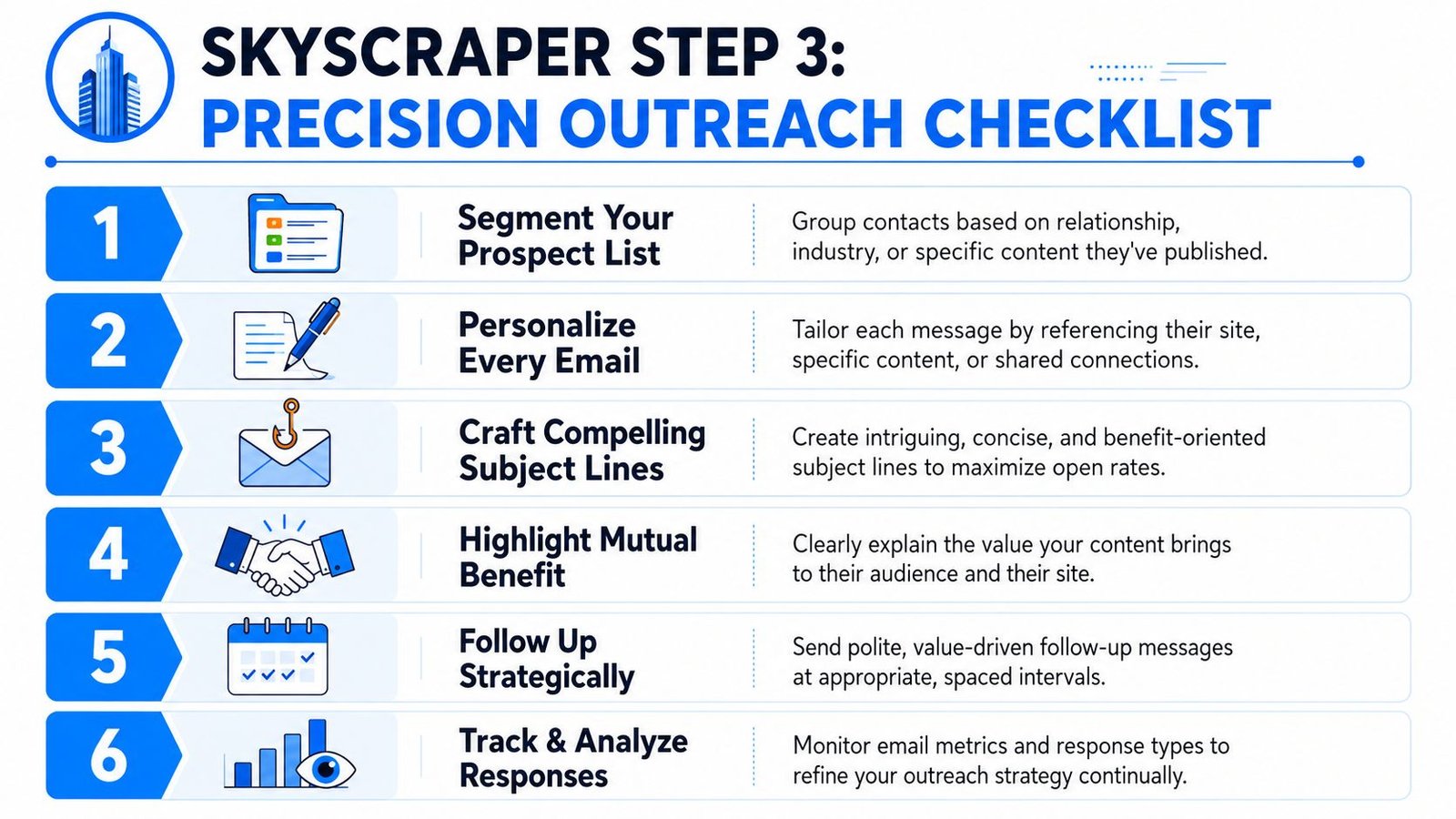
Audit for replaceable weaknesses
A practical skyscraper workflow starts with an audit of the current asset's weak spots. Strong guidance recommends checking for thin sections, outdated data, weak organization, or poor UX, and it stresses that the upgrade must add information gain such as original data, expert insight, or a tool rather than just extra words, according to Thrive Agency's execution guide.
That audit is where SaaS and eCommerce teams gain an edge because product companies can improve utility in ways media-style publishers often can't.
We usually review target assets through five lenses:
Freshness
If examples, screenshots, workflows, or product references look stale, the page becomes replaceable fast.Decision support
Does the asset help someone choose, calculate, compare, or act? If not, it may attract views but still be weak as a citation.Credibility
Is the page built from first-hand experience, or is it just a summary of what everyone else already wrote?Usability
Dense walls of text, weak structure, and clumsy mobile layouts lower the perceived quality of the citation.Commercial relevance
Can this page support rankings and create an assisted path toward product interest, trial intent, or category demand?
Build information gain into the asset
"Information gain" sounds abstract until you turn it into a build checklist. For SaaS and eCommerce, it usually comes from format choices that generic content teams can't copy quickly.
Here are the asset upgrades that tend to justify link replacement:
Original operating data
Product companies often hold anonymized usage patterns, implementation trends, support themes, or category behavior that can be turned into a benchmark asset. Even small datasets can sharpen a page if the insight is specific and well presented.Practitioner input
Interview customer success leads, solution engineers, merchandisers, buyers, or category specialists. Their insights make the page sound lived-in instead of assembled.Interactive utility
A calculator, selector, worksheet, or downloadable template often beats a long article because it saves the reader effort.Visual clarity
Side-by-side comparison tables, annotated screenshots, process diagrams, and decision trees help editors trust that their readers will get value quickly.Intent alignment
Match the actual need behind the keyword. A query that signals evaluation intent should not lead to a fluffy educational article.
Editorial test: If an editor scans your asset in under a minute, the upgrade should be obvious without explanation.
A few examples make this concrete.
A SaaS company targeting links around CRM migration shouldn't stop at a guide. A stronger asset might include a migration checklist, a field-mapping template, common failure patterns from implementation teams, and sample stakeholder timelines.
An eCommerce brand targeting mattress care or sizing doesn't need a massive essay. A stronger page might offer a room-size fit planner, material comparison chart, and maintenance schedule download.
What doesn't work anymore
Some upgrades look impressive internally but do little in outreach:
- AI-expanded copy that says the same thing in more paragraphs
- Generic examples pulled from the same SERP everyone already read
- Design polish without substance
- Asset types that don't fit the topic, such as forcing a template onto an informational query that needs a comparison page
The strongest Skyscraper SEO technique assets make the outreach email easier to write because the value is already visible on the page.
Executing a High-Precision Outreach Campaign
Weak campaigns break when teams export backlinks, dump the list into a sequence, and call it outreach.
That approach burns time and sender reputation. Precision matters more than volume.
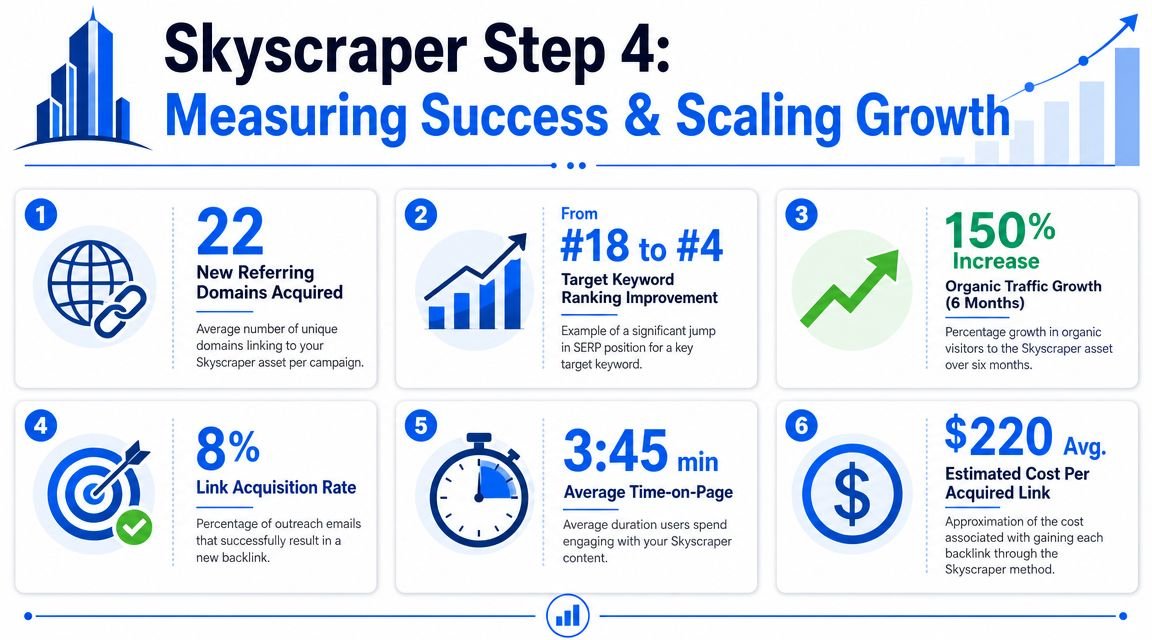
Clean the prospect list before you send anything
Higher-precision outreach improves results because the failure point is often poor qualification. Stronger playbooks advise teams to export the target page's backlinks, remove low-quality directories and forum links, and build a segmented list instead of contacting everyone, as explained in Snov.io's skyscraper outreach guide.
That one decision changes the economics of the campaign.
We segment prospects into groups such as:
Editors who linked in-body to support a claim
These are often the best replacement candidates because the existing citation serves a clear informational job.Resource page curators
Good fits when your asset is a tool, template, or reference hub.Comparison and alternatives publishers
Relevant for SaaS evaluation assets and high-intent buyer resources.Category educators
Useful for eCommerce guides where the citation helps readers choose the right product or use it correctly.
If you're running a broader white hat link building approach, skyscraper outreach fits best as one lane inside a cleaner acquisition system. It shouldn't be confused with mass list spraying.
A practical outreach structure that gets considered
The email has one job. Show the recipient why updating the link would improve their page.
We don't write outreach as a clever pitch. We write it as a fast editorial note.
A simple structure works well:
| Part | What it does |
|---|---|
| Specific opener | Proves the email is relevant to their page |
| Citation reference | Identifies the exact linked section or resource |
| Upgrade summary | Explains what's better about the new asset |
| Reader benefit | Connects the update to their audience's experience |
| Low-friction ask | Makes the decision easy |
A usable template looks like this:
Subject: possible update for your [topic] resource
Hi [Name],
I was reading your page on [topic] and noticed you reference [old asset] in the section about [specific point].We recently published a replacement resource on the same topic that adds [specific improvement: tool, template, original insight, updated examples, better comparison format].
If you're refreshing that section, this may be a better fit for readers who need [practical outcome].
Either way, thanks for putting that guide together. The section on [specific detail] was useful.
Best,
[Name]
This works when the asset is strong and the prospect is qualified. It fails when the email tries to compensate for a weak page.
A few rules keep campaigns sharp:
- Reference the exact context rather than the site in general
- Lead with the improvement instead of your brand
- Keep the ask light because editors don't owe you anything
- Match the asset to the page type rather than forcing one script onto every prospect
Good outreach doesn't "convince" someone to link. It helps them notice that your asset is a better citation.
For SaaS, personalization should often reference workflow or implementation value. For eCommerce, it should usually reference buyer clarity, usability, or maintenance help. Those are different motivations, and the email should reflect that.
Measuring and Scaling Your Skyscraper Program
A one-off win is useful. A repeatable program is more valuable because it compounds what your team learns about asset formats, outreach segments, and commercial fit.
The mistake here is measuring only the raw link count. That's too narrow.
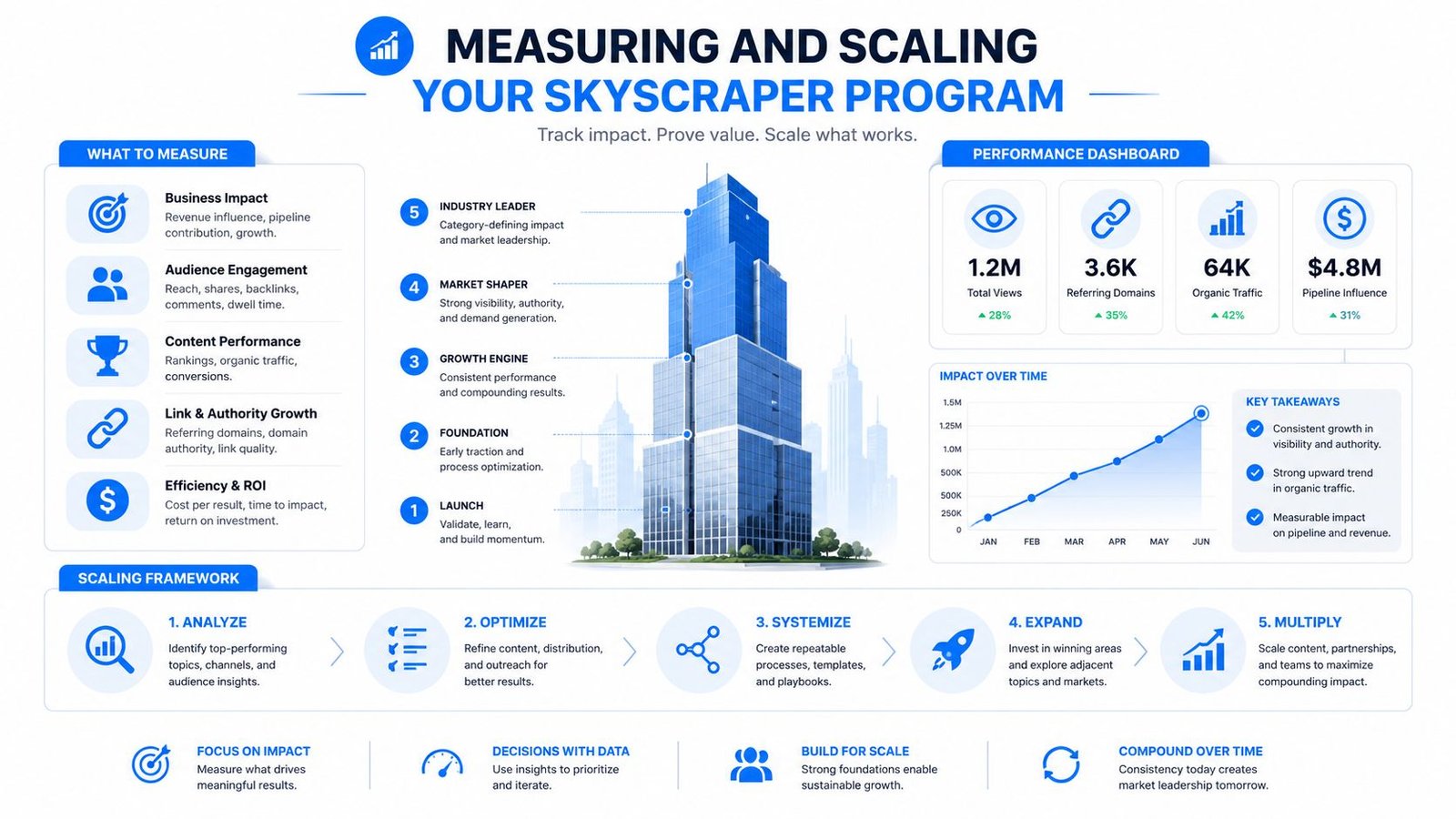
What we track after launch
We track performance at the page level and at the program level.
At the page level, focus on whether the asset is gaining the right kind of attention:
- New referring domains tied to the asset
- Link relevance based on the site and page context
- Organic traffic trend to the page
- Ranking movement across the primary keyword set
- Engagement signals that show the asset is being used
At the program level, look for repeatable patterns:
- Which asset types attract editorial links fastest
- Which prospect segments respond best to your positioning
- Which topics convert outreach effort into durable links
- Which pages support downstream commercial goals
A SaaS company may find that worksheets and implementation assets outperform broad explainers. An eCommerce brand may discover that comparison tools and fit resources earn stronger placements than standard blog content. Those insights shape the next build cycle.
When to refresh and when to scale
Strong skyscraper work isn't publish-once content. Some agency playbooks recommend refreshing skyscraper assets every 6 to 12 months to preserve their edge, especially in faster-moving markets, according to Unicorn Growth's discussion of skyscraper maintenance.
That advice lines up with what we see in practice. The winning asset often stops winning when competitors update screenshots, add better examples, or ship a more useful tool.
A good refresh doesn't mean rewriting everything. It usually means checking:
| Refresh trigger | What to review |
|---|---|
| SERP shifts | Whether new competitor formats changed user expectations |
| Link stagnation | Whether the page still feels current and cite-worthy |
| Product changes | Whether screenshots, workflows, or examples are outdated |
| Seasonal or category changes | Whether the page still matches real buyer questions |
Scale the program only after you can answer three questions clearly:
- Which asset type worked best for this business model
- Which outreach segment produced the most relevant links
- Which topics supported both rankings and business goals
If you can't answer those, scaling just multiplies noise.
From Tactic to Flywheel Building Authority
The best use of the Skyscraper SEO technique isn't as a one-time link stunt. It's an authority flywheel.
A well-built asset earns links because it's useful. Those links improve visibility. Better visibility brings more readers, more mentions, and more opportunities to learn what your market cites. That feedback then improves the next asset.
For SaaS, this flywheel often starts with practical decision-support content. Templates, tools, migration resources, and benchmark pages can earn links while also helping pipeline conversations. For eCommerce, the flywheel usually starts with buyer-assistance assets that remove friction before purchase and reduce confusion after it.
The main shift is strategic. Don't think in terms of "what blog post should we write?" Think in terms of "what citation-worthy asset can our business create that others can't easily copy?"
That mindset turns link building from an isolated SEO task into a reusable publishing system. As your authority grows, your pages have a better chance of aligning with the broader set of Google PageRank factors that influence how links support search performance.
The brands that keep winning with skyscraper SEO aren't just publishing more often. They're publishing assets with a clear reason to exist, a clear reason to be cited, and a clear reason to stay fresh.
If you want help building a skyscraper SEO program for SaaS or eCommerce, SaasSky works hands-on with teams that care about link quality, commercial relevance, and a process you can scale.