From Clicks to Customers: Deconstructing Ecommerce SEO Success
Global e-commerce sales hit $1 trillion in 2012 for the first time. That milestone matters because it marks the point where search visibility stopped being a nice-to-have and became core infrastructure for online growth. By 2017, worldwide retail e-commerce sales reached $2.3 trillion and were projected to grow to $4.891 trillion in 2021, according to the same e-commerce market history.
In ecommerce, traffic is currency. Yet most advice on an ecommerce SEO case study is too broad to help a team decide what to fix first, what to publish next, or what to stop doing. The useful lessons come from teardown-style analysis: what technical issue blocked growth, what page type drove revenue, what kind of links moved rankings, and how the team connected SEO work to commercial outcomes.
That's the lens here. These seven agencies and specialists don't just publish wins. Their best work reveals repeatable playbooks around crawl control, category architecture, product-page intent mapping, and authority building. Some are better for enterprise catalogs. Some are better for founder-led brands that need clear accountability and fast execution.
The point isn't to copy another store page for page. It's to identify the pattern behind the result, then adapt it to your own stack, margins, and buying journey.
Table of Contents
- 1. SaasSky
- 2. OuterBox
- 3. Seer Interactive
- 4. Inflow
- 5. Victorious
- 6. Coalition Technologies
- 7. Whitecap SEO
- Top 7 Ecommerce SEO Agencies: Case Study Comparison
- Your Blueprint for Ecommerce SEO Growth
1. SaasSky
SaasSky is the most focused option on this list if you care less about agency theater and more about getting relevant links placed on sites that fit a SaaS or ecommerce buyer journey. That specialization matters. Generalist link vendors often understand outreach mechanics, but they miss the commercial context behind category pages, comparison pages, collection pages, and bottom-funnel content.
The agency's model is straightforward: audit first, plan second, execution third. That sounds obvious, but plenty of teams still buy links before they know whether the actual bottleneck is weak authority, wasted crawl paths, poor internal links, or thin category templates. SaasSky's value is that it starts with diagnosis, then gives clients a visible process with a shared tracking document and recurring reporting.
Why SaasSky stands out
A lot of ecommerce SEO case study content treats link building like a volume game. SaasSky treats it like page-level distribution. The better use case is supporting the URLs that deserve authority most, such as category pages, feature pages, and commercial comparison assets, not spraying links across random blog posts.
That approach pairs well with the reality that technical cleanup often generates more value than publishing more content. In one documented ecommerce example, fixing duplicate-page crawl waste led to an 80% crawl budget problem being corrected, followed by a 312% traffic increase and $2.1M in organic revenue within 12 months. When that kind of technical foundation is in place, contextual backlinks have somewhere valuable to flow.
Practical rule: Don't build links to pages that search engines are crawling inefficiently, canonicalizing poorly, or struggling to index. Fix the plumbing first, then push authority.
SaasSky is also strong on expectations. The site positions SEO the way experienced operators do: a compounding channel that needs consistency. If you want a tactical starting point, their guide to ecommerce SEO strategies is a useful extension of that thinking.
The replicable playbook
This is the part other brands can copy.
- Start with a backlink audit: Identify pages with commercial intent but weak authority, then separate links that support ranking from links that only look good in a report.
- Map links to revenue pages: Prioritize collection, category, and high-intent editorial assets that can pass relevance internally.
- Track every placement visibly: Shared docs sound simple, but they prevent the usual black-box agency problem where clients can't tell what was built, where it points, or why it matters.
- Review monthly, not vaguely: Link building only works when anchor text mix, target-page distribution, and ranking movement are reviewed together.
Client feedback on SaasSky repeatedly points to communication and clarity, which is often the difference between a useful SEO partner and a stressful one. The trade-off is that brands outside SaaS and ecommerce may get less vertical fit than they would from a broader agency. For the audience this article targets, that narrow focus is a benefit, not a limitation.
2. OuterBox
OuterBox has been around long enough to build something many agencies never do: a deep bench of platform-specific ecommerce examples. That makes their body of work useful when you're trying to evaluate not just whether a strategy worked, but whether it worked on Shopify, BigCommerce, Magento, or a custom stack with messy templates and layered navigation.
Their case studies are especially useful for larger catalogs. You can usually see the operational fingerprints of teams that have dealt with faceted navigation, duplicate product variants, thin collection pages, and the awkward overlap between SEO and paid search.
Where OuterBox is strongest
OuterBox is a good benchmark when your store has enough complexity that “publish better content” is no longer serious advice. Their material tends to focus on template-level fixes, category page improvements, and revenue context, not just keyword movement.
For companies trying to choose between a specialist and a broad ecommerce partner, OuterBox is also a good contrast to a narrower ecommerce SEO agency. If your roadmap involves SEO plus paid search plus dev-heavy implementation, that breadth can help. If you mainly need authority growth and focused execution, it can also be more machinery than you want.
What to copy from their approach
The biggest lesson from OuterBox is sequencing. They don't present SEO as isolated blog production. The useful pattern is this:
- Fix category templates first: Category and collection pages are usually where commercial intent lives.
- Handle indexation before expansion: Large stores often lose upside because too many low-value URLs compete for crawl attention.
- Pair SEO with paid intelligently: Paid search can expose converting query classes faster, which helps refine SEO page targeting.
- Document platform constraints: Shopify, Magento, and BigCommerce don't fail in the same ways. Good ecommerce teams adapt playbooks to the CMS.
Good ecommerce SEO teams don't ask, “How do we get more traffic?” They ask, “Which page type should own this demand, and can the platform support it cleanly?”
The main trade-off with OuterBox is attribution clarity. Some public examples combine SEO and paid media, so if you want pure SEO lift, you'll need to dig deeper before using any case study as a planning model.
3. Seer Interactive
Seer Interactive is the right reference point when leadership doesn't want inspirational traffic graphs. They want a defensible connection between SEO work and business outcomes. Seer's style tends to be research-heavy, analytics-aware, and tighter than the average agency case study.
That matters because one of the biggest gaps in ecommerce SEO case study content is revenue attribution. A Bluethings analysis cites a 2025 BrightEdge report saying only 42% of ecommerce brands can directly attribute SEO-driven traffic to revenue increases, while 90% of public case studies omit that metric. That's exactly why Seer's methodology is useful to study, even when their public library is smaller than ecommerce-only firms.
Why Seer is useful for revenue-minded teams
Seer generally starts closer to buyer behavior than to rankings. Instead of treating the product page as a static endpoint, they look at query intent, user needs, and where friction lives in the conversion path. That often leads to smarter product-page rewrites, tighter internal links, and better use of supporting content.
If your team struggles to explain SEO value to finance or leadership, this approach is worth copying. It aligns with the kind of measurement discipline discussed in SaasSky's guide on how to measure SEO ROI.
What works in this playbook
Their practical advantage is that they don't over-romanticize top-of-funnel content. For ecommerce, product and category pages often deserve the first wave of strategic attention because they sit closest to revenue.
- Lead with user research: Reviews, support logs, and on-site search data usually reveal better page angles than keyword tools alone.
- Refine product-page intent: Don't optimize product pages only for exact-match terms. Build them around comparison cues, use cases, and objections.
- Track outcome by page group: Measuring all organic traffic together hides whether your commercial pages are improving.
- Use content to support commerce pages: Editorial should strengthen transactional URLs, not compete with them.
The trade-off is scale of public proof. Seer publishes fewer ecommerce examples than some larger retail-focused agencies, so you may need to extrapolate from methodology more than from volume of case studies. For discerning teams, that's often enough.
4. Inflow
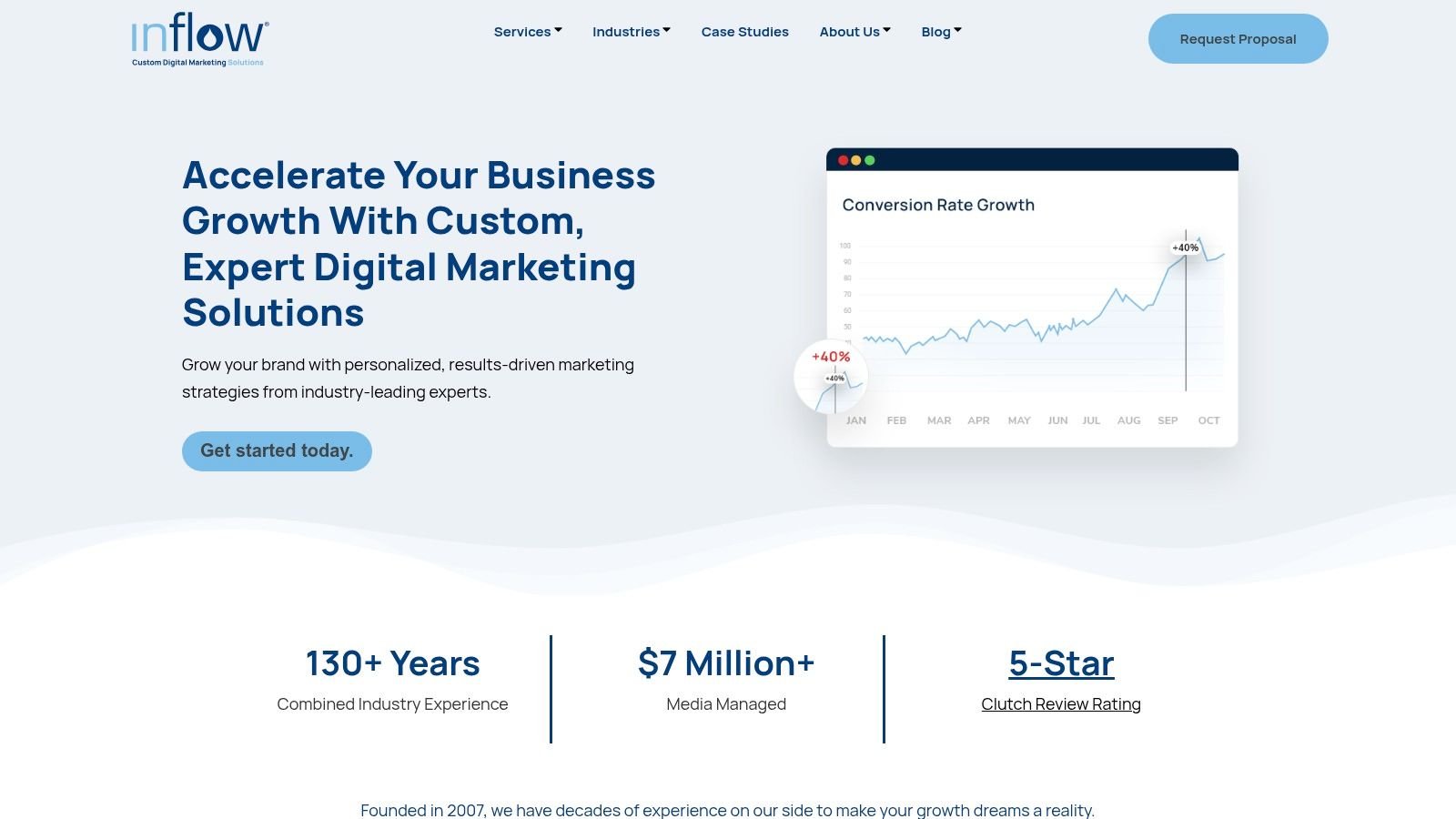
Inflow is a strong reference for brands that don't want a single spike. They want durable organic growth that keeps compounding after the first set of fixes is done. Their public work usually reflects retained programs where technical SEO, content, and selective link building reinforce each other over time.
That makes them useful for in-house teams that already know SEO isn't a one-quarter project. The work tends to show steady architecture improvement, non-brand keyword expansion, and better ownership of category demand.
Why Inflow fits long-horizon brands
Many ecommerce case studies understate maintenance. In reality, category pages need iteration, internal links need pruning, discontinued products create index clutter, and content hubs need to be aligned with actual revenue paths. Inflow's case study style is helpful because it reflects that longer operational rhythm.
This approach fits the broader market trend too. U.S. retail ecommerce sales grew from $27.6 billion in 2000 to nearly $1.2 trillion in 2024, according to BigCommerce. In a market that large and still expanding, brands rarely win by treating SEO as a short campaign.
The repeatable lesson
Inflow's work is a reminder that sustainable ecommerce SEO usually looks boring in the best way. It's continuous refinement.
The best retained SEO programs keep making the site easier to crawl, easier to understand, and easier to buy from.
A few patterns worth borrowing:
- Separate brand from non-brand growth: Otherwise brand demand can hide weak category visibility.
- Expand categories deliberately: Don't create new collections unless internal links, copy, and faceted controls are ready.
- Keep content tied to store architecture: Informational content should feed relevant collections and product clusters.
- Treat links as support, not decoration: A handful of relevant placements pointing to priority sections often beats random digital PR.
The trade-off is that some Inflow case studies are more directional than hyper-detailed. If you want every tactical artifact laid out publicly, you may find them lighter than some readers prefer. If you understand SEO already, the strategic pattern is there.
5. Victorious
Victorious is useful when you want process clarity without being locked into one ecommerce platform narrative. Their positioning is platform-agnostic, which makes them relevant for teams on Shopify, BigCommerce, WooCommerce, or hybrid environments where SEO recommendations need to survive technical constraints.
Their ecommerce material tends to emphasize keyword mapping and high-intent pages. That sounds standard, but the implementation detail is where many teams go wrong. They target the right query class, then assign it to the wrong page type.
Where Victorious makes sense
Victorious is a practical fit for companies that need structured process more than bespoke experimentation. If your store has a decent technical base and the bigger issue is weak page targeting, thin category content, or keyword cannibalization, their frameworks are worth studying.
Their public examples also make a useful counterpoint to agencies that publish wins without enough explanation. You can usually infer how they think about page mapping and content hierarchy.
The practical takeaway
What you can borrow from Victorious is discipline around page ownership.
- Map keywords by intent, not by volume alone: High-volume terms aren't helpful if they belong on a different page type.
- Give category pages a real job: They should rank, convert, and guide discovery, not just list products.
- Use content to reduce cannibalization: Supporting pages should strengthen the primary transactional URL.
- Stay platform-flexible: Good SEO frameworks adapt to the CMS instead of pretending all stacks behave the same way.
One point they indirectly reinforce is that structured data can matter a lot once the page targeting is right. In one ecommerce example, adding Product, FAQ, and Review schema produced 4x featured snippets and a 180% increase in CTR. Schema alone won't rescue a weak page strategy, but it can amplify a strong one.
The main downside with Victorious is that some case studies summarize outcomes more than they expose the operational mechanics behind them. For teams that already know the basics, that's enough. For beginners, it can leave follow-up questions.
6. Coalition Technologies
Coalition Technologies sits at the larger end of the market. They're useful to study when you want a broad sample of ecommerce success stories across retail categories, platform types, and service combinations that include SEO, design, development, and paid media.
For some brands, that's exactly the right setup. Ecommerce SEO problems often don't stay inside the SEO lane. Technical debt, poor templates, weak CRO, and content production bottlenecks are usually connected.
What Coalition does well
Coalition's biggest strength is breadth. If you sell physical products and want to find a parallel case, there's a good chance they have worked on something operationally similar. That matters because ecommerce execution depends on specifics like faceted filters, collection design, variant handling, and mobile merchandising.
Their work also tends to recognize that SEO doesn't exist in isolation from buying experience. That's practical. If category pages rank but don't support product discovery, the channel underperforms even when traffic looks healthy.
How to adapt the model
Coalition's playbook is most useful when you strip it down to the parts that matter for your situation.
- Use technical SEO with UX fixes together: Faster templates, better filter behavior, and cleaner page structure usually help both search and conversion.
- Build content around commercial pathways: Product education should guide people toward category and product pages.
- Treat replatforming as an SEO event: Migrations break visibility when redirects, canonicals, and templates aren't managed tightly.
- Ask attribution questions early: Multi-channel agencies often report blended success, so make sure you know what SEO alone is responsible for.
The trade-off is weight. Smaller teams can find a large agency model too heavy, especially if they need senior strategic attention more than a full service stack. Coalition is often best when the store's operational complexity justifies that scale.
7. Whitecap SEO
Whitecap SEO is the boutique option on this list. Their case studies are often easier to translate into action because they read like practical operating notes, not award submissions. That's valuable for founder-led brands and lean marketing teams that need a sensible sequence, not a giant transformation deck.
They're especially relevant for Shopify and Shopify Plus teams, where architecture, collection logic, and the relationship between PPC and SEO all need to be managed carefully.
Why Whitecap is worth studying
Whitecap tends to focus on page-level levers that ecommerce teams can change: category structure, content support, relaunch planning, and how paid search data can complement SEO. That makes their examples usable.
The boutique angle also changes the working style. Smaller agencies often provide more direct senior attention, which can be a major advantage when a store has a few high-stakes issues rather than a massive enterprise backlog.
What smaller ecommerce teams can borrow
The best lesson from Whitecap is that you don't need a giant program to make meaningful SEO progress. You need the right pages, the right structure, and the discipline to avoid channel conflict.
If PPC keeps proving a query converts, SEO should decide which permanent page deserves to own that demand organically.
A few practical takeaways stand out:
- Use paid search as query validation: It can reveal which categories or product themes deserve stronger SEO investment.
- Clean up collection architecture: Collections should reflect how people shop, not just how inventory is organized internally.
- Support relaunches carefully: New design without redirect planning and template QA is a common visibility killer.
- Keep recommendations adoptable: Smaller teams need fewer moving parts and tighter priorities.
The downside is capacity. A boutique firm won't have the same bandwidth as a large agency for huge catalogs or complex multi-market programs. For many ecommerce brands, that constraint comes with better focus.
Top 7 Ecommerce SEO Agencies: Case Study Comparison
| Service | Implementation Complexity 🔄 | Resource Requirements ⚡ | Expected Outcomes ⭐ 📊 | Ideal Use Cases 💡 | Key Advantages |
|---|---|---|---|---|---|
| SaasSky | Medium 🔄, audit → bespoke plan → monthly backlink delivery | Medium ⚡, recurring budget, coordination with team | High ⭐, measurable ranking & referral traffic from contextual links | Early–growth SaaS and eCommerce teams seeking sustainable backlink growth | SaaS/eCommerce focus; practitioner-led; transparent tracking & pricing |
| OuterBox | Medium–High 🔄, technical SEO + content + paid integration for large catalogs | High ⚡, resources for SKU-heavy sites and platform work | Strong 📊, traffic and revenue uplift, platform-specific results | SKU-heavy stores, migrations, and platform-specific implementations (Shopify/BigCommerce/Magento) | Deep platform expertise; abundant SKU case studies; revenue/timeline clarity |
| Seer Interactive | Medium 🔄, research-led workflow with analytics-first execution | Medium–High ⚡, analytics setup and stakeholder reporting needs | High ⭐, quantified revenue impact tied to SEO actions | Teams needing defensible, analytics-driven SEO tied to revenue | Strong analytics culture; research-first methodology; clear attribution |
| Inflow | Medium 🔄, ongoing multi-year program (content + tech + links) | Medium ⚡, retained budget for long-term stewardship | Durable ⭐📊, compounding organic growth over time | Brands wanting retained, multi-year SEO programs and steady growth | Proven multi-year case studies; balanced tactic mix; ecommerce focus |
| Victorious | Medium 🔄, process-driven, framework-based implementations | Medium ⚡, adaptable across platforms and teams | Solid 📊, measurable outcomes across product/category pages | Teams wanting platform-flexible, process-oriented ecommerce SEO | Ecommerce frameworks; platform flexibility; documented case studies |
| Coalition Technologies | High 🔄, large-scale, full-funnel programs (SEO + CRO + paid) | High ⚡, significant budget and cross-discipline resources | Strong 📊, documented retail/DTC results at scale | Large retail or DTC brands needing end-to-end digital programs | Extensive proof library; full-funnel capabilities; technical performance focus |
| Whitecap SEO | Low–Medium 🔄, boutique, senior-led playbooks and pragmatic execution | Low–Medium ⚡, smaller team, suited for mid-size catalogs | Good ⭐, direct SEO-to-sales examples in case studies | Founders/PMs wanting senior attention and adoptable Shopify playbooks | Transparent, practical case studies; Shopify Plus expertise; senior-led attention |
Your Blueprint for Ecommerce SEO Growth
The strongest ecommerce SEO case study examples all point to the same truth. Growth doesn't come from one trick. It comes from alignment. Technical SEO, page intent, internal links, content structure, and authority building have to reinforce each other.
The technical side comes first more often than teams want to admit. If duplicate URLs waste crawl budget, if category pages are thin, or if product templates create indexation noise, publishing more articles won't solve the problem. The case studies that produce meaningful outcomes usually fix site architecture before they scale content or outreach.
Content matters, but not as a vanity exercise. The useful content work in ecommerce does one of three things: it strengthens category and product pages, captures adjacent informational demand that can be routed toward revenue pages, or resolves objections that prevent conversion. Stores lose months when they publish informational content with no internal path back to commercial URLs.
Link building is still one of the clearest differentiators. Not all links are equal, and not all pages deserve them. The best agencies in this list use authority strategically. They support the pages that sit closest to purchase intent and that can distribute relevance internally. That's why practitioner-led outreach tends to outperform generic link packages. It's not just about getting placements. It's about choosing the right targets and matching links to the site's actual revenue architecture.
There's also a measurement lesson running through these examples. Traffic alone isn't enough. If an ecommerce team can't connect SEO work to page groups, assisted conversions, revenue trends, or at least commercial-intent visibility, they're flying blind. That's where many public case studies still fall short, and it's why the best operators build reporting around outcomes, not just rankings.
If you're deciding where to start, use this order. First, audit crawl waste, duplicate pages, canonicals, and category structure. Second, map search intent to the right page type. Third, build or revise supporting content so it strengthens transactional URLs. Fourth, earn contextual backlinks to the pages that matter most.
That's the blueprint behind most lasting wins in ecommerce SEO. The examples above give you the pattern. Execution is what turns it into revenue. If you want a practitioner-led partner to build the authority side properly, SaasSky is built for exactly that kind of work.
If you want an SEO partner that understands how link building fits into ecommerce revenue, not just rankings, talk to SaasSky. Their team focuses on SaaS and ecommerce brands, works with a transparent process, and builds contextual links that support the pages that matter. A free consultation is the fastest way to see where your backlink profile is helping, where it's thin, and what a realistic growth plan looks like.