You're probably in one of two situations right now. Organic revenue has flattened even though your catalog has grown, or traffic is coming in but it isn't turning into sales at the rate your finance team expects. In both cases, the usual agency pitch sounds familiar. More keywords. More blog posts. More backlinks. Better rankings.
That pitch is too shallow for ecommerce.
A good ecommerce SEO agency doesn't just improve visibility. It helps you decide which pages deserve investment, which technical issues are suppressing revenue pages, where organic fits against paid and marketplaces, and how SEO supports margin over time. That's a strategic growth function, not a vendor checklist.
The reason this matters now is simple. Google still owns about 89.85% of global search traffic, but roughly 58% to 60% of Google searches in 2025 end without a click, which means your brand has to compete for visibility inside the results page itself, not only for visits to your site, according to Seoprofy's SEO statistics roundup. For ecommerce teams, that changes the hiring question from “Who can rank us?” to “Who can capture demand across product, category, and informational intent in a search environment that often withholds the click?”
Table of Contents
- When to Consider an Ecommerce SEO Agency
- The Four Pillars of Ecommerce SEO Services
- Decoding Agency Pricing and Service Models
- Measuring the True ROI of Ecommerce SEO
- How to Evaluate and Choose the Right Agency
- Critical Red Flags and Questions to Ask
- Frequently Asked Questions About Ecommerce SEO
When to Consider an Ecommerce SEO Agency
A familiar scenario plays out around the same stage of growth. Paid acquisition is still producing orders, but costs keep rising. Email drives repeat purchases, yet it does little to expand demand. New launches create spikes, then flatten. At the same time, the site gets harder to control. Faceted navigation creates duplicate URLs, category pages stay thin, and product templates drift because merchandising, content, and development have all edited them for different reasons.
That is usually when SEO stops being a channel task and becomes an operating issue.
An ecommerce SEO agency makes sense once the in-house team can publish pages but cannot consistently diagnose crawl waste, protect indexation, improve internal linking across templates, or connect category strategy to revenue goals. The decision is not about handing off a few technical tasks. It is about bringing in a partner that can help the business choose where organic search should win, which product lines deserve investment, and how SEO should support margin, inventory movement, and customer acquisition efficiency. If your team needs a baseline before that evaluation, this guide to ecommerce SEO strategies is a useful reference point.
The signs are usually operational
A short ranking dip is not the signal. Ongoing execution problems are.
- Merchandising is outpacing search planning: New collections launch without clear category targeting, internal link support, or indexation rules.
- Engineering has higher-priority fires: Search fixes keep losing to replatforming work, conversion experiments, and checkout requests.
- Reporting stops at traffic: The team can show sessions and keyword movement, but not which page types, categories, or product groups are producing revenue.
- Channel ownership is blurred: Paid search, Shopping, marketplaces, and organic all influence the same SKUs, but no one is managing the full demand picture.
I usually use a simple rule here. Bring in an agency when the bottleneck is no longer task completion and has become decision quality across a complex store.
The wrong reason to hire one
The weakest agency engagements start with a promise of fast ranking gains. That often turns into disconnected deliverables: a generic audit, a keyword export, a few blog posts, and little change in how the store performs. Traffic may improve at the edge, while revenue barely moves.
A strong ecommerce SEO agency starts with business questions. Which categories have the best margin profile? Which product groups already convert well and need more qualified demand? Where is non-brand organic underperforming because the template, internal linking, or content model is weak? Those are the conversations that separate a strategic growth partner from a commodity provider.
The Four Pillars of Ecommerce SEO Services
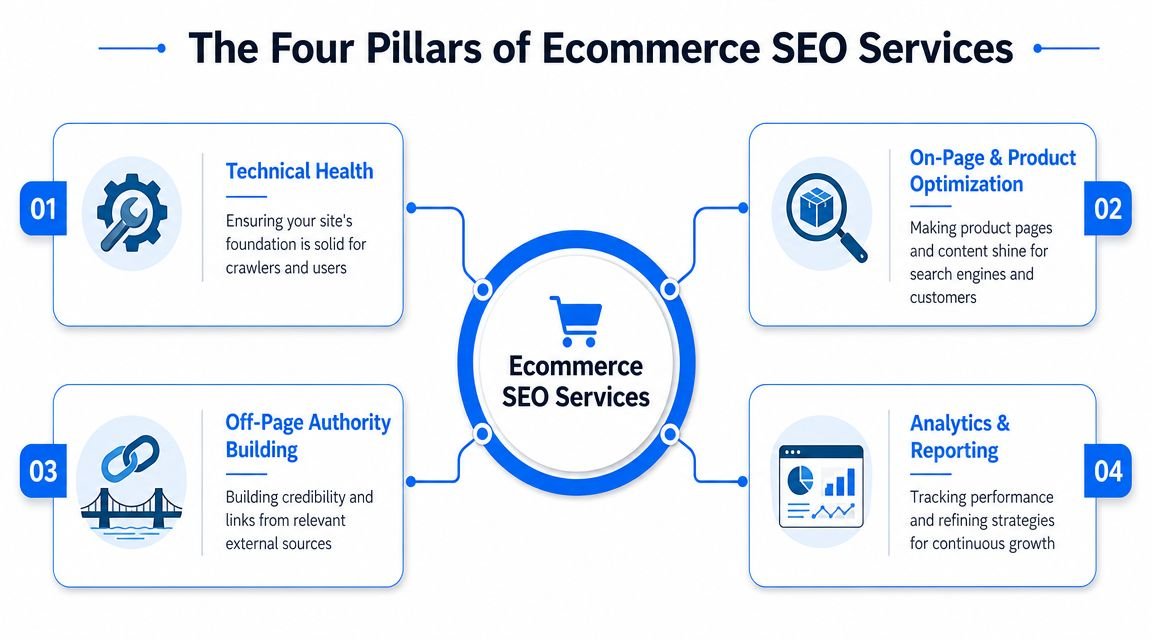
Most agency scopes look bloated because they describe outputs, not systems. The work is easier to evaluate if you group it into four pillars that support one another.
Technical health drives discoverability
Technical SEO in ecommerce is warehouse management for search engines. If aisles are blocked, labels are wrong, and inventory is duplicated, the valuable products don't get surfaced efficiently.
A capable agency treats architecture as a crawl-efficiency problem. That means category hierarchy, breadcrumb paths, canonical tags, robots directives, concise URLs, and internal linking all have to work together. This isn't theoretical. In a crawl of 25,044 ecommerce sites, the average Lighthouse score was 67/100, 53% had at least some missing canonical tags, 15.17% of crawled pages had titles under 15 characters, and the average meta description measured 96 characters, according to Victorious' ecommerce technical SEO analysis.
What that tells a marketing director is straightforward. Many stores have basic technical leakage, and a serious ecommerce SEO agency should know how to prioritize the fixes that affect revenue pages first.
On-page and product optimization shapes buying intent
This pillar covers product pages, category pages, metadata, schema, image optimization, copy structure, and internal anchors.
A commodity provider optimizes every page the same way. A strong agency doesn't. It understands that a category page often captures broader commercial intent, while a product page closes highly specific demand. Those pages need different copy depth, different internal linking support, and sometimes different schema treatment.
Useful deliverables in this pillar include:
- Category page strategy: Expand pages that can rank for commercial queries and support faceted navigation without creating index clutter.
- Product page refinement: Improve titles, descriptions, FAQs, image context, and structured data so product pages answer purchase questions directly.
- Template governance: Create repeatable rules so large catalogs don't drift into inconsistency after every merchandising update.
For a practical framework, this guide to ecommerce SEO strategies is the kind of resource I'd expect an agency team to think beyond and operationalize, not paraphrase.
Content and authority support commercial pages
Many agencies separate content from commerce. That's a mistake.
Content earns its keep when it strengthens category and product demand. Buying guides, comparison content, FAQs, and support pages should feed internal links and topical relevance into pages that generate sales. Link building works the same way. The goal isn't a raw backlink count. The goal is authority that lifts priority commercial sections.
Strong ecommerce SEO work doesn't treat blog content as a publishing calendar. It treats content as infrastructure for category growth.
A weak agency will send generic content briefs to freelancers and call it strategy. A better one maps topics to buying stages, product discovery, and merchandising priorities.
Reporting separates activity from impact
This pillar is often the difference between a strategic partner and a task vendor. Reporting should show what changed, why it changed, and what business outcome followed.
Look for agencies that can break down performance by:
- Page type: product, collection, category, brand, informational
- Intent group: non-brand commercial, informational assist, branded demand
- Revenue relevance: top margin lines, seasonal collections, core repeat-purchase products
If reporting can't tell you which page groups are gaining qualified organic visibility and which ones are wasting effort, the rest of the service model will feel busy but unconvincing.
Decoding Agency Pricing and Service Models
Pricing confusion usually comes from mismatched expectations. A marketing director thinks they're buying growth. The agency thinks it sold a list of deliverables. Those are not the same engagement.
What each pricing model really buys
Here's the cleanest way to think about the common models.
| Model | Typical Cost (USD/Month) | Best For | Key Consideration |
|---|---|---|---|
| Monthly retainer | Custom quote | Ongoing growth, continuous optimization, cross-functional support | Works best when SEO needs recurring technical, content, and strategic coordination |
| Project-based fee | Custom quote | Site migrations, technical audits, taxonomy rebuilds, one-time cleanups | Good for a defined scope, weak if you expect compounding growth without follow-through |
| Performance-based pricing | Custom quote | Brands comfortable with incentive-heavy contracts and strict measurement rules | Can create alignment, but definitions of success must be very clear |
If you need a baseline on how teams frame budgets, this overview of the average cost for SEO services is useful as a planning reference.
Retainers make sense when the site changes constantly. That's most ecommerce brands. New collections launch, products go out of stock, templates evolve, developers ship changes, and competitors move. SEO has to adapt alongside the business.
Project work fits a narrower brief. Site migration support is the obvious example. So is a category architecture redesign, a technical cleanup after years of neglect, or an indexation review before a major seasonal push.
Where buyers get trapped
Performance-based SEO sounds attractive because it appears low risk. In practice, it can get messy fast. If the contract rewards traffic, the agency may chase low-intent growth. If it rewards rankings, they may focus on terms that look good in a report but don't move revenue.
The better pricing question is this: does the service model match the nature of your problem?
- Choose a retainer if you need ongoing prioritization, implementation guidance, and cross-team coordination.
- Choose a project if you have a defined problem with a clear endpoint.
- Be cautious with performance pricing unless both sides agree on business metrics, attribution rules, and what counts as influence versus ownership.
Cheap retainers often produce expensive delays. The hidden cost isn't just weak SEO work. It's six months spent on the wrong priorities.
A serious ecommerce SEO agency should be able to explain where strategist time goes, what implementation support is included, how reporting works, and which deliverables are custom versus templated. If it can't, pricing isn't the main issue. Clarity is.
Measuring the True ROI of Ecommerce SEO
Traffic is useful. Rankings are directional. Revenue is the standard.

Revenue is the metric that matters
The business case for SEO in ecommerce is stronger than many boards assume. Independent industry data cited in 2026 shows ecommerce SEO can deliver a 317% ROI with a breakeven period of 16 months, and separate research reports an average 1.6% conversion rate for SEO traffic on ecommerce sites versus 1.3% for PPC traffic, according to Exploding Topics' SEO statistics summary. The same source notes that mobile now drives over 62% of global web traffic and 77% of retail visits.
Those numbers matter because they push the conversation away from vanity metrics. If SEO traffic converts well, compounds over time, and supports mobile shopping behavior, then the right question isn't “How many sessions did we gain?” It's “Did we increase profitable demand on the pages that matter most?”
A useful internal scorecard usually includes:
- Organic revenue by page type
- Conversion rate from organic sessions
- Average order value from organic traffic
- Assisted conversions on informational content
- Non-brand visibility on core category pages
How strong agencies prove value
Consider two agencies working on the same store. One reports keyword movement, impressions, and a stack of completed tasks. The other shows that priority category pages are gaining qualified traffic, product templates improved conversion support, and organic's share of revenue is climbing on commercially important collections.
Only one of those agencies is helping you run the business.
Good ROI measurement also accounts for lag. SEO rarely behaves like paid media. Technical fixes may enable crawling before revenue appears. Category improvements may start as impression gains before they turn into clicks and orders. Informational content may assist conversion before it drives last-click revenue. A mature ecommerce SEO agency explains those sequences clearly and still keeps the end metric tied to sales.
What doesn't work is accepting broad claims like “brand awareness improved” or “visibility is up” without commercial context. If the agency can't connect SEO work to product demand, category performance, and conversion outcomes, the campaign may be active but it isn't accountable.
How to Evaluate and Choose the Right Agency
Agency selection gets easier when you stop evaluating decks and start evaluating judgment.

Review their thinking, not just their deliverables
Start with case studies, but don't stop at the headline. Most agencies know how to present rankings and traffic trends. Fewer can explain the diagnosis, prioritization, trade-offs, and implementation constraints behind the outcome.
Look for signs of business literacy:
- Do they talk about page types? Product pages, category pages, collections, and content hubs have different jobs.
- Do they mention operational limits? Good agencies know engineering capacity, merchandising calendars, and CMS constraints shape strategy.
- Do they discuss revenue quality? They should care which products and categories drove growth, not only whether sessions increased.
You should also inspect their process during discovery. If they spend most of the call pitching deliverables before learning your catalog structure, margin priorities, platform limitations, and internal team setup, they're selling a package.
A practical aid during vetting is a detailed website auditing checklist. Not because the checklist replaces expertise, but because it shows whether the agency can move from generic audit language into concrete, store-specific diagnosis.
Ask the question most agencies still avoid
One of the best screening questions today is whether the agency optimizes only for Google or for a broader search environment.
That matters because many buyers now begin product discovery in Google Shopping, Amazon, TikTok, or AI-assisted answer engines. Yet agency positioning still tends to revolve around product-page SEO, backlinks, schema, and technical fixes. As Uncommon Logic's discussion of ecommerce SEO services highlights, there's still a noticeable gap around cross-channel attribution, organic visibility outside the website, and how agencies split effort between owned-site SEO and external discovery surfaces.
Ask directly:
- How do you think about SEO when discovery starts off-site?
- How do you decide what belongs on our site versus on marketplace or external surfaces?
- How do you measure success when visibility doesn't always produce a direct click?
If an agency has no point of view on multi-surface discovery, it's probably still operating with an older search model.
What a solid proposal should include
A proposal doesn't need to be flashy. It needs to be specific.
The strongest proposals usually include:
- A prioritized diagnosis: Not every issue matters equally.
- A point of view on revenue pages: Which categories, collections, or product groups deserve focus first.
- Implementation realities: Who needs to do what, and where bottlenecks are likely to appear.
- Measurement logic: What success looks like in commercial terms, not just SEO terms.
- Team clarity: Who you'll work with after the sale.
If the proposal reads like it could have been sent to any Shopify, Magento, or WooCommerce store, that's your answer. You're looking at a commodity provider.
Critical Red Flags and Questions to Ask
A polished sales process can hide weak delivery. This is the point where you need sharp filters.
Red flags that should stop the process
Some warning signs are obvious. Others are subtle and more dangerous because they sound convincing.
- Guaranteed rankings: No credible agency can guarantee specific Google positions.
- Secret methods: If they lean on “proprietary tactics” instead of explaining principles and process, expect weak transparency later.
- Reporting without business metrics: Dashboards full of impressions, ranks, and completed tasks won't help you defend budget.
- No implementation discussion: Ecommerce SEO succeeds or fails in execution. If they don't ask who will handle development, content, and merchandising changes, they're ignoring reality.
- Template-heavy recommendations: If every proposal looks identical, the strategy probably is too.
- Over-focus on blog output: Publishing more content isn't a growth strategy if your category and product infrastructure is underdeveloped.
Questions that expose real capability
Use questions that force the agency to reveal how it thinks.
- Which page templates would you prioritize first on our site, and why?
- How do you handle category pages with faceted navigation and duplicate URL risk?
- What would you want from our merchandising and development teams in the first quarter?
- How do you decide whether a keyword belongs on a category page, a product page, or a content asset?
- What would make you advise against publishing more content right away?
- How do you report progress if rankings improve but revenue doesn't?
- What assumptions are you making about our platform, catalog depth, and internal resources?
A good agency won't rush these answers. It will qualify them, ask clarifying questions, and explain trade-offs. That's what you want. The right partner should be comfortable saying, “It depends on your site structure,” or “We'd need to validate that in Search Console, analytics, and a crawl.”
The best discovery calls often feel less like a pitch and more like a working session.
If every answer sounds rehearsed, overly certain, or detached from ecommerce operations, keep looking.
Frequently Asked Questions About Ecommerce SEO
How long does ecommerce SEO take to show results
Plan in quarters, not weeks.
On ecommerce sites, the first visible gains often come from indexing, crawl efficiency, and template fixes. Revenue usually trails behind because commercial pages need time to be recrawled, re-evaluated, and tested in the market. If an agency is fixing category-page intent, internal linking, and product discovery at the same time, you may see earlier quality signals in Search Console and assisted conversions before last-click revenue moves.
A credible agency should map expectations by workstream. Technical cleanup can surface faster. Category rewrites, internal linking changes, and product page improvements usually need more time because they affect rankings, click-through rate, and conversion rate together.
Should you hire an agency or build in house
The right answer depends on the bottleneck.
If the brand lacks senior ecommerce SEO leadership, an agency can add pattern recognition quickly. That matters when the actual issue is not task volume, but bad prioritization, weak collaboration with development, or a category structure that does not match how customers search. If the company already has strong search leadership and clean operating processes, building in house often makes more financial sense.
Many ecommerce teams get the best result from a split model. Internal teams own merchandising context, promo calendars, margin priorities, and implementation relationships. The agency brings outside perspective, technical specialists, and the discipline to challenge assumptions that have become normal inside the business.
How is ecommerce SEO different from regular SEO
The complexity sits in the page types and the commercial stakes.
A content-led SEO program can win with editorial production and link acquisition. Ecommerce SEO usually breaks or scales at the template level. The work includes managing canonicalization for product variants with different URLs, controlling faceted navigation so filtered pages do not create index bloat, deciding when out-of-stock products should remain live, and aligning category pages to search demand without wrecking merchandising logic.
It also forces harder trade-offs. Sometimes the highest-volume keyword is a bad target for revenue because the query belongs on a buying guide, not a category page. Sometimes a technical fix that improves crawl efficiency conflicts with platform limitations or paid media landing page needs. A strong ecommerce agency can explain those trade-offs in commercial terms, not just SEO terms.
What should an ecommerce SEO agency own versus your team
The agency should own diagnosis, prioritization, and a point of view on what will move revenue. That includes technical audits tied to business impact, page-type recommendations, content briefs for commercial intent, testing ideas, and reporting that connects search performance to conversion and revenue trends.
Your team should own the operating context. That means brand standards, pricing and promotion decisions, margin realities, inventory constraints, approval workflows, and final implementation choices.
The failure point is usually not effort. It is unclear decision rights. If no one knows who can approve a category rewrite, retire a duplicate collection page, or escalate a development ticket, the roadmap stalls.
Can a smaller agency outperform a larger one
Yes. I have seen smaller firms outperform bigger networks when the smaller team put senior people on the account, understood ecommerce economics, and worked directly with the people who could ship changes.
Larger agencies can be the better fit if the site spans multiple regions, business units, or platform stacks and needs more production capacity. Smaller agencies often win on focus and speed. The question is not agency size by itself. It is whether the people doing the work can connect search opportunities to merchandising, conversion, and implementation reality.
If you're comparing options and want a partner that treats SEO like a revenue function, not a task list, take a look at SaasSky. Their positioning around transparent pricing, practitioner-led execution, and measurable impact is the kind of operating model serious SaaS and ecommerce teams should expect when they hire outside help.