
You're probably in one of two situations right now.
Either you've already spoken to a few agencies in Hyderabad and every proposal sounds identical. SEO, PPC, social media, “brand awareness,” monthly reports, vague promises. Or you haven't hired yet, because your gut is telling you most of these firms are built for local lead gen, not a SaaS company trying to win buyers in North America, Europe, or across India's enterprise market.
That instinct is right.
If you run a B2B SaaS company, a product-led startup, or a tech-enabled services business, choosing a digital marketing agency in Hyderabad shouldn't be a beauty contest. It's a filtering exercise. You're not buying activity. You're buying execution against pipeline, deal quality, category authority, and sales efficiency.
Table of Contents
- Beyond Generic SEO for Hyderabad's Tech Scene
- Defining Your Needs and Budget Before You Search
- The Vendor Evaluation Checklist You Can Actually Use
- Key Interview Questions to Uncover True Expertise
- Setting Channel Expectations and Sample KPIs
- The Onboarding Playbook for a Strong Partnership
Beyond Generic SEO for Hyderabad's Tech Scene
Most agency pitches in Hyderabad still assume you need local visibility, generic traffic growth, and some social posting to stay “active.” That's fine if you sell apartments, clinics, or wedding services. It's useless if you're selling software to procurement heads, RevOps teams, CTOs, or finance buyers.
A SaaS buyer journey is longer, messier, and more international. You need category-specific content, high-intent search capture, technical site health, product positioning, and backlinks from domains your market trusts. You also need someone who understands that a content page without demo influence is just a page.

The market gap is real
The biggest mistake founders make is assuming any competent local agency can “figure out SaaS” after onboarding. Usually, they can't. They know channel mechanics, but they don't know SaaS buying committees, product messaging, sales-assisted funnels, or how content supports demos and pipeline.
The gap is especially obvious in SEO and authority building. Data shows that 78% of SaaS startups in India struggle with international market penetration primarily due to weak backlink profiles from authoritative global domains, yet Hyderabad agency listings rarely highlight practitioners with proven SaaS link-building case studies or transparent pricing for global link acquisition, according to this analysis of Hyderabad digital marketing agencies for SaaS buyers.
Practical rule: If an agency talks about “ranking your keywords” before it talks about your ICP, sales cycle, and expansion market, it's not built for B2B tech.
What tech companies in Hyderabad actually need
You need a partner that can do work like this:
- Map search intent to revenue stages. Not every keyword deserves content. Some deserve product pages, comparison pages, or sales enablement assets.
- Build global authority. A backlink from a relevant software publication matters more than a pile of low-quality directory links.
- Support demand generation. Paid search, retargeting, landing page testing, and CRM feedback loops should connect.
- Work with your product and sales team. Agencies that stay inside a marketing silo usually miss what buyers object to on calls.
The phrase digital marketing agency Hyderabad gets searched by every kind of business. That's the problem. The search term is broad, but your requirement shouldn't be. If you're a tech company, don't hire broad. Hire narrow, accountable, and commercially literate.
Defining Your Needs and Budget Before You Search
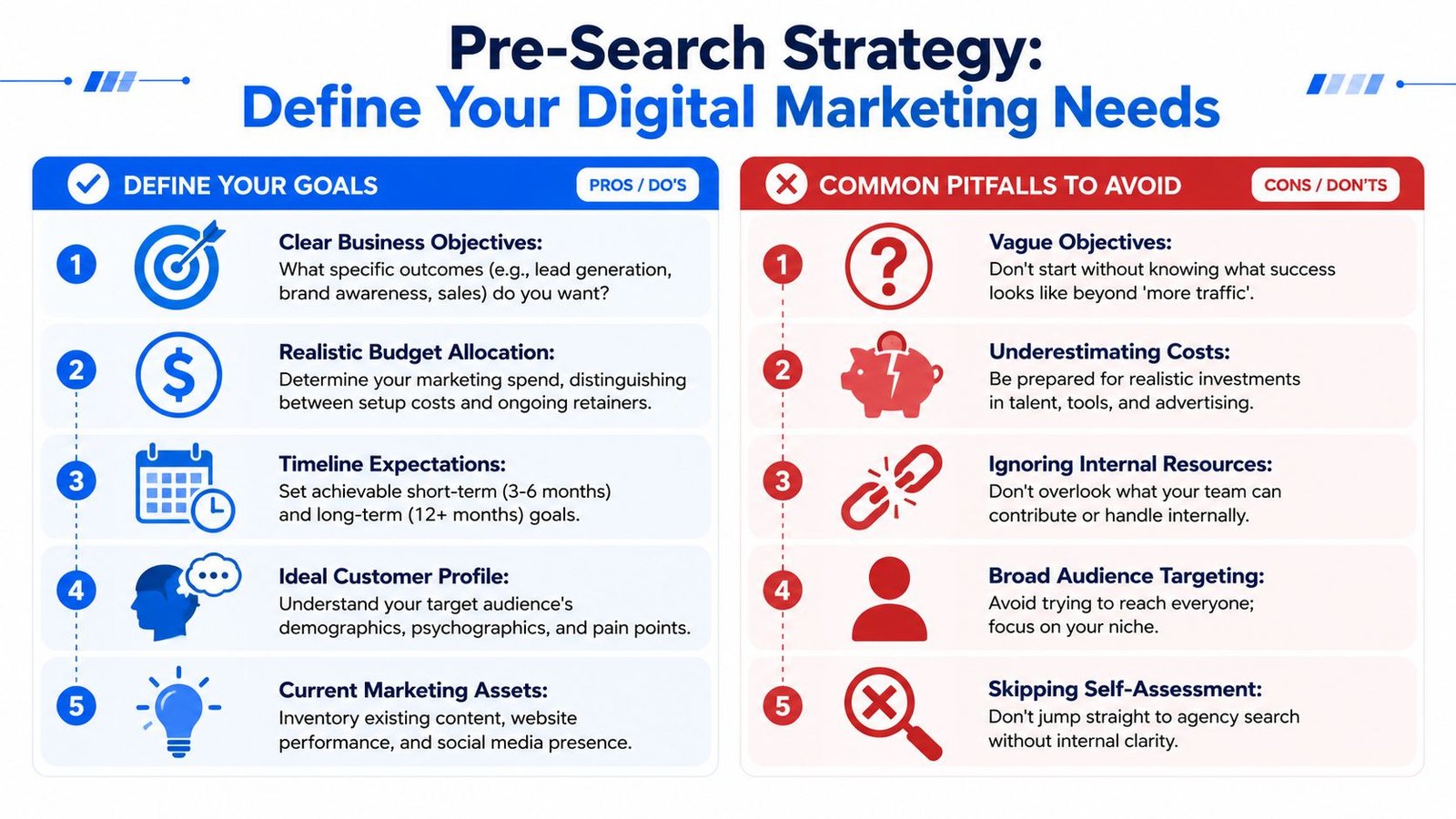
If you start with “we need SEO,” you're already behind. Start with the business problem.
Do you need more qualified demo requests from non-branded search? Better conversion from paid traffic? Stronger authority in a category where larger competitors dominate? More opportunities from a specific geography? Until you answer that, every agency conversation will drift toward deliverables instead of outcomes.
Start with business metrics, not channel wish lists
The best agencies don't anchor on traffic and rankings. They anchor on business movement. A strong benchmark for agency quality is whether they can connect activity to pipeline impact, CAC reduction, and LTV contribution, rather than stopping at vanity metrics. That distinction is called out in this guide to choosing a high-performing digital marketing agency in Hyderabad.
Write down your targets in plain language:
- Pipeline target. How much sourced or influenced pipeline should marketing create?
- Lead quality target. What counts as sales-accepted? Job title, company size, geography, tech stack, urgency?
- Sales efficiency target. Are you trying to reduce wasted paid spend, shorten the path to demo, or improve win-quality from inbound?
- Market target. Are you focused on Hyderabad, India-wide enterprise, or international expansion?
If you can't answer those, the agency will answer for you. Usually in ways that flatter their reports.
Budgeting in Hyderabad without getting trapped
Hyderabad is still cost-competitive. The average hourly rate for digital marketing services in Hyderabad is between $25 and $49 per hour, and leading agencies often operate with team sizes ranging from 41 to 49 employees, according to GoodFirms' Hyderabad agency directory. That sounds attractive, but hourly pricing alone tells you very little.
A low hourly rate can still produce expensive waste if the team is junior, bloated, or misaligned with SaaS. A higher retainer can be cheaper in practice if the agency owns strategy, content direction, link acquisition quality, CRO feedback, and reporting discipline.
Use this frame before you talk to anyone:
- Separate build from run. A technical audit, analytics cleanup, CRM attribution mapping, and messaging overhaul are not the same as ongoing campaign management.
- Define internal ownership. Decide what your team will own. Product marketing, founder content, webinars, sales collateral, design, and landing page dev often sit partly in-house.
- Ask for pricing logic. Don't accept a single-line retainer with no explanation of hours, outputs, review cycles, and senior involvement.
If you need a reality check on budget structure before you shortlist firms, this guide on average cost for SEO services is useful as a planning reference.
If the proposal makes it hard to tell what you're paying for, assume the reporting will be just as vague.
Know what you won't buy
This matters as much as your target list.
Don't pay for broad social media management if your buyers don't discover software that way. Don't fund blog volume if there's no distribution and no commercial intent model behind it. Don't approve link building if the agency can't explain where links come from, why those sites matter, and how they avoid junk placements.
You don't need “full-service.” You need the right service mix for your current bottleneck.
The Vendor Evaluation Checklist You Can Actually Use
Agency selection gets sloppy when teams judge confidence instead of competence. Nice decks, polished founders, and familiar jargon fool a lot of buyers. What matters is operating discipline.
What a real growth partner looks like
A serious agency has a documented, sequential methodology. It doesn't just offer SEO, PPC, content, and social as menu items. It explains how research leads to prioritization, how prioritization drives execution, and how execution gets tied back to revenue logic.
That same Hyderabad-focused agency selection guide is worth reviewing alongside technical evaluation, because technical depth is where many generic firms fall apart. If they can't diagnose crawl waste, weak site architecture, indexation issues, or content cannibalization, they can't support a serious search program for SaaS.
A service list tells you what they sell. A methodology tells you how they think.
SaaS Agency Evaluation Checklist
| Evaluation Criteria | What to Look For (Green Flag) | What to Avoid (Red Flag) |
|---|---|---|
| Strategy model | Clear sequence from market analysis to channel prioritization and measurement | “We do SEO, PPC, and content” with no order of operations |
| SaaS and B2B fit | They understand ICPs, long sales cycles, demo funnels, and sales handoff | They mostly show local business work and vanity lead gen |
| Link building approach | Specific explanation of target sites, relevance, outreach process, and quality control | Generic “high DA links” language with no sourcing clarity |
| Reporting | Includes pipeline indicators, lead quality, conversion path, and channel-level insights | Focuses on impressions, traffic, keyword counts, and follower growth |
| Team structure | You meet the people doing strategy and execution, not only sales | Senior people sell, juniors disappear into delivery |
| Case evidence | Anonymized or named examples with measurable business context | Screenshots with no context, no funnel logic, no business outcome |
| Paid media discipline | Keyword intent, landing page alignment, CRM feedback, negative keyword hygiene | More spend presented as the default solution |
| Technical capability | Audit depth across site structure, indexation, templates, page speed, and tracking | Surface-level recommendations from a template tool export |
| Communication | Clear cadence, escalation path, and decision ownership | “We'll keep you posted” with no operating model |
| Commercial transparency | Scope, exclusions, billing logic, and review periods are written clearly | Hidden add-ons, vague retainers, and unclear approval rules |
A few filters matter more than the rest.
- Method first. If they can't explain the first 90 days in order, stop the process.
- Specialization over size. A larger team doesn't help if nobody understands SaaS demand gen.
- Proof over polish. I'd take a blunt strategist with clean thinking over a charismatic sales team every time.
A useful final test is simple. Ask them what they'll deprioritize. Weak agencies say yes to everything. Strong ones cut scope aggressively because they know distraction kills results.
Key Interview Questions to Uncover True Expertise
Most buyers ask terrible interview questions. “What's your SEO process?” invites rehearsed fluff. “How many clients have you worked with?” tells you almost nothing. “Can you handle social media too?” just encourages bundling.
You need questions that force an agency to think on its feet.
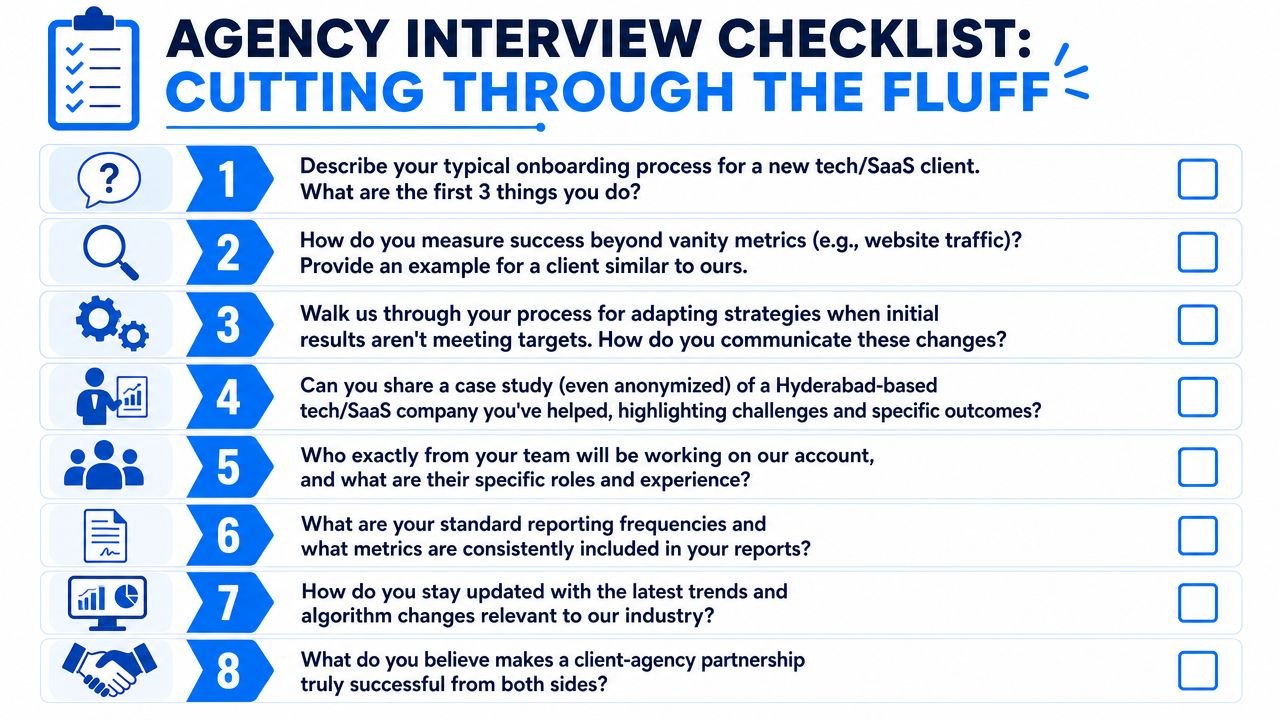
Ask scenario questions, not brochure questions
This is one of the biggest selection upgrades you can make. Scenario questions reveal whether the team understands your market, your buyer, and the tradeoffs between channels.
That matters because 65% of SMEs in Hyderabad that hired digital marketing agencies reported unexpected costs or poor ROI, largely due to opaque pricing and lack of clear, verifiable case studies, based on a 2025 Hyderabad agency industry report. Tougher vetting isn't optional. It's basic hygiene.
Questions that expose real capability
Use questions like these in founder calls, strategy reviews, and final-round interviews.
- For SEO strategy: Walk me through how you'd build topical authority for a new B2B SaaS product targeting buyers outside India. Which page types come first, and why?
- For content: Show me how you decide between a comparison page, use-case page, feature page, and educational article for the same topic cluster.
- For link building: Explain what a relevant backlink prospect list looks like for our category. Which sites would you reject even if they offered placement?
- For paid search: If branded campaigns perform well but non-branded doesn't, how would you diagnose the issue before asking for more budget?
- For reporting: Which metrics would appear in month one, and which would you refuse to put on the first slide of a board update?
- For collaboration: What do you need from our product marketing, sales, and RevOps teams in the first month?
- For failure handling: Tell me about a campaign that underperformed. What did you change, and how fast did you change it?
- For pricing: Which tasks are included in the retainer, which are extra, and what usually triggers scope expansion?
“Walk us through a hard tradeoff you made for a tech client, and what you deliberately chose not to do.”
That question is excellent because it forces judgment. Agencies that have run SaaS programs know tradeoffs are constant. Teams that haven't will answer in abstractions.
A few more signals to watch during the call:
- Sharp answers mention inputs. Good operators talk about CRM stages, intent buckets, landing page friction, and content-production constraints.
- Weak answers hide behind process words. “Optimization” and “best practices” usually mean they're stalling.
- Confident teams admit limits. If they claim mastery across every channel and every market, they're selling, not advising.
You're not interviewing for enthusiasm. You're interviewing for judgment under uncertainty.
Setting Channel Expectations and Sample KPIs
Once you hire an agency, the next risk appears fast. Misaligned reporting. This misalignment often causes decent engagements to falter. The agency reports what's easy to measure. The client assumes that activity means progress.
It doesn't.
Hyderabad's agency market is large and established. Top firms in the city hold an average rating of 4.4 out of 5 based on 149 verified reviews, according to Qoruz's Hyderabad agency data. That tells you strong service is possible. It doesn't tell you what to measure. You still need KPI discipline.
What success should look like by channel
For SaaS and B2B tech, each channel needs its own scorecard.
SEO
- Organic-sourced demo requests
- Qualified leads from non-branded pages
- Conversion rate by page type
- Share of traffic from commercial-intent clusters
- Backlink relevance by category fit
- Technical issue resolution and indexing health
Content
- Contribution to assisted conversions
- Performance by funnel stage
- Sales reuse of pages in live deals
- Expansion of category coverage against competitors
- Content refresh velocity for important pages
Paid search and paid social
- Cost per qualified lead
- Conversion rate from click to booked demo
- Lead quality by campaign and audience
- Pipeline created or influenced
- Waste reduction from poor queries, weak geos, and low-fit audiences
Lifecycle and remarketing
- Demo no-show recovery
- Re-engagement of high-intent visitors
- Opportunity acceleration support
- Segmentation quality across product interest and buying stage
If you want a cleaner framework for tying search effort back to business impact, this breakdown of how to measure SEO ROI is a practical reference.
Useful benchmark: If a monthly report can't help your sales leader or founder make a decision, it's not a good report.
What a useful report includes
A real report doesn't drown you in dashboards. It answers a few hard questions clearly.
| Report Section | What it should answer |
|---|---|
| Executive summary | What changed, why it changed, and what needs a decision |
| Channel performance | Which programs are producing qualified demand and which aren't |
| Funnel view | Where leads are stalling between visit, form fill, meeting, and opportunity |
| Content insights | Which assets attract qualified buyers and which assets only attract noise |
| Paid efficiency | Where spend is being wasted and where budget should shift |
| Technical health | Which site issues are limiting discoverability or conversion |
| Next actions | What gets launched, fixed, tested, paused, or removed next |
Bad agencies report backwards. They start with traffic. Better ones start with commercial movement and then explain channel inputs underneath.
One more point. Don't let an agency own the KPI language alone. Define terms like MQL, SQL, opportunity, influenced pipeline, and sourced pipeline internally before reporting starts. Otherwise every monthly review becomes a debate about definitions.
The Onboarding Playbook for a Strong Partnership
The contract is the easy part. Operational clarity is harder.
A good onboarding process creates momentum without creating chaos. A bad one burns the first month on access issues, generic audits, and meetings that don't lead to decisions.
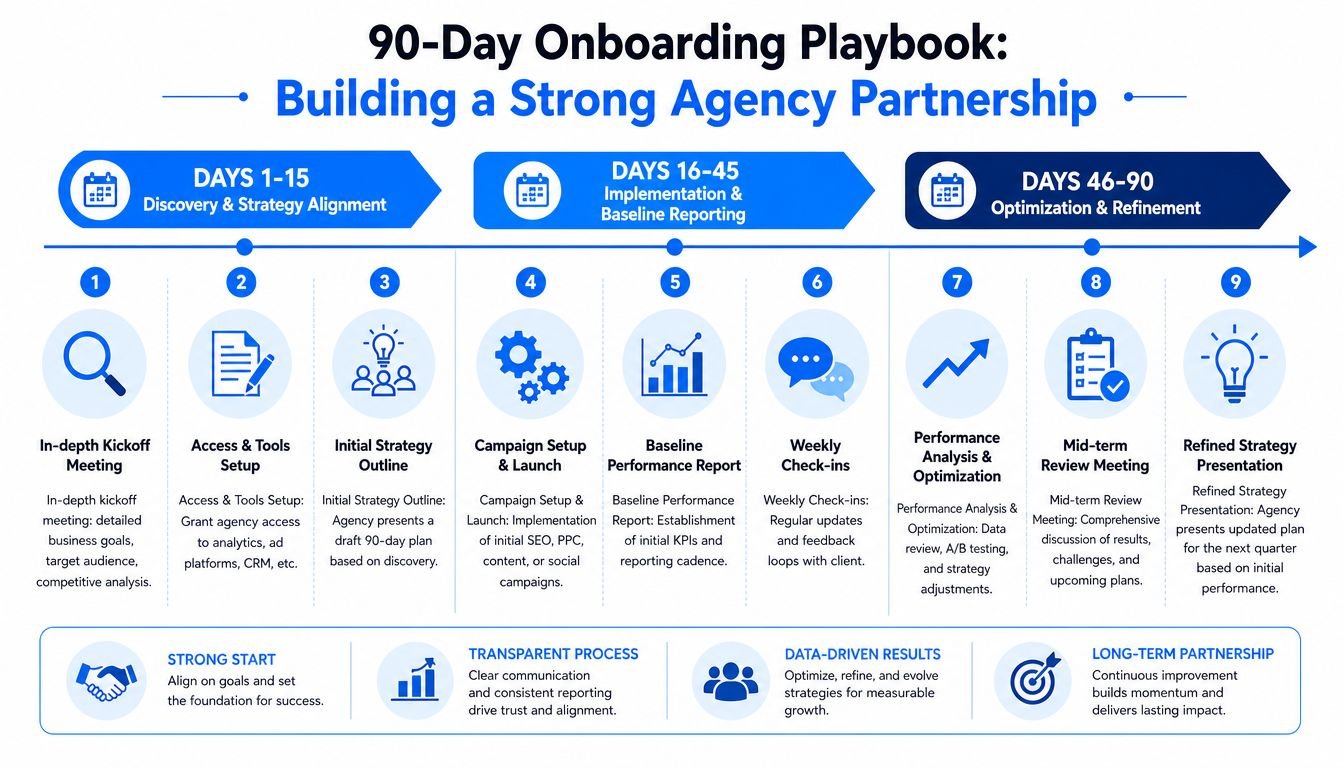
Days 1 to 15
This phase should be intense and structured.
- Kickoff workshop. Bring in marketing, sales, product marketing, and whoever owns revenue operations.
- Access handover. Analytics, Search Console, ad platforms, CRM views, CMS, heatmaps, and reporting tools.
- Baseline review. Current funnel numbers, landing pages, content library, technical debt, and active campaigns.
- Decision map. Clarify who approves copy, design, budgets, targeting, and publication.
The agency should leave this phase with a sharp view of your ICP, offers, objections, and growth bottlenecks. If they spend two weeks “getting familiar” without making directional calls, they're already behind.
Days 16 to 45
Here, strategy becomes visible.
Expect a written operating plan with channel priorities, dependencies, and near-term experiments. You should also see the first batch of execution, not just more planning. That might include technical fixes, campaign restructuring, content briefs, landing page revisions, audience exclusions, or prospecting lists for link outreach.
A strong plan usually includes these elements:
- Primary bet. One core growth thesis for the quarter
- Support bets. A small number of secondary experiments
- Reporting cadence. Weekly check-ins and monthly review structure
- Escalation rules. What triggers immediate change, and who gets involved
The first month should produce clarity. The second month should produce evidence.
Days 46 to 90
By this point, the partnership should start acting like an operating rhythm, not a vendor relationship.
You want to see early signal quality, not miracle claims. Which messages attract better-fit buyers? Which pages convert below expectation? Which campaigns deserve expansion? Which tasks looked smart in the proposal but aren't worth more time?
Use the first quarterly review to make hard calls:
- Keep what's showing credible movement.
- Fix what has signal but weak execution.
- Cut what looked attractive but isn't tied to buying intent.
- Re-scope any work that belongs in-house or with a specialist.
The best agency relationships in Hyderabad don't feel like outsourced activity. They feel like a sharp external team that brings advantage, pressure-tests assumptions, and tells you where your own internal process is slowing growth.
If you're a SaaS or eCommerce team that cares about transparent pricing, practitioner-led execution, and link building tied to real commercial outcomes, take a look at SaasSky. They focus on the accountability most agencies talk about but rarely operationalize, especially for brands that need authority growth beyond generic local marketing playbooks.