
White hat SEO is ethical optimization that follows search engine guidelines, and it usually takes 4 to 8 months to establish rankings that can then compound for years. For SaaS brands, that isn't the slow lane anymore. It's often the fastest route to durable visibility because AI-driven search increasingly rewards expertise, trust, and clean site structure instead of shortcuts.
A lot of SEO advice still sells the old trade-off. Go white hat if you want safety, go aggressive if you want speed. That framing is outdated. In B2B tech, the brands that publish real expertise, build technically sound sites, and earn credible mentions are the ones most likely to keep showing up in both classic search results and AI-generated answers.
That matters because SEO isn't just traffic acquisition. It's asset building. A site with durable rankings becomes part of the company's moat, while a site propped up by loopholes stays exposed to churn, rework, and sudden losses. If you need the broader foundation first, this overview of search engine optimization fundamentals is a useful starting point before you get into the white hat playbook itself.
Table of Contents
- What White Hat SEO Means in 2026
- The Three Hats of SEO A Clear Comparison
- The Core Pillars of a White Hat SEO Strategy
- Actionable White Hat Link Building for SaaS Brands
- Measuring Success and Debunking Common SEO Myths
- Your 90-Day White Hat SEO Playbook for Growth
What White Hat SEO Means in 2026
White hat SEO means improving a site in ways that comply with search engine guidelines and serve the user first. Historically, that meant avoiding manipulative tactics like hidden text, spam links, and keyword stuffing. In 2026, the definition is wider. It now covers visibility across traditional search engines and AI answer engines, not just ten blue links, according to White Hat SEO's 2026 definition and timeline.
For SaaS teams, the practical meaning is simple. Build a site that search engines can crawl, publish content that demonstrates real expertise, and earn authority from relevant publications and communities. That's white hat SEO in operation.
The old critique is that this takes too long. It's true that durable rankings take longer to establish than shortcut tactics. But the same source notes that white hat rankings typically take 4 to 8 months to establish and then compound for years, while manipulative gains can spike and disappear quickly. It also argues that a site with sustainable white hat rankings is worth 10x more than one trapped in algorithm churn.
White hat SEO isn't just “safe SEO.” It's the discipline of building an acquisition channel you can still trust after the next update.
There's also a business model reason to care. SaaS companies don't just need impressions. They need qualified discovery around category terms, problem-aware searches, comparison intent, and brand credibility. A quick ranking for a weak page doesn't help much if the page can't convert a serious buyer or support an AI citation with enough substance to be trusted.
Three forces changed the playbook:
- AI surfaces reward expertise: Thin pages and recycled summaries struggle when answer engines look for clear signals of authority.
- Technical quality matters more: If the site is slow, messy, or hard to parse, both crawlers and users lose confidence.
- Brand mentions carry more weight: Visibility now includes being cited, referenced, and associated with ideas, even when the click doesn't happen immediately.
That's why asking “what is white hat SEO?” in 2026 leads to a more strategic answer than it did a few years ago. It's not merely the ethical version of SEO. It's the operating system for sustainable search visibility.
The Three Hats of SEO A Clear Comparison
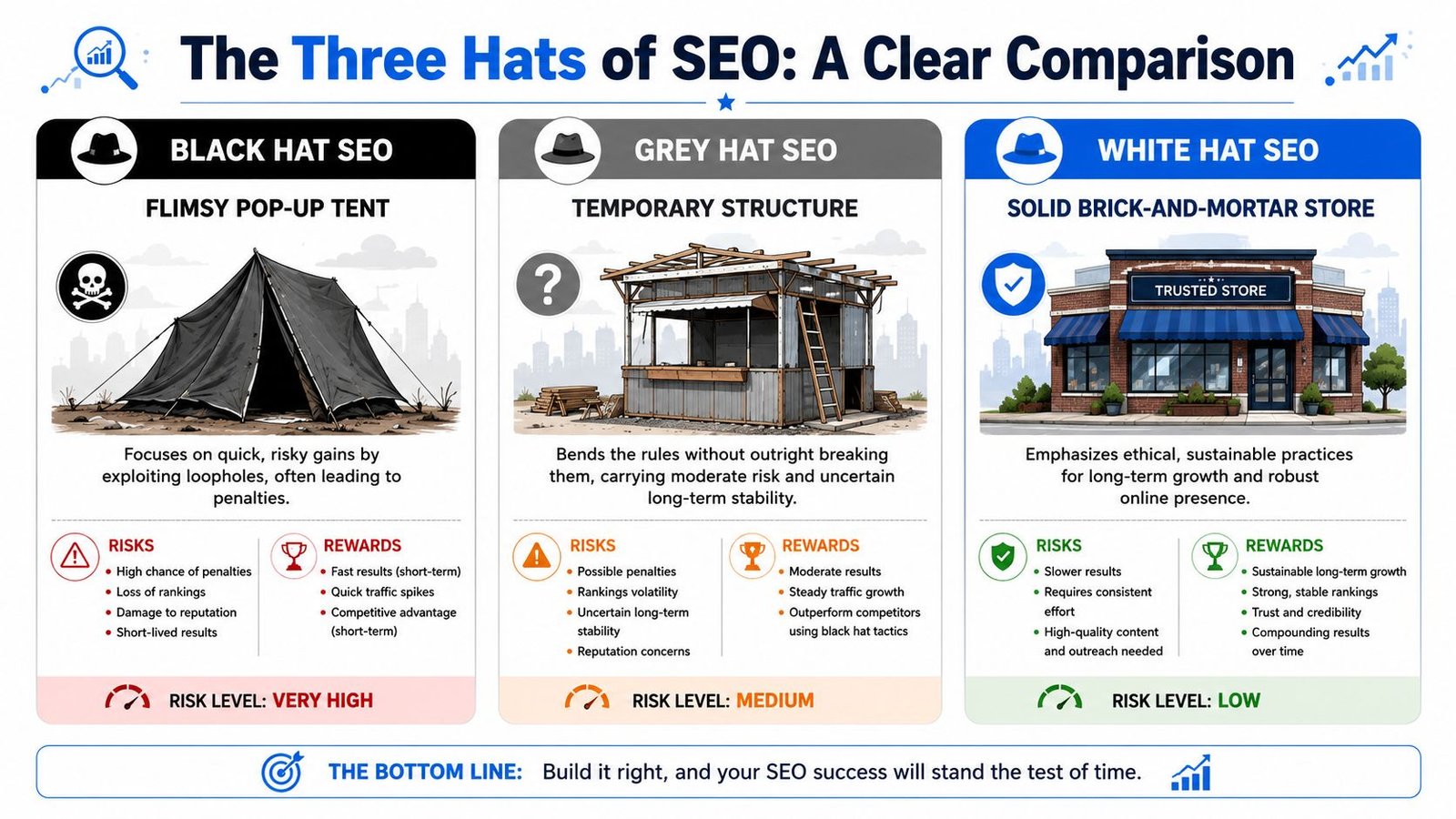
SEO strategy usually falls into three buckets. White hat, grey hat, and black hat. The easiest way to explain the difference to a founder is to borrow a real-world analogy.
Black hat is a pop-up tent. It goes up fast, looks useful from a distance, and can collapse as soon as weather changes. Grey hat is a temporary structure. It may hold for a while, but it's built with compromise. White hat is a permanent storefront. It takes more planning, but it creates a business asset.
How each hat thinks about growth
White hat SEO follows guidelines closely. It invests in technical quality, content that answers real questions, and backlinks earned from relevant sources. The upside is stability. The trade-off is that it requires discipline, editorial effort, and patience.
Grey hat SEO bends the rules without openly breaking them. In practice, that can mean scaling low-value content, over-optimizing anchor text, or relying on questionable link placements that are hard to defend if an update changes the standard. Sometimes it works for a while. The problem is that your team ends up building on shaky assumptions.
Black hat SEO is deliberate manipulation. Think spammy link schemes, deceptive page behavior, and tactics designed for the crawler instead of the user. It aims for speed, but speed is the only thing it has.
One reason white hat wins over time is link quality. Earning backlinks from reputable sources through original content can reduce the risk of de-indexing penalties by up to 90% compared to manipulative tactics, based on Helium SEO's white hat overview.
Practical rule: If you'd be uncomfortable explaining a tactic to your executive team, it probably doesn't belong in your SEO plan.
A side-by-side view
| Attribute | White Hat SEO | Grey Hat SEO | Black Hat SEO |
|---|---|---|---|
| Primary goal | Durable growth and trust | Faster gains with controlled risk | Rapid rankings by exploiting loopholes |
| Guideline alignment | Strong | Partial or ambiguous | Weak |
| Typical tactics | Technical cleanup, expert content, editorial links | Aggressive automation, borderline link tactics, over-optimization | Link schemes, cloaking, spam tactics |
| Risk level | Low | Moderate | High |
| Ranking pattern | Slower start, more durable | Uneven, often unstable | Short spikes, sharp drops |
| Best fit | Serious brands building long-term demand | Teams willing to gamble | Usually not a fit for real SaaS businesses |
For SaaS, the comparison gets even sharper. Software buyers look for trust signals before they book a demo or start a trial. If your acquisition depends on pages that can vanish after an update, your pipeline is fragile by design.
The Core Pillars of a White Hat SEO Strategy
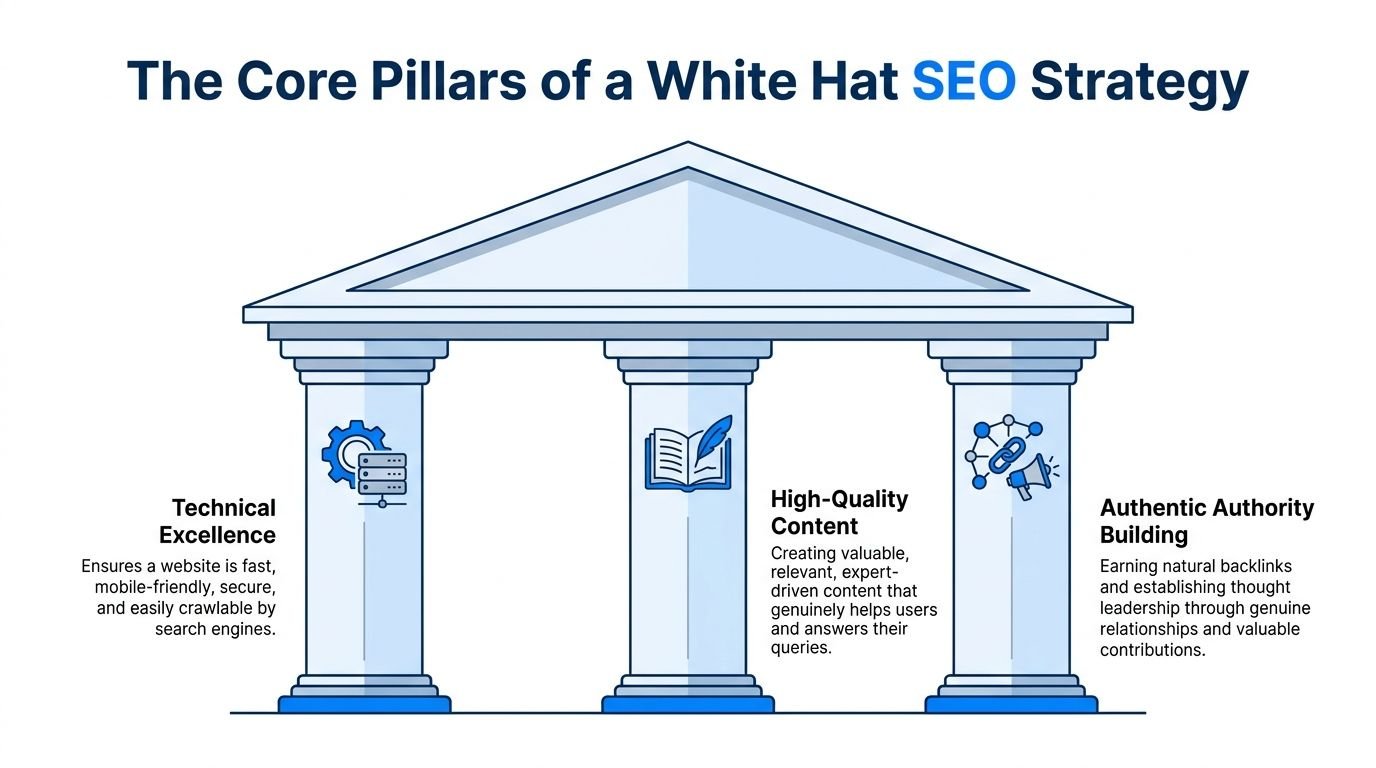
White hat SEO works when three parts reinforce each other. Technical performance gives crawlers and users a clean experience. Content proves you deserve attention. Authority signals show the market trusts what you publish.
Technical excellence comes first
A lot of teams want to jump straight into content production. That's a mistake if the site itself is weak. White hat SEO starts with infrastructure.
Landingi's guidance is unusually specific here. It says white hat SEO should target a PageSpeed Insights score of 80+ and use a single primary query architecture for each page, with the target keyword placed in the meta title, H1, and URL without repetition. It also says this structural precision can improve organic traffic longevity by 20 to 30%, according to Landingi's white hat SEO framework.
That doesn't mean every page needs robotic exact-match optimization. It means each page should have one job. One core intent. One obvious reason to exist.
Use this as a baseline checklist:
- Improve speed: Compress large images, lazy-load below-the-fold media, and remove scripts nobody needs.
- Clean page targeting: Give each URL a primary query and stop making three pages compete for the same intent.
- Protect usability: Keep the mobile experience clean. Most SaaS buyers will first encounter you on a small screen, even if they convert later on desktop.
Content has to prove expertise
Good white hat content doesn't try to trick relevance into existence. It earns relevance by answering the exact question behind the query.
For SaaS, that usually means organizing content into topic clusters rather than publishing isolated blog posts. A category page, feature page, integration page, and supporting educational content should connect logically. If you want a sharper framework for that, this guide on topical authority is the right next step.
Here's what strong content usually looks like:
- Problem-led pages: Content starts with the buyer's pain, not your product pitch.
- Clear query mapping: Each article or landing page matches a specific stage of awareness.
- Original contribution: Bring product insight, workflows, examples, screenshots, or expert commentary. Don't just rephrase what everyone else already published.
When a SaaS site underperforms, the problem usually isn't “we need more content.” It's “we published pages that don't own a distinct intent.”
Authority should be earned, not manufactured
Authority is where many teams drift into bad habits. They know backlinks matter, so they chase volume. White hat SEO takes the opposite approach. It values relevance, editorial quality, and brand fit.
That includes digital PR, linkable assets, expert commentary, guest contributions, and genuine partnerships with publications that reach your market. It also includes structured data and schema where relevant, because search engines need help understanding entities, products, reviews, and context.
The key trade-off is obvious. Manufactured authority is easier to scale. Earned authority is harder to fake and far more useful once you have it.
Actionable White Hat Link Building for SaaS Brands
Most SaaS link building fails because the team asks for links before it creates anything worth citing. White hat link building starts the other way around. Build the asset first, then do outreach around a real value exchange.
If you want a deeper operating model, this resource on white hat link building for SaaS and eCommerce is worth keeping open while you plan campaigns.
Build assets people actually want to cite
The best linkable assets for SaaS usually fall into a few categories:
- Original research: Customer usage patterns, benchmark reports, or survey-backed industry analysis.
- Free tools: Calculators, generators, templates, checklists, or diagnostics tied to your product category.
- Strong opinion pieces: Founder-led or operator-led content that adds a real perspective to an active industry conversation.
- Comparison resources: Honest breakdowns of approaches, workflows, or trade-offs buyers are already evaluating.
A generic “ultimate guide” can still work, but it rarely earns links by itself anymore. A practical template library, a cost calculator, or a benchmark report usually gives editors a stronger reason to reference your page.
Guest posting works when the expertise is real
Guest posting still works well in white hat SEO. The problem is how many organizations do it. They write filler for low-value sites, insert a backlink, and call it strategy. That creates little authority and even less brand lift.
The better version is selective and expert-led. Uroboro reports that nearly 65% of link builders call guest blogging the most popular white hat tactic, and that guest posts in the 1,500 to 2,000 word range that cite trustworthy sources increase backlink likelihood by over 300%, based on Uroboro's white hat tactics guide.
That lines up with what works in SaaS outreach:
- Choose relevance over raw authority: A respected niche publication in your exact category often beats a giant general marketing site.
- Lead with point of view: Offer a framework, teardown, or lesson from actual product, sales, or growth work.
- Link where it helps the reader: The backlink should support the article, not interrupt it.
Reclaim the easy wins
Not every good link requires a big campaign. SaaS teams often ignore easier authority wins that already exist around the brand.
Look for:
- Unlinked mentions: Publications, newsletters, and roundups that mention your company or founder but don't link.
- Partner pages: Integrations, marketplaces, agencies, and reseller ecosystems often have legitimate profile or resource pages.
- Internal experts: Your product lead, CTO, or solutions consultant may be your best source for commentary that earns citations.
A weak outreach email asks for a favor. A strong outreach email offers a useful asset, a specific angle, and a credible reason the editor's audience will care.
Measuring Success and Debunking Common SEO Myths
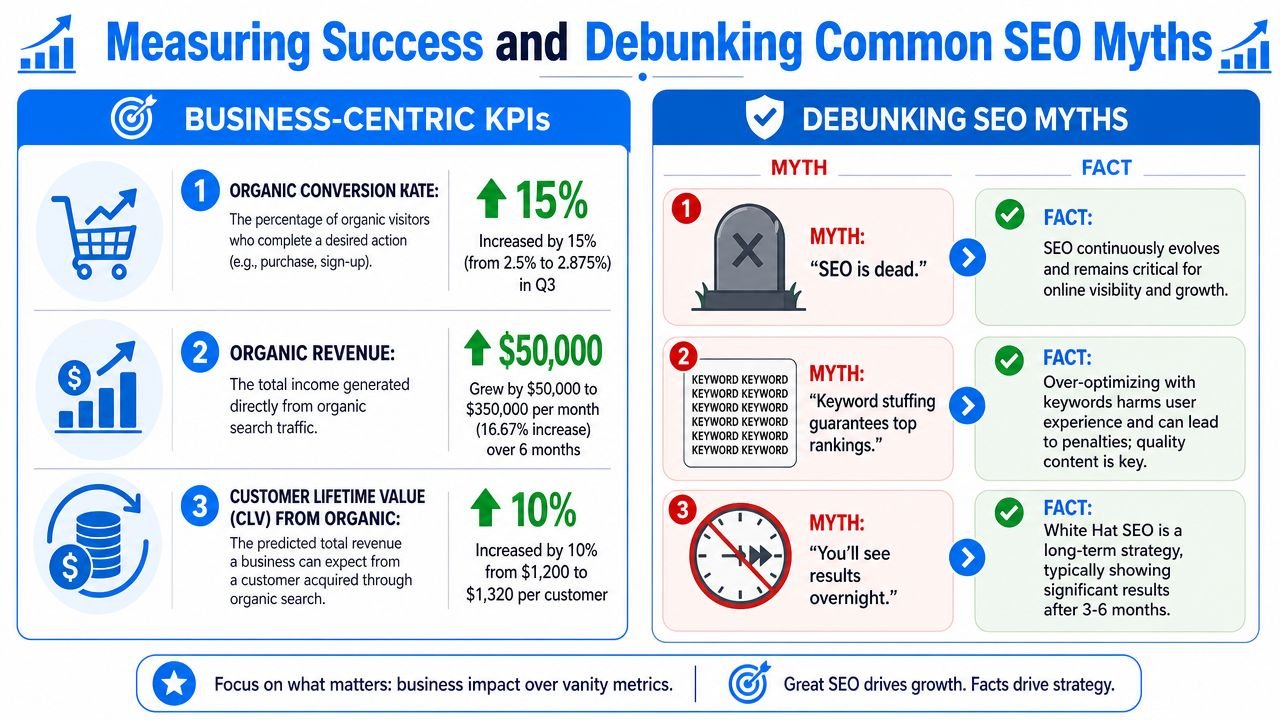
White hat SEO gets dismissed as the patient option. For B2B SaaS in AI-driven search, that framing is outdated. The brands that publish real expertise, show clear ownership, and earn credible mentions often get picked up faster across search, AI summaries, and buyer research workflows than brands trying to manufacture authority.
Measure pipeline, not just positions
Rankings still matter. They just matter as a leading indicator, not the final score.
For SaaS teams, the better question is whether organic search is producing revenue opportunities. Are high-intent pages driving demos, trials, or qualified contact requests? Are prospects arriving with a clearer understanding of the problem, your category, and your product? Does sales report that buyers already trust your point of view before the first call?
Track metrics like:
- Organic-driven trials and demos: Connect landing pages and content hubs to form fills, trial starts, and sales-qualified leads.
- Topic-level share of voice: Measure visibility across the commercial themes tied to pipeline, not a handful of trophy keywords.
- Assisted conversions: Educational content often influences branded search, return visits, and multi-touch deals before a conversion happens.
- Citation visibility: Check whether your brand is showing up in answer engines, industry roundups, analyst references, and editorial mentions.
A lot of reporting still breaks at this point. B2B marketing teams spend hours reacting to weekly keyword swings while missing the larger pattern. If a cluster of solution pages gains impressions, earns better engagement, and starts assisting demos, the program is working even if one head term moved down three spots.
That trade-off matters. Chasing daily ranking volatility produces busywork. Measuring topic momentum and conversion impact produces better decisions.
The biggest myths that waste time
The first myth is that white hat SEO is too slow for companies with aggressive growth goals. In practice, weak SEO is what moves slowly. Thin pages, generic AI copy, and irrelevant links rarely hold visibility for long, especially when search systems are trying to identify experience, credibility, and clear source attribution. Google's guidance on creating helpful, reliable, people-first content makes that direction plain, especially around trust signals and demonstrated expertise: Google Search Central's people-first content guidance.
For SaaS brands, that changes the math. A credible expert article, a well-structured comparison page, or a product-led solution page can gain traction faster than a larger library of low-conviction content because it is easier for both users and search systems to trust.
A few myths to retire:
- “More pages means better SEO.” More low-value pages usually create crawl waste, duplicate intent, and weaker internal relevance.
- “Any backlink is a good backlink.” Poor-fit links can weaken trust and leave the site with cleanup work later.
- “SEO success equals traffic growth.” Traffic without qualified intent does little for pipeline.
- “AI search makes white hat slower.” AI search raises the value of clear authorship, strong sourcing, and original insight. For expert-led B2B brands, that can shorten the path to visibility.
The practical takeaway is simple. Measure SEO like an acquisition channel, build for trust, and judge progress by revenue signals. That is how white hat SEO stops being a branding exercise and starts compounding as a growth program.
Your 90-Day White Hat SEO Playbook for Growth
A good white hat program doesn't start with a giant content calendar. It starts with sequencing. Fix the foundation, publish the pages that matter most, then earn authority around them.
Days 1 to 30 fix the foundation
Start with a real audit. Use Google Search Console, PageSpeed Insights, Screaming Frog, and your analytics stack to identify crawl issues, duplicate intent, weak templates, and speed problems.
Then narrow the keyword map. Assign one primary intent to each core page. For most SaaS sites, that means tightening homepage messaging, feature pages, solution pages, comparison pages, and a handful of high-intent educational topics.
Focus on:
- Technical cleanup: Resolve crawl blockers, broken internal links, and obvious mobile UX issues.
- Intent mapping: Decide which pages target category, solution, competitor, and problem-aware searches.
- Conversion alignment: Make sure key pages are able to turn visibility into trials, demos, or qualified leads.
Days 31 to 60 publish the money pages
Now create the pages most likely to influence pipeline. Usually that means one strong pillar page, several supporting cluster pages, and one linkable asset with a genuine reason to exist.
Don't spread effort too thin. A few excellent pages with a sharp purpose outperform a flood of generic blog content.
A solid publishing sprint often includes:
- One category-level pillar page
- Two to four supporting articles
- One authority asset such as a benchmark, calculator, or template
- On-page refinement across titles, H1s, URLs, schema, and internal links
Days 61 to 90 earn authority
With strong assets live, start promotion. Outreach should be personalized and tied to relevance, not blasted across a spreadsheet.
Run a focused program across guest contributions, digital PR opportunities, partner mentions, founder commentary, and unlinked brand mention reclamation. At the same time, review early performance and improve pages based on actual user behavior.
The first 90 days of white hat SEO shouldn't try to win the whole market. They should create a system your team can repeat without cutting corners.
The payoff is that you're no longer guessing what white hat SEO is. You're operating it.
If your team wants a practitioner-led SEO program built around authority, transparent execution, and links that support real growth, SaasSky is worth a look. They work with SaaS and eCommerce brands that care about measurable impact, clear pricing, and white hat link building that holds up over time.