You've probably lived this already. The team publishes a thoughtful article targeting a sensible keyword. It's well written, on brand, and useful to a real buyer. A few weeks later, it's buried so deep in search results that it may as well not exist.
That pattern shows up constantly in SaaS. Companies produce isolated “good” content, but they don't build a content system. Google doesn't just evaluate whether one article is decent. It evaluates whether your site looks like a credible destination on the topic behind that article.
That's where topical authority changes the game. It's the difference between publishing blog posts and building a body of knowledge that search engines trust.
Table of Contents
- The Content Graveyard Why Good Articles Fail to Rank
- What Is Topical Authority Really and What It Is Not
- The Business Case Why Topical Authority Matters to Your Bottom Line
- The 4 Part Playbook for Building Topical Authority
- Measuring Topical Authority with Real World Examples
- Sustaining Authority and Avoiding Common Pitfalls
The Content Graveyard Why Good Articles Fail to Rank
A common SaaS scenario looks like this. The company has a product with a clear value proposition, a capable writer, and a list of keywords from Ahrefs or Semrush. They publish “best workflow automation tools,” then “how to automate approvals,” then “B2B onboarding checklist.” Each post is fine on its own. Together, they still don't rank.
The problem usually isn't effort. It's fragmentation.
One article on workflow automation doesn't tell Google you're a serious source on workflow automation. It tells Google you wrote one article on workflow automation. If your site has no clear pillar page, no supporting subtopics, and weak internal links, search engines see disconnected assets instead of a trusted knowledge base.
I've seen this in audits where a company has dozens of posts but no real topic ownership. The blog reads like a backlog of keyword ideas, not a coherent system. In those cases, the fastest win usually isn't “write more.” It's “decide what you want to be known for, then rebuild the structure around that.”
Good articles fail when they live alone.
That's why a website auditing checklist for content and structure is often more useful than another writing sprint. You need to inspect crawl paths, orphan pages, overlapping topics, and whether your commercial pages are supported by informational content.
What failing content usually has in common
- Isolated targeting: The post goes after one keyword but ignores the related questions buyers ask before and after that search.
- Weak context: There's no surrounding cluster to help Google understand why your site should rank on the broader topic.
- No reinforcement: Product pages, guides, comparisons, and use case pages don't support each other.
A content graveyard isn't full of bad writing. It's full of content with no ecosystem.
What Is Topical Authority Really and What It Is Not
A generalist site can publish a decent article on SOC 2 and still lose to a smaller security SaaS site that has clear coverage of audits, evidence collection, vendor reviews, control mapping, implementation timelines, and renewal prep. That is topical authority in practice. Search engines do not just evaluate whether one page is useful. They evaluate whether your site has earned the right to be trusted on the subject.
For SaaS teams, that changes how content should be planned. Topical authority is not a volume play. It is a relevance and structure play. Your site needs a clear topic area, supporting subtopics that match how buyers research the problem, and internal links that show how those pages relate.
The specialist site test
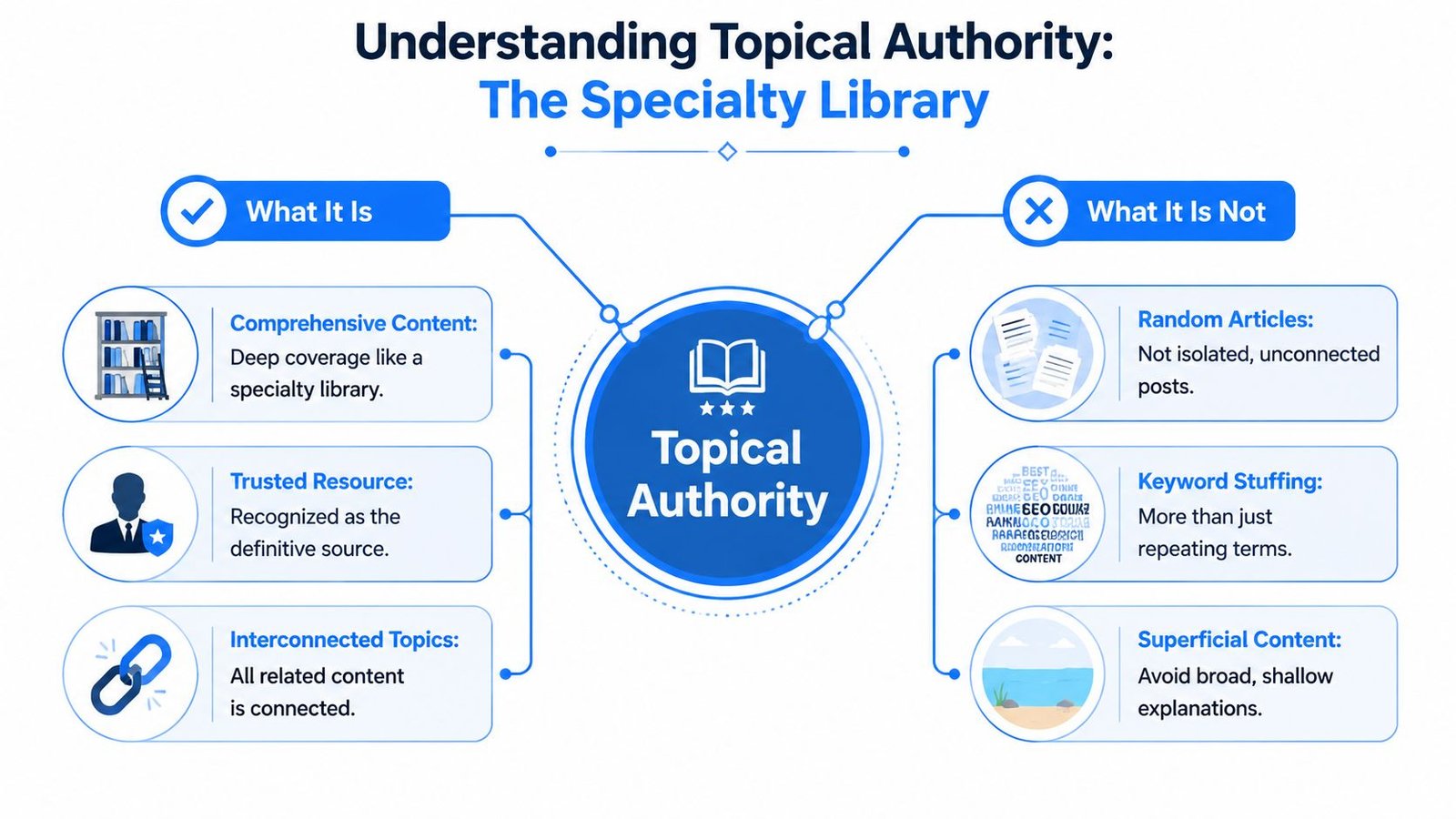
A site with topical authority works like a specialist reference library. It covers the core topic, the common follow-up questions, the edge cases, and the decision-stage comparisons. It also helps users and crawlers move from one question to the next without friction.
A site without topical authority looks different. It has a few isolated posts, uneven coverage, and no clear signal about which subject it wants to own.
That distinction matters because teams often mistake topical authority for “having a lot of content.” Quantity helps only when the pages reinforce each other and build a usable topic graph around a business priority.
What search engines are evaluating
In practical terms, search engines look for signals that your site covers a topic with enough range and enough connection to be credible. That includes topical breadth, depth on high-intent subtopics, entity relationships, internal linking, and consistency between informational and commercial pages.
This is also where teams mix up domain authority and topical authority.
| Concept | What it signals | What it does not guarantee |
|---|---|---|
| Domain authority | General site strength, often driven by links | That you're the best result for a niche topic |
| Topical authority | Focused expertise in a defined subject cluster | That you can ignore links or technical SEO |
A strong domain can publish on a new subject and get some traction faster. A focused specialist can still outrank it if the specialist has tighter coverage, better alignment to search intent, and a cleaner internal structure around that topic.
Here is the practical test I use in audits. If the topic can survive the loss of one page because five related pages still support the same subject, the site is building authority. If one post has to do all the work alone, it is not.
Topical authority also is not permanent. Subject areas decay when information ages, new subtopics appear, product positioning changes, or AI search systems start preferring fresher and better-connected sources. A site can win a topic, then slowly lose it without a clear maintenance plan.
So the true definition is straightforward. Topical authority is your site's proven ability to cover a subject in a connected, useful, and commercially relevant way over time. It is not publishing more for the sake of publishing. It is building a topic system your buyers trust, search engines understand, and your team can maintain before topic decay erodes the gains.
The Business Case Why Topical Authority Matters to Your Bottom Line
A SaaS company can publish 30 decent articles, see a brief lift in impressions, and still miss pipeline goals. I see that pattern in audits all the time. The problem usually is not effort. It is that the content sits as isolated assets instead of working like a revenue-supporting system.
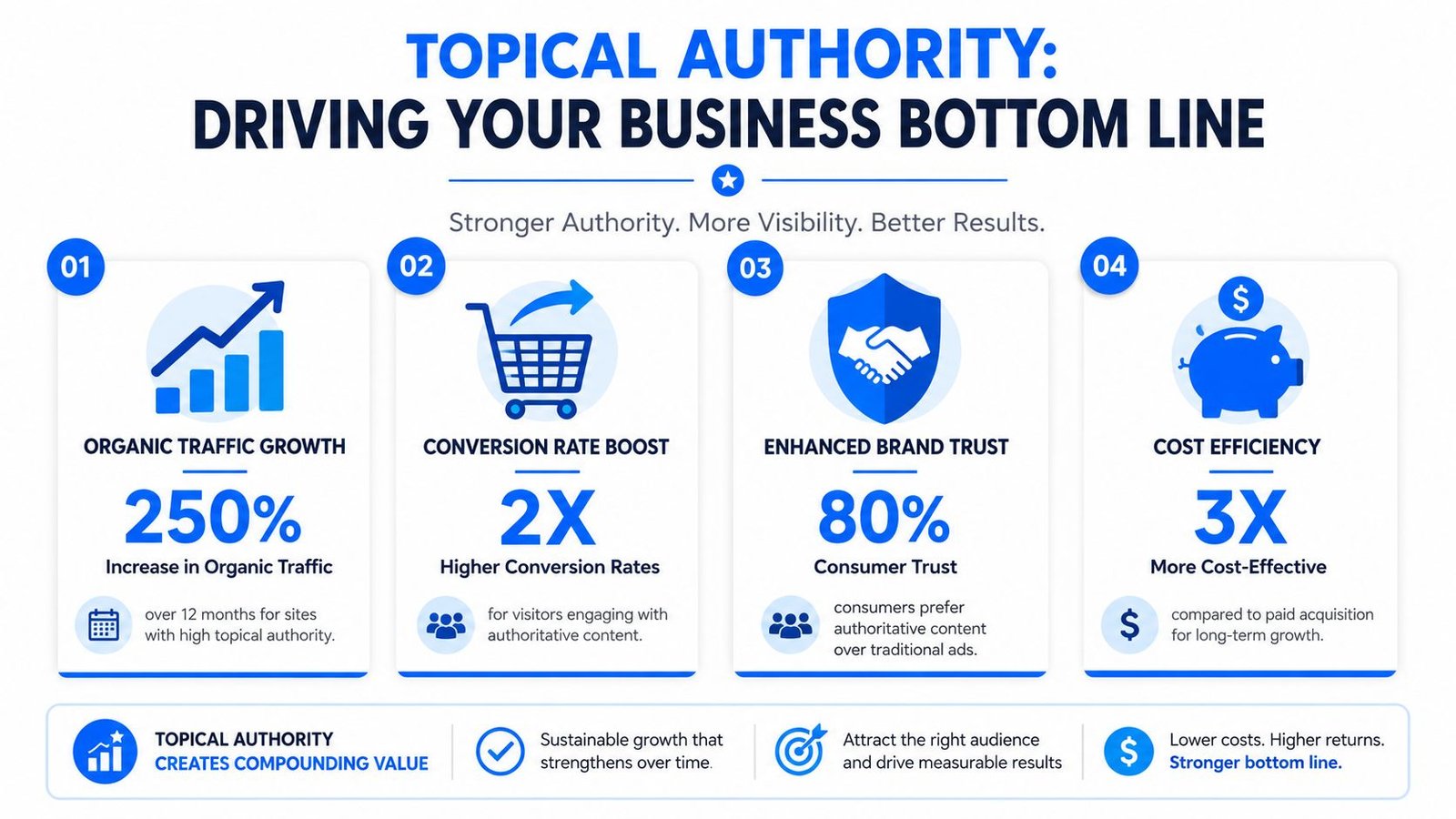
Topical authority changes the economics of SEO. It improves how efficiently your content budget turns into qualified traffic, product discovery, and assisted conversions. It also lowers the cost of getting each new page to perform because related pages already provide context, internal links, and search relevance around the same commercial theme.
Why founders should care
If you run a SaaS business, organic search has to do more than bring in visits. It needs to reduce paid acquisition pressure, support category education, and create more entry points for buyers who are comparing tools, workflows, and implementation options.
Google's own guidance on creating helpful, reliable, people-first content repeatedly points toward depth, relevance, and demonstrated expertise across a topic, not isolated keyword targeting. In practice, that means a site with connected coverage around a product-adjacent subject often gives new pages a stronger starting position than a site publishing one-off posts across unrelated themes. You can see that logic reflected in Google's documentation on helpful, reliable, people-first content.
That is the business case. A stronger topic footprint gives each new asset a better chance to rank, earn clicks, and support revenue without starting from zero every time.
Why this beats a scattered content strategy
Scattered content looks cheaper at first. It usually is not.
Teams publish broad articles across many themes, hope one breaks through, and then wonder why rankings stall after the first page or two. Each article has to build credibility on its own. Internal links are weak. The surrounding context is thin. Sales teams cannot reuse the content easily because it does not map cleanly to one buyer problem or product motion.
A focused cluster works more like compound interest. A pillar on workflow automation software can support comparison pages, implementation guides, integration content, templates, ROI explainers, and pain-point pages for operations leaders. Each asset makes the others more useful. Search engines get a clearer signal about subject depth. Buyers get more paths from early research to commercial evaluation.
The trade-off is concentration. You will publish fewer disconnected topics, and that can feel slower in the short term. For SaaS companies, it is usually the right trade. Depth around a revenue-adjacent topic tends to produce better commercial intent, stronger internal distribution, and more reuse across demand gen, sales enablement, and customer education.
There is a budgeting angle too. If the team has resources for ten pieces this quarter, the safer bet is rarely ten unrelated posts. It is usually one well-scoped cluster built around a commercial topic, informed by a proper content gap analysis process, then expanded based on what the market, the SERP, and your pipeline data show.
That cluster becomes an asset your team can keep improving.
It also gives you a defense against topic decay, which is where the business impact gets missed. Rankings fade when definitions change, competitors add missing subtopics, product categories shift, or AI search systems start preferring fresher and better-connected explanations. A topic you owned last year can weaken gradually. The companies that protect performance treat topical authority as an operating system, not a publishing sprint. They refresh aging pages, add new subtopics before gaps widen, and consolidate overlapping content before it starts competing with itself.
For early-stage and growth-stage SaaS teams, that maintenance discipline protects more than traffic. It protects the efficiency of the content investment you already made. Your best topic clusters keep supporting demos, partner conversations, onboarding, and buyer education long after the original campaign ends.
The 4 Part Playbook for Building Topical Authority
A SaaS team publishes 20 solid articles in six months and still loses ground on the terms that drive demos. The usual problem is not effort. It is that the content was produced as separate assets instead of a system built around one commercial topic.
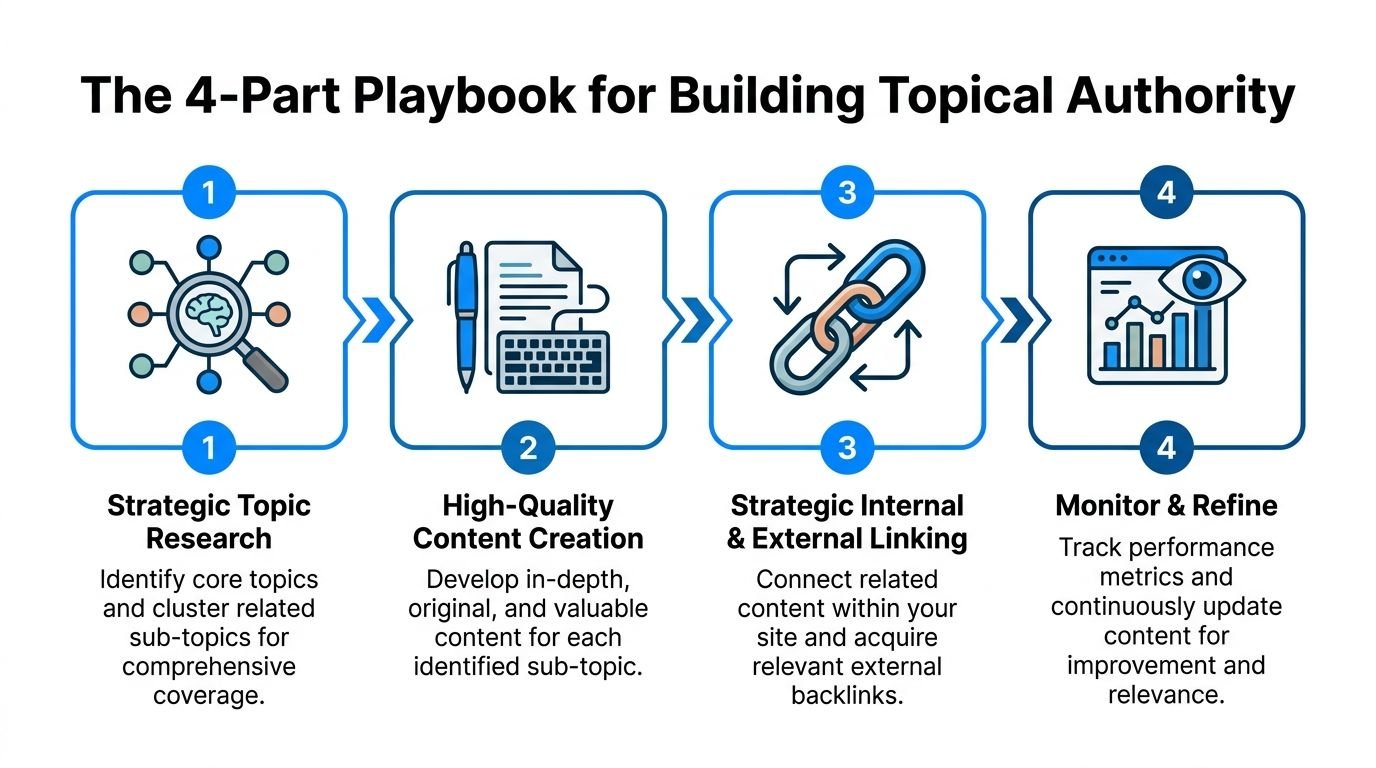
Part 1 Strategic topic research
Start with the revenue path. For a SaaS company, that usually means a topic tied to a product category, a high-value use case, a key integration, or a painful operational problem your buyers are already trying to solve.
Then build the topic map around how buyers evaluate the category.
- Choose a core topic: “Customer onboarding software” is tighter and more monetizable than a broad label like “customer success.”
- Map the decision surface: List the comparisons, implementation questions, risks, objections, workflows, pricing questions, and stakeholder concerns around that topic.
- Find weak spots: Run a content gap analysis for competing topic clusters against search competitors that already own the SERP.
The goal is full buyer coverage, not an arbitrary post count. If a prospect has to leave your site to understand setup, cost, security, migration, or vendor fit, the cluster is still incomplete.
This is also where future topic decay starts. A topic map that only reflects today's SERP gets stale fast. Build room for adjacent subtopics you know will matter in six to twelve months, especially where AI search systems are rewarding fresher, better-connected explanations.
Part 2 Internal linking that proves relevance
Internal links show search engines how your expertise is organized. They also shape user behavior. A strong cluster keeps qualified visitors moving deeper into the topic instead of sending them back to Google.
The working model is simple:
- A pillar page covers the parent topic and frames the decision.
- Cluster pages answer the major subtopics in detail.
- Each cluster page links back to the pillar page.
- Related cluster pages link to each other when the relationship is useful to the reader.
For example, a pillar on “CRM data migration” might connect to pages on migration timelines, common errors, security reviews, audit checklists, pricing variables, and platform-specific migrations. A page about migration risks should point readers to a pre-migration audit page and a rollback planning page if those are the next practical questions.
That structure works like a well-labeled warehouse. If every aisle is connected clearly, both visitors and crawlers can find the right inventory fast.
A common failure point is execution. Teams approve the cluster in a planning doc, publish the pages, then skip the cross-links, hub navigation, or contextual links inside the body copy. The topic looks coherent in a spreadsheet and fragmented on the site.
Part 3 Link acquisition that validates expertise
External links still matter, but the job is different here. You are not trying to inflate domain metrics. You are trying to validate the commercial topic you want to own.
For SaaS brands, the best links usually come from places that reinforce category expertise:
- Digital PR with a topical angle: Comment on trends, benchmarks, or operational problems inside your category.
- Partner and ecosystem pages: Integration partners, marketplaces, consultants, and implementation firms often provide context that aligns with your cluster.
- Useful assets inside the cluster: Templates, calculators, glossaries, migration checklists, and benchmark pages earn links because they save people time.
Trade-offs matter. A low-effort link to an unrelated page may look productive in a monthly report, but it rarely improves the topic that supports pipeline. Fewer links aimed at the right cluster usually produce better business results than a scattered campaign.
Part 4 Technical signals that support the cluster
Technical SEO supports the topic map by removing ambiguity. If your architecture is messy, your authority signals get diluted across duplicate pages, weak canonicals, or buried hubs.
Prioritize the parts that clarify topic ownership:
| Technical area | What to check | Why it matters |
|---|---|---|
| URL structure | Group related pages logically | Helps users and crawlers recognize the cluster |
| Schema markup | Apply article, FAQ, product, or organization schema where appropriate | Adds context about page type and subject |
| Indexation | Confirm key cluster pages are crawlable and canonicalized correctly | Prevents authority from splitting across duplicate versions |
| Navigation | Surface topic hubs in menus, resource centers, and related-content modules | Signals which subjects matter most on the site |
If I were advising a new SaaS client, I would rather build one disciplined cluster around a high-intent topic than publish a larger set of loosely related posts. It is easier to rank, easier to measure, and easier to maintain as the topic changes.
That last point matters more now. Topical authority is not built once. It has to be defended. The teams that keep winning revisit aging cluster pages, add missing subtopics before competitors do, and merge overlapping content before cannibalization sets in.
Measuring Topical Authority with Real World Examples
You can't manage topical authority if you only look at page-level rankings. The right question isn't “did this article move?” It's “are we becoming more visible across the topic?”

What to measure in practice
Google confirmed in May 2023 that topical authority is a core system for determining which experts are most helpful for news-related queries in sensitive niches, linking it directly to E-E-A-T considerations. That confirmation also reinforced the role of content clusters, citation quality, and third-party validation in how authority is assessed, as noted in this Google topical authority and E-E-A-T confirmation.
Even if you're not in health or finance, the operational lesson applies. Measure topic-level trust signals, not just isolated rankings.
A practical measurement stack looks like this:
- Google Search Console: Filter queries by cluster theme and watch whether impressions spread across more related searches over time.
- Ahrefs or Semrush: Track keyword sets by topic cluster instead of by page alone.
- Manual SERP review: Check whether your pages are appearing across informational, comparison, and solution-intent variants.
- Backlink relevance review: Evaluate whether pages in the cluster are earning topically aligned links and mentions. A guide to referring domains and what they tell you helps here.
If your rankings improve on one page but the cluster doesn't expand, you probably optimized a page. If the whole cluster broadens, you're building authority.
Two examples SaaS and eCommerce
Consider a B2B SaaS company selling workflow automation software. Its core topic might be “approval workflow automation.” The pillar page covers strategy, use cases, software considerations, and implementation. Cluster pages target procurement approvals, finance approvals, HR approvals, approval routing logic, compliance controls, and integration questions. Success looks like growing impressions across the whole approval-workflow theme, not just movement on the head term.
Now take an eCommerce brand selling specialty tea. Its pillar might be “matcha tea guide.” Supporting pages could cover ceremonial vs culinary matcha, preparation methods, storage, flavor profiles, accessories, and gift options. Measurement should include whether the brand starts appearing for broader matcha education queries, buying queries, and product-adjacent searches within that category.
These examples matter because what is topical authority looks different by business model, but the measurement logic stays consistent. You're checking whether search engines are associating your site with a topic cluster more broadly over time.
Sustaining Authority and Avoiding Common Pitfalls
The biggest misconception about topical authority is that once you build it, you keep it. That's no longer safe.
Authority decays if you stop maintaining it
Search has become more dynamic, especially in AI-shaped result environments. Existing coverage can lose relevance if newer competitors answer emerging questions better, update examples faster, or structure information more clearly.
A 2026 Clearscope study found that topics updated less than quarterly see a 40% drop in visibility within AI-generated search results compared with topics updated monthly, according to the topic decay study on AI search visibility. The same framing highlights an emerging decay window of roughly 6-9 months without active updates.
That doesn't mean rewriting every page constantly. It means maintaining the pages that carry authority.
A sensible maintenance routine looks like this:
- Review pillars first: Update definitions, screenshots, product references, and outdated examples.
- Check cluster gaps: Add new subtopics when the market changes or search intent shifts.
- Refresh links and citations: Replace broken references and improve internal pathways.
Three mistakes that waste the effort
First, teams build clusters around topics that don't matter commercially. Ranking for adjacent educational terms feels good until you realize they don't support demos, trials, or product discovery.
Second, they publish cluster pages but leave them as islands. No hub. No sibling links. No route from education to commercial intent.
Third, they stop after the initial build. That's where topic decay sets in. Competitors update. New use cases appear. Search behavior changes. Your once-strong cluster starts to age.
The teams that win treat topical authority like product maintenance. Build it, monitor it, refresh it, and keep tightening the map around the topics your business needs to own.
If your team wants help turning scattered content into a defensible search strategy, SaasSky works with SaaS and eCommerce brands on the hard parts that matter most: topic-focused link building, authority growth, and SEO execution that's tied to real business outcomes.