
Most SaaS SEO advice is stuck in a publishing-era playbook. Build a pillar page. Add cluster posts. Chase volume. Wait. If you're lucky, you get traffic from students, job seekers, and people doing casual research. If you're unlucky, you get nothing except a larger content library to maintain.
That approach breaks because a real SaaS SEO strategy isn't a blog calendar. It's a revenue system. Buyers don't search in neat topic clusters. They search when they have a problem, when they're comparing vendors, when they need pricing, when procurement asks for alternatives, and when a champion inside the account needs proof your product will work.
The teams that win in SEO treat search as demand capture around product truth. They build pages for intent, wire those pages into demos and trials, and use product data, customer language, and implementation knowledge that content farms can't fake.
Table of Contents
- Laying the Groundwork for SaaS SEO Success
- Mapping High-Intent Keywords to Your Buyer Journey
- Creating Content That Drives Demos and Trials
- Prioritizing Technical SEO for SaaS Applications
- Executing Scalable SaaS Link Building Playbooks
- Measuring Pipeline Impact and Prioritizing Next Steps
Laying the Groundwork for SaaS SEO Success
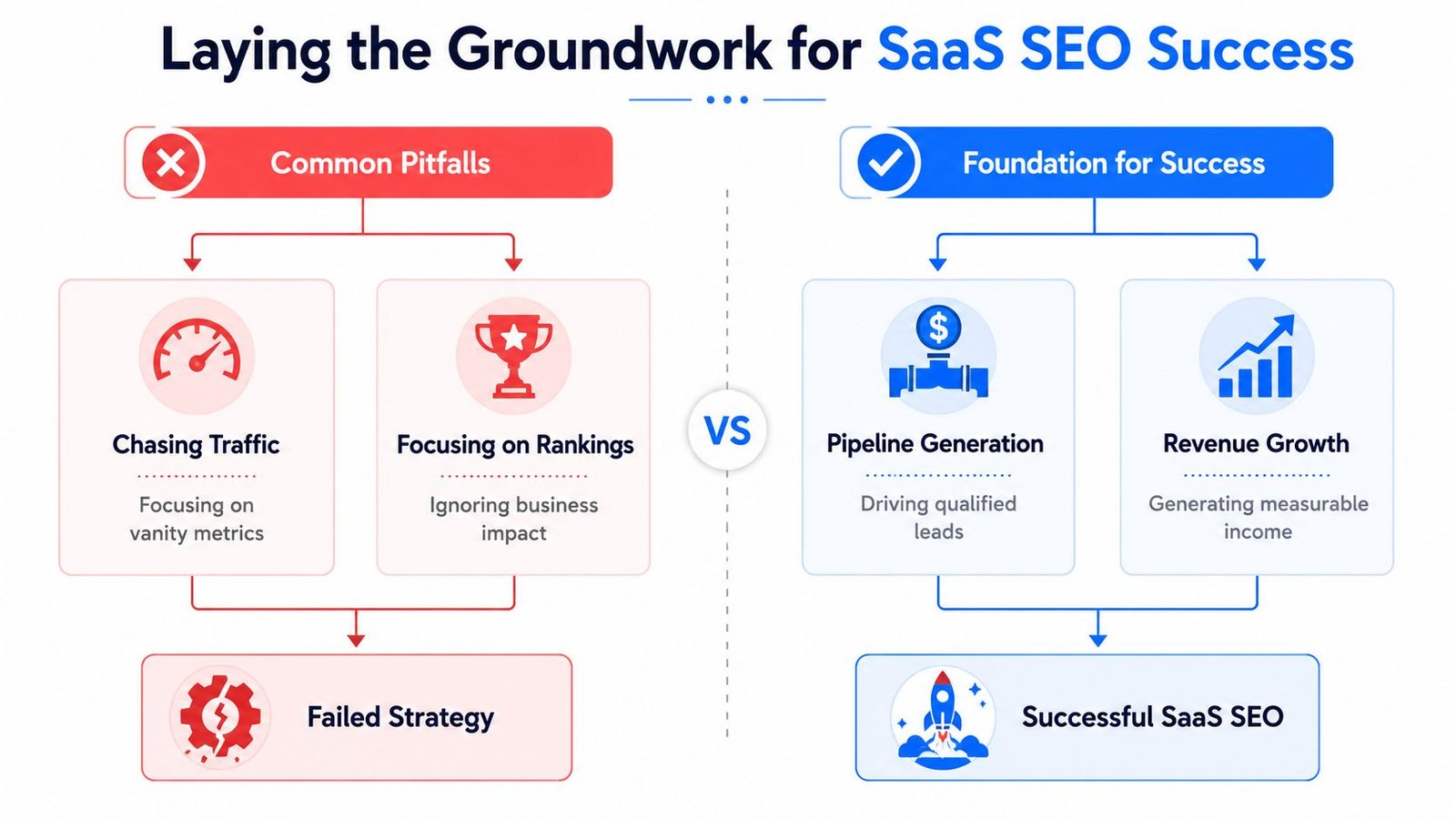
Most SaaS SEO programs fail before the first page is published. The problem usually isn't writing quality. It's target selection and success criteria. Teams celebrate impressions, non-brand clicks, and ranking reports while sales asks a simpler question: did organic create qualified pipeline?
That gap matters because SEO can be a serious commercial channel when it's built correctly. One 2026 SaaS marketing statistics roundup reports that B2B SaaS companies achieve a 702% ROI from SEO, reach break-even in 7 months, and that organic search generates 44.6% of all B2B revenue in that dataset, which is why I treat SEO as a revenue program rather than a publishing function (Oliver Munro's SaaS marketing statistics roundup).
Stop calling traffic success
Traffic is useful. It just isn't the scorecard.
A blog post can bring in visitors for months and still have no business value if those visitors never request a demo, start a trial, or influence an opportunity. That's why new hires need to learn this early: SEO doesn't deserve protection in the budget because it's "organic." It deserves protection when it reliably contributes to pipeline.
Practical rule: If a page can't plausibly assist a buyer toward evaluation, expansion, or purchase, it shouldn't sit high on your roadmap.
If you need a basic refresher on search fundamentals before building the system, this primer on understanding search engine optimization is a useful starting point.
Run the three audits that actually matter
I start with three audits. Not because audits are exciting, but because they stop bad assumptions from driving the next quarter.
Technical audit
Check what prevents crawling, indexing, rendering, and page experience. On SaaS sites, common problems live in JavaScript-heavy pages, thin template sets, duplicate URL paths, or pages hidden behind awkward navigation. If Google can't reliably access or understand your pages, content production just piles more weight onto a weak foundation.Content audit
Pull every important URL into one sheet. Include blog posts, feature pages, integration pages, pricing, comparison content, docs, and use-case pages. Then sort by intent. Which pages attract problem-aware visits? Which pages help buyers compare options? Which pages should convert ready-to-buy traffic but currently don't?Competitive audit
Don't just study who ranks. Study what they built to earn those rankings. Are they winning with comparison pages, integration hubs, branded alternatives, deep product education, or original data? The point isn't to copy them. The point is to see where the market is already saturated and where your product knowledge can create an unfair advantage.
Set KPIs your CFO will respect
The cleanest shift you can make is from SEO metrics to business metrics.
Use a core KPI set like this:
- Organic-sourced MQLs tied to forms, trials, or hand-raisers
- Organic-sourced SQLs where sales accepted the lead
- Demo requests and trial starts from organic landing on commercial pages
- Pipeline value and closed-won revenue influenced or sourced by organic
- Customer acquisition cost for organic compared against paid and partner channels
Then keep a support layer underneath:
| Primary business metrics | Supporting SEO metrics |
|---|---|
| Organic MQLs | Organic sessions |
| Organic SQLs | Conversion rate by landing page |
| Demo requests | Referring domains |
| Trial starts | Page-1 keyword counts |
| Revenue attribution | Branded and non-branded click trends |
This changes behavior fast. Writers stop chasing broad topics that "might build awareness." Product marketers start caring about alternative pages. Growth teams care more about internal links into money pages than another thought-leadership essay.
Mapping High-Intent Keywords to Your Buyer Journey
Keyword research gets distorted when teams start with tool exports. A spreadsheet full of terms looks productive, but it hides the underlying question: what was the buyer trying to accomplish when they searched?
A better approach is to map keywords by intent, then assign each intent its own page. That's the workflow I trust because it aligns content with buying behavior instead of search volume alone. One practitioner-led framework recommends classifying keywords into category, comparison or alternative, and jobs-to-be-done buckets, inspecting the live SERP before drafting, and creating a dedicated URL for each target intent rather than forcing many near-duplicate terms onto one page (Grow and Convert's SaaS SEO strategy guide).
Start with intent buckets, not keyword lists
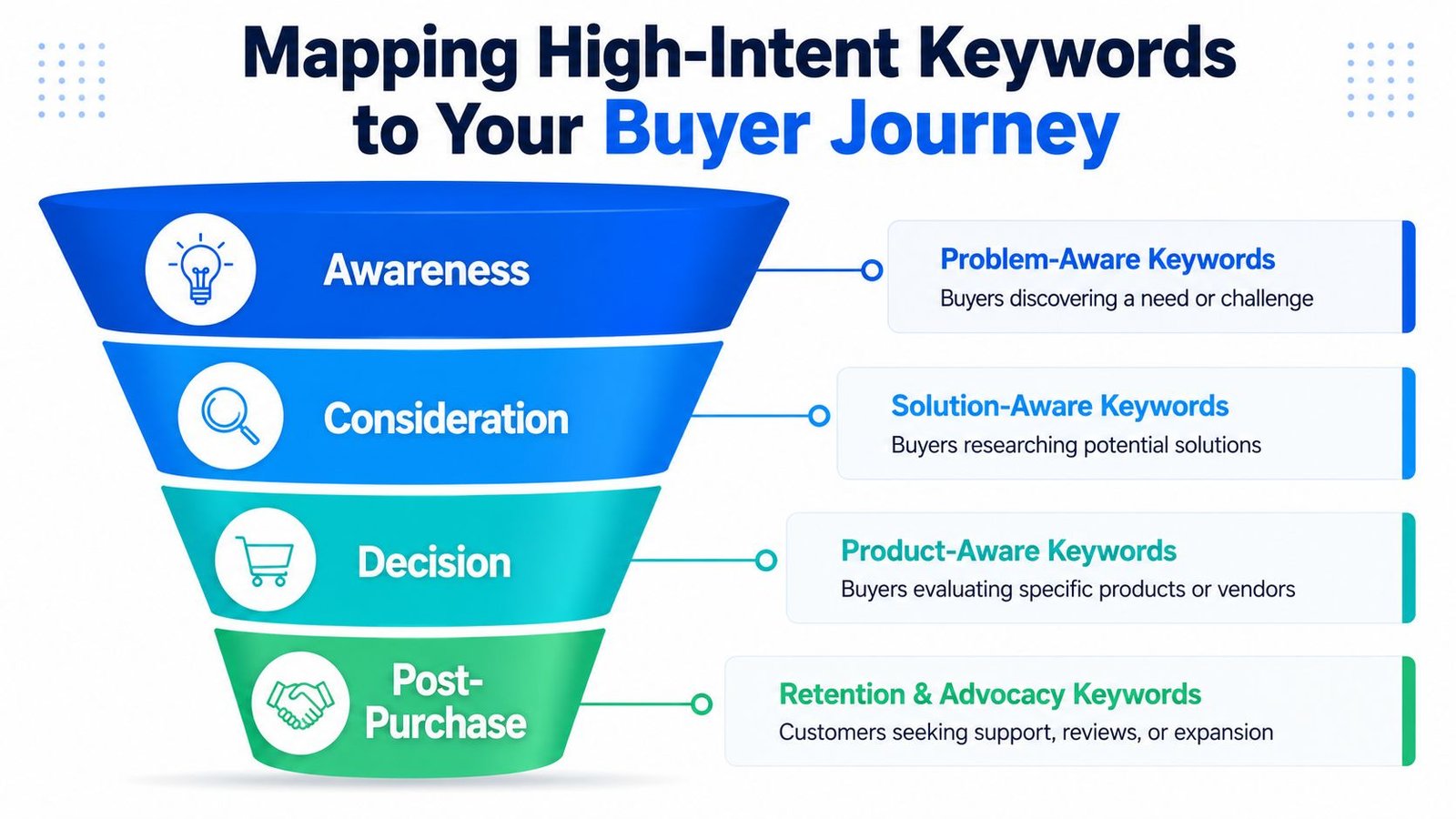
I use four buckets that mirror how SaaS buying happens.
Awareness
The buyer knows the problem, not the product category. They search questions, workflows, pain points, and process issues.Consideration
The buyer is researching solutions. They search category terms, use cases, implementation details, and workflow options.Decision
The buyer is evaluating vendors. They search comparisons, alternatives, pricing, integrations, migration paths, and feature-specific questions.Post-purchase
The customer wants onboarding help, support docs, templates, training, or expansion use cases. These terms matter because they reduce churn risk and help expansion revenue surface in search too.
Persona work pays off. Sales calls, support tickets, onboarding notes, Gong snippets, product feedback, and win-loss interviews give you the language buyers use. That's better input than a keyword tool guessing semantic variants.
Build one page per buying intent
A common mistake is trying to make one "ultimate guide" rank for everything around a category. That sounds efficient. It usually creates a page that doesn't fully satisfy any one query.
If someone searches a competitor alternative, they don't want a broad educational article. They want a buying page with product differences, migration concerns, pricing context, use-case fit, and a clear next step. If someone searches a category term, they usually want a category-level landing page, not a company blog post disguised as one.
Buyers don't search in topics. They search in moments of decision.
When you inspect the SERP, look at format first. Is Google rewarding comparison tables, category pages, product pages, listicles, docs, or how-to posts? Match that pattern before you try to improve on it. Relevance comes before originality.
A simple keyword map you can reuse
Here's a practical structure for building your keyword map.
| Buyer stage | Intent bucket | Page type | Example theme | Primary conversion goal |
|---|---|---|---|---|
| Awareness | Problem-aware | Educational guide | Solving a workflow bottleneck | Newsletter signup or product CTA |
| Consideration | Solution-aware | Category or use-case page | Best-fit approaches for a team | Demo click or trial visit |
| Decision | Product-aware | Comparison, alternative, pricing, feature page | Vendor evaluation | Demo request or trial start |
| Post-purchase | Retention and advocacy | Docs, templates, onboarding content | Implementation and expansion | Product adoption or upsell path |
A few rules keep this map clean:
- Use one canonical target intent per page. Don't assign five main intents to one URL.
- Group near-duplicates carefully. If the SERP treats terms differently, give them different pages.
- Include a commercial purpose. Every page should either capture, assist, or convert buying intent.
- Map internal links in advance. Awareness pages should feed solution and decision pages. Decision pages should link into pricing, demo, and trial paths.
If your keyword map doesn't show how a searcher becomes a pipeline event, it's not a strategy. It's an inventory list.
Creating Content That Drives Demos and Trials
The biggest content mistake in SaaS is overinvesting in educational content that never gets close to the product. Teams publish broad thought pieces because they feel safe. Meanwhile, their pricing page is thin, their integrations are underexplained, and nobody has built a serious alternative page for the competitor sales keeps hearing about every week.
The better content mix is narrower, more commercial, and more product-informed.
Recent guidance on sustainable SaaS SEO makes this point clearly. The durable gains come from product inputs, user research, support insights, and unique datasets, not just keyword-targeted articles. It also points out that lower-volume branded queries such as pricing, contact, and comparisons can carry strong intent and deserve deliberate optimization (ProductLed on sustainable SEO strategy for SaaS).
What a high-converting content mix looks like
Think in page types, not blog categories.
First, build comparison and alternative pages. If a prospect searches "[competitor] alternatives," they are already in-market. A weak page that takes cheap shots at a competitor won't convert them. A strong one explains fit by team type, migration friction, implementation differences, and where your product is better or worse.
Then build feature and use-case pages. These are often the most neglected commercial assets on a SaaS site. If your product solves different workflows for RevOps, Finance, IT, or Customer Success, each one deserves its own page with screenshots, process detail, and a CTA that matches the use case.
Next come integration pages. These attract searchers who are actively evaluating workflow compatibility. On many SaaS sites, integration pages demonstrably outperform generic blog content because they sit closer to actual implementation intent.
Finally, use educational content selectively. It should earn attention from the right audience and route that attention toward product-relevant pages. If it can't do that, it belongs lower on the backlog.
How prospects move through these pages
A realistic example helps.
A buyer starts with a workflow problem. They search for a better way to manage handoffs between marketing and sales. They land on an educational guide. The guide shouldn't end with generic advice. It should show the workflow inside the product, link to a use-case page, and connect the problem to a concrete solution.
Later, procurement asks for options. The same buyer searches a competitor alternative. Now they need a decision page. They want feature depth, pricing posture, implementation considerations, and honest trade-offs. If your page dodges weaknesses, trust drops fast.
Then the champion shares the product internally. Someone else on the team searches your pricing page, a feature page, or an integration page. Those pages need to carry the deal forward without sales in the room. Clear packaging, real screenshots, FAQ handling, and path-to-value matter more here than clever copy.
A strong SaaS content engine doesn't just attract visits. It helps the buying committee answer the next hard question.
What weak SaaS content gets wrong
Weak SaaS content usually fails in one of three ways.
It hides the product
Writers avoid mentioning the product until the last paragraph because they've been told not to be salesy. That's backward for high-intent searches. Buyers came to evaluate solutions.It sounds like outsourced research
The article summarizes what already ranks, adds no workflow detail, and uses generic examples. Anyone can reproduce it with AI and an afternoon.It ignores key buying objections
No mention of migration. No mention of implementation effort. No explanation of who the product is for. No clarity on how teams use it day to day.
A stronger page includes things generic content farms don't have:
- Product screenshots tied to real workflows
- Customer language pulled from calls, tickets, and onboarding
- Specific use-case advice by role or team type
- Clear next steps like demo, trial, or pricing paths
- Honest fit criteria explaining when the product isn't ideal
The moat isn't volume. It's specificity. The more your content reflects product truth, the harder it becomes for competitors to clone your search footprint with generic publishing.
Prioritizing Technical SEO for SaaS Applications
Technical SEO for SaaS is where elegant marketing sites often betray themselves. They look polished, animate beautifully, and still bury critical content behind rendering issues, duplicate paths, or weak information architecture.
I don't treat technical SEO as a giant checklist. I treat it as a bottleneck analysis. Which technical issues are stopping your best commercial pages from being crawled, indexed, understood, or trusted?
Indexability comes before elegance
The first question is simple: can search engines access the page as intended?
That matters a lot on SaaS sites using React, Next.js, or other JavaScript-heavy setups. If your feature page loads core content late, hides important copy behind tabs, or relies on client-side rendering for essential details, you're asking search engines to work harder than they need to.
This isn't just about traditional rankings. Recent guidance on SaaS SEO also emphasizes fixing technical issues that affect indexing and Core Web Vitals, alongside making content more scannable for AI overviews, strengthening brand mentions, and using schema markup plus natural-language queries to fit newer search behaviors (Sure Oak on creating a winning SaaS SEO strategy).
Technical fixes that matter most on SaaS sites
The priorities usually look like this:
JavaScript-rendered commercial pages
If the pricing, feature, or integration page depends on heavy client-side rendering, verify what search engines see. Important copy should render reliably without requiring fragile interactions.Faceted navigation and duplicate URLs
Template libraries, solution directories, and resource hubs often create filtered URL variants that dilute signals. Decide which combinations deserve indexation and keep the rest controlled.Internal linking into money pages
Blog posts often attract links while commercial pages stay isolated. Route authority intentionally from educational pages into features, integrations, comparison pages, and pricing.Thin templated pages
Programmatic sets can work, but not if every page says nearly the same thing. Each page needs enough unique utility to justify being indexed.Core Web Vitals and page experience
On SaaS sites, bloated scripts, visual effects, chat widgets, and large media files can slow key landing pages. The fix is usually operational discipline, not SEO theory.
If you need a practical review process for these issues, use a structured website auditing checklist and run it against your highest-intent pages first.
Build pages for AI-era search behavior
AI-shaped SERPs reward pages that are easier to parse.
That means:
| Technical or structural element | Why it matters |
|---|---|
| Clear heading hierarchy | Helps engines and users scan answers fast |
| Concise summaries near the top | Supports list-like and overview-style extraction |
| Schema markup | Improves machine understanding of page type and entities |
| Natural-language phrasing | Matches how buyers search and how AI systems summarize |
| Strong brand mentions | Reinforces trust and entity association |
Structure wins twice. It helps human buyers move faster, and it makes your pages easier for search systems to interpret.
The wrong move is to react by making every page shorter and flatter. The right move is to make pages easier to scan while keeping the depth that serious buyers need. Concise doesn't mean shallow.
Executing Scalable SaaS Link Building Playbooks
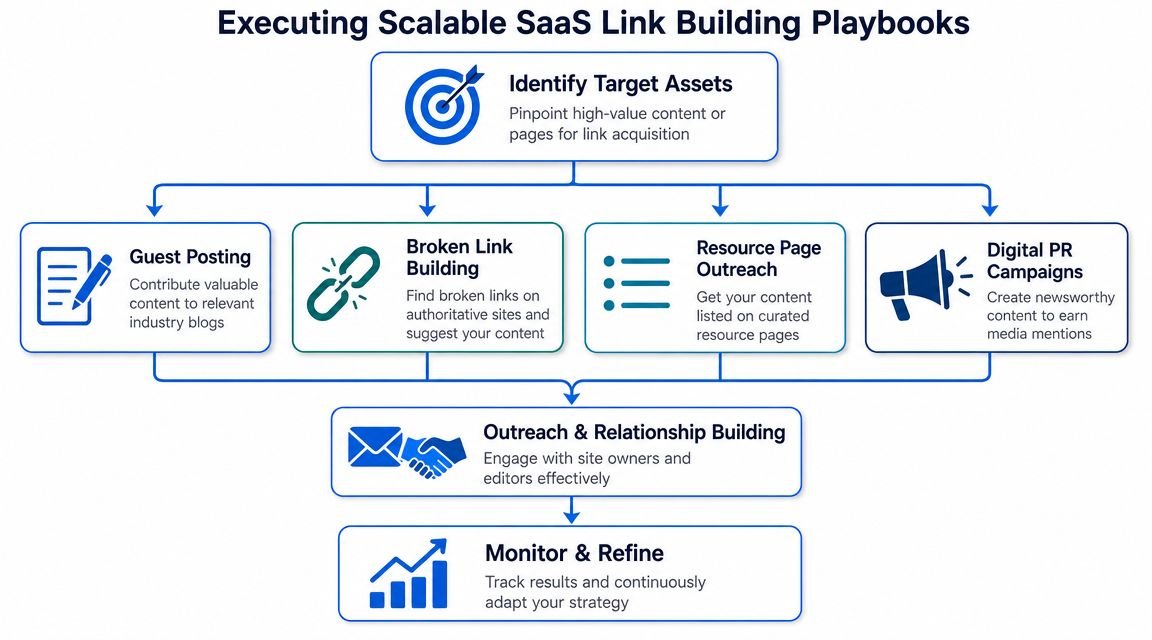
A lot of SaaS link building wastes time because it starts with tactics instead of assets. Teams chase guest posts, send cold outreach to strangers, and celebrate links that never strengthen a commercially useful page.
That's a weak model for a category where search is still a primary discovery channel. One benchmark summary notes that 68% of website traffic starts from a search query and that Google holds about 89.85% of global search traffic, which is why authority around the right pages matters so much for SaaS demand capture (Powered by Search SaaS SEO stats).
Why generic guest posting underdelivers
Guest posting isn't useless. It just gets overvalued.
The standard play looks like this: pitch a generic article to a mid-tier blog, publish it, place one contextual link, repeat. You end up with links, but not much compounding advantage. Competitors can copy the same tactic with the same freelance writers and reach similar sites.
That's why I don't want a link building plan centered on volume outreach. I want a plan built around assets competitors can't easily reproduce.
If you're evaluating ethical outreach models, this overview of white hat link building is a solid reference point.
Three playbooks worth serious effort
The strongest SaaS link building usually comes from three directions.
Product-led assets
Build something people want to cite or share. That might be a free template library, a calculator, a benchmarking tool, a glossary with actual product depth, or a resource hub tied to a workflow your audience already searches.
This works because the asset earns links for utility, not because someone accepted a pitch. It also keeps generating opportunities after launch, which makes it far more scalable than one-off placements.
Strategic partnerships
Most SaaS companies sit inside an ecosystem but underuse it. Integration partners, implementation agencies, consultants, marketplaces, and complementary vendors can all create contextual link opportunities.
The key is not to ask for a homepage logo swap. Build pages together. Publish integration explainers. Co-create migration guides. Contribute partner education that solves a real workflow problem. These links carry more relevance because they're tied to actual product relationships.
Data-driven digital PR
This is the highest-upside playbook when you have proprietary data or strong internal subject matter experts.
Support tickets, anonymized usage trends, implementation findings, workflow benchmarks, and category observations can all become linkable narratives if they're packaged well. The advantage isn't just the link. It's that original data also strengthens commercial pages by giving your brand evidence others don't have.
Operator's note: If your company has unique data and you're still spending most of your outreach budget on generic guest posts, you're underusing your strongest asset.
How to decide which assets deserve outreach
Not every page deserves link building.
Use this filter before you put outreach behind anything:
Commercial relevance
Does the asset help a buyer evaluate, implement, or trust the product?Linkability
Is there a real reason another site would cite it?Internal distribution value
Can this page pass authority into feature, pricing, comparison, or integration pages?Defensibility
Would it be annoying for a competitor to replicate?
A generic blog post often fails this test. A product-led tool, ecosystem page, or original data asset often passes.
The goal isn't to "build backlinks." The goal is to build authority around the pages and themes that create pipeline.
Measuring Pipeline Impact and Prioritizing Next Steps
SEO gets messy when reporting and planning live in separate systems. One dashboard shows clicks and rankings. Another shows conversions. A third lives in the CRM. Nobody can tell which pages deserve more investment.
I prefer one operating view. Search performance on the left. Pipeline movement on the right. Decisions in the middle.
A useful measurement model comes from running SaaS SEO as a pipeline model rather than a traffic model. That means tracking organic MQLs, SQLs, demo requests, and revenue attribution first, then using traffic, conversion rate, referring domains, and page-1 keyword counts as supporting indicators. It also helps to remember that even small on-page changes matter. One practitioner benchmark notes that title-tag wording can change CTR by 15-20% on the same domain (YesOptimist on SaaS SEO strategy).
Build one dashboard for search and pipeline
Your dashboard should answer four questions.
- Which landing pages attract commercially relevant organic visits?
- Which pages turn those visits into demos, trials, or qualified leads?
- Which opportunities and customers came from those paths?
- What should we fix or scale next?
A simple dashboard layout looks like this:
| Dashboard view | What to include |
|---|---|
| Acquisition | Organic sessions to key commercial and educational pages |
| Conversion | Demo rate, trial rate, and form completion rate by landing page |
| Pipeline | Organic MQLs, SQLs, sourced opportunities, influenced revenue |
| Authority and visibility | Referring domains, page-1 keyword counts, CTR trends |
This structure keeps teams from obsessing over raw growth in blog traffic while a comparison page with buyer intent underperforms because the title tag is weak or the CTA is buried.
Use a prioritization matrix that forces trade-offs
Most SEO backlogs are too democratic. Everything sounds useful, so nothing gets sequenced properly.
Use a simple scoring table and be ruthless.
| Initiative | Potential Impact (1-5) | Effort/Cost (1-5) | Priority Score (Impact/Effort) |
|---|---|---|---|
| Refresh competitor comparison page | 5 | 2 | 2.5 |
| Add internal links from blog winners to pricing and features | 4 | 1 | 4.0 |
| Fix rendering issue on integration pages | 5 | 3 | 1.67 |
| Publish broad awareness article | 2 | 3 | 0.67 |
| Rewrite title tags on high-impression pages | 4 | 1 | 4.0 |
A matrix like this does two useful things. It stops random content production, and it gives growth, product marketing, and SEO a common language for trade-offs.
Where to look for the next win
Most near-term gains come from one of these places:
Pages with impressions but weak CTR
Improve titles and meta positioning first.Pages with traffic but weak conversion
Tighten CTA placement, strengthen product proof, and align the offer with intent.Commercial pages with weak internal authority
Add contextual links from relevant educational pages.Valuable pages stuck by technical friction
Fix rendering, indexation, or duplication issues before publishing more content.High-intent gaps sales hears every week
If prospects keep asking about a competitor, integration, workflow, or pricing concern, build that page.
Good SaaS SEO teams don't ask, "What should we write next?" They ask, "What change is most likely to create qualified pipeline from organic?"
If you want help turning this kind of SaaS SEO strategy into a link-worthy growth system, SaasSky is worth a look. They focus on practitioner-led link building for SaaS and eCommerce brands, with transparent pricing, clear case studies, and an accountable service model that fits teams who care about measurable impact rather than vague SEO activity.