

A web directory is a human-edited, categorized list of websites, and Yahoo! Directory's 1994 to 2014 run shows how important that model was before search took over. In 2026, directories still matter for SaaS and eCommerce, but only when they're niche, well-maintained, and clearly useful to real buyers.
A lot of advice on this topic is still stuck in two bad extremes. One side says directories are dead. The other still treats submissions like a low-effort SEO shortcut. Both miss the operational reality.
For a SaaS marketing lead, the question isn't just what is web directory. The key question is whether a listing helps qualified people discover your product, strengthens brand trust, and creates a clean editorial signal without drifting into link spam. That's a very different standard from the old “submit everywhere” playbook.
The useful way to think about directories now is simple. They're not a volume channel. They're a selective distribution channel. If a directory is tightly aligned with your category, reviewed by humans, and built for users who are comparing vendors, it can still earn its place in your SEO mix. If it exists mostly to sell links or publish endless low-quality listings, it's a liability.
Table of Contents
- Are Web Directories Still Relevant in 2026
- The Anatomy of a Web Directory
- A Brief History of Finding Things Online
- The Modern Link Building Value and Risks
- A Practical Framework for Directory Vetting
- Directory Examples for SaaS and eCommerce Brands
Are Web Directories Still Relevant in 2026
Yes, but not in the way most SEO posts describe them.
The old model of mass directory submission is obsolete. The modern use case is narrower and more practical. A relevant directory can still help a SaaS or eCommerce brand show up where buyers browse by category, compare options, and validate credibility before booking a demo or making a purchase.
A web directory is a structured catalog of websites, usually organized into categories and subcategories and often edited by humans rather than indexed automatically like a search engine, as described in Wikipedia's overview of web directories. That human-curated structure is the whole point. It means the value of a listing comes from placement, fit, and editorial control, not from volume.
What changed
Search engines replaced directories as the default way people find things online. That didn't eliminate directories. It forced them to specialize.
For SaaS and eCommerce teams, that specialization is where the opportunity is. The best directories now sit closer to marketplaces, software comparison hubs, partner ecosystems, local business catalogs, industry associations, and vertical resource lists. They don't compete with Google on breadth. They compete on relevance.
Practical rule: If a directory helps a buyer narrow options inside a specific category, it may still be worth pursuing. If it tries to list everything on the internet, it probably isn't.
What relevance looks like now
A good directory listing won't replace content marketing, digital PR, or editorial link acquisition. It complements them. It can support local visibility, category discovery, and trust signals, especially when your company fits a clear niche.
That's also why broad ranking advice about directories often fails. Google evaluates many signals around quality and intent, and Google page rank factors matter far beyond whether a site contains a backlink. Directory links only make sense when they align with real user discovery and editorial judgment.
The Anatomy of a Web Directory
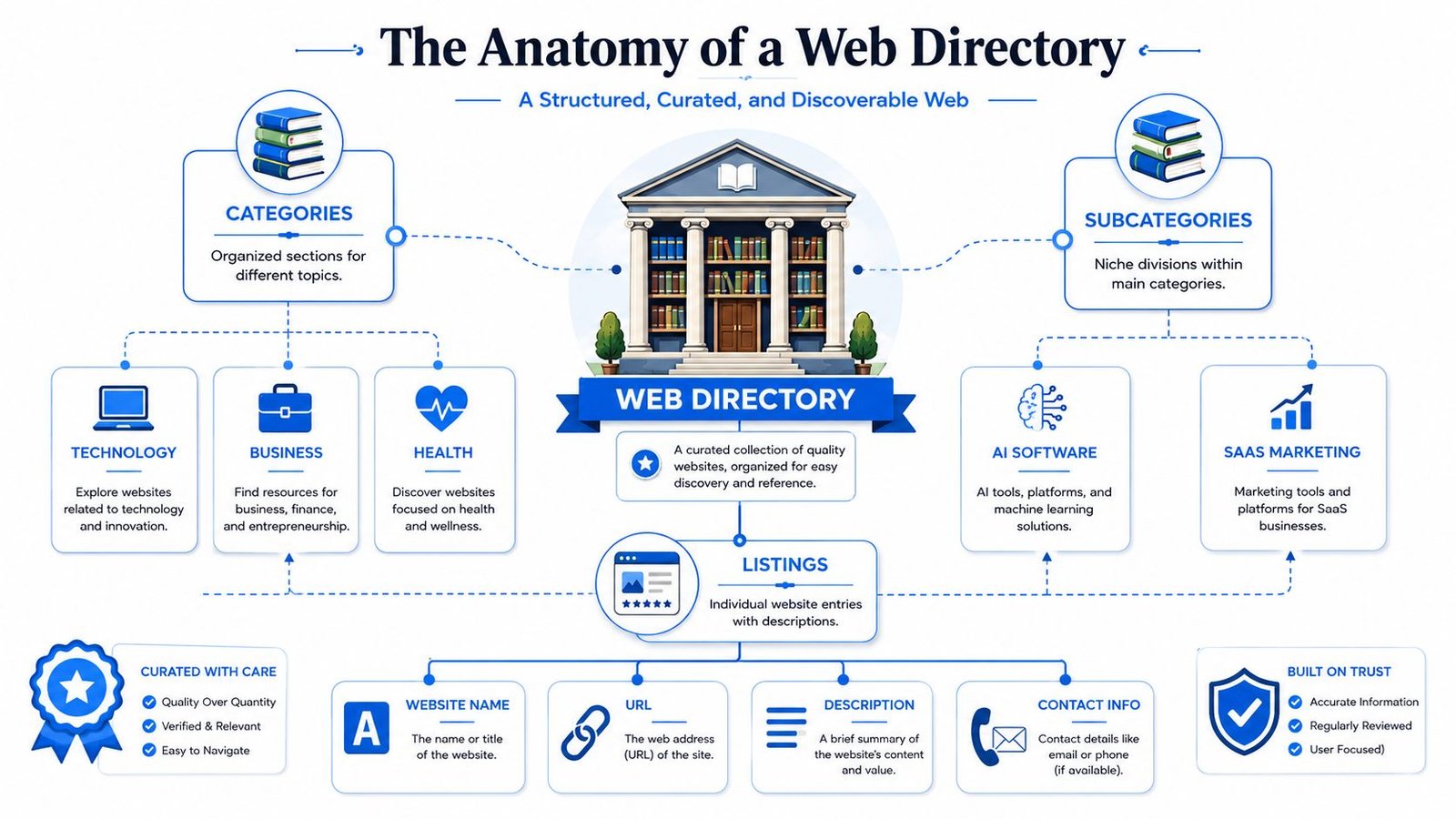
Think of a web directory like a library card catalog. A person places each item into a logical shelf, section, and topic path. A search engine is closer to full-text search across every book in the building.
That distinction matters because it changes how users discover you. In a search engine, a page competes algorithmically against a huge index. In a directory, a site earns visibility through category placement, listing quality, and editorial fit.
How a directory differs from a search engine
A directory is built top-down. Someone defines categories, subcategories, and inclusion rules first. Websites get added into that structure later.
A search engine works bottom-up. It crawls, indexes, and ranks pages based on algorithmic systems. It doesn't need an editor to decide that one site belongs in “B2B CRM” and another belongs in “Email Deliverability.”
That's why directories usually focus on whole websites rather than individual pages. They often include more than a URL too. A listing may have a title, short description, business details, and a category path that tells users where the site belongs.
What a listing usually contains
Most directories share a similar skeleton:
Category placement
This is the most important structural element. A strong listing lives in the right section, not just somewhere on the site.Site title and URL
Basic, but still useful. The directory is identifying your brand as an entity, not just dropping a random link.Description field
Many submissions fail in this area. Generic copy wastes the listing. The description should explain what the product does, who it serves, and how it differs.Business details
Some directories include contact information, locations, pricing notes, product type, or integrations.Review or approval workflow
Better directories usually gate submissions through human review, which helps filter out junk.
Here's the practical split organizations should understand:
| Directory trait | What it usually signals |
|---|---|
| Clear categories | Better user navigation and stronger topical fit |
| Human review | Editorial control |
| Descriptive listings | Real discovery value |
| Loose acceptance standards | Lower trust |
| Endless unrelated categories | Weak topical focus |
A directory becomes useful when the category structure matches the way buyers actually shop.
In other words, asking “what is web directory” isn't enough. You also need to ask whether the taxonomy is thoughtful, whether the listings are curated, and whether the site helps a user make a decision.
A Brief History of Finding Things Online
Directories started as a user product, not an SEO tactic.
When directories led the web
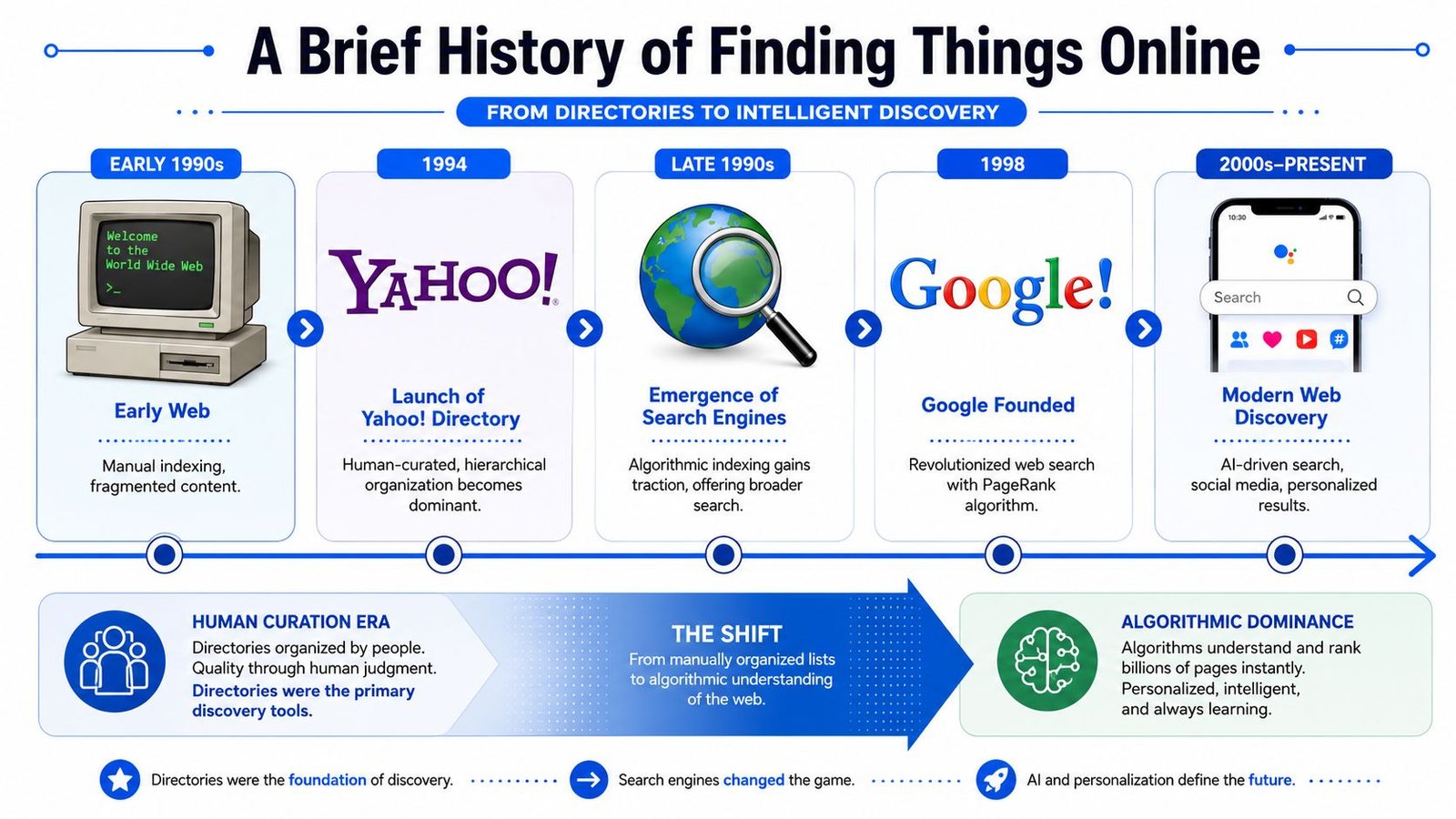
In the early web, search quality was limited and the index was incomplete. Curated directories filled that gap by organizing sites into browseable topics, then narrower subtopics, so users could reach a relevant website without guessing the right query.
Yahoo! Directory became the best-known example of that model and stayed relevant for years because manual curation solved a real discovery problem. The value was simple. Editors sorted the web for you.
That approach worked while the web was small enough for humans to keep up. It also created an early version of what SaaS buyers still want today: a filtered list of options inside a category they already understand.
Why the model lost ground
Search engines improved faster than directories could. They indexed more pages, handled long-tail queries better, and returned results with less friction than browsing a nested category tree.
Marketers then made the problem worse. Once directory links started affecting rankings, thousands of low-quality sites copied the format without keeping the editorial standards that made directories useful in the first place. Categories got bloated. Review disappeared. Listings existed to pass links, not to help a buyer choose.
That distinction still matters if your team is evaluating directories in 2026. The decline came from generic, low-trust directories losing their purpose. Curated discovery did not disappear. It narrowed.
I still treat directories as part of white hat link building for SaaS brands only when they help a real buyer compare vendors in a defined market. That is the practical lesson from the history. Broad web catalogs faded. Focused directories with clear audiences kept a place because they serve a concrete commercial use case.
So the historical question is not whether directories "worked." They did. The better question is why some stopped working. Once you answer that, the modern screening criteria become much clearer.
The Modern Link Building Value and Risks
Directory links still sit in a gray area for many teams because the answer isn't “always good” or “always bad.” The key issue is selectivity.
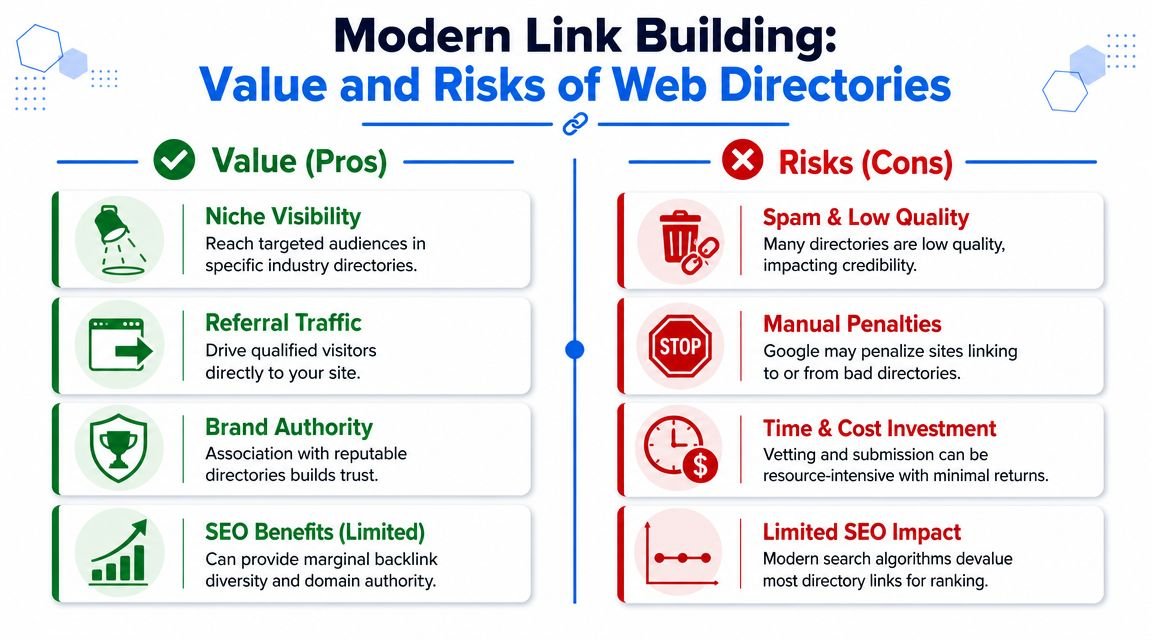
From an SEO perspective, the technical distinction is that directories are curated by humans rather than ranked by a search algorithm, so inclusion can signal editorial review and relevance. LinkAssistant's web directory explanation also notes that value is concentrated in niche, well-maintained directories with strong topical alignment, which is especially relevant for SaaS and eCommerce.
Where directories still create value
The best use cases are surprisingly narrow, which is why they still work.
A niche SaaS directory can help a buyer discover tools inside a category they already understand. A local or industry-specific directory can reinforce entity validation and trust. A respected partner or association directory can put your brand next to other credible businesses.
That value usually shows up in three forms:
Qualified referral traffic
Visitors arriving from a category page often have more context than general search users. They're already browsing a narrowed set of options.Brand credibility
A listing on a curated, relevant platform can support the way buyers verify vendors.Link profile diversity
Not as a numbers game, but as a side effect of being listed where your company logically belongs.
For teams building links conservatively, this is close to white hat link building. You're not manufacturing a mention out of nowhere. You're placing the business into a relevant catalog where users expect to find it.
Where teams get into trouble
The failure mode is easy to spot once you know what to look for. Marketers chase directories for the backlink alone, ignore quality, and submit to every generic site that accepts a URL.
That approach creates several risks:
Weak editorial signals
If every submission gets accepted instantly, the link means very little.Spam association
If the directory is packed with junk listings, casino pages, spun descriptions, or broken categories, your brand inherits some of that context.Wasted team time
Submission work adds up fast, especially when legal, product marketing, or partnerships teams need to review descriptions.Policy risk
Google has repeatedly warned against links intended to manipulate rankings, and directory links are not exempt when the intent is artificial.
If the directory's main customer is the submitter rather than the end user, treat it as a warning sign.
The operational question isn't whether a directory link can help. It's whether the directory deserves to exist even if backlinks had zero ranking value. If the answer is yes, it may be worth testing. If the answer is no, skip it.
A Practical Framework for Directory Vetting
Most SaaS teams don't need a giant list of directories. They need a filter that eliminates bad opportunities quickly and identifies the few that deserve attention.
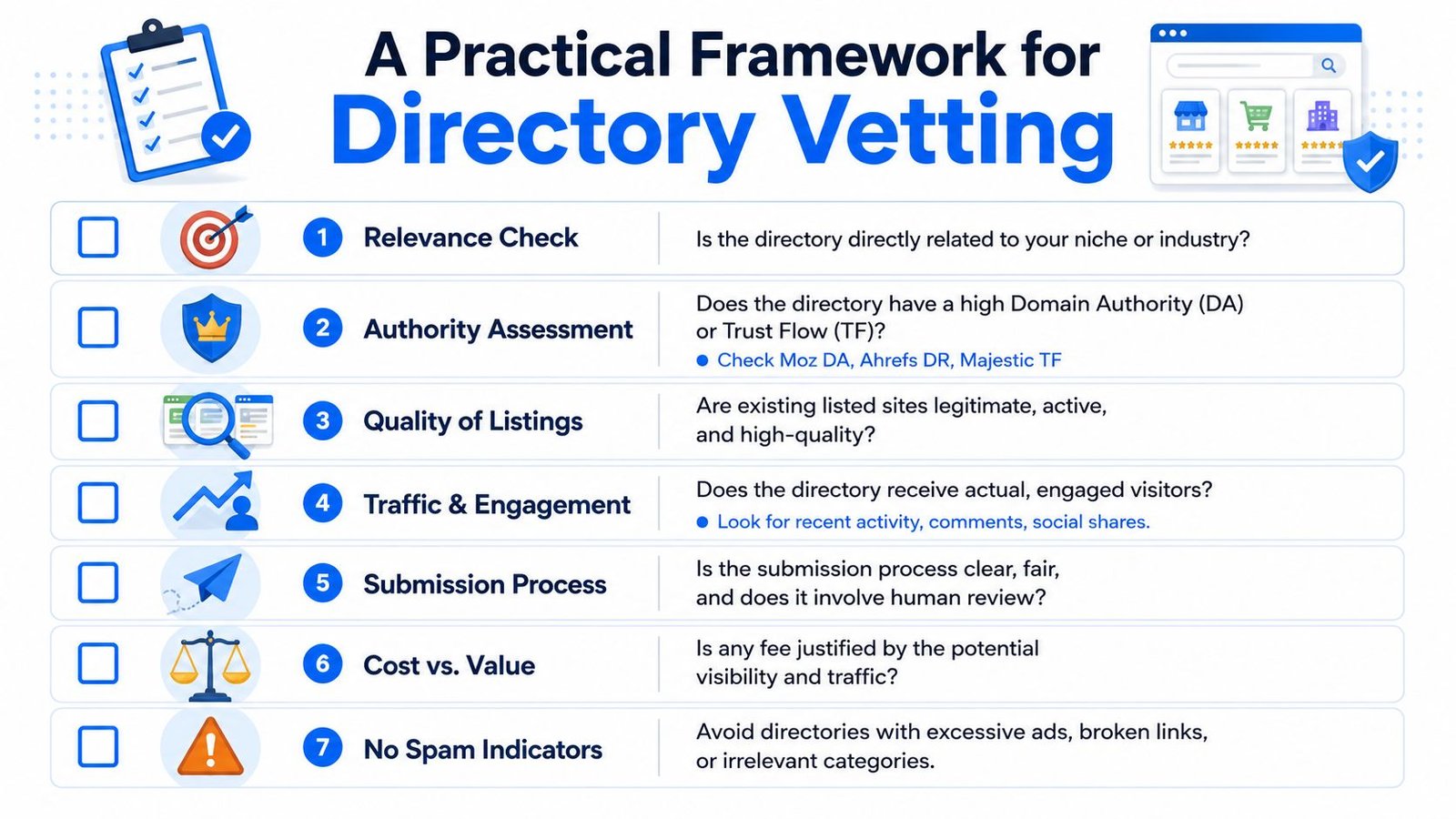
As Sitechecker's discussion of directory websites puts it, the key issue is quality, relevance, and editorial control. Human-curated niche directories can send referral traffic and help users find credible businesses, while mass-submission directories can look manipulative or low-value.
The first pass screen
Use a quick triage before anyone on your team spends time preparing copy.
Check topical fit first
If the directory isn't clearly relevant to your software category, buyer segment, region, or industry, move on. Broad “business directory” sites rarely justify the effort for SaaS unless local discovery is a real growth motion.Look at the category tree
Good directories have clean structure. You should be able to predict where your company belongs. If categories feel random, stuffed, or absurdly broad, the site probably isn't curated well.Open existing listings
This is one of the fastest ways to spot quality. Are listed companies legitimate and active? Are descriptions unique? Do pages look maintained?
Field note: A directory full of expired domains, thin profiles, and irrelevant businesses usually tells you everything you need to know in under five minutes.
The deeper review before submission
Once a directory passes the first screen, review it more carefully.
Here's the checklist I'd use:
Human review standards
Read the submission guidelines. Is there an approval process? Does the site explain what qualifies for inclusion? Editorial friction is good here.User experience quality
You don't need a perfect design, but the site should be navigable, current, and functional. Broken pages, overloaded ads, and obvious neglect are red flags.Listing depth
Can you add a meaningful description, product category, business details, and differentiators? Richer listings usually create more discovery value than a bare URL.Traffic intent
You may use tools like Ahrefs, Semrush, Similarweb, or first-party referral data if you have access, but the core question is simpler. Does this site appear built for real users who are comparing providers?Cost logic
Some directories charge for review, placement, or premium visibility. A fee isn't automatically bad. The issue is whether you're paying for audience access and editorial maintenance, or just buying a link.
A useful support check during review is understanding whether the listing link is follow or nofollow. That shouldn't decide the opportunity by itself. A nofollow listing can still send qualified traffic and support trust. But if a site charges aggressively while offering little user value, link attributes won't save the economics.
A simple accept or reject table
| Question | Good sign | Bad sign |
|---|---|---|
| Is it relevant to your market? | Clear niche or buyer fit | Generic catch-all |
| Is there human review? | Guidelines and moderation | Instant approval |
| Are current listings credible? | Real companies, useful descriptions | Spam, thin content |
| Is the site maintained? | Working pages, clear taxonomy | Broken links, clutter |
| Would you still want the listing without SEO value? | Yes | No |
If you can't defend the listing as a discovery channel, don't submit.
Directory Examples for SaaS and eCommerce Brands
The term “web directory” makes many people think of old-school website lists. In practice, the strongest examples for SaaS and eCommerce often look more modern than that.
What counts as a directory today
For SaaS, software review and comparison platforms such as G2 and Capterra function like high-intent directories. They categorize vendors, structure discovery around use cases, and help buyers compare options. They're not useful because they contain a link. They're useful because they sit near the decision point.
Other strong examples include:
Industry-specific software catalogs
Martech directories, HR tech listings, or security vendor indexes can be valuable when they map closely to your ICP.Association and partner directories
If your company belongs to a trade group, certification body, or integration ecosystem, that listing often supports both discovery and trust.Marketplace-style eCommerce directories
For eCommerce brands, supplier networks, wholesale directories, and curated shopping guides can matter when buyers browse by product category rather than keyword.
How to think about ROI in 2026
The right ROI model is not “How many directory links can we get?” It's “Which listings can produce measurable business value with low downside?”
That usually means scoring each opportunity against a few practical outcomes:
- Referral quality instead of raw visits
- Sales-assist value if buyers mention the platform during evaluation
- Category visibility when your brand needs to appear in comparison sets
- Trust reinforcement for newer companies that need third-party validation
For some brands, the answer will be a small handful of high-fit directories and nothing else. That's fine. Directory strategy works best when it stays selective.
If your team wants a partner that treats link acquisition with that level of scrutiny, SaasSky helps SaaS and eCommerce brands build practical, low-risk link strategies with transparent pricing, real case studies, and a clear path to contact.