A digital marketing agency is an external team that plans, executes, and measures online promotion across channels like search, social, email, display, and content. The category exists because digital advertising became too large and too complex to manage casually, with worldwide digital ad spend reaching $485 billion in 2023 and $526 billion in 2024, with projections as high as $786.2 billion in 2026 according to WordStream's digital marketing statistics roundup.
If you're reading this, you're probably in one of two situations. Growth has stalled and your team is guessing which lever to pull next, or revenue is moving but your acquisition machine feels fragile because too much depends on one person, one channel, or one lucky campaign. In both cases, the question isn't just what is a digital marketing agency. It's whether an agency can become a useful growth lever for your business, or whether it will just add meetings, decks, and spend.
For SaaS and eCommerce companies, that distinction matters. A good agency isn't just a vendor that posts on social or runs some ads. It's an external operating team that brings channel expertise, measurement discipline, and execution capacity that your internal team may not have yet. Just as important, it's not the same thing as a broader digital agency. One is built to improve traffic, pipeline, and sales efficiency. The other may be built to design, brand, and ship digital experiences.
Table of Contents
- Defining a Digital Marketing Agency Beyond the Buzzwords
- The Core Service Stack What They Actually Do
- Agency Engagement and Pricing Models
- When and Why to Hire an Agency for Your SaaS or eCommerce
- A Look Inside a Specialist Playbook The Link Building Example
- How to Vet and Choose the Right Agency Partner
Defining a Digital Marketing Agency Beyond the Buzzwords
Monday morning, pipeline is light, paid spend is creeping up, and nobody on the team can say which channel is still producing efficient growth. That is the moment founders start looking for a digital marketing agency.
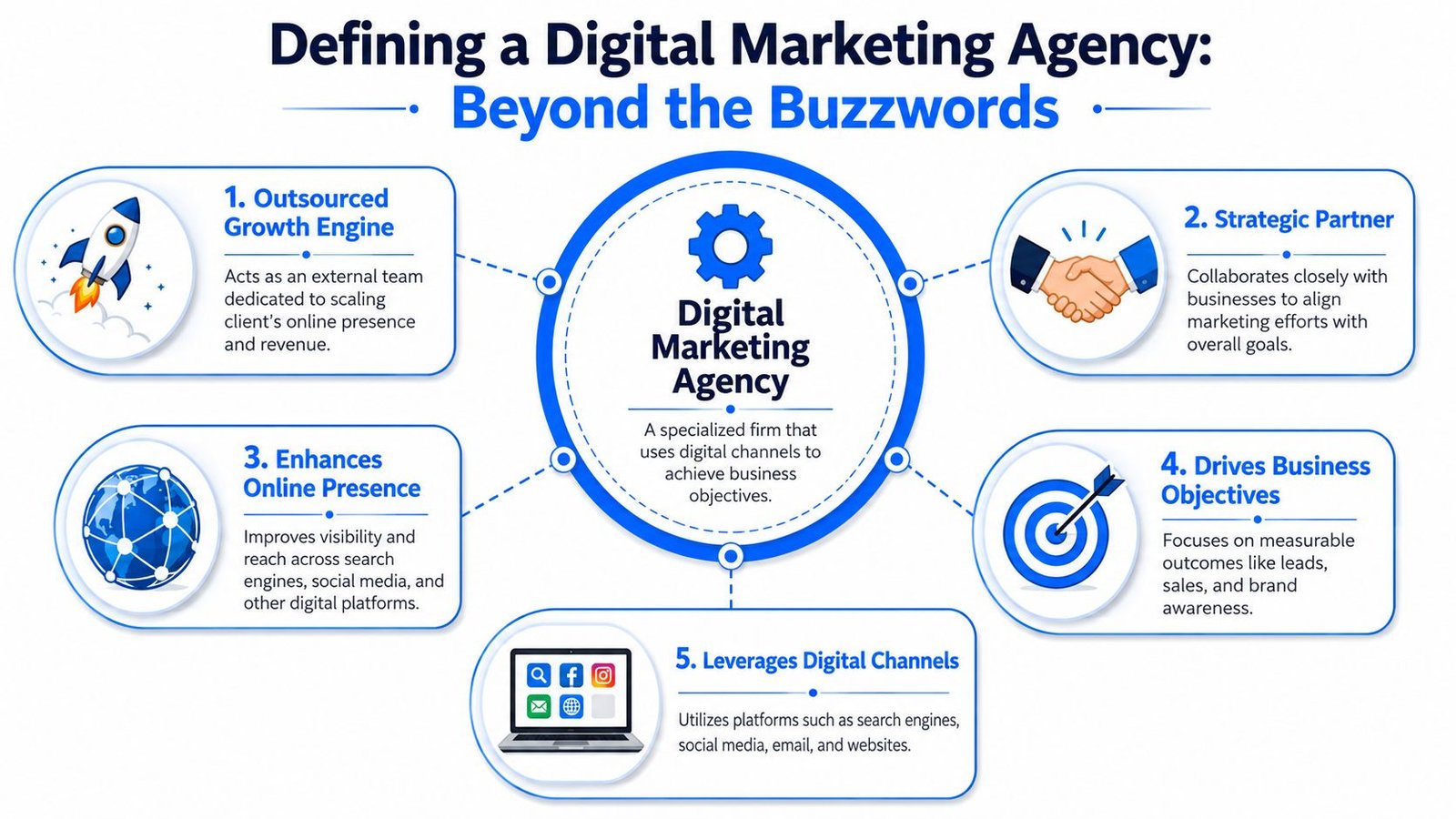
A digital marketing agency is an outside team hired to improve customer acquisition through online channels and prove the result in business terms. For SaaS and eCommerce companies, that usually means more than running campaigns. It means helping the company find the actual constraint in the funnel, fix it, and measure whether the fix improved revenue, payback, or margin.
The useful definition is operational, not promotional. A good agency owns a slice of growth performance. It should be able to answer questions like: Where are qualified visitors coming from? Which campaigns lead to demos, trials, purchases, or repeat orders? Which spend is inefficient? What should change this week based on the numbers?
What the term should mean in practice
Most definitions stop at "a company that markets businesses online." That tells a founder almost nothing.
A better definition is this: an agency is a growth operator outside your payroll. It brings execution across channels, a measurement system that ties activity to outcomes, and enough judgment to prioritize the next bottleneck instead of spreading effort across ten low-impact tasks.
In practice, that usually includes:
- Channel execution: SEO, paid search, paid social, lifecycle email, content, and campaign launches.
- Measurement discipline: tracking traffic, click-through rate, conversion rate, customer acquisition cost, return on ad spend, and customer lifetime value, as outlined in Stape's overview of digital marketing analytics.
- Optimization cadence: reviewing performance on a fixed schedule and reallocating budget or effort based on results.
- Strategic prioritization: deciding whether the biggest problem is traffic quality, conversion rate, retention, creative fatigue, weak landing pages, or poor attribution.
Practical rule: If an agency cannot connect channel work to pipeline, revenue, or margin, it is a task vendor, not a growth partner.
That distinction matters because agency value rarely comes from doing more activities. It comes from doing the right work in the right order. A SaaS company with weak demo-to-close rates does not need more top-of-funnel traffic first. An eCommerce brand with strong conversion and poor new-customer volume may need media buying help before it needs another content calendar.
Where founders get confused
A common hiring mistake is treating a digital agency and a digital marketing agency as the same category. They are not. Upwork's explainer on digital marketing agencies lays out the distinction clearly: digital marketing agencies focus on channels such as SEO, paid media, email, content, social, and analytics, while digital agencies may also handle website design, development, UX, branding, and digital products.
That difference changes the brief, the budget, and the expected outcome.
A digital agency is usually the broader build partner. It may redesign your site, sharpen the brand, or improve UX. A digital marketing agency is the performance partner. Its job is to improve acquisition efficiency and help the business get more revenue from digital channels.
For founders, the easiest test is to look at the bottleneck. If the company is pre-launch, repositioning, or rebuilding the site, a broader digital agency may fit better. If the product, store, and site already exist but growth is stalling, you usually need marketing specialization tied to a measurable constraint such as weak lead flow, expensive paid acquisition, low organic visibility, or poor lifecycle conversion.
That is also why agencies became part of the operating model for many internet-first companies. As spend, channels, tracking, and creative complexity increased, many teams needed specialists who could go deeper than an in-house generalist. It's not merely about complexity for its own sake. It is that online marketing now affects a large share of growth, so outside specialists often sit close to revenue decisions, not just campaign execution.
The Core Service Stack What They Actually Do
A founder usually hires an agency after something breaks in the growth model. Paid spend rises but CAC does not improve. Traffic grows but pipeline stays flat. The useful question is not which services an agency sells. It is which constraint they can remove.
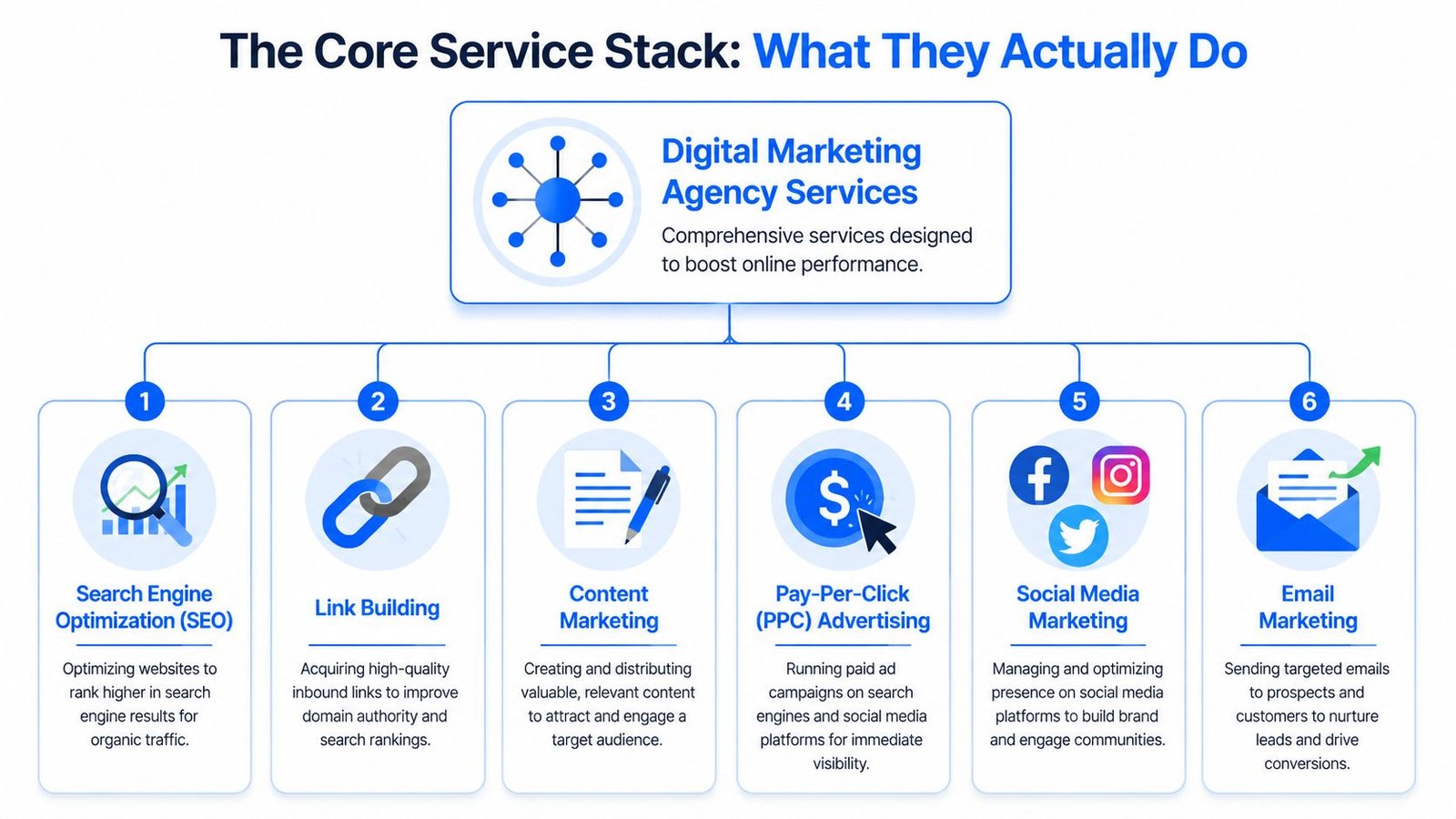
The core stack is usually some mix of SEO, link building, content, PPC, email, and analytics with CRO. On paper, that looks like a standard menu. In practice, each service plays a different role in the economics of growth. Good agencies know which channel creates demand capture, which one buys speed, which one lifts conversion, and which one gives the team trustworthy measurement.
The channels that usually matter
Here are the services that tend to matter most for SaaS and eCommerce teams.
SEO for durable demand capture
SEO helps the business win traffic from buyers who are already looking for a solution. In SaaS, that often means comparison terms, integration pages, use-case pages, and problem-aware content. In eCommerce, it usually means category pages, product pages, and commercially relevant informational queries. The trade-off is speed. SEO compounds over time, but it rarely fixes this quarter on its own.Link building for authority
Many agencies roll this into SEO, but that often hides whether they can move competitive rankings. Strong link building supports the pages that matter most to revenue, not just any URL that is easy to promote. It also needs editorial judgment. A pile of irrelevant links can waste budget or create risk. If this is the bottleneck, it helps to benchmark against the average cost for SEO services so pricing matches the difficulty of the market.Content marketing for intent matching
Content earns its keep when it closes the gap between what a buyer searches and what your site helps them do next. That includes product-led education, landing pages, comparison pages, migration pages, buyer guides, and post-signup content. Publishing more is not the goal. Building pages that pull qualified visitors toward signup, demo, or purchase is.PPC for speed and controlled testing
Paid search and paid social are useful when the company needs immediate distribution, faster feedback loops, or coverage in markets where organic visibility is weak. The upside is control. You can test offers, audiences, and landing pages quickly. The downside is just as clear. Poor conversion rates, weak creative, or loose targeting will show up in CAC fast.Email marketing for monetization and retention
Email often has the clearest path to revenue because the audience already knows the brand. For SaaS, that usually means trial activation, onboarding, expansion, and reactivation. For eCommerce, it means abandoned cart recovery, replenishment, repeat purchase flows, and campaign sends tied to margin and inventory.Analytics and conversion work for decision quality
Here, weak agencies get exposed. If attribution is messy, event tracking is broken, or reporting stops at channel-level vanity metrics, the team cannot tell what is creating revenue. Good agencies fix measurement, test landing pages, and help the company decide where the next dollar should go.
How the stack works as a system
The strongest agencies do not treat channels as separate departments fighting for credit. They run them as one acquisition system tied to revenue.
| Service | Primary job | Metric it should influence |
|---|---|---|
| SEO | Capture existing demand | Organic conversion volume, pipeline quality |
| Link building | Strengthen ranking ability | Visibility of priority pages, non-brand growth |
| Content | Match intent and educate buyers | Assisted conversions, influenced revenue |
| PPC | Buy immediate attention and test offers | CAC, ROAS, lead quality |
| Convert and retain existing demand | Activation, repeat purchase, expansion revenue | |
| Analytics and CRO | Improve decision quality | Conversion rate, attribution accuracy |
That last line matters more than agencies like to admit. If reporting does not change budget allocation, creative direction, or funnel priorities, it is not operating work. It is documentation.
A good agency earns its place by connecting these services to the business model. In SaaS, that might mean using paid search to validate messaging, SEO to lower blended CAC over time, and lifecycle email to improve trial-to-paid conversion. In eCommerce, it might mean using paid social to create demand, SEO to capture high-intent category traffic, and email to raise repeat purchase rate. Same stack. Different growth logic.
That is how founders should read the service menu. Not as a checklist, but as a set of tools for removing specific growth bottlenecks.
Agency Engagement and Pricing Models
A lot of agency frustration starts before the work begins. The underlying problem isn't usually price alone. It's a bad match between pricing model and business need.
Three ways most engagements are structured
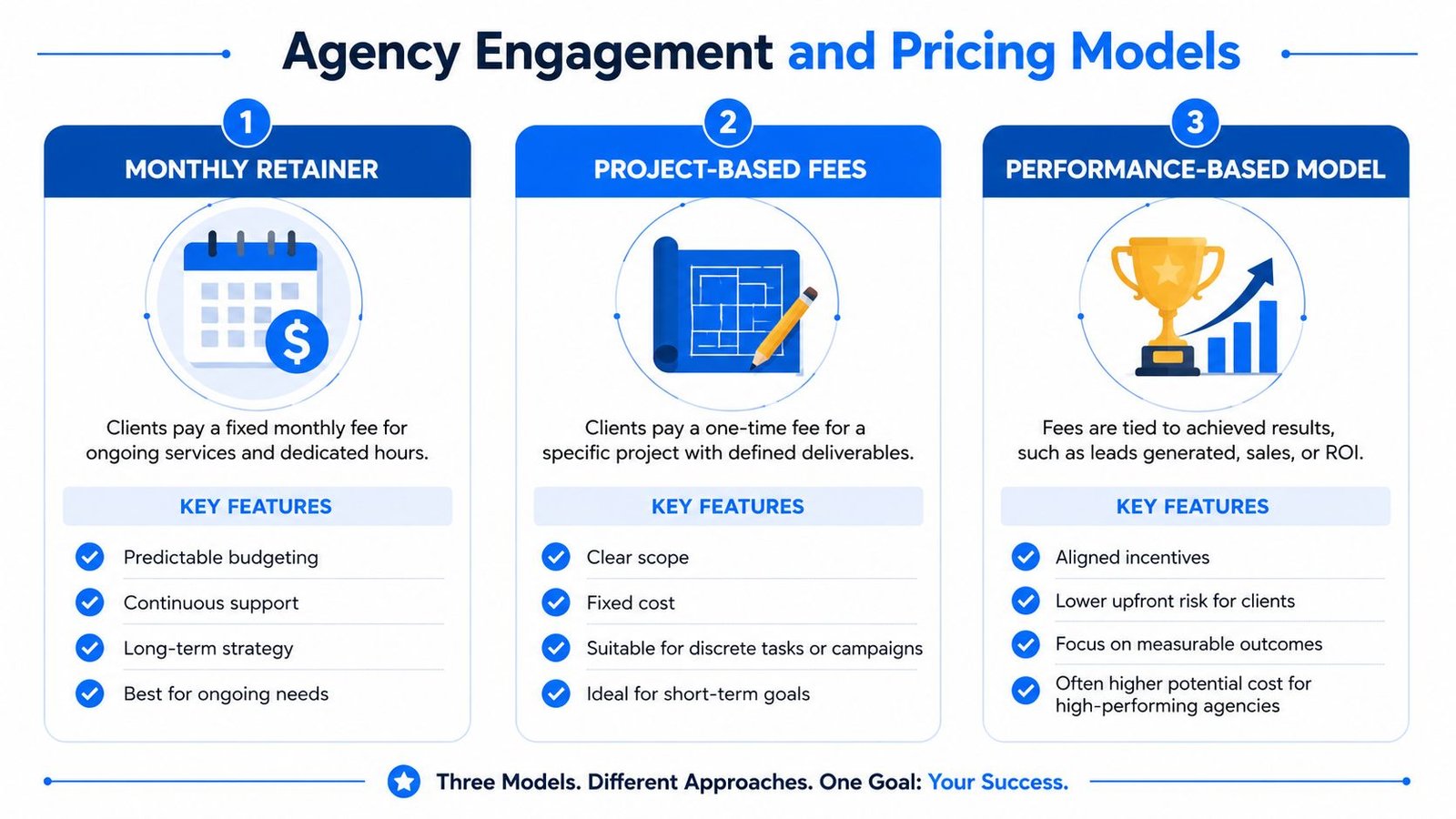
The three common models are retainers, projects, and performance-based agreements.
| Model | Best For | Pros | Cons |
|---|---|---|---|
| Monthly retainer | Ongoing growth programs | Predictable workflow, deeper partnership, continuous optimization | Can feel expensive if scope is vague |
| Project-based fees | Defined one-off work | Clear deliverables, easier budgeting, useful for audits or migrations | Stops when project ends, limited continuity |
| Performance-based model | Businesses with strong tracking and clear outcome definitions | Incentives can align around results | Often hard to structure cleanly, can create disputes over attribution |
UK agencies commonly quote retainers in the £3,000–£15,000+ range depending on scope, according to White Hat SEO's breakdown of what agencies do. That's useful not because every business should pay that range, but because it shows how quickly costs expand when you ask for strategy, execution, reporting, and specialist capability across multiple channels.
How to choose the least painful model
For most SaaS and eCommerce brands, here's the practical fit:
- Choose a retainer when you need an ongoing growth function. This works best when acquisition is already a priority and you want the agency embedded in planning, reporting, and weekly decisions.
- Choose a project when the problem has edges. A technical SEO cleanup, analytics implementation, content audit, account restructure, or website migration fits here.
- Choose performance pricing only if both sides agree on attribution, time lag, lead quality definitions, and excluded variables. Otherwise everyone argues about what "performance" means.
AI-powered search is also changing agency scope, as noted in the White Hat SEO article above. That matters because channel complexity affects pricing. An agency that's handling traditional search, paid acquisition, analytics, and emerging search surfaces is doing materially different work from one that's just posting content and sending a monthly report.
If you're trying to estimate SEO-specific budget expectations, this guide to the average cost for SEO services is a useful planning reference.
The wrong pricing model creates the wrong behavior. Retainers can hide drift. Performance deals can reward short-term wins at the expense of long-term value. Projects can leave execution gaps after the handoff.
When and Why to Hire an Agency for Your SaaS or eCommerce
You log into the dashboard on Monday and see the same pattern again. Traffic is up a little, pipeline is flat, paid efficiency is slipping, and nobody can say with confidence which channel is creating revenue. At that point, hiring an agency is not about getting "more marketing." It is about fixing a specific growth constraint faster than you could by building the capability in-house.
That distinction matters.
An agency makes sense when the bottleneck is expertise, system design, or execution quality. If the work is clear and your team just lacks capacity, hire internally. If the team is debating basics, working from weak data, or patching together tactics without a coherent acquisition model, outside specialists can shorten the learning curve and reduce expensive trial and error.
The clearest signals that it is time
The best hiring trigger is a business problem with a measurable cost.
Growth has stalled after early traction
You have proof the product can sell, but acquisition is no longer improving from month to month. In SaaS, that often shows up as flat demo volume or stagnant self-serve signups. In eCommerce, it looks like rising acquisition costs without enough new customer growth to justify them.A channel matters, but nobody on the team fully owns it
This happens a lot with SEO, lifecycle, paid search, and attribution. Work gets done, but no one is setting strategy, prioritizing experiments, or tying channel performance back to revenue and payback period.The internal hire plan is too slow for the problem
Building a capable growth team takes time. You need recruiting, onboarding, channel knowledge, management, and reporting discipline. An agency can give you a functioning team faster, especially if the problem spans multiple specialties.You need specialist help for a narrow bottleneck
Sometimes the answer is not a full-service firm. It is one specialist who can solve one problem well. Link acquisition is a good example. If authority is holding back rankings on money pages, a team with a defined white hat link building process can move the metric that matters instead of adding more top-of-funnel content and hoping for lift.You have data, but not decision-grade measurement
Founders often have plenty of dashboards and very little clarity. If CAC, conversion rates, assisted revenue, or channel contribution are being argued over every week, the first win from an agency may be a measurement system you can trust.
Why founders hire too late
The usual reason is understandable. They want to prove the team can solve it internally first.
Sometimes that discipline is healthy. Sometimes it turns into hidden cost. The team spends six months testing tactics, the channel falls behind competitors, and the business loses time it cannot recover. In SaaS, that can mean slower pipeline growth while sales capacity sits underused. In eCommerce, it can mean missing seasonal demand because the category pages, feeds, and conversion paths were never properly tuned.
The better question is simple. What is the cost of waiting compared with the cost of competent execution now?
When an agency will not help much
Agencies are multipliers. They are weak substitutes for product clarity.
If your positioning is vague, retention is poor, margins are broken, or the site cannot explain the offer, an agency will struggle to create durable growth. Good partners can diagnose those issues quickly and keep you from wasting budget, but they cannot paper over weak fundamentals.
This is why the smart way to hire is to define the job in business terms first. Reduce blended CAC. Increase qualified demo volume. Grow non-brand pipeline. Improve new customer revenue from organic category traffic. Once the target is clear, you can decide whether you need a full agency, a specialist, or an internal operator.
A good agency should plug into your model, not sit beside it. For SaaS, that means understanding funnel stages, lead quality, sales cycles, and payback. For eCommerce, it means knowing margin structure, merchandising, repeat purchase behavior, and the difference between revenue growth and profitable growth.
The hiring trigger is not "we need help with marketing." It is "we know where growth is constrained, and outside expertise can fix it faster, with a better return than building from scratch."
A Look Inside a Specialist Playbook The Link Building Example
Link building is a good example of where founders often buy the wrong thing.
Many generalist agencies say they do link building. What they often mean is basic outreach, a few directory placements, or occasional guest posting with no clear tie to business goals. That can produce activity without producing movement.
Why link building exposes the difference between generalists and specialists
A specialist starts from the ranking problem, not from the deliverable.
For a SaaS company, that may mean a competitor outranks you for bottom-funnel comparison terms because its commercial pages have stronger authority. For an eCommerce brand, it may mean category pages never break through because supporting content and external authority are thin. In both cases, the issue isn't "we need more links" in the abstract. The issue is that priority pages aren't competitive enough.
A useful playbook usually includes:
- Competitor gap analysis: which domains link to competing pages and why
- Target page mapping: which commercial or high-intent pages need authority support
- Asset strategy: what content or resources are worth pitching
- Prospect qualification: who is relevant, not just reachable
- Outreach execution: messaging that sounds human and editorial, not automated
- Impact review: whether links help the pages that matter
What a real playbook looks like
Specialist partners earn their keep. They know that not every link has the same value, not every page deserves promotion, and not every outreach list is worth touching.
A mature campaign often combines editorial judgment with SEO prioritization. It asks whether the target page can convert, whether the anchor and context make sense, and whether the referring site is relevant to the buyer journey. That's very different from buying a package and counting placements.
If you're trying to understand what specialist execution in this area looks like, this overview of white hat link building is a useful benchmark for the process and standards to expect.
Good link building doesn't start with outreach. It starts with deciding which ranking gains would matter to the business.
How to Vet and Choose the Right Agency Partner
Most agencies are easy to like in a sales call. That's the problem. The wrong partner can sound polished, show attractive dashboards, and still leave you with weak execution and muddy accountability.
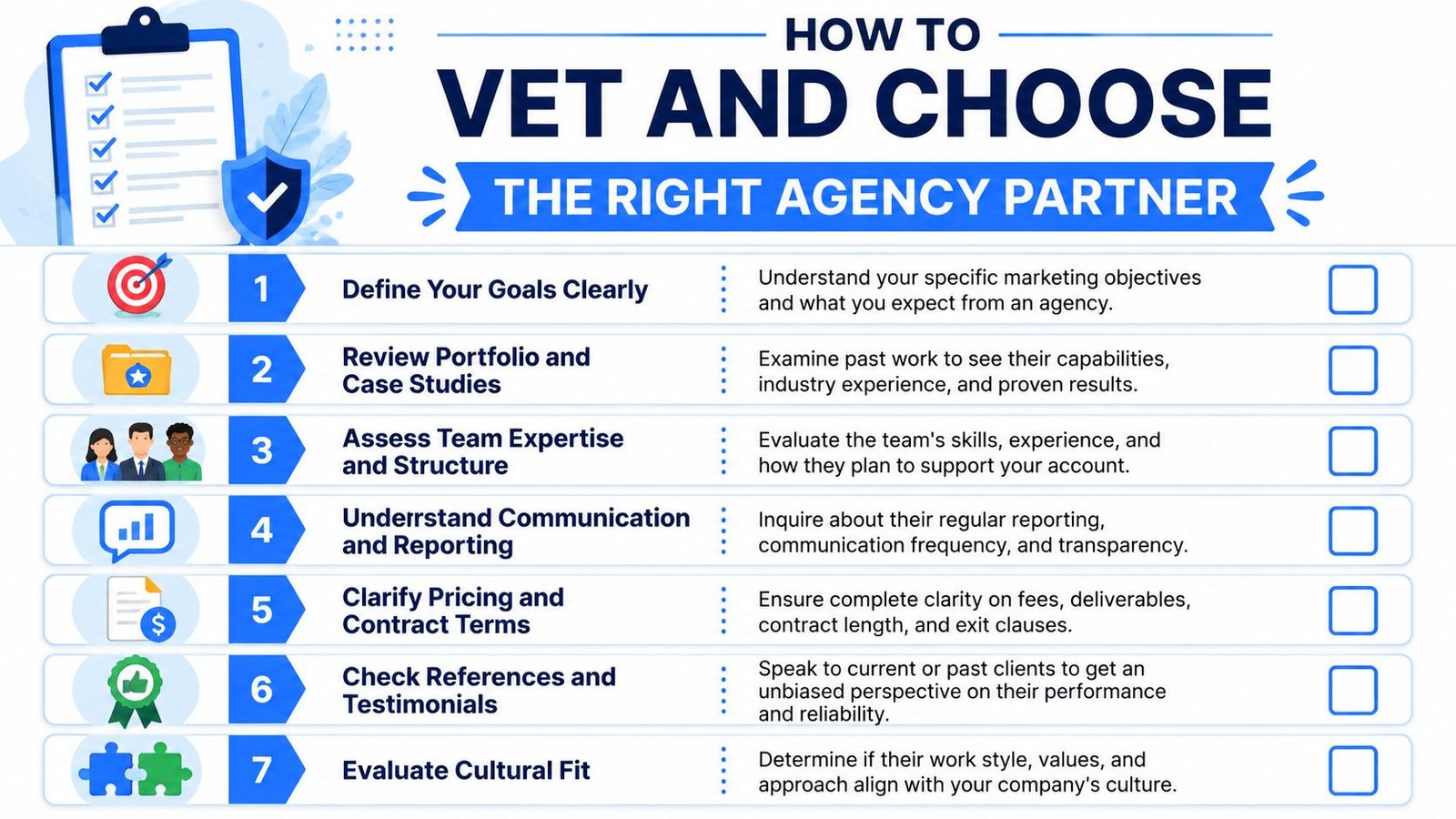
The short checklist that saves you from the wrong hire
Strong agencies differ less by how many services they list and more by how they define success, capture data, and make decisions. ProjectCor's guidance on data-driven agencies puts it well: high-performing agencies define KPIs, track everything, and turn raw metrics into actionable insight rather than vanity metrics.
Use that as your filter.
- Ask how they set KPIs: If they jump straight to impressions, clicks, or follower growth, keep pushing.
- Ask what they need access to: Serious operators want analytics, CRM visibility, ad accounts, historical performance, and sales feedback.
- Ask who does the work: Sales teams often promise senior thinking while junior staff execute everything.
- Ask how often they change strategy: You want responsiveness, not random motion.
- Ask what happens if a channel underperforms: Look for a decision process, not excuses.
Questions that reveal how they actually work
These questions are better than "What services do you offer?"
What would you audit in the first 30 days, and why?
This shows whether they can prioritize.How do you decide whether a problem is traffic, conversion, or offer?
Good agencies diagnose before prescribing.Which metrics would you report weekly, and which ones belong in a monthly review?
This exposes whether they understand operating cadence.How do you connect channel performance to pipeline or revenue quality?
Especially important for B2B SaaS.What do you need from our internal team for this to work?
The best agencies know the client has to participate.What does failure look like early, and how would you respond?
You want honesty here, not confidence theater.Can you show work relevant to our motion?
SaaS self-serve, sales-led SaaS, and eCommerce all need different playbooks.
If you need a benchmark for what a focused specialist partner in online retail looks like, reviewing an eCommerce SEO agency approach can help you compare process, transparency, and fit.
The best agency relationships feel boring in the right way. Clear goals. Clean reporting. Fast feedback loops. Few surprises. Steady improvement.
If you're a SaaS or eCommerce team that needs specialist support on organic growth, SaasSky is worth a look. The company focuses on link building for SaaS and eCommerce brands, with transparent pricing, practitioner-led execution, and case-study-driven thinking that makes it easier to judge fit before you commit.