You've probably already felt the failure mode.
Your team has a spreadsheet full of target keywords, a backlog of blog ideas, a few product pages that rank for the wrong terms, and pressure from leadership to show how content contributes to pipeline. Traffic might be moving, but sign-ups, demos, and revenue still feel disconnected from the content plan.
That's where most first-time content gap analysis projects go off course. Teams treat the exercise like a keyword export. They compare domains, pull missing terms, assign briefs, and publish into a vacuum. Rankings may improve, but the business case stays fuzzy.
For SaaS and eCommerce, a useful content gap analysis has to answer a harder question: which gaps are blocking revenue, not just traffic? That means looking at missing topics, weak pages, and funnel coverage at the same time.
Table of Contents
- Beyond Keywords Finding Revenue Gaps in Your Content
- The Practitioner's Toolkit and Data Sources
- A Three-Lens Audit for a Complete Picture
- How to Prioritize Gaps for Maximum Impact
- Activating Your Findings A Tale of SaaS and eCommerce
- Measuring Success and Building a Continuous Rhythm
Beyond Keywords Finding Revenue Gaps in Your Content
The usual definition of a content gap is too narrow. Teams often define it as “keywords competitors rank for that we don't.” That's useful, but it's incomplete. A page can win traffic and still fail the sales process. It can rank, attract visitors, and never help a buyer move closer to a decision.
A more useful definition is this: a revenue gap is an unaddressed customer question, objection, comparison point, or use-case that sits on the path to conversion. In SaaS, that might be a missing alternatives page, a weak integration page, or no content for a procurement objection. In eCommerce, it might be a thin category page that doesn't help buyers choose between product types, sizes, or features.
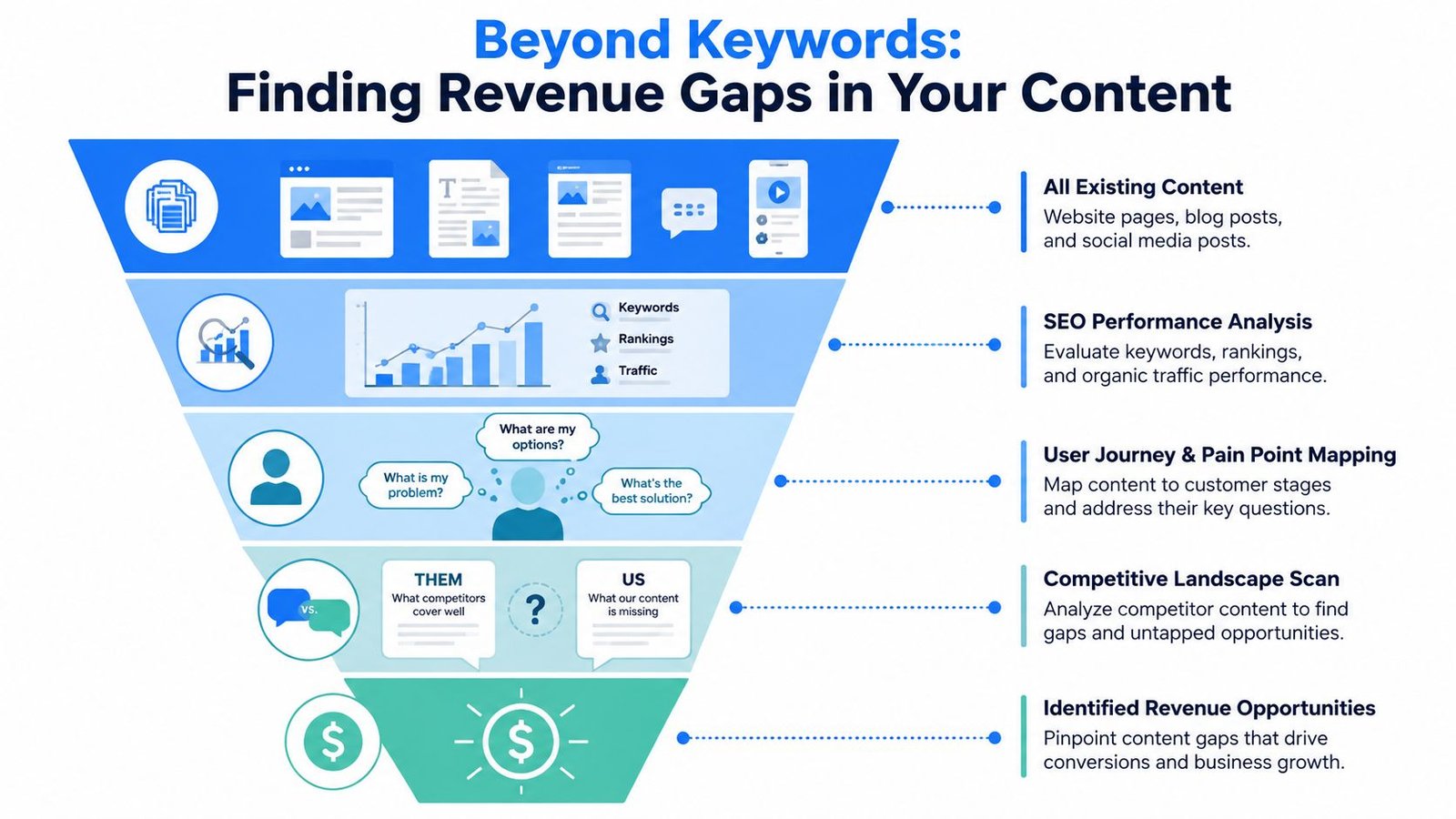
The business case for this shift is strong. A 2024 Forrester study on B2B tech found that companies that explicitly link content topics to specific deal stages and pipeline cohorts see 39% higher win-rate increases within six months than those that don't, and a HubSpot report found 68% of tech marketers struggle to show how content influences revenue according to Nightwatch's summary of content gap analysis and revenue alignment.
What revenue gaps look like in practice
A keyword gap says, “Competitors rank for project management software for agencies.”
A revenue gap asks different questions:
- Buyer stage: Is this query early research, vendor comparison, or purchase intent?
- Sales relevance: Does your sales team get this question on calls?
- Conversion path: Does the visitor have a clear next step after reading?
- Commercial fit: Does the topic attract your actual ICP or just broad traffic?
That's the difference between publishing for visibility and publishing for movement through the funnel.
Practical rule: If a topic can't be tied to a real buyer question, a product use-case, or a stage in the purchase journey, it probably belongs lower on your list.
Where teams waste effort
The biggest waste is overproducing awareness content because it's easier to brief and easier to justify with search volume. SaaS companies do this with generic educational posts. eCommerce brands do it with trend-driven blog content that never supports category or product discovery.
That doesn't mean top-of-funnel is bad. It means it needs a job. If a topic attracts the wrong audience, competes in a crowded SERP, and doesn't support sign-ups or assisted conversions, it isn't a priority gap. It's just available inventory.
A serious content gap analysis starts with rankings, but it ends with business impact. That changes what you collect, how you score opportunities, and which pages you build first.
The Practitioner's Toolkit and Data Sources
The right toolkit isn't “more SEO software.” It's a mix of external search intelligence and internal buyer intelligence. If you only use keyword tools, you'll find demand. You won't understand which demand matters.
The core stack
For most SaaS and eCommerce teams, the base layer is straightforward:
- Ahrefs or Semrush: Use one primary SEO platform for keyword gap reports, competitor top pages, backlink overlap, and topic cluster research.
- Google Search Console: Identify pages already getting impressions for adjacent queries. Those are often easier wins than net-new content.
- Google Analytics 4: Use it to compare landing page engagement and conversion paths. A page with traffic but weak assisted conversion value often signals an intent mismatch.
- A full URL inventory: Pull every indexable URL into a sheet with page type, funnel stage, target topic, last updated date, and owner.
Without that inventory, most audits turn into opinion battles.
The data sources most teams skip
The highest-value inputs usually sit outside the SEO toolset.
Sales and customer-facing data
Start with the sources that contain raw objections and buying language:
- CRM notes: Look for repeated blockers before deals move forward.
- Sales call transcripts: Comparison requests, migration fears, implementation questions, pricing friction, and stakeholder objections belong in your gap analysis.
- Customer support tickets: These reveal post-purchase confusion that can become pre-purchase enablement content.
- Onboarding questions: In SaaS, weak onboarding content often exposes missing middle- and bottom-funnel pages.
- Live chat logs: These show what visitors expected to find on the site but didn't.
A keyword tool shows search behavior. These sources show commercial intent.
Sales usually tells you where content is missing long before your rankings do.
Product and merchandising inputs
For SaaS, pull in product marketing docs, release notes, integration lists, and feature adoption themes. For eCommerce, review category hierarchies, filter logic, merchandising priorities, and return reasons.
That matters because some gaps aren't editorial. They're structural. A collection page might rank poorly because it lacks explanatory copy, comparison guidance, or internal links from supporting content. A SaaS feature page might underperform because it never addresses implementation, buyer role, or alternatives.
A simple view of what each source is for
| Source | Best for | What it helps you find |
|---|---|---|
| SEO platform | Competitive visibility | Missing topics, SERP overlap, authority gaps |
| Search Console | Existing traction | Queries where a page is close but incomplete |
| Analytics | Behavioral signals | Low-engagement or weak-converting content |
| CRM and sales calls | Commercial insight | Objections, proof needs, deal-stage questions |
| Support and chat logs | Friction points | Missing help content and weak pre-purchase education |
What not to do
Don't start with a giant keyword dump and force the rest of the business to react to it. That creates content no one in sales uses and no buyer remembers.
Also don't let one tool define the project. Content gap analysis works best when each source answers a different question. Search tools tell you what the market sees. Internal systems tell you what your buyers need. The overlap is where the best opportunities usually sit.
A Three-Lens Audit for a Complete Picture
A content gap audit fails when it produces a long keyword list and no clear path to pipeline or sales. That happens a lot in SaaS. Teams find topics, publish articles, and still struggle to show which pages support demos, trials, or expansion revenue. In eCommerce, the same problem shows up as traffic that never reaches category pages or product detail pages.
A useful audit checks three things at once. Market demand. Current content performance. Funnel coverage tied to business outcomes.
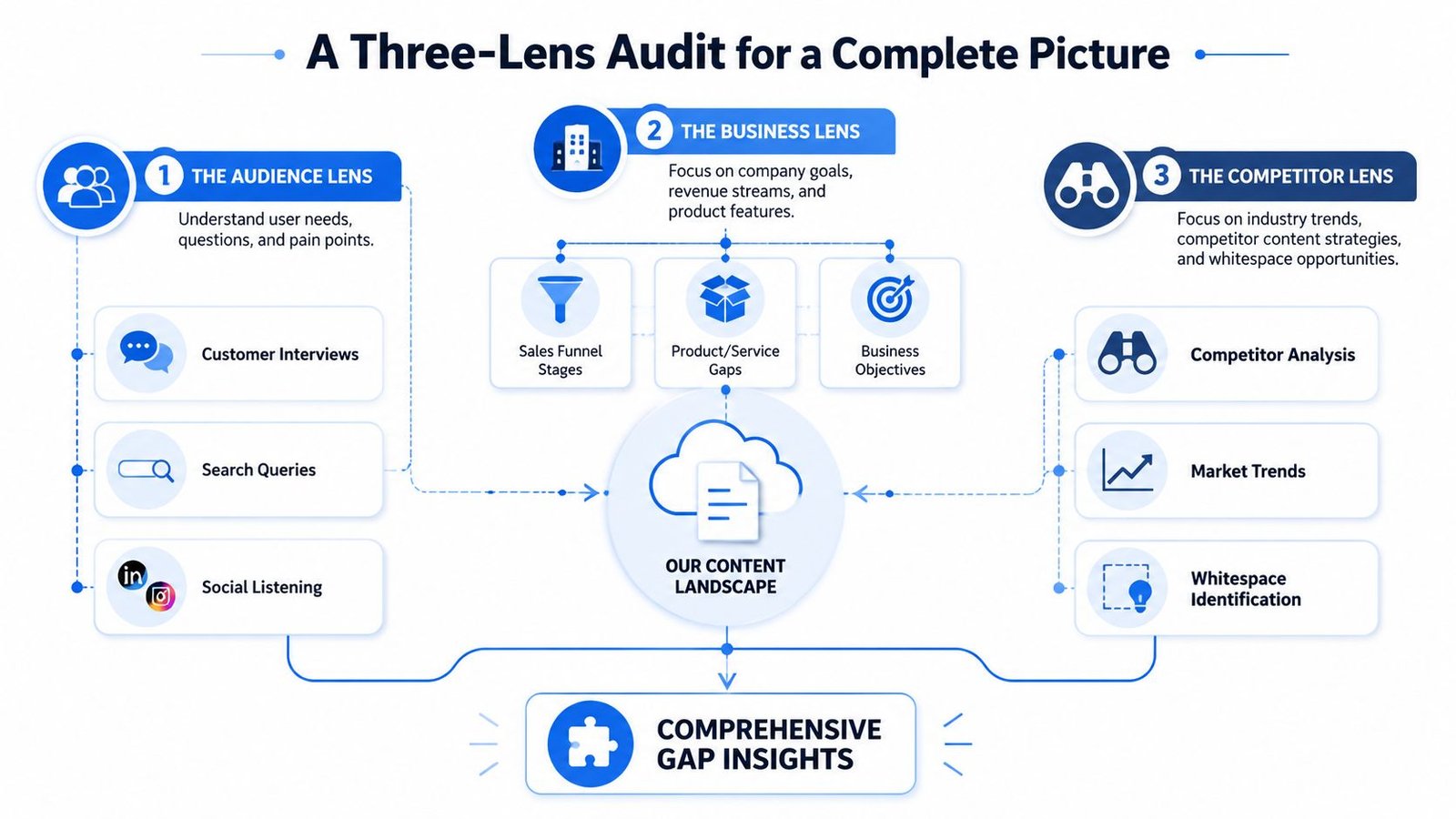
That structure matters because the actual gap often sits underneath the obvious one. A competitor may rank for a term you do not target, but the bigger issue is often that your existing page does not match buyer intent, does not move visitors to the next step, or sits in a funnel stage with no commercial bridge. The three lenses below help separate publishing opportunities from revenue opportunities.
The Competitor Lens
Start with search competitors, not the companies your sales team talks about most. In SaaS, a product-led startup often competes in search with review sites, template libraries, integration marketplaces, and vendors outside its pricing tier. In eCommerce, your organic competitors may be publishers, marketplaces, or niche stores with stronger category depth.
Pull three buckets:
- Missing topics: terms several competitors rank for and you have no relevant page for
- Weak coverage: terms where you have a page, but it lacks the depth, format, or intent match of competing pages
- Format mismatches: queries where the winning asset is a comparison page, use-case page, category guide, template, or integration page instead of a standard blog post
This lens is useful, but it can waste time if you treat every ranking gap as a content brief. A CRM platform aimed at RevOps teams does not need every broad “sales tips” keyword a giant publisher ranks for. An eCommerce brand does not need top-of-funnel traffic if the topic never connects to a high-margin category. Filter competitor gaps through product fit and commercial relevance before anything reaches the roadmap.
The Performance Lens
Some of the best gains come from pages you already own.
This lens looks for content that attracts attention but fails at the next job. In SaaS, that might be a feature page that earns impressions for high-intent queries but gets low demo clicks because pricing, implementation, or proof is missing. In eCommerce, it might be a collection page with decent rankings and poor conversion because the copy does not address sizing, materials, compatibility, or return concerns.
Review pages that:
- rank for relevant queries but produce weak assisted conversions or low next-step clicks
- earn impressions but have weak click-through rates because the angle is off
- overlap with nearby pages and split authority across similar intents
- cover the main keyword but miss decision-stage questions from buyers, champions, or procurement
For a cleaner review process, a structured website auditing checklist helps teams catch intent mismatches, thin sections, internal linking gaps, and outdated positioning before they publish replacement content.
Treat any page that draws qualified traffic and fails to move the visitor forward as a content gap. It already has visibility. It just does not do enough with it.
The Funnel Lens
This is the lens many teams skip, and it is usually where the revenue case becomes clear.
Map each important page to a funnel stage and to the KPI it should influence. For SaaS, that can mean problem awareness, solution education, evaluation, comparison, purchase validation, and expansion. For eCommerce, it usually means discovery, category evaluation, product comparison, purchase confidence, and post-purchase retention. Then check whether the content hands the visitor to the next stage.
Common gaps look like this:
- an awareness post with no path to a use-case, comparison, or demo page
- a feature page with no customer proof, onboarding detail, or objection handling
- a category page with no buying guide, filter explanation, or comparison support
- a comparison page that never links to a trial, product collection, or high-intent commercial page
Brafton's analysis of content gap analysis as a broader strategy discipline supports this wider view. Strong results come from topic coverage that works together, not from isolated articles published one by one.
That is the gap within the gap. You are not only finding missing topics. You are finding missing connections between search intent, funnel stage, and business outcome.
How to Prioritize Gaps for Maximum Impact
A serious audit leaves you with too many opportunities. That's normal. The mistake is treating all gaps like equal publishing tasks.
The easiest way to prioritize is to score each opportunity against three filters: revenue potential, SEO opportunity, and strategic fit. You don't need a complicated model. You need one your team will actively use every quarter.
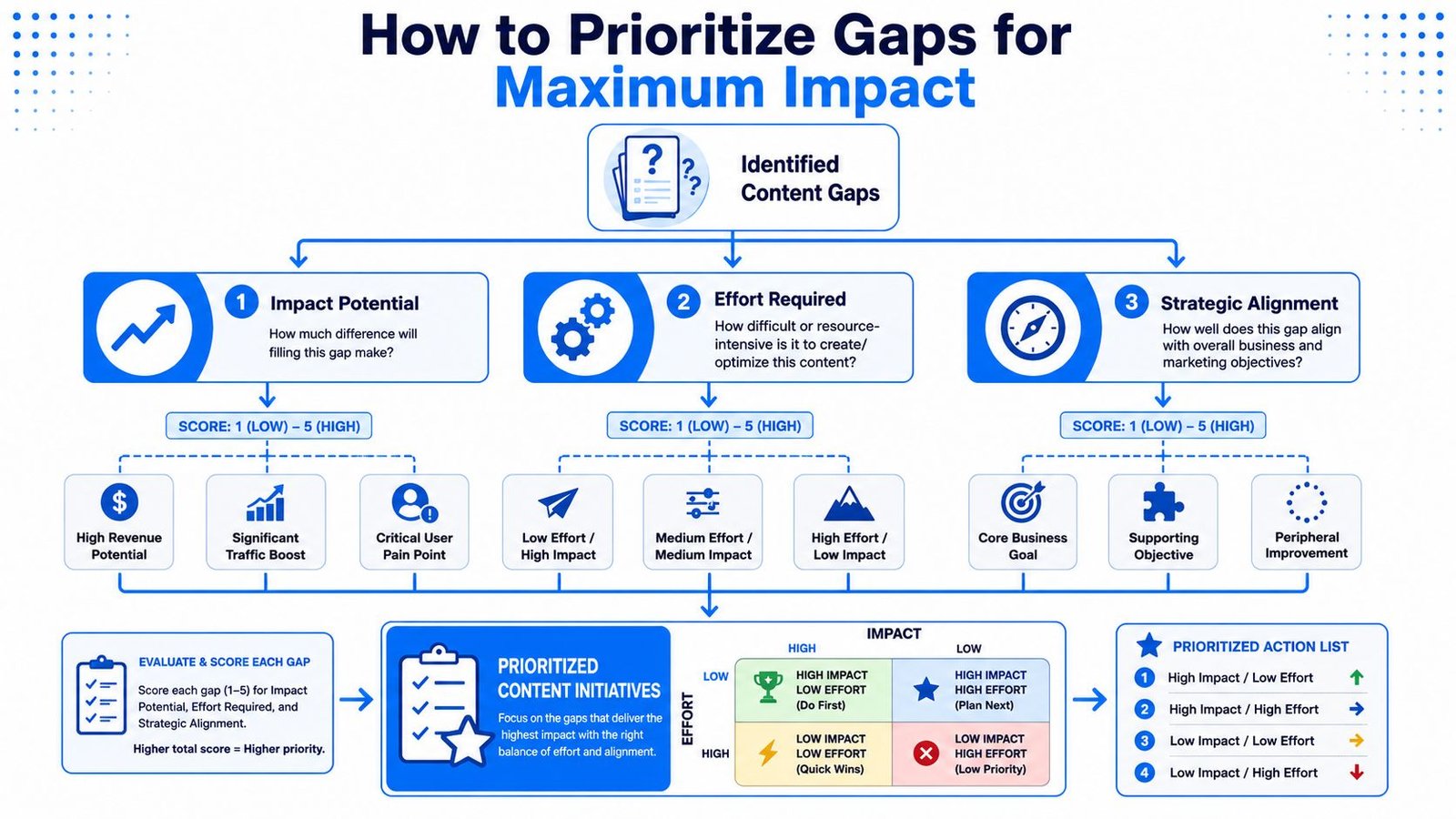
The three filters that matter
Revenue potential
Ask how directly the topic connects to a commercial action.
A SaaS “best CRM for startups” post may have traffic potential, but a “HubSpot alternatives for sales teams” page is often closer to evaluation intent. In eCommerce, “how to choose a standing desk” can support discovery, but “standing desk sizes for dual-monitor setups” may bring in a buyer with clearer purchase intent.
Signals that raise revenue potential include sales-team usage, product relevance, objection handling, and alignment with high-value categories or features.
SEO opportunity
Search data still matters. Review demand, SERP quality, page-type fit, and competitive strength. Also check whether your site already has partial relevance through existing impressions, internal links, or topical coverage.
If your team needs a shared baseline for evaluating search competition, this guide on keyword difficulty is useful for deciding whether a gap is a near-term win or a longer-term authority play.
Strategic fit
Some topics can rank and still weaken the overall strategy. Strategic fit asks whether the gap reinforces the brand you're trying to build.
For SaaS, that usually means alignment with your product category, differentiators, integrations, and target accounts. For eCommerce, it means supporting priority collections, margin-friendly products, seasonal merchandising, or repeat-purchase categories.
A practical scoring example
Use a simple 1-to-5 scale for each factor.
| Opportunity | Revenue potential | SEO opportunity | Strategic fit | Priority read |
|---|---|---|---|---|
| Competitor alternatives page for core SaaS feature | 5 | 4 | 5 | Build now |
| General educational blog on broad industry term | 2 | 3 | 2 | Lower priority |
| eCommerce category guide tied to top collection | 4 | 4 | 5 | High priority |
| Trend piece with weak product connection | 1 | 3 | 1 | Usually skip |
This doesn't need false precision. The point is to force trade-offs.
A lower-volume topic with strong buyer intent often beats a larger keyword that attracts the wrong visitor.
What usually rises to the top
Across SaaS and eCommerce, the first wave often includes:
- Bottom-funnel comparison pages
- High-impression pages that need intent repair
- Category or feature hubs with thin content
- Cluster support pages that strengthen a money page
- Content tied to repeated sales objections
That's how you turn a noisy spreadsheet into a roadmap. Not by chasing the biggest keyword, but by choosing the gaps that support revenue, rankings, and authority at the same time.
Activating Your Findings A Tale of SaaS and eCommerce
A backlog doesn't create results. The work starts when the gap turns into a page brief, an update plan, and a promotion path.
SaaS example from keyword gap to revenue page
Say a B2B SaaS company finds a strong gap around competitor alternatives. The old approach is to write a generic comparison article and hope it ranks. The better approach is to build a page that supports both SEO and sales.
The brief should include:
- Primary job: help evaluation-stage buyers compare options
- Core sections: who each tool is for, where each one falls short, migration considerations, pricing model differences, implementation complexity, and ideal use cases
- Conversion path: demo CTA, product tour, proof assets, and internal links to feature and integration pages
- Enablement use: sales team can send it after discovery calls when a competitor enters the conversation
The page shouldn't read like a blog post. It should read like a decision asset. If the company has a strong angle, such as faster onboarding or cleaner reporting, that angle belongs near the top, not buried under generic definitions.
Distribution matters too. Once the page is live, give it a real path to links and visibility. Build outreach around review sites, niche newsletters, partner ecosystems, and comparison-focused publisher pages. For a broader rollout, this overview of content distribution channels is a good framework for deciding where the page should earn attention after publication.
eCommerce example from thin category page to buying guide
Now take an eCommerce brand with a category page that lists products but gives buyers almost no help. The page might rank for some commercial terms, but it doesn't explain how to choose, compare, or buy with confidence.
A stronger category brief usually includes:
- A short category introduction that explains product purpose and buyer fit.
- Selection guidance such as material, size, compatibility, intended use, or feature trade-offs.
- Trust-building elements like shipping expectations, returns context, FAQs, and product comparison cues.
- Supporting internal links to buying guides, comparison content, and high-intent subcategory pages.
That's often more effective than spinning up another standalone blog post because it improves the page closest to purchase.
What works and what doesn't
What works is tight alignment between page type and intent. Comparison terms deserve comparison pages. Category terms deserve category pages with useful copy. Product-adjacent informational terms often need guides that route users into collections or feature pages.
What doesn't work is forcing every gap into a blog format. That's one of the most common reasons content programs look busy and still fail to influence revenue.
The strongest execution plans also assign ownership. SEO defines the opportunity. Content builds the asset. Design improves usability when needed. Sales or merchandising validates whether the page helps buyers decide.
Measuring Success and Building a Continuous Rhythm
A content gap analysis pays off only when the team can prove three things. The gap was real. The fix matched intent. The page improved a business outcome tied to revenue.
That last part is where many teams get stuck. They find topics, publish pages, and report traffic lifts, but they cannot show whether those pages helped pipeline, product discovery, or sales conversations. That is the gap within the gap.
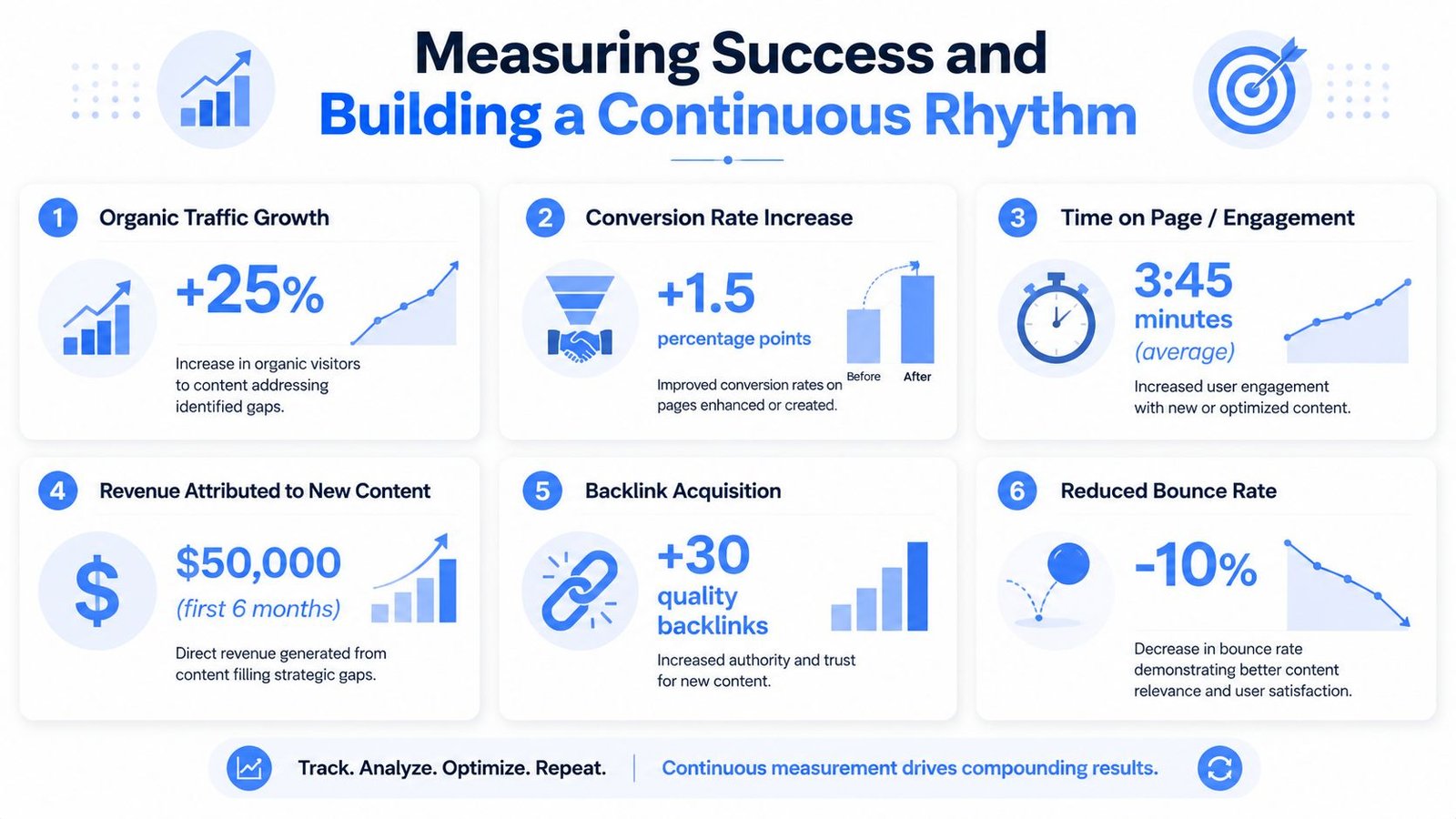
The KPIs that matter
Measure content in layers, starting with visibility and ending with commercial impact. If a page ranks but does not move buyers deeper into the funnel, it solved an SEO problem and left the revenue problem untouched.
Search visibility metrics
Use these to confirm that the update earned traction in search:
- Topic-cluster visibility: Are your core pages showing up across the cluster, or is one post carrying the whole topic?
- Share of voice against direct competitors: Are you gaining ground on the queries tied to your product category and buying journey?
- Internal page support: Are supporting assets helping the main commercial page rank, or are they splitting authority and attention?
Business and funnel metrics
Use these to confirm that the page did its job:
- Demo requests, free trials, or assisted conversions for SaaS
- Category-page clicks to product pages for eCommerce
- Lead quality by landing page
- Sales adoption of comparison pages, alternatives pages, and use-case assets
- Movement from educational content into feature, pricing, category, or product pages
For a SaaS client, I usually want to see more than rankings on a new bottom-funnel page. I want evidence that the page brings in qualified signups, supports sales follow-up, or shortens the path from first visit to demo. For eCommerce, the equivalent signal is stronger product discovery and better movement from category or guide pages into product detail pages.
One warning matters here. Poor site hierarchy, overlapping pages, and weak internal linking can blur results. A team may publish three assets around the same buying question, see impressions spread across all of them, and still get mediocre conversions because no single page becomes the clear decision asset.
Track the job the page was meant to do, then judge it against that job.
Build a repeatable operating rhythm
Strong teams do not treat content gap analysis as a one-off audit. They build it into planning, reporting, and page maintenance.
A practical rhythm looks like this:
- Monthly: review new queries in Search Console, recurring sales objections, and pages with clear drops in engagement or conversion
- Quarterly: rescore priority gaps, update high-value commercial pages, and check whether key clusters need support or consolidation
- Twice a year: run a broader competitor, funnel, and performance review across the site
This cadence matters because content gaps change with the business. A SaaS company launches a new integration and suddenly needs comparison, migration, and use-case content. An eCommerce brand expands into a higher-ticket category and needs stronger category copy, buying guides, and trust signals closer to purchase. Search demand shifts too, but revenue priorities should decide what gets fixed first.
What mature teams learn
The strongest content programs stop treating gap analysis as an idea engine. They use it as a prioritization system.
For SaaS, that usually means mapping content to funnel stages, pipeline influence, and sales enablement. For eCommerce, it means improving the pages that help shoppers compare options, choose faster, and buy with fewer objections. Once that rhythm is in place, content stops behaving like a publishing calendar and starts working like a growth channel.
If your team needs a sharper way to connect content opportunities with rankings, links, and revenue, SaasSky helps SaaS and eCommerce brands turn scattered SEO ideas into focused content and link-building programs. Their work is built for teams that want clear prioritization, transparent execution, and content that supports both search visibility and commercial outcomes.