You have a strong product, a decent website, and a sales team asking the same question every quarter. Why aren't more qualified buyers finding us?
That's the situation most SaaS and eCommerce founders are in when they start taking SEO seriously. They don't have a traffic problem in the abstract. They have a discoverability problem. Buyers are already searching for the category, the problem, the feature, the comparison, the alternative, and the use case. Your site just isn't showing up where decisions get made.
That's the right frame for understanding search engine optimization. It isn't a bag of tricks for gaming rankings. It's the operating system behind product discoverability. For SaaS, that means making sure your feature pages, solution pages, documentation, integrations, and content can be found when intent is high. For eCommerce, it means turning category pages, product pages, and buying guides into assets that capture demand before a shopper reaches a marketplace or a competitor.
Table of Contents
- Why Your SaaS or eCommerce Business Needs SEO
- How Search Engines Actually Work
- The Technical SEO Checklist for Modern Websites
- Content and On-Page SEO Strategy That Converts
- Link Building Playbooks for Authority and Trust
- Measuring SEO Success and Calculating ROI
- Your First 90 Days Implementing SEO
Why Your SaaS or eCommerce Business Needs SEO
If your growth depends on people discovering your product at the moment they need it, SEO isn't optional. It's the system that connects existing demand to your site without paying for every click.
By 2024, Google was processing about 8.5 billion searches per day, and the top organic result on Google had an average click-through rate of 27.6%, while the second page got about 0.78% of clicks, according to this SEO statistics summary. That gap is the difference between being considered and being invisible.
The real business case
Founders often treat SEO as a marketing add-on. That leads to the wrong decisions. They publish a few blog posts, assign “SEO” to a generalist marketer, and expect pipeline to appear.
That almost never works.
SEO works when you treat it like product discoverability infrastructure. Your market already contains demand. Prospects are searching for:
- category terms
- problem-aware queries
- feature comparisons
- alternatives and competitor comparisons
- implementation questions
- product-specific buying terms
If your site doesn't answer those searches clearly, buyers don't stop searching. They find someone else.
Practical rule: SEO captures demand that already exists. It doesn't create product-market fit, but it does decide whether buyers can find the fit you already built.
Why this matters more for SaaS and eCommerce
SaaS and eCommerce businesses both rely on trust before conversion, but they express it differently.
For SaaS, search often touches multiple pages before revenue happens. A buyer may land on a blog post, move to a solution page, read docs, compare alternatives, and then request a demo or start a trial.
For eCommerce, search shortens the distance between discovery and purchase. A shopper may enter through a category page, compare product pages, and buy in the same session if the site makes selection easy.
In both models, SEO isn't just “traffic.” It's how your site becomes the best available answer for a real commercial question.
What SEO is actually trying to do
A useful way to think about understanding search engine optimization is this: your site needs to prove three things at the same time.
- Relevance: this page matches the search.
- Accessibility: search engines can discover and process it.
- Trust: the site deserves to rank above similar options.
When one of those breaks, performance stalls. Great content on a hard-to-crawl site struggles. A technically clean site with vague pages struggles. A polished site with no authority struggles.
SEO is the discipline of fixing all three.
How Search Engines Actually Work
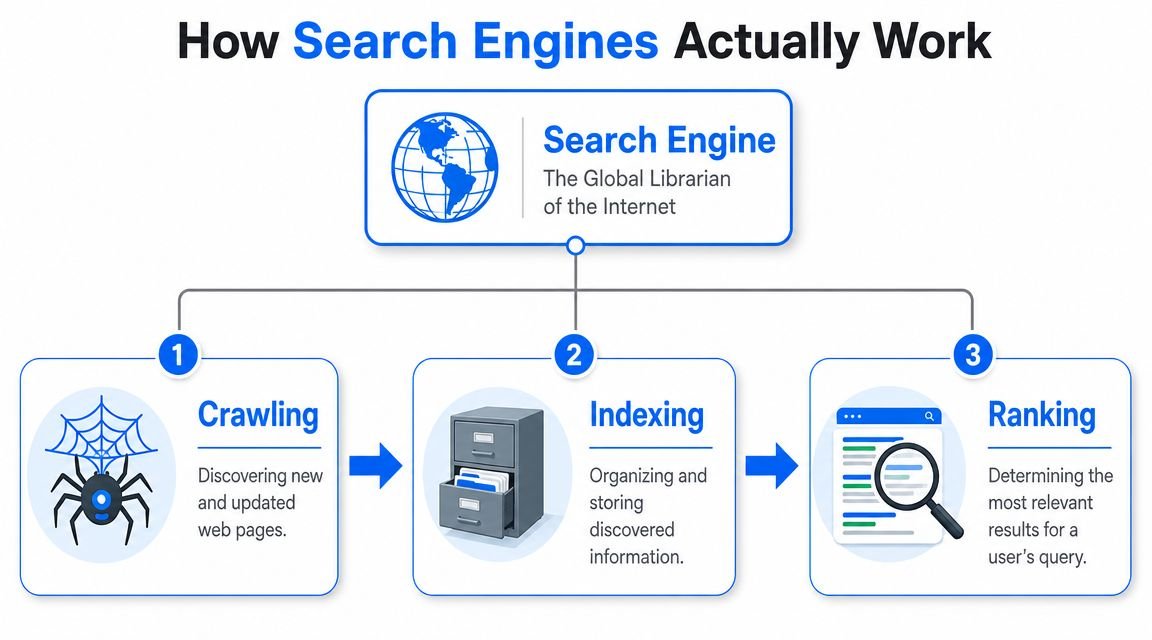
Search engines are giant librarians. Their job isn't to admire your website. Their job is to find pages, understand what those pages contain, and decide which ones deserve to appear first for a query.
That process feels mysterious until you reduce it to three jobs.
The three jobs search engines perform
Crawling is discovery. Search engines follow links, read sitemaps, and find new or updated pages. If a page is orphaned, blocked, or hidden behind weak architecture, it's harder to discover.
Indexing is organization. After discovery, search engines decide whether a page belongs in their searchable database. Not every discovered page gets indexed. Thin, duplicate, confusing, or low-value pages often don't make the cut.
Ranking is prioritization. Once a page is indexed, search engines decide where it belongs for a given query. That decision depends on relevance, usefulness, clarity, technical quality, and authority signals.
If you want a deeper look at the signals involved, this overview of Google PageRank factors is a useful companion.
Search engines don't rank websites because they exist. They rank pages that are easy to find, easy to interpret, and worth showing.
What this means for SaaS and eCommerce sites
For SaaS sites, the biggest misunderstanding is assuming a polished design equals search readiness. It doesn't. A homepage built in Webflow or a JavaScript-heavy app shell can look excellent and still make discovery harder if core content and links aren't easy to process.
For eCommerce sites, the risk usually comes from scale. Filters, variants, sorting options, internal search pages, and duplicate category structures can generate far more URLs than the business wants indexed.
A simple mental model helps:
| Search engine job | What your site must provide | Common failure |
|---|---|---|
| Crawl | clear internal links, sitemap access, useful architecture | orphan pages, blocked resources |
| Index | unique value, distinct purpose, controlled duplication | thin pages, near-duplicates |
| Rank | intent match, trust signals, strong page quality | vague targeting, weak authority |
This is why understanding search engine optimization starts with mechanics, not hacks. If your pages never get discovered properly, content quality won't save them. If they get discovered but look duplicative, they may never be indexed. If they get indexed but fail to answer the search better than alternatives, they won't rank where it matters.
A lot of teams skip straight to keywords. The better sequence is simpler. Make the site discoverable. Make pages distinct. Then make them the best answer for the searches that matter.
The Technical SEO Checklist for Modern Websites
Technical SEO is the foundation. If the foundation is weak, content and links sit on unstable ground.
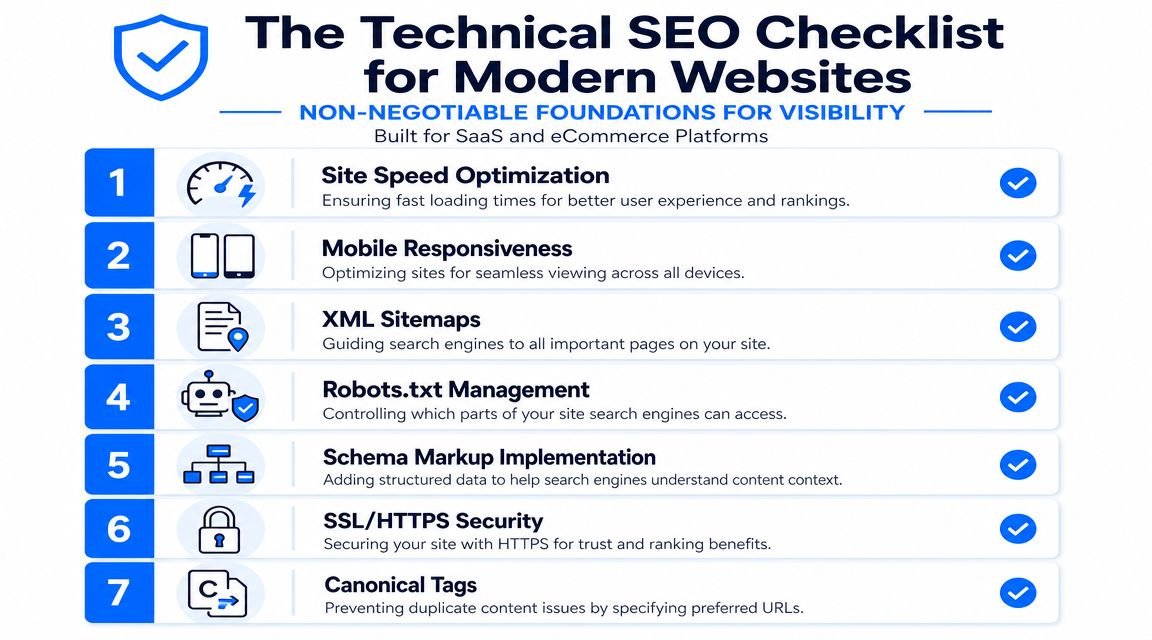
Search Engine Land notes that technical SEO is about making a site crawlable, indexable, fast, and secure, and that for SaaS and eCommerce sites with faceted navigation or large product libraries, uncontrolled parameter combinations can create index bloat and dilute ranking signals across near-duplicate pages, which is why canonical tags and sitemaps matter so much in practice, as explained in this guide to technical SEO fundamentals.
What to check first
Most technical audits become too long and too abstract. Founders don't need a giant spreadsheet first. They need a shortlist of issues that affect discoverability and revenue.
Start here:
- Crawl access: Important pages should be reachable through normal internal links. Product pages, category pages, feature pages, docs, and pricing pages shouldn't depend on odd navigation paths.
- Index control: Decide which pages should rank and which pages should stay out of the index. Filter combinations, duplicate variants, and internal result pages often need tighter control.
- Speed and stability: Slow pages reduce usability and can limit how efficiently search engines process the site.
- Mobile usability: Buyers compare products on phones all day. If your mobile experience hides content, breaks layout, or slows to a crawl, performance suffers.
- Security and consistency: HTTPS, clean redirects, and stable canonical behavior are table stakes.
Where modern sites usually break
SaaS sites often break on rendering.
A lot of modern marketing sites rely on JavaScript for navigation, pricing components, testimonials, tabs, and comparison blocks. That's not automatically bad. The problem starts when essential text, links, or product information only appears after client-side execution. If the important page elements aren't reliably available, crawling and indexing become less predictable.
Webfor points out that server-side rendering and making important content available in the HTML source improves the reliability of discovery and lowers the risk that search engines miss core page elements, as described in this introduction to technical SEO.
eCommerce sites break differently. Their usual enemy is uncontrolled scale:
- filters generating endless URL combinations
- variant pages competing with parent products
- duplicate category structures
- weak internal linking to priority collections
- discontinued product pages handled badly
What works: a smaller, controlled index where each indexed page has a clear reason to exist.
What fails: letting every generated URL compete for crawl attention.
A practical technical review table
Here's the checklist I'd use in a first pass with a SaaS or eCommerce founder:
| Area | Good sign | Warning sign |
|---|---|---|
| Site architecture | priority pages are reachable in a few clicks | key pages buried or orphaned |
| URL structure | readable, descriptive URLs | parameter-heavy clutter |
| Canonical setup | duplicates consolidate to preferred URLs | self-conflicting canonicals |
| XML sitemap | includes important indexable URLs | includes junk, redirects, or duplicates |
| Robots and indexing | intentional control of crawl and index behavior | useful pages blocked by mistake |
| Rendering | main content visible in source HTML | critical content loaded late |
| Internal linking | clear paths from high-authority pages to money pages | blog and product sections disconnected |
The founder-level takeaway
Technical SEO isn't a developer side quest. It decides whether your best pages are even eligible to compete.
If you run a SaaS company, check whether your feature and solution pages are fully understandable without fancy frontend behavior. If you run an eCommerce store, control what gets indexed before the catalog grows into a mess.
The fastest way to waste SEO effort is to publish into a broken architecture.
Content and On-Page SEO Strategy That Converts
Content strategy fails when every page tries to do everything.
That's common on SaaS sites. A “solutions” page tries to rank for a category term, explain the platform, compare alternatives, answer objections, and close the deal in one place. eCommerce teams make a similar mistake by expecting one product page to satisfy informational, comparison, and transactional intent at once.
Good on-page SEO works better when each page has a distinct search role.
Every page needs one job
Google's starter guidance emphasizes unique titles, descriptive headings, and content that clearly answers a specific user question. That matters because a major issue for SaaS sites with overlapping feature, solution, and use-case pages is keyword cannibalization, where multiple pages compete for the same query instead of supporting each other, as outlined in Google's SEO starter guide.
A healthy content system usually looks like this:
- Category or solution pages target commercial intent. These help buyers evaluate fit.
- Feature or product pages explain capability, use cases, and differentiation.
- Comparison pages capture late-stage evaluation.
- Educational content answers earlier questions and routes visitors toward money pages.
- Documentation or help content supports implementation and long-tail discovery.
The mistake isn't having multiple page types. The mistake is making them overlap so heavily that search engines and users can't tell which page should own which query.
If two pages could swap titles and still make sense, your site structure is probably too blurry.
What good on-page SEO looks like
On-page SEO isn't keyword stuffing. It's page clarity.
That starts with a few basics that still matter:
- Titles: unique, specific, and aligned to the page's real purpose
- Headings: descriptive enough that a user can scan the page and know what they'll get
- URLs: short and readable
- Internal links: useful paths to related pages, not random cross-linking
- Body copy: direct answers, not generic marketing language
- Alt text and media context: helpful for understanding the page, not filler
For SaaS, I like to force a simple question before writing or revising any page: What exact search should this page deserve to rank for? If the answer is broad, the page is usually weak.
For eCommerce, the equivalent question is: Is this page helping a shopper choose? Category pages should narrow a choice set. Product pages should remove hesitation. Buying guides should clarify trade-offs.
A useful decision framework looks like this:
| Page type | Primary intent | Common mistake | Better approach |
|---|---|---|---|
| Feature page | understand capability | too much brand language | explain problem, workflow, fit |
| Solution page | assess use case relevance | overlaps with feature page | focus on audience-specific outcome |
| Product page | evaluate and buy | thin manufacturer copy | add original detail and decision support |
| Blog post | learn or compare | no path to conversion | link naturally to commercial pages |
The best converting SEO content libraries feel organized, not crowded. Each page has a lane. Each lane supports a stage of the customer journey. And internal links connect those lanes without making them compete.
Publishing more pages doesn't fix a weak content system. Sharpening page purpose does.
Link Building Playbooks for Authority and Trust
Authority is still earned off-site. You can write a strong page and fix the technical setup, but if nobody references your brand or your best content, ranking headroom stays limited.
That's why link building matters. Not as a vanity exercise, but as trust transfer.
Search Engine Land recently made an important point. Effective SEO is constrained less by publishing more pages and more by proving distinct expertise through fewer topics covered more thoroughly, with pages that act as primary sources and naturally attract authority, as argued in this analysis of why more content can hurt SEO.
What earns links now
The old model was volume. Publish lots of decent content, send lots of outreach emails, and hope some links land.
The better model is asset-first. Build pages worth citing, then promote them intelligently.
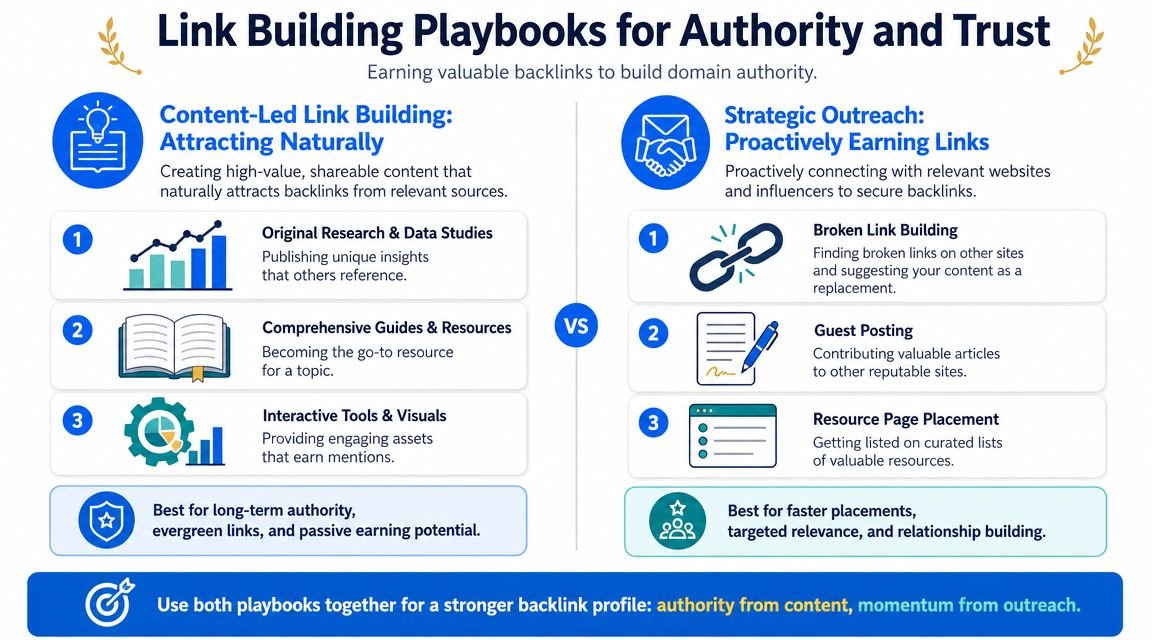
The strongest linkable assets for SaaS and eCommerce usually fall into a few buckets:
- Original research or data pages: These work when you have something others might reference.
- Definitive guides: Not generic overviews. Real operating guides with hard-won detail.
- Tools and calculators: Especially effective when they simplify a common decision.
- Category education pages: Useful in markets where buyers need help understanding differences between options.
- Visual resources: Comparison charts, process diagrams, and reference assets can attract mentions.
If you want a cleaner framework for earning links without crossing into manipulative tactics, this guide to white hat link building is worth bookmarking.
A good link target is usually a page that teaches something competitors can't easily rewrite from memory.
Choosing the right playbook
Not every link-building method fits every business model.
Content-led link building works well when you already have genuine expertise or proprietary material. This is common in SaaS with internal product data, customer workflow knowledge, or implementation insights. It also works in eCommerce when a brand can publish original guides, buyer education, or product selection tools.
Strategic outreach works better when you already have a useful asset but it's not going to spread on its own. Resource page placements, selective guest contributions, broken link replacement, and relationship-led outreach help put that asset in front of relevant publishers.
Here's how I'd compare them:
| Playbook | Best fit | Strength | Risk |
|---|---|---|---|
| Original research | data-rich SaaS | strong citation potential | weak if the insight is generic |
| Resource guides | SaaS and eCommerce | durable relevance | too broad becomes forgettable |
| Guest posting | thought leadership | controlled messaging | low-quality placements waste time |
| Broken link outreach | evergreen educational assets | practical and targeted | weak asset means low acceptance |
| Resource page outreach | tools, guides, reference pages | relevant placements | poor targeting hurts results |
What doesn't work well anymore is chasing links to weak pages. If the destination isn't useful, outreach performance drops and even successful placements don't move the business much.
The strongest pattern I see is simple. Brands that earn links consistently usually create a few pages with obvious citation value, then direct outreach around those pages with discipline. Brands that struggle usually ask for links to pages that were never worth linking to.
Measuring SEO Success and Calculating ROI
Most SEO reporting is too shallow for a founder and too noisy for a finance lead.
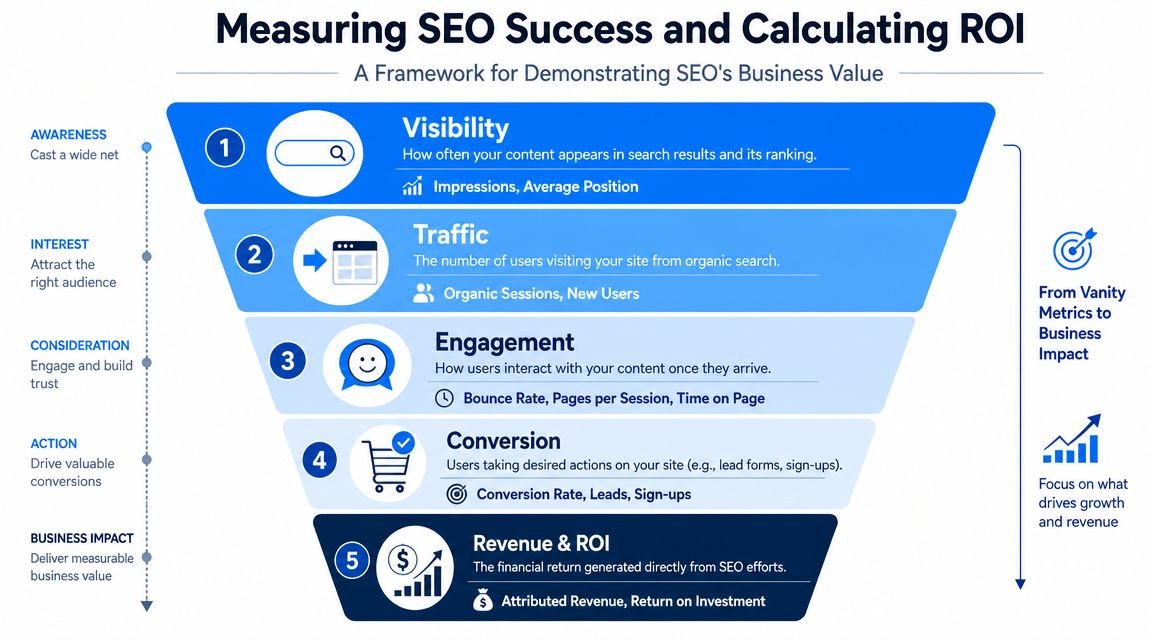
Rankings alone don't answer the core question. That question is whether organic search is producing revenue outcomes that matter. For SaaS, that usually means qualified leads, demo requests, or trial starts. For eCommerce, it means transactions, revenue, and assisted purchases from organic sessions.
What to measure beyond rankings
SEO is often judged by return, not just visibility. One source reports an average SEO ROI of 22:1, while another cites 8x ROI and eCommerce SEO returns of 5.2x over 36 months, according to this roundup of SEO ROI statistics. Treat those as directional benchmarks, not promises. The point is that SEO can compound when measurement is tied to business outcomes.
You still need leading indicators. They tell you whether the system is improving before revenue fully shows up.
A useful measurement stack looks like this:
- Visibility: impressions, query coverage, average position for priority pages
- Traffic quality: organic sessions to pages that matter, not just total traffic
- Engagement: whether visitors continue deeper into the site
- Conversion: demo requests, trial starts, purchases, add-to-cart behavior, qualified leads
- Revenue: closed-won pipeline or attributed organic sales
A clean explanation of what organic traffic means helps non-SEO stakeholders align on the difference between visits and value.
A simple founder dashboard
You don't need a 40-tab report. You need a dashboard that answers three questions:
- Are we becoming more visible for the right searches?
- Are the right pages getting more qualified visits?
- Is that traffic turning into pipeline or revenue?
Here's a simple version:
| Layer | SaaS metric | eCommerce metric |
|---|---|---|
| Discovery | impressions to feature and solution pages | impressions to category and product pages |
| Acquisition | organic sessions to commercial pages | organic sessions to shopping pages |
| Action | demo requests, trials, qualified leads | transactions, revenue, assisted conversions |
Use Google Search Console to understand search demand and page-level visibility. Use Google Analytics to track landing pages, conversion paths, and revenue behavior. Then review performance by page type, not only by channel total.
Key takeaway: If organic traffic rises but qualified conversions stay flat, the strategy is attracting the wrong searches or sending visitors to the wrong pages.
That's the discipline founders need. SEO should be measurable as a growth system. If reporting stops at traffic, it's incomplete.
Your First 90 Days Implementing SEO
A good SEO start doesn't begin with publishing ten blog posts. It begins with removing obvious blockers, sharpening the pages closest to revenue, and building the first assets that can earn authority.
Days 1 through 30
Focus on measurement and technical cleanup.
Set up or verify Google Search Console and Google Analytics. Make sure you can see which pages receive organic impressions, clicks, sessions, and conversions. Then audit your current site structure with one practical question in mind: which pages should be discoverable, and which ones are creating noise?
Prioritize:
- fixing crawl and indexing mistakes
- checking XML sitemap quality
- reviewing canonical behavior
- improving internal links to core commercial pages
- confirming important content is visible and accessible
If you're in SaaS, review your feature, solution, pricing, and docs pages first. If you're in eCommerce, start with category pages, top product pages, and faceted navigation controls.
Days 31 through 60
Shift to on-page clarity and content mapping.
Pick the pages closest to revenue and assign each one a single search role. Rewrite weak titles. Tighten headings. Remove vague copy. Add internal links that help users move from educational pages into commercial ones.
This is also the right time to identify cannibalization. If three pages are competing for the same query, choose a primary owner. Merge, redirect, rewrite, or reposition the others.
A strong month-two output often includes:
- upgraded feature or product pages
- cleaner solution or category pages
- one comparison page
- one or two educational assets that directly support the buying journey
Don't start with your biggest content gap. Start with the pages that could influence revenue fastest if they performed better.
Days 61 through 90
Begin the first authority-building cycle.
By this stage, your site should have at least a few pages worth promoting. That's when outreach starts to make sense. Choose one or two assets that deserve links. A definitive guide, a useful comparison page, a category education hub, or a helpful resource usually works better than generic blog content.
Build a small promotion list with relevance in mind:
- industry blogs
- niche publications
- resource pages
- partners
- communities
- selective guest contribution targets
At the same time, keep improving what's already live. SEO isn't a launch event. It's a compounding system. Teams that win in search tend to do the boring parts well. They maintain page quality, protect technical health, and keep authority flowing toward the pages that matter most.
By day 90, the goal isn't to “finish SEO.” The goal is to have a working system:
- measurement is reliable
- technical blockers are controlled
- key pages have distinct search roles
- first authority campaigns are underway
That's when understanding search engine optimization turns from theory into a growth channel founders can trust.
If you want help turning this into an execution plan, SaasSky works with SaaS and eCommerce brands on link building and SEO growth systems built around clear priorities, transparent process, and measurable outcomes.