
Organic traffic stalls in a way that makes teams second-guess everything. Content is going out, links are coming in, rankings move a little and then flatten, or worse, important pages slip. In SaaS, that often shows up after a redesign, a CMS change, or a new JavaScript-heavy marketing site. In eCommerce, it usually appears as category pages underperforming while filtered URLs multiply and product variants compete with each other.
Marketing directors usually ask the same reasonable question: is this a demand problem, a content problem, or a technical problem?
A good SEO technical audit service answers that before the team wastes another quarter pushing harder on campaigns that can't perform because the site itself is blocking discovery, indexing, or rendering. The point isn't to produce a giant spreadsheet of defects. The point is to find the technical debt acting like a handbrake on search visibility, translate it into business risk, and give the marketing and product teams a fix sequence they can execute.
Table of Contents
- When Your SEO Engine Is Sputtering
- What Exactly Is a Technical SEO Audit Service
- The Core Components of a Comprehensive Audit
- The Audit Process from Kickoff to Completion
- Understanding Audit Deliverables and Remediation
- Budgeting for an Audit and Choosing a Vendor
- Technical SEO Playbooks for SaaS and eCommerce
When Your SEO Engine Is Sputtering
The familiar pattern looks like this. The content team is publishing regularly. Demand gen is reporting decent branded interest. Search Console still shows impressions, but the pages that should be carrying pipeline aren't pulling their weight. Nobody can tell whether Google dislikes the content, can't properly process the site, or is spending time on the wrong URLs.
On SaaS sites, I often see this after a perfectly sensible set of changes. The product marketing team launches new comparison pages, engineering ships a component library, the website gets faster for users in some places and more dynamic in others, and then key content starts under-indexing or dropping in and out of visibility. The team assumes they need more content when the actual issue is that search engines aren't getting the right version of the page consistently.
For eCommerce teams, the warning signs are different but just as costly. Collection pages don't rank as expected. Product detail pages exist, but Google keeps surfacing odd parameter URLs, duplicate variants, or shallow pages with little internal authority. Merchandising keeps adding new inventory, but search isn't discovering or prioritizing it efficiently.
Technical debt in SEO doesn't announce itself. It shows up as content that never reaches its expected ceiling.
That is why a technical audit matters most when the rest of marketing appears to be working but results aren't compounding. It gives you a way to separate a strategic issue from an infrastructure issue.
A marketing director doesn't need another vague recommendation to “improve crawlability.” They need to know whether the site is wasting crawl paths, hiding critical content behind rendering behavior, sending mixed canonical signals, or forcing Googlebot into dead ends.
When those issues are fixed, content, links, and brand demand stop working against friction. They start working on a stable foundation.
What Exactly Is a Technical SEO Audit Service
Think of it as a structural inspection, not a cosmetic walkthrough. You're not evaluating whether the copy is persuasive or whether the brand design looks modern. You're checking the foundation, the load-bearing walls, the wiring, and the routes people and crawlers use to move through the property.

A proper SEO technical audit service isn't just a crawl report exported from Screaming Frog, Sitebulb, Ahrefs, or Semrush. Those tools are useful, but they don't decide what matters to your business. They don't know whether a noindex on a comparison page is harmless or a revenue problem. They don't know whether a faceted navigation issue is a cleanup task or a crawl-budget drain that is starving core category pages.
According to this report on expanded technical SEO audit scope, a technical SEO audit can systematically examine over 300 data points, and best practice is to run a thorough audit at least once per quarter, with monthly audits ideal for large websites or sites with frequent updates.
Software finds symptoms, people find causes
That distinction is where buying the service intelligently matters.
A tool can flag duplicate titles. A senior technical SEO should tell you whether those duplicates come from pagination, templating, canonicals, filtered URLs, localization logic, or low-quality page generation. Beyond identifying the source, they should pinpoint which issue deserves engineering time first.
A useful service usually combines several layers of investigation:
- Crawling tools that map URLs, response codes, canonicals, directives, and internal links
- Search Console review to compare what the crawler sees with what Google reports
- Template analysis to identify issues repeated across page types
- Manual checks for rendering, indexing behavior, structured data, and mobile presentation
- Business interpretation so the findings connect to traffic, revenue, leads, or product discovery
What the service is supposed to protect
A technical audit protects four outcomes:
Discovery
Search engines need a clear path to your important URLs.Indexing
The right pages should be stored and eligible to rank. The wrong pages should stay out.Interpretation
Search engines need consistent signals about canonicals, structured data, language targeting, and page purpose.Stability
The site must remain accessible during updates, releases, migrations, and crawl spikes.
Practical rule: If a vendor can't explain business impact in plain English, they're probably selling diagnostics without judgment.
A marketing director should expect the audit partner to answer practical questions. Which templates are holding back growth. Which fixes require developers. Which changes belong to content or merchandizing. Which risks are urgent before the next launch. That is the service.
The Core Components of a Comprehensive Audit
A useful audit earns its keep by separating blocking issues from background noise. Marketing leaders do not need a longer checklist. They need a clear view of what is suppressing revenue pages, what can wait, and which fixes are worth engineering time this quarter.
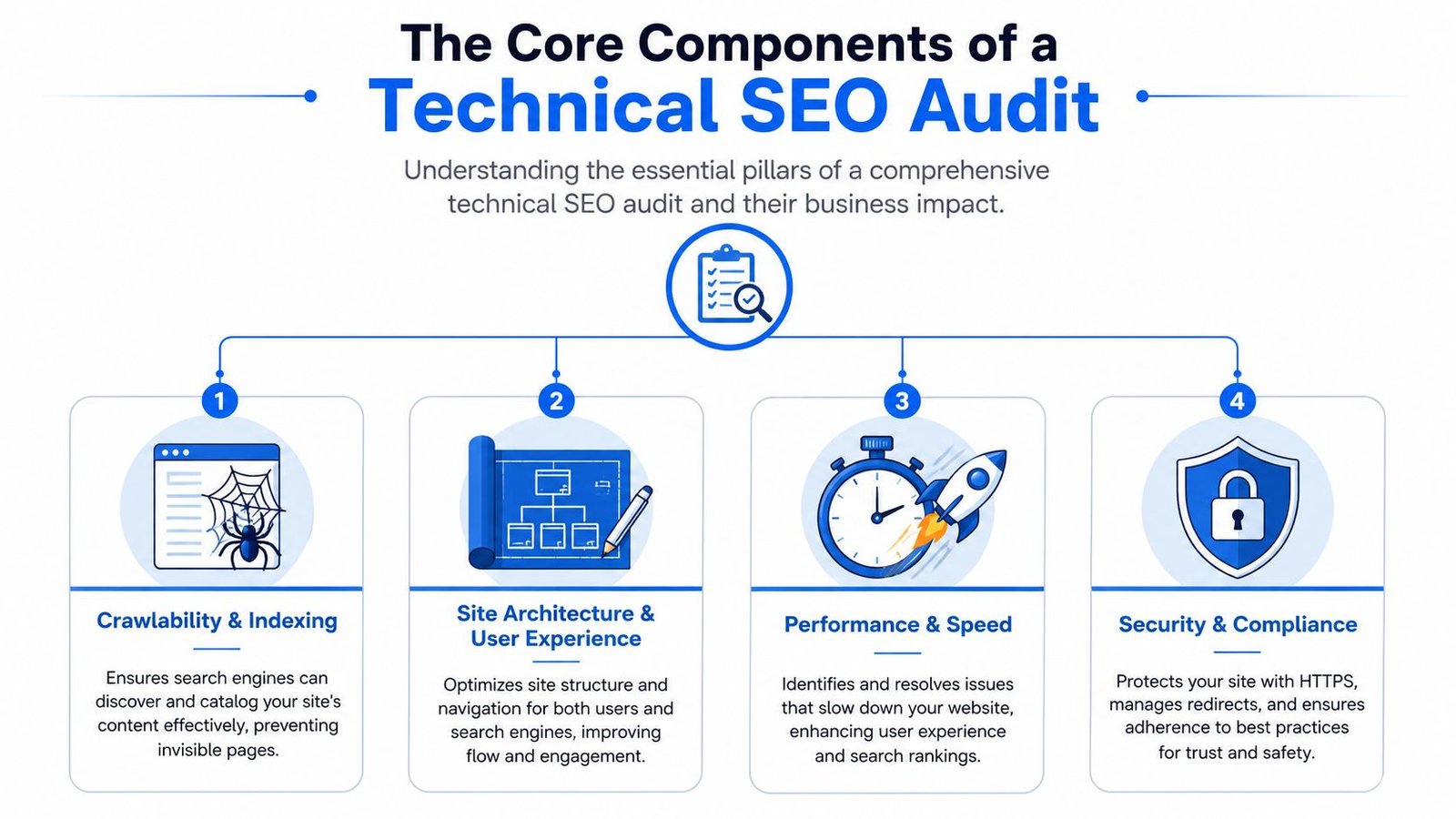
The strongest audits examine four operating areas. Crawlability and indexing. Site architecture and internal linking. Performance and crawl stability. Technical signals on the page. Together, they show whether search engines can reach priority URLs, process them correctly, and keep doing so as the site grows.
For teams that want a broader planning reference, a solid companion resource is this website auditing checklist for marketers. It helps frame the audit in the context of overall site quality, not just SEO diagnostics.
Crawlability and indexing
This is the first gate. If high-value pages are blocked, excluded, duplicated, or misdirected, later recommendations have limited value.
The work here usually covers robots.txt, meta robots, canonicals, redirects, status codes, XML sitemaps, orphan pages, and internal link access. On larger sites, it also means checking whether crawl activity is reaching category pages, product detail pages, feature pages, documentation, and other commercial templates instead of getting trapped in parameter URLs, internal search results, account areas, or duplicate paths.
I often see vendors spend too much time on cosmetic page issues before they confirm indexing integrity across templates. That wastes attention and budget.
A disciplined review starts with questions like these:
- Are priority URLs indexable without noindex mistakes, canonical conflicts, or redirect chains?
- Do redirects preserve intent for users and search engines, especially on retired products, variants, or campaign pages?
- Does the sitemap reflect the pages you intend to rank rather than every URL the CMS can generate?
- Are there repeatable URL patterns creating crawl waste such as faceted combinations, sort states, or duplicate pagination paths?
Google's own documentation on SEO-friendly JavaScript sites explains that critical content and links should be available to Google during rendering, and that relying on client-side JavaScript for key page elements can weaken crawling and indexing. That matters for SaaS sites in particular. A feature page may look finished in the browser while shipping weak initial HTML, missing body copy, or delayed internal links that reduce what Google can process reliably.
Site architecture and internal linking
Once a page can be indexed, the next question is whether the site sends enough internal authority and context to that page.
Architecture issues usually appear at the template level. Category pages sit too deep. Feature or integration pages are reachable only through mega menus or JavaScript interactions. Editorial content links heavily to other articles while ignoring product or commercial pages. Faceted navigation creates thousands of thin URLs while the pages that drive revenue receive little support.
Good architecture is predictable. Important pages are close to strong hubs. Internal links reflect business priorities, not just publishing habits. URL structures also help search engines distinguish a category page from a support article or a product comparison page.
A serious audit looks for:
| Audit area | What the auditor checks | Why it matters |
|---|---|---|
| Navigation paths | Whether core pages are reachable through HTML links | Search engines need reliable discovery routes |
| Internal link concentration | Which templates receive and pass authority | Important pages should not be isolated |
| URL logic | Whether structures match page purpose | Messy structures weaken prioritization |
| Orphan and near-orphan pages | Pages with weak or no internal references | Good pages struggle if nothing points to them |
Weak internal linking does more than lower rankings. It sends an unclear signal about which pages the business values.
For eCommerce brands, architecture and crawl control are tied together. Facets help shoppers, but uncontrolled filtered URLs can flood the crawl path and dilute category strength. For SaaS companies, the pattern is different. New feature pages, use cases, integrations, docs, and comparison pages get added over time, but the internal linking model never gets rebuilt around pipeline priorities.
Performance and crawl stability
Performance should be audited as an operational issue, not a speed score exercise.
Some sites pass a homepage test and still fail where it matters. Category templates may load slowly under inventory changes. JavaScript bundles may delay rendering on product or feature pages. Servers may become unstable when search engine crawlers increase request volume after a launch, migration, or large content release.
A strong audit reviews Core Web Vitals with both lab and field evidence, then connects those findings to server behavior, rendering, and crawl efficiency. It also tests page types separately, because the homepage is rarely the page template causing the actual loss.
The highest-value checks usually include:
- Log analysis to confirm what Googlebot is requesting
- Template-level performance review so slow high-value page types are not hidden by averages
- Field-data validation to compare lab assumptions with real user conditions
- Server and CDN review to identify instability, throttling, or caching problems during crawl spikes
The business impact is direct. If important templates are slow, unstable, or hard to render, rankings can plateau even when content quality is strong. The site becomes harder to crawl, harder to trust, and more expensive to maintain.
Technical signals on the page
This layer covers the signals that help search engines interpret page purpose correctly. Structured data, hreflang, canonical consistency, pagination handling, meta directives, image indexing considerations, and template-level HTML quality all sit here.
These checks matter, but they do not all deserve the same urgency. A schema issue on a low-priority blog template does not carry the same weight as a canonical conflict on product variants or a hreflang error across international category pages. An audit service should make that distinction clear, because marketing, engineering, and product teams need a ranked list of actions, not a flat spreadsheet of defects.
Useful vendors usually separate findings into three groups:
- Revenue-adjacent issues such as canonical confusion, thin rendered content, or internal linking gaps on commercial pages
- Scale issues such as templated metadata, hreflang, or duplicate title problems repeated across large sections
- Enhancement issues such as rich result opportunities that improve visibility but do not remove a blocker
That prioritization is what turns an audit from a diagnostic document into a service. The deliverable should show which fixes protect revenue now, which ones reduce future risk, and which ones can wait until the roadmap allows it.
The Audit Process from Kickoff to Completion
A marketing director usually feels the gap before they can name the cause. Pipeline pages stop growing, engineering says the release was fine, and the content team keeps publishing. An audit service earns its fee by turning that uncertainty into a clear diagnosis, a workable fix plan, and a realistic view of what the business can expect from remediation.
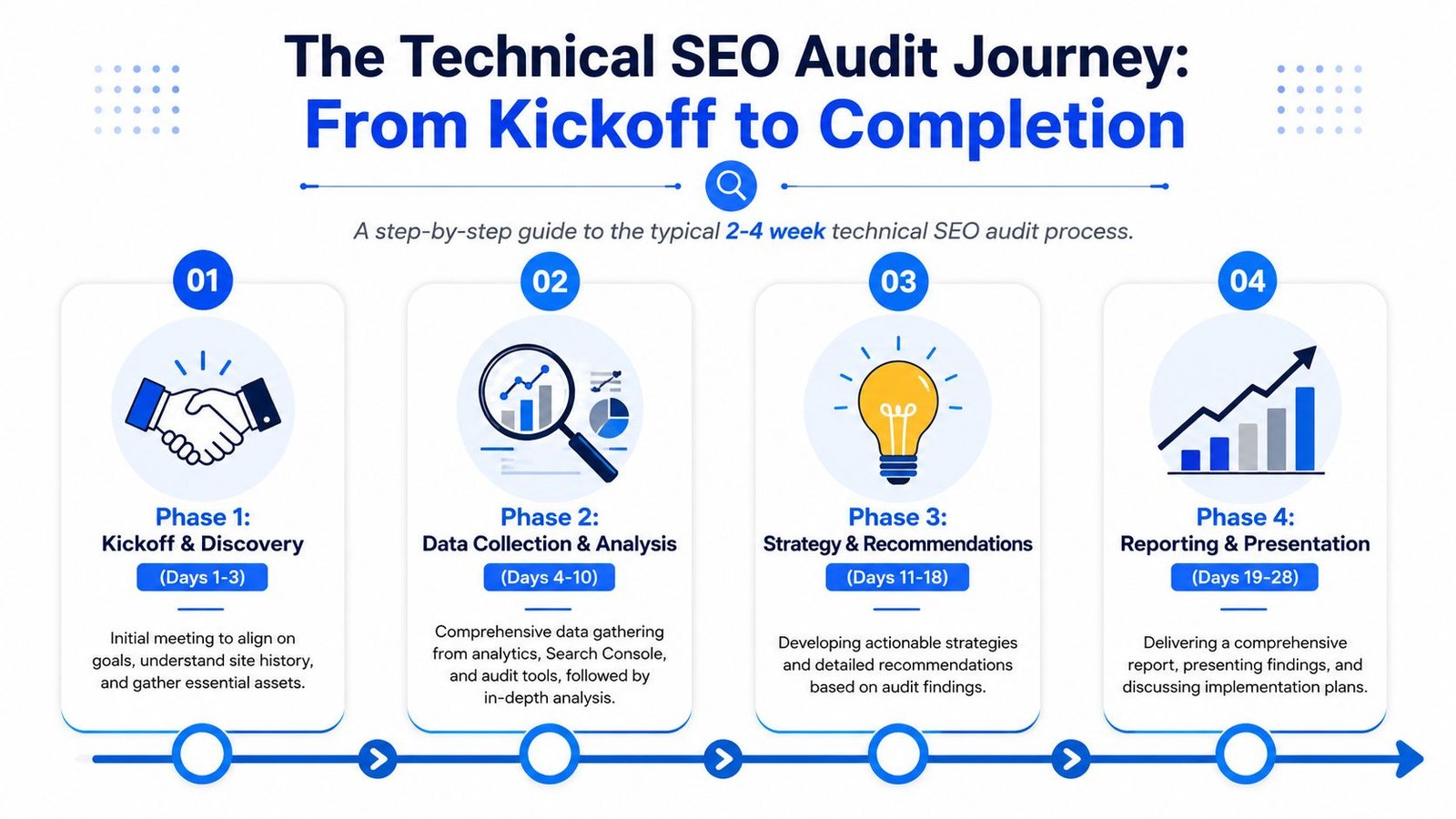
Kickoff and access
The first phase sets the quality ceiling for the whole engagement. If the vendor starts crawling before they understand your revenue drivers, release history, and platform constraints, they are auditing a website in the abstract instead of auditing your business.
Good kickoff calls get specific fast. The auditor should ask which page groups matter most to pipeline or sales, what changed recently, where the CMS or frontend is brittle, and how much engineering capacity exists this quarter. SaaS teams often need close review of documentation, app-adjacent content, and rendered JavaScript. eCommerce teams usually need tighter scrutiny on category logic, faceted navigation, product variants, and feed-driven template behavior.
Access should match the site's complexity. That commonly includes Google Search Console, analytics, sitemap files, crawling tools, and staging references. On larger sites, server logs are often part of the scope because crawl simulations and third-party crawlers cannot show how Googlebot spends its time. Google's documentation on verifying Googlebot and using log files for analysis is useful here.
If a vendor does not ask what success looks like before they ask for access, the process is already off track.
Collection and diagnosis
Once access is in place, the work becomes investigative. The auditor will usually run full crawls, review rendered HTML, compare canonical and indexation signals, test templates, inspect internal linking paths, and check sitemap alignment against live URLs. Performance review belongs here too, especially for commercial templates, and findings often connect directly to Core Web Vitals optimization for SEO rather than sitting in a separate performance bucket.
The stronger services do more than list defects. They compare what should happen against what is happening in production.
Log file analysis is one of the clearest examples. On a large SaaS site, logs can show Googlebot spending time on old documentation versions, parameter URLs, or low-value search pages while recently updated money pages get crawled less often. On an eCommerce site, logs often expose wasted crawl activity on filtered combinations, out-of-stock product URLs, or duplicate variant paths. That distinction matters because the fix is rarely “improve crawlability” in general. The fix is usually to reduce wasted demand on low-value URLs and strengthen signals on the pages that affect revenue.
Pattern recognition is the core job in this phase. A capable auditor will tie issues back to a template, a directory, a release, or a ruleset in the platform. That is what makes remediation possible. Engineering teams can fix a repeatable pattern. They cannot efficiently fix 200 isolated rows in a spreadsheet.
Prioritization and presentation
The last phase decides whether the audit becomes action or shelfware. A vendor should turn findings into a decision model that reflects impact, effort, dependencies, and ownership.
That means grouping issues by page type and business consequence, then mapping them to the team that can resolve them. Marketing needs to know which fixes protect demand capture and which ones support future growth. Product and engineering need enough specificity to size the work properly. Leadership needs to understand trade-offs, especially when a technically correct fix competes with roadmap commitments or release risk.
The strongest engagements usually end with three working sessions:
- Executive review for the commercial summary, major risks, and expected upside
- Technical walkthrough for SEO, product, and engineering to validate root causes
- Prioritization workshop to align fixes with sprint capacity, release windows, and QA needs
A mature audit process feels operational from start to finish. The team leaves with clear owners, a ranked fix list, and a shared view of what should happen first.
Understanding Audit Deliverables and Remediation
A technical audit starts proving its value when your team tries to ship the fixes. That is the moment you learn whether the vendor understood your business, your platform, and your delivery constraints, or only documented problems.
Strong deliverables reduce decision time. They help a marketing director understand revenue risk, give product a reason to schedule the work, and give engineering enough detail to implement changes without a second discovery cycle.
What good deliverables look like
Useful audit packages usually come in three parts.
The first is an executive summary written for decision-makers. It should explain the business impact of the findings in plain language. Which issues are limiting indexation on money pages? Which ones affect conversion-supporting templates? Which fixes protect current demand versus supporting future growth?
The second is a detailed findings report for SEO, product, and engineering. Good reports go beyond labels such as “duplicate pages” or “slow pages.” They show the affected templates, root cause, scope, likely consequence, recommended fix, dependencies, and any known implementation risk. For SaaS, that often means mapping issues to documentation hubs, feature pages, app subfolders, or JavaScript rendering rules. For eCommerce, it usually means category templates, faceted navigation, product variants, internal linking paths, and crawl waste.
The third is a prioritized remediation roadmap. This is the document teams rely on. It should rank work by likely business impact, effort, owner, and release dependency.
A usable roadmap answers questions such as:
- Which fixes belong in the next sprint
- Which issues should be solved at the template or ruleset level
- Which recommendations require engineering, and which can be handled by SEO or content operations
- Which changes need QA checks before launch
- Which pages or templates should be re-crawled and re-validated after release
Google's guidance on SEO-friendly site architecture and URL structure supports this kind of output. The point is not to hand over a stack of findings. The point is to turn crawling, indexation, internal linking, and rendering problems into fixable work with clear owners.
How remediation should work
Remediation works best when the audit becomes part of normal delivery. The SEO lead or vendor should convert findings into tickets that engineering can estimate, product can prioritize, and QA can verify. If that handoff is weak, the report usually stalls after the presentation.
Performance work is a common failure point. “Improve Core Web Vitals” is not implementable. Teams need a scoped task such as deferring third-party scripts on collection pages, resizing oversized hero images on blog templates, or reducing unused JavaScript on app-related landing pages. If your team needs a parallel reference for that part of implementation, this guide to Core Web Vitals optimization is a practical starting point.
Good vendors also separate quick wins from structural fixes. Updating a robots directive or correcting canonicals may be fast. Reworking faceted navigation, JavaScript rendering, or pagination logic may require product input, sprint planning, and regression testing. That trade-off matters because the highest-impact fix is not always the fastest one, and the fastest one is not always the one worth interrupting a release for.
Bundling related changes often improves ROI. If engineering already plans a release on category or documentation templates, that is usually the right time to address metadata rules, schema, internal links, canonicals, and page performance together. One release, one QA cycle, one measurement window.
That is what mature remediation looks like. The audit gives leadership a business case, gives delivery teams a working backlog, and gives the company a realistic path from findings to traffic and revenue gains.
Budgeting for an Audit and Choosing a Vendor
A marketing director approves an audit, gets a 70-page PDF, and six weeks later nothing has shipped. The budget was not the problem. The buying decision was.
Audit pricing is really a scoping question. A five-page SaaS marketing site with clean templates is a different job from a multi-country eCommerce catalog with faceted navigation, JavaScript rendering, and a history of migrations. Cost usually rises with page volume, platform complexity, release risk, and the amount of analysis beyond crawler output, such as log files, rendering checks, or migration planning.
The budgeting lens that matters is exposure. How much revenue depends on organic traffic to the affected templates, and how expensive will those fixes be to validate and deploy safely? Google's own guidance on managing site changes in Search is a useful reminder that technical mistakes during launches and migrations carry real visibility risk. A good audit helps quantify that risk before engineering time is committed.
For broader planning, this overview of average SEO service costs helps place a technical audit inside the wider search budget.
Cheap audits often cost more later. They tend to surface obvious issues, miss template-specific failure points, and leave internal teams debating what matters. A more expensive engagement can be the better buy if it shortens diagnosis, gives engineering a usable backlog, and prevents work on low-value fixes.
What you're actually paying for
Price should reflect four things:
- Diagnostic depth across crawling, indexing, rendering, internal linking, canonicals, structured data, performance, and template behavior
- Business prioritization that ties findings to traffic, revenue, lead flow, or migration risk
- Delivery quality in the form of clear examples, affected templates, implementation notes, and QA criteria
- Senior involvement from the person doing the analysis, not just the person selling the project
If one of those is missing, the engagement is usually overpriced even if the quote looks reasonable.
How different vendor types compare
The right provider depends on site complexity and on how much your internal team needs after the diagnosis.
| Vendor Type | Typical Cost | Best For | Potential Drawback |
|---|---|---|---|
| Freelancer | Lower end of the market | Smaller sites, targeted reviews, in-house teams that already know how to ship fixes | Can lack process depth, stakeholder management, or validation across complex templates |
| Boutique agency | Mid-range project work | SaaS and eCommerce companies that need technical diagnosis tied to prioritization and remediation planning | Quality depends heavily on who does the work day to day |
| Large agency | Higher-cost engagements | Enterprise sites, migrations, international setups, complex stakeholder environments | Delivery can get diluted if strategy, analysis, and presentation sit with different teams |
Questions that separate strong vendors from weak ones
Strong vendors answer directly and with examples.
- How do you prioritize by business impact and implementation effort
- Can you show a sample deliverable with issue detail, affected templates, and recommended owners
- How do you test rendering on JavaScript-heavy pages
- When do you bring in log file analysis
- What does post-implementation QA include
- Who will perform the audit, and who will present it to stakeholders
- What would you choose not to fix in the first sprint, and why
That last question is useful because experienced technical SEOs understand opportunity cost. If a vendor wants every issue fixed at once, they may not understand release constraints, QA load, or the difference between a real blocker and a minor defect.
Red flags are usually easy to spot:
- Ranking guarantees
- Generic reports with little page-type or template logic
- Recommendations copied from tool exports
- No clear remediation path for engineering, product, or content owners
- Sales-led calls where the technical lead is absent
- Confident answers without access questions about CMS, framework, or deployment process
Choose the team that can explain trade-offs in plain language, defend the order of operations, and connect technical work to revenue protection or growth. That is the service you are buying.
Technical SEO Playbooks for SaaS and eCommerce
Industry-specific technical SEO considerations for maximizing search visibility.
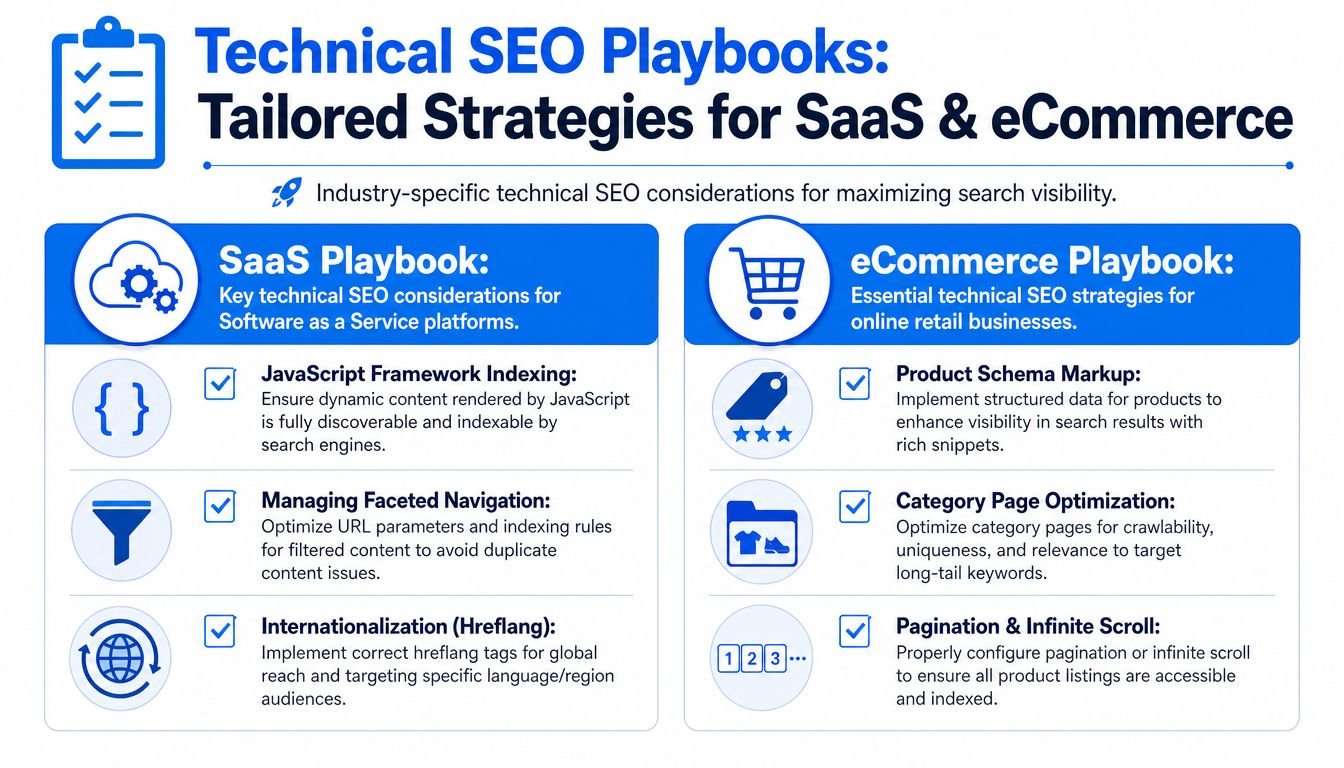
A generic audit misses too much. SaaS and eCommerce sites have different failure modes, different release patterns, and different relationships between product architecture and search visibility.
SaaS priorities
SaaS sites often struggle at the boundary between the marketing site and the product. One side should be highly crawlable and indexable. The other often should not. Teams using modern frontend frameworks also need to be especially careful about what appears in the initial HTML versus what appears only after hydration.
The priority list usually looks like this:
- Rendering integrity so feature pages, solution pages, docs, and comparison pages expose meaningful content in server-rendered or initial HTML output
- Clear crawl separation between indexable marketing assets and non-indexable app environments
- Internal link design that pushes authority to commercial pages, not just blog archives or changelog entries
- Template discipline across landing pages created quickly by demand gen teams
For B2B SaaS, documentation can be an asset or a mess. It becomes an asset when docs are discoverable, internally linked to product pages, and managed intentionally. It becomes a mess when search engines spend time in thin support content while high-intent pages sit underlinked.
eCommerce priorities
eCommerce audits are often won or lost on URL governance. Product variants, filters, sort states, pagination patterns, seasonal categories, and low-value search pages can multiply quickly.
The core playbook usually includes:
- Canonical control across variants, colorways, and parameterized duplicates
- Filtered navigation management so user experience remains strong without creating search waste
- Category page strength through better internal linking, uniqueness, and crawl emphasis
- Pagination or infinite scroll handling that keeps inventory discoverable
- Structured data accuracy on product and category templates
Good auditors are practical, not doctrinaire. Not every filtered URL should be blocked. Some deserve to rank. The job is to distinguish demand-bearing combinations from thin duplicates and then implement rules accordingly.
AI search readiness is now part of technical scope
A modern audit for either SaaS or eCommerce should also check whether the site is prepared for AI-driven discovery, not just traditional crawling.
According to this piece on AI search readiness in technical audits, a 2024 Stackline report found that 68% of brands lack a structured framework to audit their presence in AI overviews, while 42% of B2B buyers now use AI for initial research. The same source argues that modern audits should include LLMs.txt configuration, AI crawler accessibility, and Share of Model baseline metrics.
That matters more for SaaS than many teams realize. Buyers increasingly use AI interfaces to narrow a category before they ever visit vendor pages. If your site is technically crawlable for search but weak for AI extraction, citation, and entity clarity, you may lose visibility earlier in the buying journey.
For eCommerce, the same principle applies to product understanding. Clean structure, accessible product information, and reliable markup make it easier for AI systems to interpret what you sell and where your pages fit.
A good technical audit in 2026 isn't just asking whether Google can crawl your site. It's asking whether search systems, including AI-driven ones, can consistently access, interpret, and surface your most important content.
If you're evaluating how technical SEO, authority building, and implementation fit together for a SaaS or eCommerce growth plan, SaasSky is worth a look. Their positioning is especially useful for teams that want transparent service structure, clear accountability, and search work tied to measurable business outcomes rather than vague activity.