Most advice about Google featured snippets is outdated. It still treats snippets like a standalone SEO win, when the job now is to win the snippet, support the AI Overview, and earn the click anyway.
That change matters for SaaS teams because the old playbook was simple: rank on page one, add a short answer, hope Google lifts it. The current SERP is less forgiving. Google still rewards direct answers, but it also expects depth, clean structure, and evidence that the page can satisfy the search after the first answer. If your content rambles before the answer, uses messy formatting, or hides the useful part under brand-heavy copy, you make extraction harder and lose visibility.
For practitioners, Google featured snippets still matter because they shape attention, trust, and how your page is interpreted. They also expose weak content architecture fast. The pages that win tend to be easier to scan, easier to parse, and easier to refresh. That makes snippet work useful beyond position zero.
Table of Contents
- Featured Snippets in the Age of AI Overviews
- The Strategic Value of Position Zero for Growth
- How to Find High-Impact Snippet Opportunities
- The Content and HTML Optimization Playbook
- Promoting Content and Protecting Your Snippets
- Your Featured Snippet Questions Answered
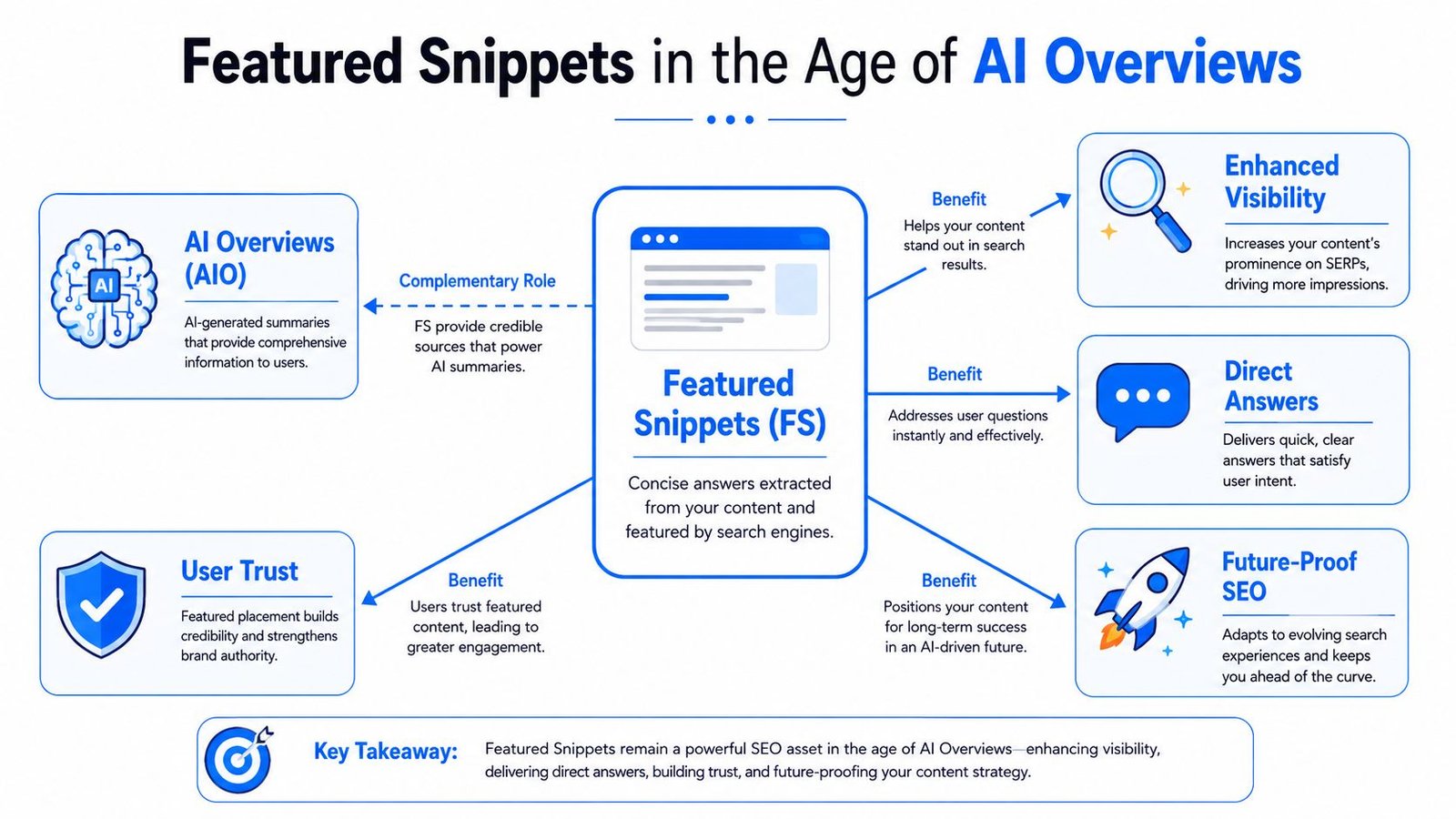
Featured Snippets in the Age of AI Overviews
The biggest mistake in 2026 is assuming featured snippets are dead because AI Overviews exist. They aren't dead. They're just no longer the whole story.
Early 2026 coverage notes that AI Overviews displace featured snippets on 58% of queries, which means optimization has to prioritize the page experience after the direct answer, not just the answer itself. The same coverage also points out that pages still winning clicks after the AI response tend to use 40 to 60 word direct answers followed by structured examples, while pages that bury the answer in a long preamble lose snippet eligibility (analysis of snippet optimization in the AI Overview era).
Why the old snippet playbook breaks
A lot of older SEO guidance still assumes that getting extracted is enough. It isn't. Google now weighs whether your page can serve two jobs at once:
- Answer immediately so the snippet or AI layer can extract a clean passage
- Support the next question so the user has a reason to keep reading
- Offer structured evidence with lists, tables, definitions, or examples that Google can parse reliably
For SaaS content, that usually means your page needs a direct definition near the top, then a stronger second layer like use cases, comparison criteria, implementation notes, or pricing logic. If the answer is surrounded by filler, promotional copy, or vague thought leadership, extraction becomes inconsistent.
Practical rule: Put the shortest correct answer first. Put the proof and nuance right after it.
What still earns visibility
Google featured snippets still come in familiar formats. Paragraph snippets work for definitions and direct questions. List snippets work for steps, workflows, checklists, and ranked options. Table snippets work for comparisons, feature breakdowns, and pricing-style formats where rows and columns matter.
What changed is the tolerance for sloppy structure. Native HTML matters more now. If you're targeting a list snippet, use a real ordered or unordered list. If you're targeting a comparison query, use a real table with semantic sections instead of a fake table built from styled divs.
For agency work, the modern goal isn't just "get position zero." It's to create content that can be lifted into a snippet, cited in adjacent SERP features, and still earn the visit because the page goes deeper than the extracted answer.
The Strategic Value of Position Zero for Growth
Featured snippets are still one of the fastest ways to make a smaller brand look established. That's why I don't treat them as a vanity KPI. I treat them as a distribution asset.
Google featured snippets show up in approximately 12.29% of all search queries, and 41% of question-based queries trigger a featured snippet in position zero. The same analysis found that "why" questions account for 70% of all featured snippets, and because Google holds over 90% of the global search engine market share, snippet placement carries a trust effect that users often interpret as neutral validation (featured snippet market and query analysis).

Why snippets still influence buyer perception
A strong snippet does two things before the click. It tells the searcher that your brand has a usable answer, and it tells Google that your page is a candidate for direct extraction. Those are different wins.
For SaaS, that matters most on commercial education queries. Think:
| Query pattern | Why it matters |
|---|---|
| Competitor alternative queries | Searchers are evaluating replacement options and want fast differentiation |
| Category definition queries | Buyers need clarity before they compare tools |
| Process questions | Teams are figuring out implementation, rollout, or measurement |
| Objection queries | Searchers want reassurance before a demo or trial |
If a CRM vendor wins a snippet for a query like "what is sales pipeline automation," it gets to frame the definition before the comparison phase begins. If a billing platform wins a snippet for "why subscription churn increases," it enters the conversation before the buyer starts vendor evaluation.
Where SaaS teams get the most leverage
The best snippet targets usually sit between pure awareness and pure conversion. They aren't always your highest-volume terms. They're often the questions that shape how a buyer understands the category.
That is why "why" queries are so valuable in practice. They often reveal pain, urgency, or evaluation friction. A searcher asking "why is onboarding adoption low" or "why does revenue recognition matter in SaaS" isn't browsing casually. They're trying to diagnose something.
A snippet can shorten trust-building when the searcher sees your brand attached to the clearest answer on the page.
There is a trade-off. Some snippets reduce clicks because the user gets the answer immediately. That's real. But for SaaS brands, the right snippet often improves the quality of the click that does happen. The visitor arrives with context, not confusion.
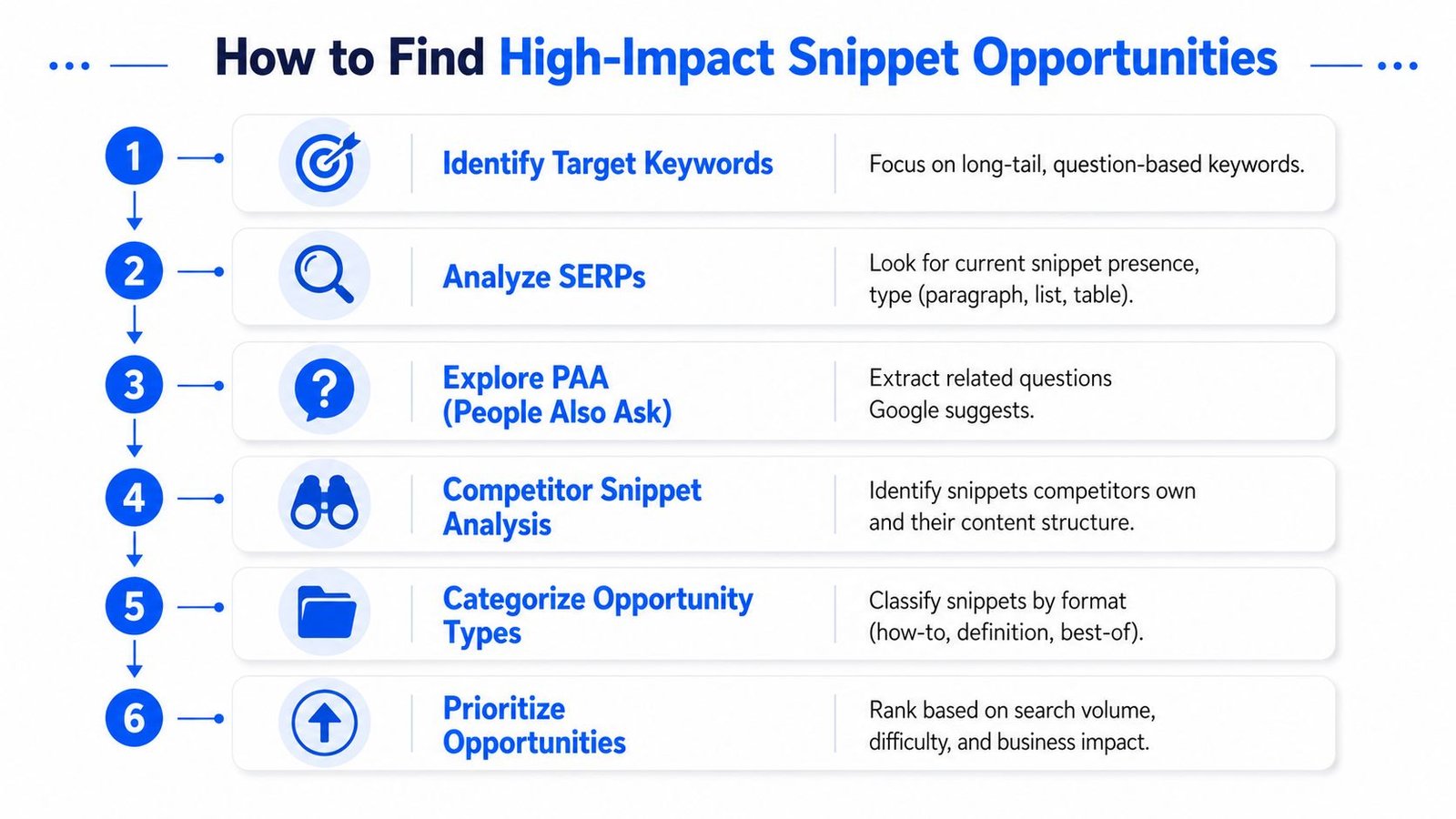
How to Find High-Impact Snippet Opportunities
The wrong way to do snippet research is to export every question keyword you can find and start writing net-new posts. That creates content sprawl and usually targets terms your site has no chance of winning.
The better method is narrower. Start with pages that already have authority, then identify the questions those pages are close to owning. Tools like Ahrefs, Semrush, and STAT assist in this. They don't replace judgment, but they make the shortlisting process much faster.
Start where you already have ranking strength
The most reliable methodology starts with question-based, long-tail keywords where the site already ranks in positions two through five, because pages rarely win snippets if they aren't already highly ranked. The same guidance warns against using the brand name or first-person phrasing like "I" or "we" in the answer block because it weakens clarity and objectivity (step-by-step featured snippet methodology).
My standard workflow looks like this:
- Pull page-one rankings from Ahrefs or Semrush.
- Filter for question modifiers such as what, how, why, vs, best, and difference between.
- Check whether Google is already showing a snippet.
- Flag terms where your page sits just below the snippet holder.
- Group those opportunities by business value, not just keyword pattern.
If your team hasn't mapped topic gaps yet, a structured content gap analysis process makes this shortlist cleaner. It helps separate terms you can upgrade from terms that need an entirely different page.
Audit the current snippet before writing anything
Don't optimize blind. Open the SERP and study the current result.
Look for three things first:
- Format match: Is Google pulling a paragraph, list, or table?
- Weakness: Does the current answer dodge the question, over-explain, or use awkward structure?
- Page type: Is the snippet coming from a glossary page, product page, blog post, or help doc?
Then look at the extraction mechanics. If the competitor owns a table snippet, don't answer with prose and hope Google improvises. If the current snippet is a numbered process, use a real ordered list and make each step self-contained.
When a page is already ranking well, small structure changes often matter more than large content rewrites.
Build a shortlist that can actually move pipeline
I usually sort opportunities into three buckets.
Near-win terms are keywords where you already rank close to the snippet and only need formatting, concision, or a better answer block.
Expansion terms are adjacent questions that belong on an existing page. These often come from People Also Ask patterns and can be added as new subheads.
Authority terms need a stronger page, stronger linking, or both. They're worth targeting, but not first.
A short practical checklist helps keep this sane:
- Revenue relevance: Would a prospect searching this term be useful to sales, success, or product marketing?
- SERP fit: Can your page realistically match the current snippet format?
- Page strength: Does the URL already have topical authority?
- Refresh feasibility: Can your team update and maintain the answer without friction?
Many teams often overbuild. They target every question in the category. The better move is to target the questions your current domain can credibly answer and defend.
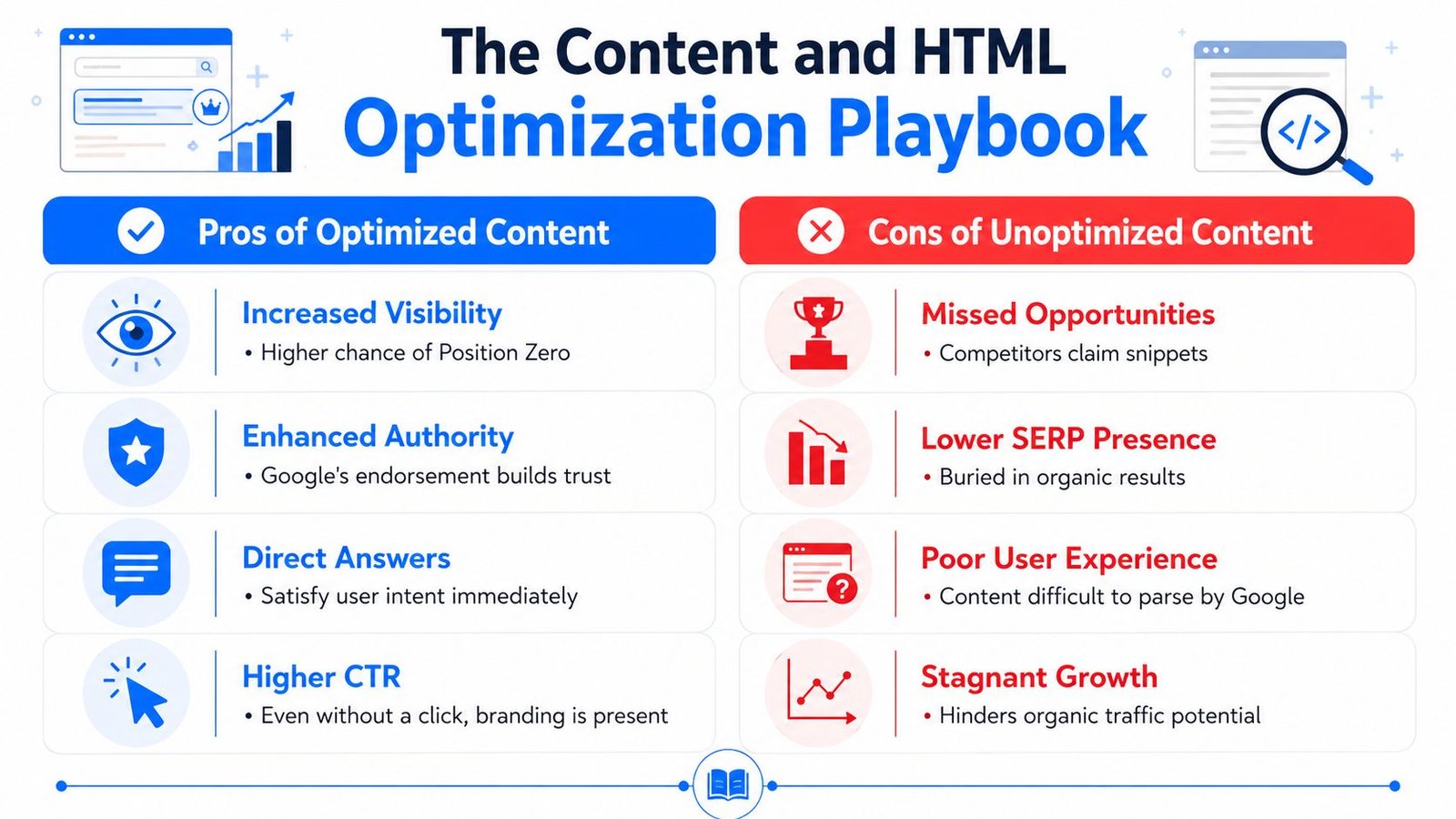
The Content and HTML Optimization Playbook
Once the target is selected, execution gets technical fast. At this stage, most snippet projects fail. The content may be smart, but Google can't extract it cleanly.
The playbook I use is simple. Match the query intent, match the existing snippet format, and make the answer block painfully easy to parse.
Paragraph snippet template
For paragraph snippets, the most useful rule is still the clearest one. Write a direct, factual answer of 40 to 50 words, and make the first sentence an "is" statement such as "[Keyword] is…". Research summarized in the snippet statistics also notes that winning the snippet can move CTR from 1.8% to 5.8% and capture 35.1% of total click share for that query (featured snippet CTR and paragraph-length analysis).
A working template looks like this:
[Keyword] is [direct definition]. It [explains core function or outcome]. It is commonly used for [primary use case or context].
Example for a SaaS page:
Revenue operations is the practice of aligning sales, marketing, and customer success around shared data, processes, and reporting. It helps teams improve forecasting, reduce handoff friction, and manage growth with a single operational view.
Keep the answer near the relevant heading. Don't sandwich it under a personal anecdote. Don't lead with your product. Don't write like ad copy.
List and table snippet structures
List snippets are usually easier to win when the query implies sequence, criteria, or options. Use clean HTML, not visual hacks.
For lists, I use this structure:
- H2 with the exact question or process
- One-sentence setup paragraph
- Native
<ol>for steps or<ul>for non-sequential items - Short list items that still make sense out of context
For example, if the query is "how to reduce SaaS churn," each list item should stand alone:
- Identify churn by segment.
- Fix onboarding friction first.
- Trigger expansion and rescue workflows.
- Review cancellation reasons monthly.
Table snippets are different. Google needs structure it can read without guessing. For comparison queries, use a real <table> with <thead> and <tbody>, then write a concise sentence above the table telling Google what the table shows.
A simple pattern:
| Plan feature | Best practice |
|---|---|
| Table title | Use a heading that mirrors the comparison intent |
| Header row | Keep labels plain and scannable |
| Body rows | Focus on one comparison variable per row |
| Surrounding copy | Explain what the reader should learn from the table |
If the SERP already shows a table snippet, matching that format isn't optional. It is the optimization.
Schema and page structure rules
Schema doesn't guarantee a featured snippet, but it helps search engines understand the page. FAQ and HowTo markup are the practical options for content teams because they reinforce question-answer structure and process logic.
I also pay close attention to page architecture. A weak page structure makes even good snippet bait unreliable. Strong internal hierarchy, clean heading order, and crawlable content blocks all help Google extract the right passage. This is one reason technical layout work and snippet work overlap. Teams that need to fix both usually benefit from revisiting their site structure for SEO before scaling content production.
Use this do-and-don't list when editing:
- Do answer early: Put the snippet candidate directly below the relevant heading.
- Do write objectively: Keep the tone factual in the answer block.
- Do use semantic HTML: Real lists and tables beat styled containers.
- Don't use first person: "We believe" and "our platform" weaken extractability.
- Don't overstuff context: The supporting detail belongs after the answer, not inside it.
The page should read like something Google can lift without rewriting.
Promoting Content and Protecting Your Snippets
Publishing the page isn't the finish line. Snippets are volatile. A better-structured competitor, a fresher answer, or a stronger internal linking pattern can take the spot.
That is why I treat snippet work as an operating loop, not a one-time optimization sprint.
Promotion gives the page enough authority to stick
The first phase after publishing is support. A newly optimized page needs authority signals from the rest of the site. Internal links do most of that work.
I usually add links from three page types:
- High-authority blog posts that already earn links and impressions
- Commercial pages that are topically adjacent to the snippet target
- Resource hubs or glossaries where definitions and comparisons are expected
Anchor text should reflect the query naturally. If the target page is answering a category question, link with the category phrase or a close variation. Don't force exact-match anchors into every paragraph.
External promotion matters too, especially for competitive SaaS SERPs. If the page is strategically important, distribute it through partner mentions, founder content, newsletters, and targeted outreach. A broader content distribution channel mix gives the page more ways to earn discovery and authority.
Refreshing a page without improving its authority usually creates a temporary lift, not a durable one.
Defense is a repeatable operating rhythm
Protecting a snippet means watching for decay. The warning signs are familiar. Search Console impressions rise but clicks flatten. A competitor publishes a cleaner answer. Google starts pulling a different passage from your page than the one you intended.
My maintenance rhythm is practical:
- Review the live SERP: Confirm whether the snippet format changed.
- Check the extracted passage: Make sure Google is lifting the right block.
- Refresh examples and comparisons: Especially on software categories that evolve quickly.
- Tighten the answer block again: Teams often let intro copy expand over time.
- Watch page speed and UX issues: Slow or clumsy pages make ranking harder to sustain.
If a competitor takes the snippet, I don't usually rewrite the entire page first. I compare structures side by side. In many cases, the fix is sharper formatting, cleaner HTML, or a better follow-up section after the answer block.
The pages that hold snippets longest tend to stay current and stay easy to parse.
Your Featured Snippet Questions Answered
How long does it take to win a snippet
There's no fixed timeline. Some pages get picked up soon after a recrawl. Others need multiple edits, stronger internal links, or improved rankings before Google considers them. If the page isn't already competitive on page one, patience won't solve the core issue.
Do you need a developer
Not always. A content strategist or SEO manager can handle a lot of snippet work inside a modern CMS. But if your site uses messy templates, fake tables, inconsistent heading markup, or broken schema implementation, developer help becomes important fast.
Can a homepage win a featured snippet
It can, but it usually isn't the best page type for the job. Google often prefers pages that answer one question clearly. Homepages tend to serve too many intents at once. A focused product, glossary, blog, or help page is usually easier to optimize.
Should you chase position zero or rank one
Treat that as a false choice. You usually need strong organic rankings to win the snippet anyway. The actual question is whether the query rewards a direct answer and whether owning that answer helps your business. If yes, optimize for both.
Are snippets still worth it with AI Overviews
Yes, but only if the page does more than answer the first question. The direct answer gets you visibility. The structured depth underneath it earns the visit.
What usually stops a good page from winning
Three things show up again and again: weak ranking position, poor formatting, and an answer block that sounds like brand messaging instead of a factual response. Many organizations don't have a knowledge problem. They have an extraction problem.
If your team wants help turning ranking content into pages that win and hold SERP real estate, SaasSky works with SaaS and eCommerce brands on the authority side of the equation. That includes the links, distribution support, and practical SEO execution that make snippet-ready content harder for competitors to dislodge.