Your budget sheet is open. One tab shows content costs, technical fixes, and link acquisition. Another shows social creative, community management, and paid distribution. The question looks simple: SEO or SMO?
For most SaaS and eCommerce teams, that's the wrong framing.
What sits underneath the SEO vs SMO decision is a growth sequencing problem. Do you need demand now, or do you need to build an acquisition asset that keeps compounding? Do you need to validate messaging fast, or capture buyers already searching for a solution? If you spend everything on search too early, you can wait too long for signal. If you spend everything on social, you can create attention that never turns into durable pipeline.
The right move is usually to build both, but give each channel a different job. SEO captures existing demand. SMO creates and shapes future demand. When those roles are clear, budget decisions get much easier.
Table of Contents
- The SaaS and eCommerce Growth Dilemma
- SEO and SMO Defined for Modern Growth Teams
- Comparing Time to Value and Cost Implications
- Measuring Success The Right KPIs for Each Channel
- Channel-Specific Tactics for SaaS and eCommerce
- The Unified Growth Playbook Integrating SEO and SMO
- Allocating Your Budget and Resources Wisely
The SaaS and eCommerce Growth Dilemma
A founder with limited runway doesn't usually ask for “more marketing.” They ask for traction. They want to know whether the next dollar should go into content that may rank later, or social activity that can generate attention this week.
That tension is real because the channels solve different problems. SEO helps you show up when buyers already know they need something. SMO helps you get in front of people before they search, while they're browsing LinkedIn, Instagram, X, or another feed.
For SaaS, this often shows up as a hard trade-off between pipeline quality and speed of market feedback. Search traffic usually brings stronger intent because the user is actively looking for a solution. Social gives you faster message testing because comments, shares, and post performance tell you quickly whether the market cares.
For eCommerce, the split often comes down to category capture versus brand energy. SEO can turn category, product, and comparison pages into durable acquisition assets. SMO can make new products feel visible, desirable, and current.
Practical rule: If your team is arguing about SEO vs SMO as if one must replace the other, you're usually mixing up channel roles with budget timing.
The better question is this: what should each channel do for the business over the next two quarters? Once you answer that, the budget stops feeling abstract. Search becomes your long-term demand capture system. Social becomes your demand creation and distribution layer. Together, they form a growth engine instead of two disconnected bets.
SEO and SMO Defined for Modern Growth Teams
SEO and SMO get flattened into generic marketing jargon too often. For operating teams, the distinction is simpler and more useful.
SEO is demand capture. You optimize pages, internal links, site architecture, technical health, and authority signals so search engines trust your site enough to rank it for relevant queries. Those queries often come from people already evaluating a problem, product category, or vendor.
SMO is demand creation and amplification. You publish and distribute content on social platforms so people who weren't actively searching still discover your brand, ideas, and offers. The goal isn't just reach. It's familiarity, trust, and repeated exposure.
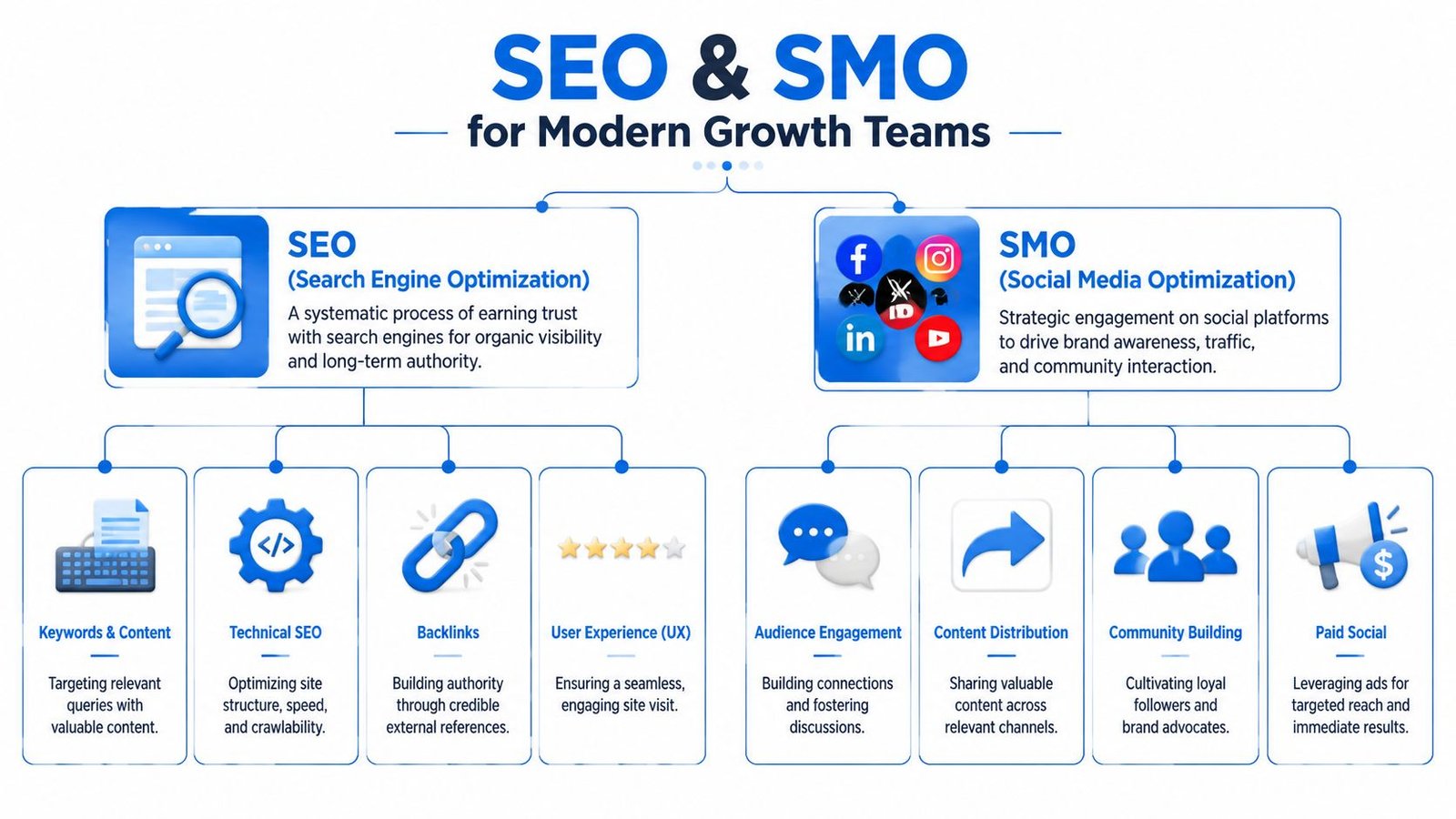
According to Virtuosity Digital's 2026 comparison of SEO and SMO, SEO delivers stronger long-term ROI because it targets users actively searching for specific solutions, while SMO reaches discovery-oriented users and drives faster visibility. The same analysis notes that SEO benchmarking includes Core Web Vitals compliance such as LCP below 2.5 seconds and FID below 100 milliseconds, mobile friendliness, and domain authority tracking, while SMO optimization leans on sharing frequency, deeper interaction, and platform-specific engagement behavior.
Where SEO earns its keep
SEO does its best work in the middle and bottom of the funnel. That includes pages like:
- Problem-aware content that targets searches tied to pain points
- Comparison pages for buyers evaluating alternatives
- Category and collection pages for eCommerce shoppers who know what they want
- Use-case pages that map product value to clear buying intent
A good SEO program doesn't just publish articles. It builds a searchable system. That means content briefs tied to query intent, technical cleanup in Google Search Console and crawling tools, internal links that pass context, and pages built to satisfy the searcher rather than just hit a keyword.
Where SMO changes the game
SMO works higher in the funnel, but that doesn't make it soft. It's where teams test angles, sharpen positioning, and create repeated brand exposure before a buyer ever opens Google.
In practice, that means social content such as:
- Founder-led insight posts on LinkedIn for B2B SaaS
- Short-form product education on Instagram, YouTube, or X
- Customer proof snippets pulled from reviews, demos, and support wins
- Community interaction that turns a passive audience into a remembered brand
SEO answers demand. SMO shapes it first.
The strongest growth teams don't ask which discipline is more “important.” They assign each one a job in the buyer journey, then build reporting and workflow around that role.
Comparing Time to Value and Cost Implications
When a founder asks about SEO vs SMO, they're usually asking two operational questions. How long until this works, and how much effort does it take to keep working?
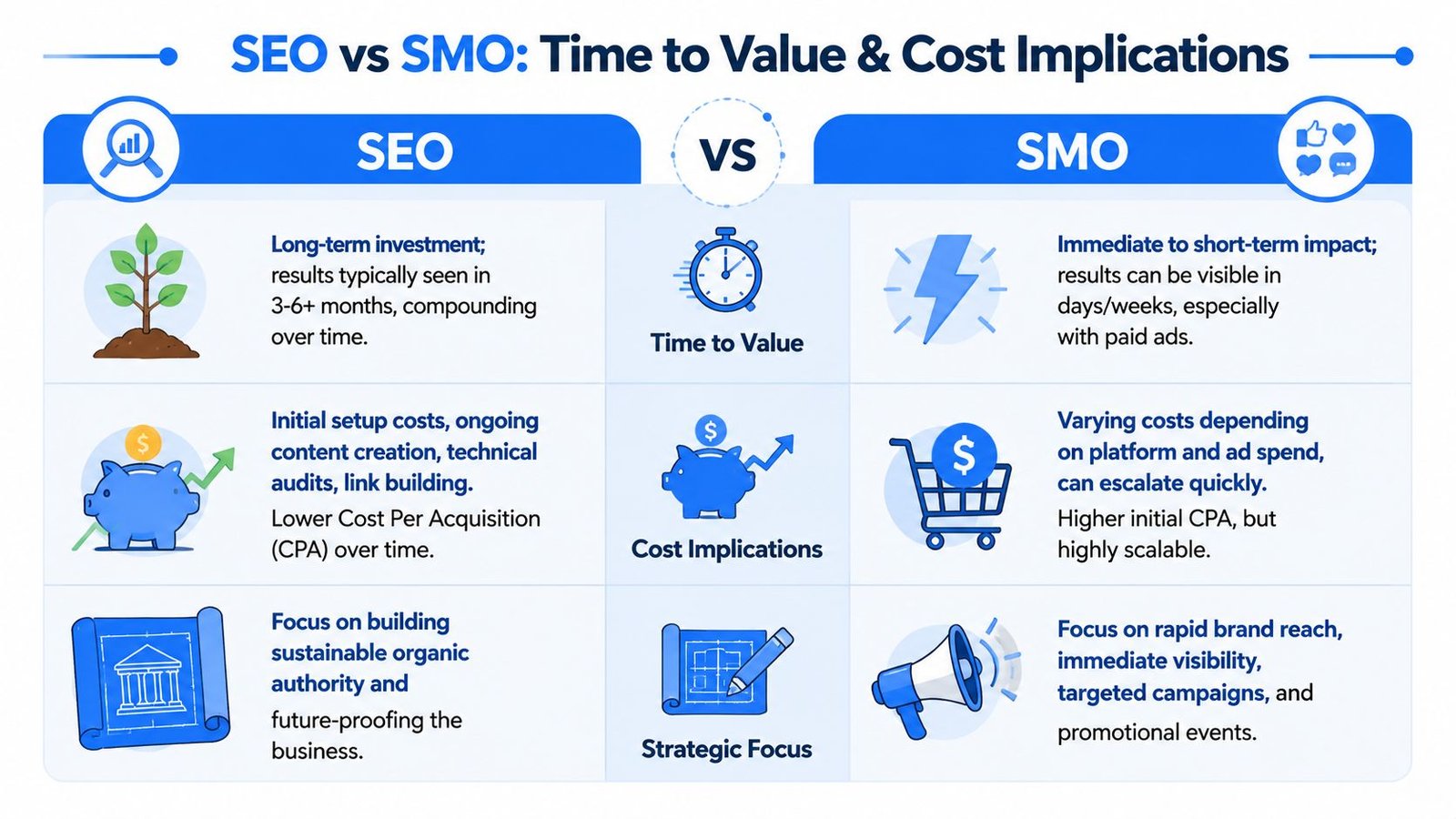
Search has a slower start. Social gives feedback much faster. That's not a flaw in either channel. It's the core trade-off.
Search Atlas notes that new websites typically need 6 to 12 months to achieve noticeable SEO visibility, established sites often see changes within 3 to 6 months, and local SEO can show progress in 2 to 3 months. The same source frames SEO as a long-term demand capture strategy whose returns compound as content improves, backlinks accumulate, and authority builds over time.
SEO vs. SMO At a Glance
| Metric | SEO (Demand Capture) | SMO (Demand Creation) |
|---|---|---|
| Primary role | Capture existing search intent | Create attention and interest before search |
| Time to value | Slower, with longer payoff horizon | Faster feedback and visibility |
| Asset lifespan | Content and rankings can compound | Attention fades without continued publishing |
| Core work | Technical SEO, content, internal links, authority building | Content creation, distribution, engagement, community |
| Best fit | Buyers already evaluating a solution | Audiences still discovering the problem or brand |
| Main risk | Teams quit before compounding starts | Teams mistake engagement for revenue progress |
What the investment curve really looks like
SEO usually feels expensive early because you pay before you see stable output. You invest in content strategy, technical fixes, on-page optimization, and authority building before rankings settle. That can be frustrating for early teams that need signal now.
SMO feels cheaper at the start because the loop is shorter. A post goes live, and you know quickly whether the message landed. But social has a hidden operating cost: it demands consistency. If your team stops publishing, comments slow down, reach falls off, and the channel goes quiet.
Insprago explains that SMO creates immediate engagement and brand visibility, with performance tracked in real time through likes, shares, comments, and follower growth, while also supporting broader SEO efforts by increasing content reach.
Where teams overspend
The most common waste patterns are predictable.
- Overfunding SEO too early: Teams produce top-of-funnel articles before they've validated positioning, pricing language, or ICP pain points.
- Overfunding SMO too long: Teams keep feeding social reach without turning winning narratives into search assets on their site.
- Ignoring operational capacity: SEO breaks when no one updates pages. SMO breaks when no one ships content every week.
Spend on SEO when you're ready to build an asset. Spend on SMO when you need signal, reach, and message learning. Fund both when you can connect the two.
If you need immediate market response, social is often the faster place to start. If you need durable acquisition that doesn't disappear when campaigns pause, search deserves a bigger share over time.
Measuring Success The Right KPIs for Each Channel
A lot of channel confusion comes from bad reporting. Teams judge social by last-click conversions and judge SEO by vanity traffic. Both mistakes create bad budget decisions.
Intergrowth's benchmark analysis shows that SEO performance is measured through long-term, high-intent metrics including organic sessions, keyword rankings in top 3 positions, and organic conversion rates, while SMO relies on short-term engagement benchmarks such as shares per post, reach velocity, comment-to-view ratios, and follower growth rates that often peak within 24 to 48 hours.
SEO KPIs that show business value
For SEO, the strongest dashboard starts with intent and ends with commercial outcome.
- Organic sessions by page type tell you whether blog, comparison, category, or product pages are pulling in the right traffic.
- Keyword rankings in top 3 positions matter more than raw ranking counts because that's where visibility becomes meaningful.
- Organic conversion rates show whether the traffic is commercially useful, not just present.
- CTR by query group helps identify where title tags and page positioning need work.
- Technical health signals such as Core Web Vitals, mobile usability, and crawl coverage reveal whether the site can support growth.
If your team needs a quick refresher on how search visits differ from paid or direct sessions, this guide to organic traffic is a useful baseline.
SMO KPIs that actually matter
Social metrics should reflect attention quality, not just raw exposure.
- Shares per post indicate whether people found the content worth passing on.
- Reach velocity helps you spot which topics earn fast distribution.
- Comment-to-view ratio is one of the better signals of actual resonance.
- Follower growth matters when it comes from relevant audiences, not broad giveaways or low-intent content.
- Interaction depth matters more than shallow likes. A thoughtful comment usually says more than a passive tap.
A good social report also separates content by objective. Thought leadership, product education, user-generated content, and launch announcements shouldn't be judged with the same benchmark.
The reporting mistake that hides good performance
The biggest mistake is forcing both channels into one conversion model.
A top-of-funnel LinkedIn post may never look great in last-click attribution. It can still be doing critical work by introducing the brand, testing pain-point language, and warming future buyers. Likewise, an SEO article can drive lots of sessions and still fail if it never connects to product intent.
The fix is simple. Give each channel its own scoreboard, then build one shared view at the business level. SEO should prove intent capture and conversion quality. SMO should prove reach, engagement quality, and topic validation.
Channel-Specific Tactics for SaaS and eCommerce
The easiest way to waste budget is to run generic tactics in a specific market. SaaS and eCommerce need different execution, even when the channel label is the same.
What works for SaaS
For SaaS SEO, start with pages tied to buying or evaluation behavior. That usually means solution pages, alternative pages, integration pages, and problem-led guides.
A practical workflow looks like this:
- Build a page around a clear problem query your buyers use.
- Add product context early so the page attracts qualified readers, not just broad traffic.
- Support it with internal links from feature, use-case, and comparison pages.
- Refresh the page when sales calls reveal new objections or wording.
For SaaS SMO, LinkedIn often outperforms broader awareness channels when the buyer is a team lead, operator, or executive. Repurpose real sales and customer language into posts, carousels, and short clips. Product marketers often do well with content that explains one pain point, one mistake, or one buying insight at a time.
Useful social content formats for SaaS include:
- Founder commentary on market changes, product decisions, or customer problems
- Mini teardown posts that analyze workflows, onboarding friction, or common software gaps
- Customer proof snippets turned into simple visuals or text posts
- Feature education clips that focus on the outcome, not the UI tour
What works for eCommerce
For eCommerce SEO, category and collection pages usually deserve more attention than blog volume. Buyers often search with strong commercial intent, so page structure, product filtering, copy clarity, and internal linking matter.
Strong eCommerce SEO work often includes:
- Optimized category pages that match the language shoppers use
- Product page improvements with clear specs, FAQs, and intent-matching copy
- Internal links from buying guides into collections and featured products
- Technical cleanup so pages load cleanly on mobile and are easy to crawl
For eCommerce SMO, visual proof matters. Social works best when the product is shown in context and the audience sees use, style, or outcome quickly. Instagram, short-form video, creator content, and user-generated content often do more than polished brand-only posts.
Social should make the product feel real. Search should make it easy to buy.
What usually fails in both
Some patterns underperform across both business models.
- Publishing without a point of view: Commodity content disappears in both search and feeds.
- Sending social traffic to weak landing pages: Good distribution can't rescue confusing copy or poor page structure.
- Separating content teams from revenue teams: Sales calls, support tickets, reviews, and product feedback are often the best source material.
- Treating every channel asset as standalone: The best-performing teams build once, then adapt the idea for search, social, email, and sales enablement.
If a tactic doesn't connect to audience intent, message clarity, or conversion flow, it won't matter whether you call it SEO or SMO.
The Unified Growth Playbook Integrating SEO and SMO
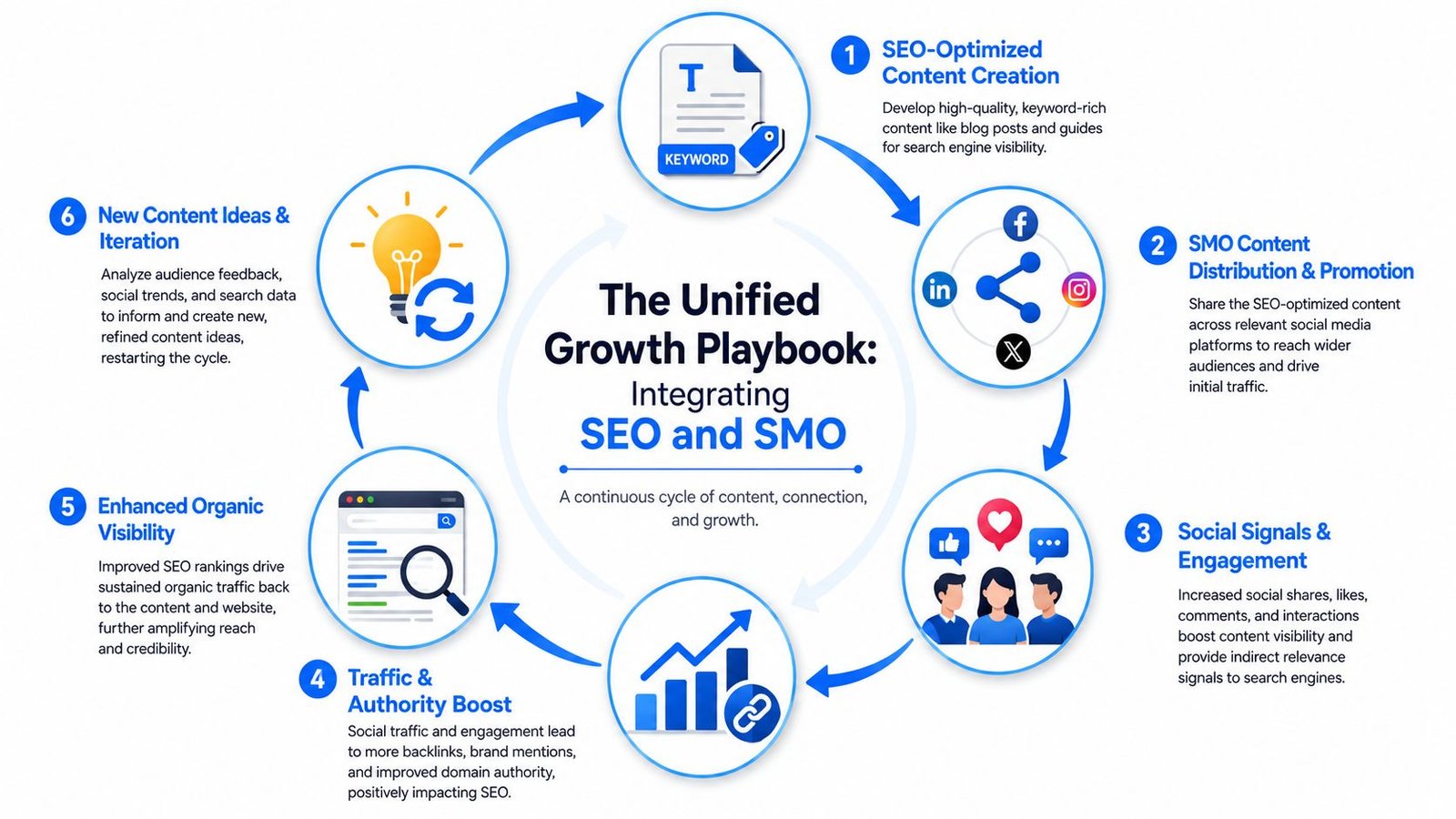
The strongest answer to SEO vs SMO is operational, not philosophical. Use social to find out what people care about. Use search to turn those proven ideas into durable assets. Then distribute those assets back through social.
How the flywheel works
A practical integrated workflow looks like this:
- Start in social: Test hooks, pain points, objections, and product angles through LinkedIn posts, threads, reels, short clips, or community prompts.
- Promote what resonates: When comments deepen and shares increase, that topic has earned more investment.
- Build SEO assets from proven themes: Turn the winning angle into a guide, comparison page, category page, use-case page, or glossary entry.
- Redistribute the owned asset: Break the page into carousels, quote graphics, short videos, or founder commentary.
- Collect feedback and refine: Use both search data and social responses to sharpen the next iteration.
A broader content planning process across channels works best when distribution is part of the brief from day one. This overview of content distribution channels is a useful way to think about that workflow operationally.
Why AI discovery changed the playbook
The 2026 projection from 12am Agency argues that 65% of SaaS discovery now occurs via AI-curated social feeds, only 15% of SaaS SEO strategies have adapted to AI-generated search queries, SaaS firms using traditional SEO miss 50% of AI-driven intent traffic, and 70% of SaaS buyers now use AI assistants for initial research. Treat that as a directional signal about where buyer behavior is heading, not a reason to abandon search.
What it means in practice is that discovery and intent are blending. A buyer may first encounter your category through an AI-personalized LinkedIn feed, then ask an AI assistant a solution query, then compare vendors through search. If your team isolates SEO and SMO, you lose continuity across that journey.
The channel handoff matters more now. Social creates the first memory. Search captures the serious evaluation.
That's why integrated teams outperform siloed ones. They don't just create content. They build topic systems that can live in feeds, on site, in AI-assisted research flows, and inside sales conversations.
Allocating Your Budget and Resources Wisely
The cleanest budget framework is stage-based. Not industry-average percentages. Not channel dogma. Business stage.
If you're early-stage and still tightening positioning, lean heavier into SMO. You need message testing, audience feedback, and visible market presence. Keep SEO active, but focused. Build core pages, fix technical issues, and publish only the highest-intent assets first. Don't try to win the entire SERP before you know which narrative converts.
If you're growth-stage and product-market fit is clearer, move toward balance. At this stage, SEO starts paying off because your positioning is stable enough to support scaled content and authority work. Social should still run hard, but with a sharper role: distribute, validate, and reinforce the narratives already proven in pipeline.
If you're more mature, SEO should usually become the larger long-term engine, while SMO supports launches, thought leadership, community presence, and brand retention. At that point, search helps defend category share and lower dependence on rented attention.
A practical budgeting rule is simple:
- Early-stage: Bias toward learning and awareness
- Growth-stage: Balance capture and creation
- Mature stage: Bias toward durable search visibility while maintaining social distribution
Resource planning matters as much as budget planning. If you want SEO to work, assign owners for technical health, editorial quality, and authority building. If you want SMO to work, assign owners for creative production, distribution cadence, and community response. If you need a grounded reference point before planning spend, this breakdown of the average cost for SEO services helps frame the conversations teams usually have with agencies and operators.
The best next marketing dollar rarely goes to SEO or SMO in isolation. It goes to the missing part of the system.
SaaS and eCommerce teams that want a more durable growth engine usually don't need more channel noise. They need cleaner execution, better authority building, and a plan that turns content into measurable visibility. If that's the stage you're in, SaasSky is worth a look for practitioner-led SEO and link building support built around transparency, accountability, and results that compound.