Search visibility is the share of potential organic clicks your brand captures for its target keywords, and the metric is usually expressed as a 0 to 100% score based on rankings, estimated click-through rate, and keyword search volume. For many sites, this matters immediately because organic search accounts for approximately 30% of overall website traffic, and organic channels can convert at upwards of 20% to 25%.
You probably know the feeling. The product is solid, the site looks fine, paid campaigns are running, and yet the pipeline from search is thin. A founder searches the category term and sees competitors everywhere. Their own site is buried so far down the results that it may as well not exist.
That's why what search visibility is shouldn't be treated as a vague SEO term. It's a core health metric for a digital business. It tells you how much of the demand already present in search your brand is capturing. In practical terms, it measures whether buyers can find you when they're looking for the problem you solve, the category you operate in, or the product you sell.
That matters even more in a market where Google holds 89.74% of all search engine queries worldwide, making Google visibility effectively global visibility for most SaaS and eCommerce brands, as noted by the Digital Marketing Institute's SEO statistics roundup. The same source notes that over 53% of all search traffic is organic, which is why visibility compounds in a way most channels don't.
There's another layer now. Ranking on Google is no longer the whole game. Brands also need to appear in AI-generated answers, where visibility depends less on blue links and more on whether systems like ChatGPT or Gemini cite your brand at all.
Table of Contents
- Introduction Why Your Product Is Invisible Online
- What Search Visibility Actually Means Beyond Rankings
- How to Measure Search Visibility Accurately
- The Business Case for Visibility in SaaS and eCommerce
- The New Frontier of Classic vs AI Search Visibility
- The Playbook to Increase Your Search Visibility
- Common Questions About Search Visibility
Introduction Why Your Product Is Invisible Online
A lot of companies mistake low search traffic for a content problem. Sometimes it is. More often, it's a visibility problem hiding underneath several smaller issues: weak rankings across commercial terms, thin coverage of adjacent topics, poor internal linking, and pages that don't earn enough trust to surface consistently.
For a SaaS company, that can mean your competitor appears for “best CRM for startups” while you only rank for your own brand name. For an eCommerce store, it can mean your category pages never break into the results for the exact products buyers compare before purchase. The site exists, but the market barely sees it.
Why invisibility is a growth issue
Search isn't just another acquisition channel. It captures intent that already exists. During queries for a problem, a comparison, or a category, they're often much closer to action than they are on social or display. If your site doesn't appear in those moments, someone else gets that demand.
That's why search visibility works as a business KPI, not just an SEO metric. It reflects your share of opportunity in search. A stronger score usually means broader market penetration across the terms that matter to your revenue model.
Search visibility is the cleanest way to answer a simple question: when your market goes looking, how often does your brand show up where clicks happen?
Why this now includes AI surfaces
Founders and growth teams still focus heavily on rank trackers, and they should. But users increasingly ask tools, assistants, and AI search experiences to summarize options instead of clicking through ten blue links. If your brand isn't cited in those answers, your actual visibility can be weaker than your SERP positions suggest.
That's why the useful version of this topic isn't just “what is search visibility.” It's how to measure it in the classic Google sense and how to adapt it for AI-driven discovery.
What Search Visibility Actually Means Beyond Rankings
Ranking reports are useful, but they often create the wrong mental model. A single keyword in position one can look impressive while the business remains mostly absent across the broader category.
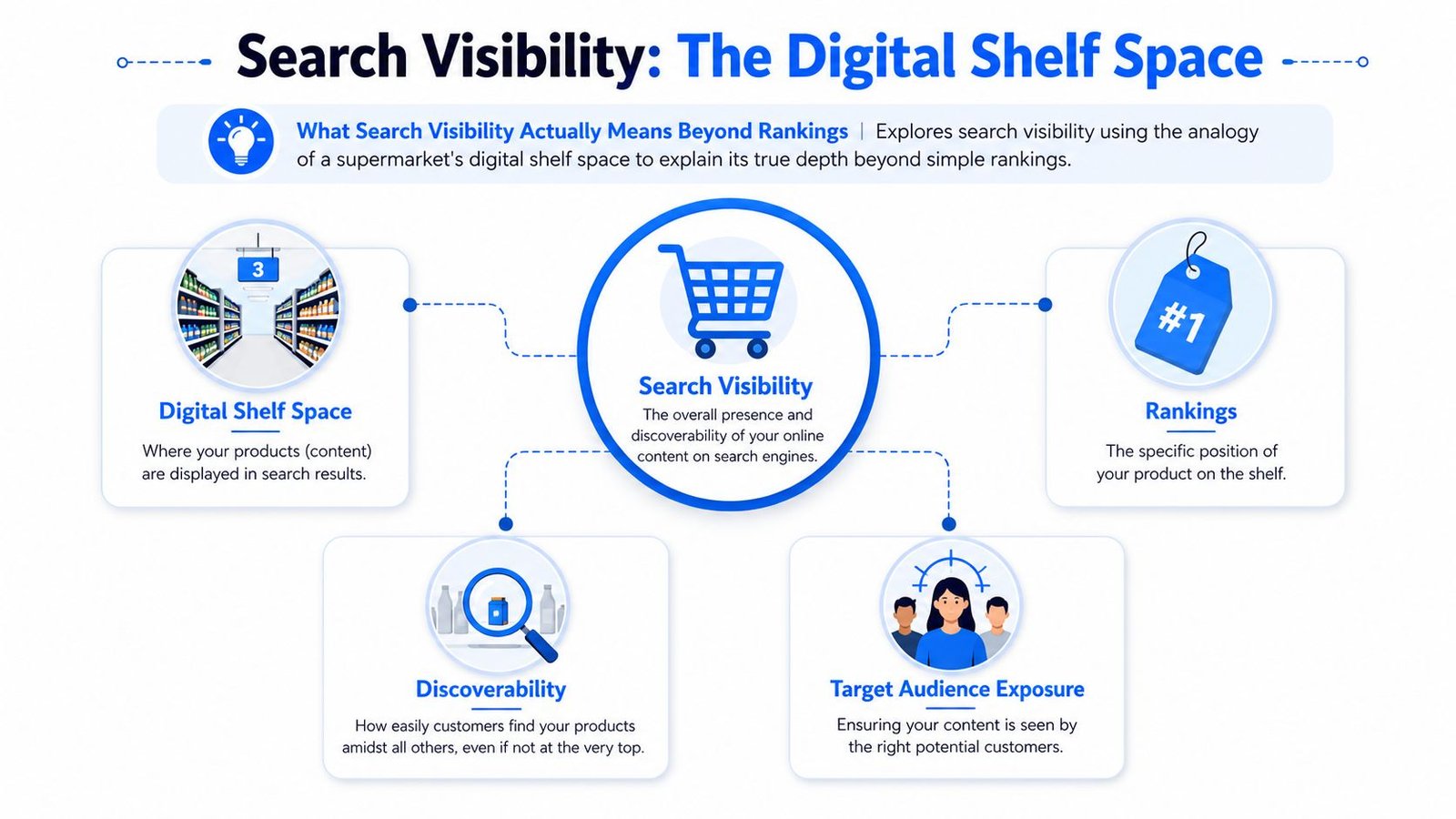
The better analogy is digital shelf space. In a supermarket, eye-level placement matters, but one product on one shelf doesn't mean your brand dominates the store. Search works the same way. Visibility is the amount of shelf space your brand occupies across the results that matter to your audience.
Rankings are inputs, not the KPI
If you rank first for a low-value keyword and nowhere for the core category, your visibility can still be weak. Search visibility weighs both where you rank and how much demand exists for the terms you track. That makes it far more useful than a screenshot of a few vanity positions.
A SaaS company selling onboarding software might rank well for a niche article topic but miss higher-intent terms like implementation software, onboarding checklist software, or employee onboarding platform. An eCommerce brand might rank for blog content while product and collection pages stay invisible on transactional searches. In both cases, rankings exist, but meaningful visibility doesn't.
Working definition: Search visibility measures how much of the potential organic click opportunity your site captures across a tracked set of keywords.
Why coverage matters as much as position
The strategic approach sharpens. Good visibility comes from breadth plus depth. You need category pages, comparison pages, use-case pages, supporting educational content, and internal links that help search engines understand the relationships between them. If you're building authority around clusters, this guide on topical authority is a useful complement to that approach.
A few practical distinctions make this easier to evaluate:
| Situation | What it looks like | What it usually means |
|---|---|---|
| Strong rankings, narrow keyword set | You perform well on a handful of terms | Limited market reach |
| Broad keyword footprint, weak positions | You appear often but too low to win clicks | Authority or page quality gap |
| Strong visibility across core topics | You rank consistently where intent is high | Search is becoming a growth engine |
The biggest mistake teams make here is treating visibility like a trophy metric. It's not. It's a forecast of how much search demand you're positioned to capture if your pages continue to hold or improve.
How to Measure Search Visibility Accurately
Search visibility isn't a mysterious score invented by SEO tools. It's a modeled estimate of how much organic click share your site captures based on the keywords you track, the positions you hold, and the search volume attached to those terms.
According to Moz's explanation of visibility scoring, search visibility is calculated as a weighted percentage of estimated organic clicks. The score is built by aggregating ranking positions, applying a position-based CTR model, using examples such as Position #1 ≈ 30%, multiplying by keyword search volume, and expressing the result as a 0 to 100% score.
The inputs behind the score
The math is only useful if the keyword set is useful. That's the part many teams get wrong.
Your visibility score depends on:
- Tracked keywords: The terms you choose define the market you're measuring. If the list is too narrow or full of low-intent terms, the score won't reflect real business opportunity.
- Ranking position: Higher positions carry more estimated click value than lower ones.
- Search volume: A move on an important keyword affects visibility more than a move on a fringe term.
- CTR weighting: The click curve is not linear. Moving up a few spots near the top usually matters far more than moving from deep page positions.
What a visibility trend is really telling you
A rising trend usually means one of three things is happening. You're ranking higher for existing tracked terms, you've added more relevant keywords to the set and now appear for them, or your highest-value pages are gaining stronger positions on higher-volume queries.
A falling trend can mean the reverse. It can also mean your tracked keyword set is outdated. This is why a visibility graph should never be read in isolation. It needs context from page types, intent segments, and whether the tracked set still matches your business.
Practical rule: Treat search visibility as a directional KPI. Use it to spot gains and losses in market presence before raw traffic or leads fully reflect the change.
What to look for in tools
Ahrefs, Semrush, and Moz all automate versions of this scoring model. The exact naming differs, but the interpretation should stay consistent.
Use the metric to answer questions like:
- Are category and solution pages gaining share?
- Are non-brand queries improving, or are branded terms inflating the score?
- Which topic clusters contribute most of the score?
- Did the score move because rankings improved, or because tracked keywords changed?
If your team is still conflating visibility with sessions, it helps to ground the conversation in organic traffic fundamentals. Traffic is the outcome. Visibility is the upstream signal that often moves first.
The Business Case for Visibility in SaaS and eCommerce
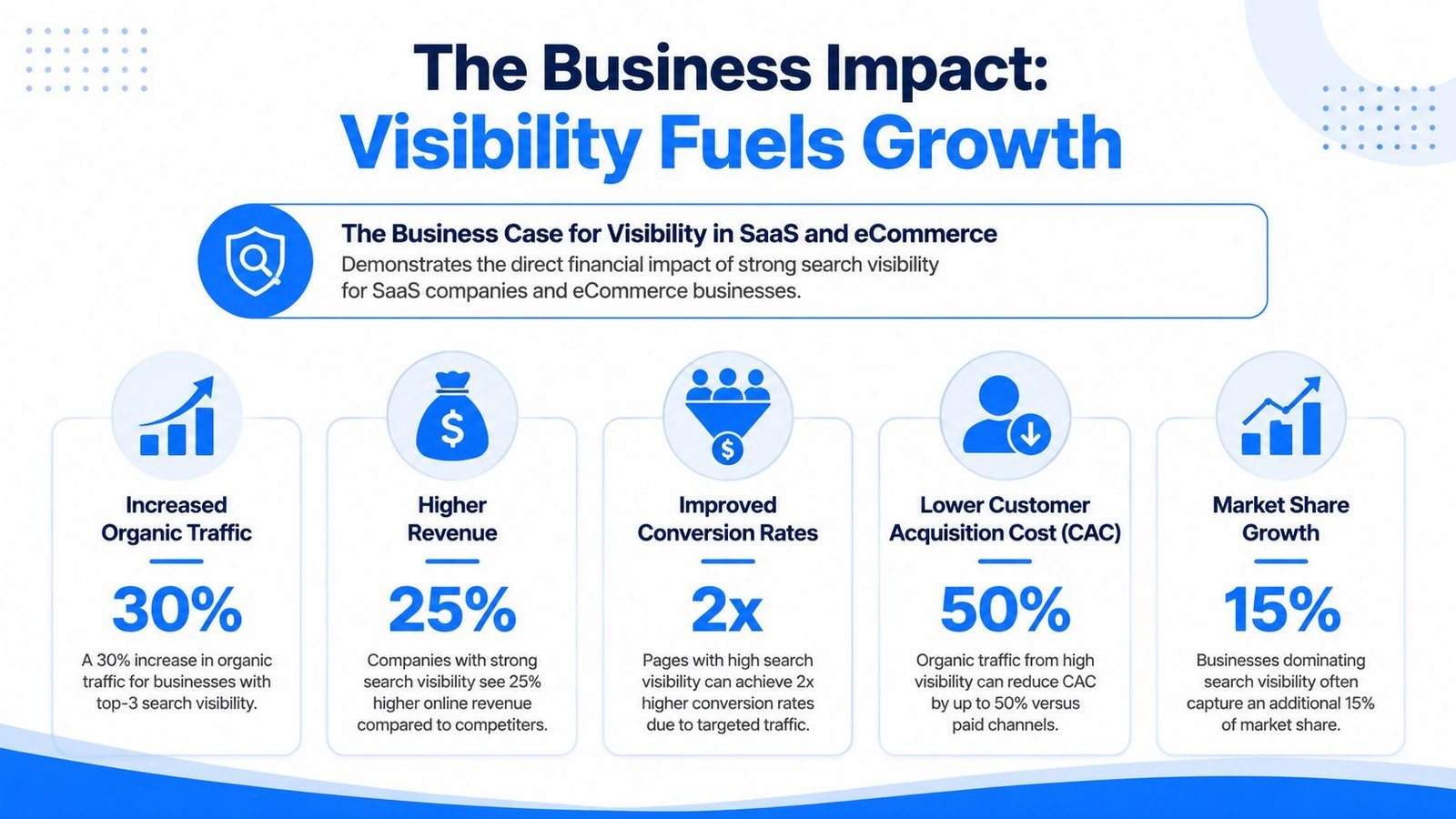
A common SaaS scenario looks like this: paid search is filling the demo calendar, CAC is rising, and leadership wants margin back. The problem is not always traffic. It is often that the brand is absent from the searches that shape shortlists before a buyer ever clicks an ad. The same pattern shows up in eCommerce when a store depends on Shopping ads but has weak organic presence across category, comparison, and support queries.
Visibility changes revenue quality because it changes entry points into the buying journey. If your CRM software appears for “best CRM for small sales teams,” “HubSpot alternatives,” and “how to reduce sales admin,” you are not just collecting visits. You are showing up at multiple decision stages, which gives the pipeline more ways to grow. If your outdoor retail site appears for “waterproof hiking jacket women,” “rain shell vs hard shell,” and “best jacket for alpine trekking,” you are capturing both direct purchase demand and the questions that remove friction before purchase.
Why high-intent visibility converts
Search traffic is rarely equal. A visitor who searched for your product category, a competitor comparison, or a use-case query is usually further down the path than someone who clicked a display ad while skimming news.
For SaaS, that often means three page types carry outsized business value:
- Problem-aware content that frames the operational pain, such as reducing invoice errors or speeding up customer onboarding
- Solution and category pages that match evaluation intent, such as expense management software or headless CMS for enterprise teams
- Comparison pages that help buyers defend a decision internally, such as Brand A vs Brand B or best tools for a specific team
In eCommerce, the equivalent mix is category pages, product detail pages, comparison content, and practical buying guides. A store that ranks only with top-of-funnel blog posts can report strong traffic and still miss revenue targets because purchase-intent pages never gain enough visibility.
Why visibility improves acquisition economics
Paid media is useful for speed, testing, and filling gaps. It is also rented attention. Once spend drops, the traffic drops with it.
Organic visibility works differently. A strong page can keep producing qualified visits after the initial content and optimization cost is paid back. That is the business case. Better visibility can lower dependence on paid capture for every marginal click, especially in categories where CPCs keep climbing.
This trade-off matters in boardroom terms:
| Business outcome | What better visibility usually improves |
|---|---|
| Lead quality | More visits from buyers actively researching a problem, category, or vendor set |
| Pipeline stability | Less reliance on paid campaigns to keep demand flowing |
| Revenue efficiency | Lower pressure to buy every click in competitive auctions |
| Category presence | Stronger share of the searches and answers buyers use to build shortlists |
Why this matters more now
The old model was straightforward. Rank on Google, earn clicks, convert demand.
Now there are two visibility layers. One is classic search visibility in the SERP. The other is AI visibility, where your brand or content gets cited in tools like ChatGPT and Gemini. For SaaS and eCommerce teams, the business implication is simple: if your brand is absent from both, you lose consideration twice. First in search results, then again in generated answers that influence vendor research and product discovery.
I see this most clearly in software categories with long evaluation cycles. A company can rank well for a commercial term and still lose mindshare if AI systems consistently cite analyst sites, review platforms, or better-structured competitors. In eCommerce, a retailer can win product queries in Google but miss AI-driven recommendation surfaces because its content does not clearly answer fit, use case, compatibility, or comparison questions.
Traffic still matters. Revenue matters more. Visibility earns its place as a KPI because it measures whether the brand is present where buying decisions are formed, both in traditional search and in AI-assisted discovery.
The New Frontier of Classic vs AI Search Visibility
Many still assume that if they rank well in Google, they're covered. That assumption is getting weaker.
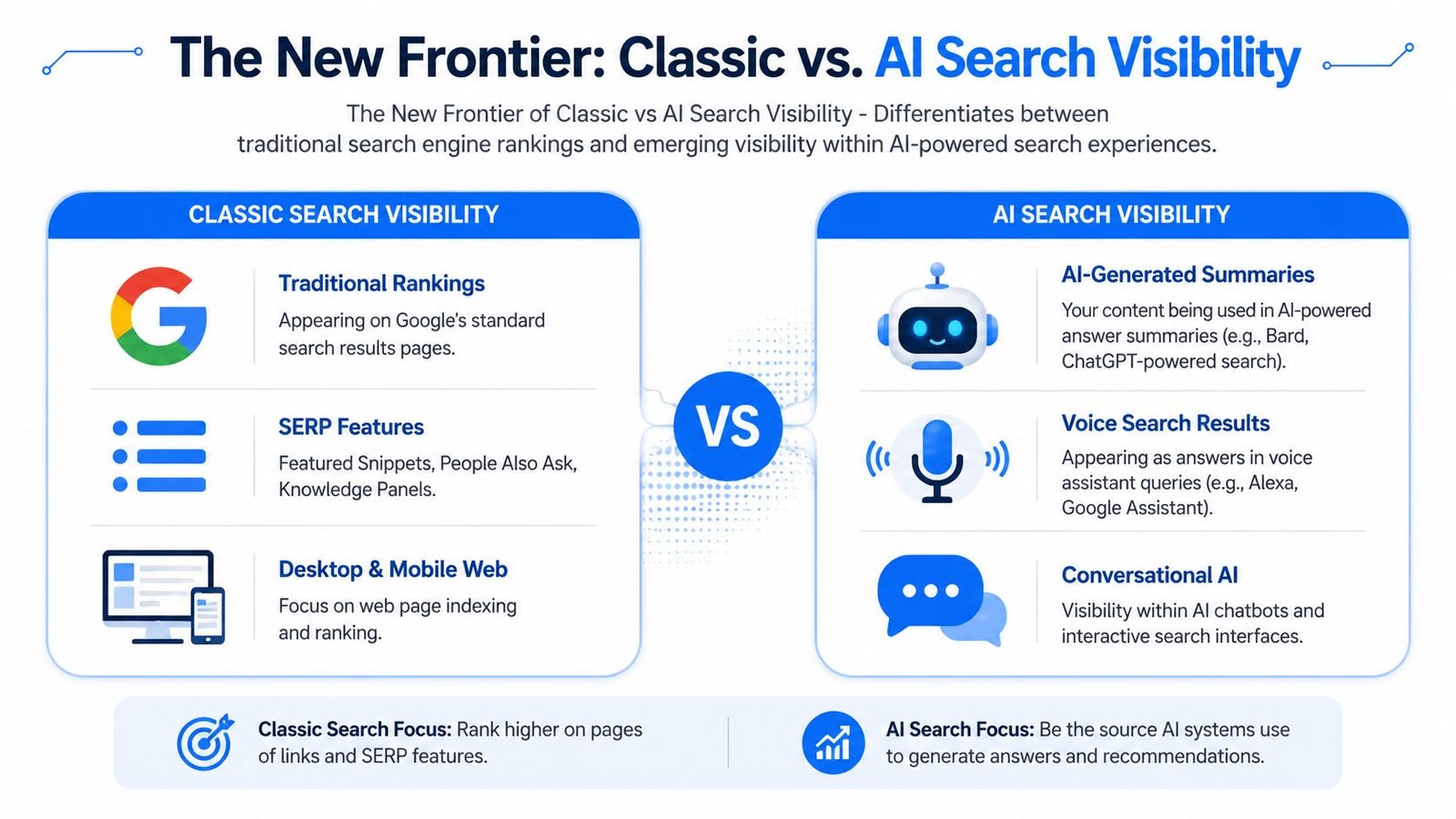
Classic search visibility measures your share of clickable search results. AI visibility measures whether your brand gets mentioned or cited inside generated answers. Those are related, but they are not the same thing. As explained in this analysis of classic and AI visibility, a brand can have classic visibility, even 5% of clicks for a keyword, and still have no meaningful AI visibility if AI systems never cite it.
Why ranking strength doesn't guarantee citation strength
Google rankings reward many familiar signals: relevance, authority, page quality, links, and technical accessibility. AI systems still depend on many of those signals, but they also need content they can parse, summarize, and trust enough to cite in a response.
That creates a new problem for brands. You might own the SERP for a category term, but if your content is vague, thin, hard to extract, or missing direct answers, AI systems may choose another source when generating a summary.
A practical dual-tracking model
The cleanest way to manage this is to track both forms of visibility separately.
- Classic visibility should monitor rankings, click share, and page-level contribution across your target keywords.
- AI visibility should monitor whether your brand, product, or content gets cited in AI answers for the prompts that mirror buyer intent.
- Unified interpretation should ask one question: where does the brand appear during discovery, evaluation, and decision?
If classic visibility tells you whether people can click you, AI visibility tells you whether machines consider you worth mentioning.
This matters most for SaaS companies with complex products and eCommerce brands with strong comparison behavior. In both cases, structured, direct, intent-matched content gives you a better chance to win in classic search and to become citable in AI interfaces.
The Playbook to Increase Your Search Visibility
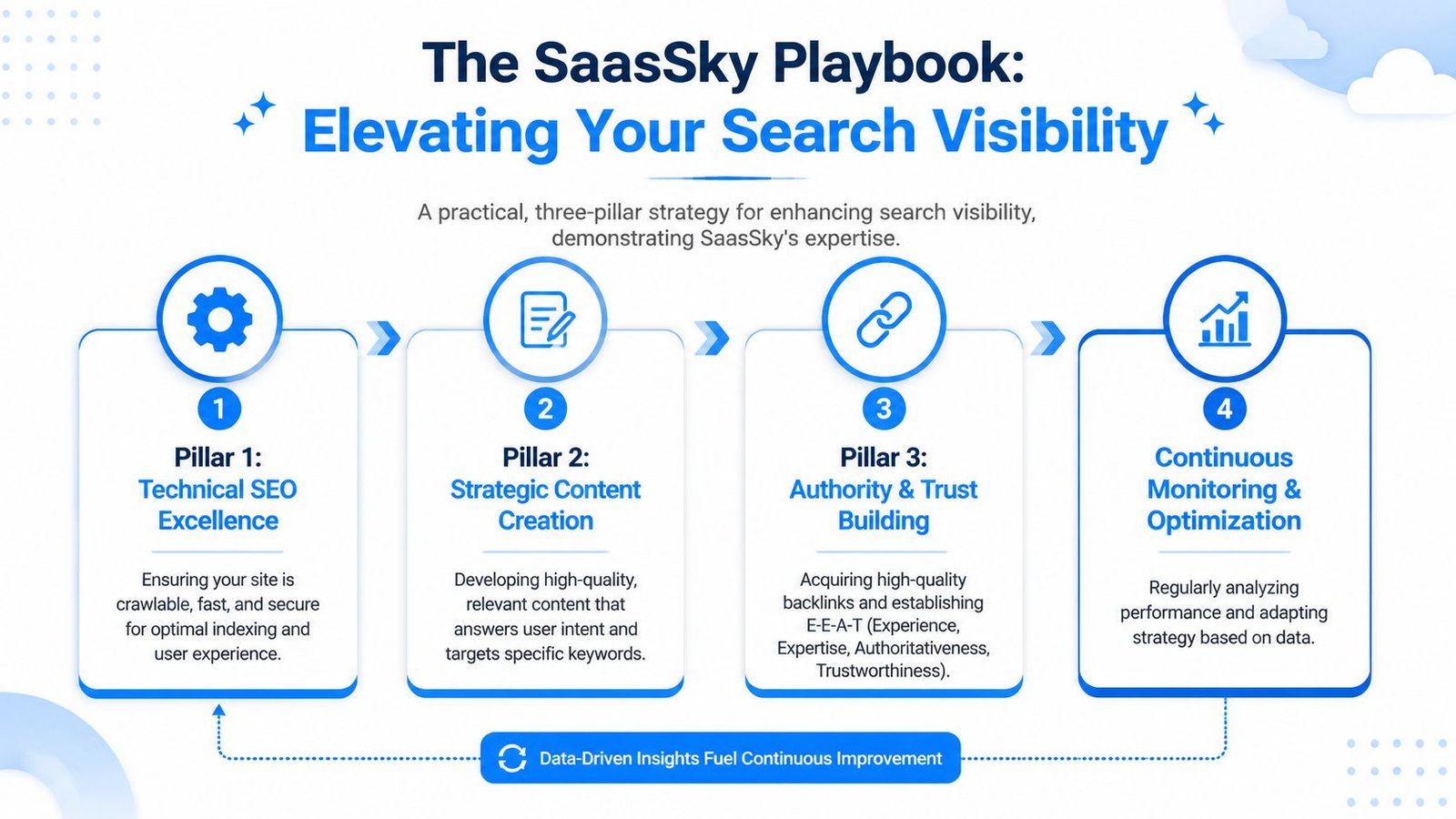
Improving visibility usually doesn't require exotic tactics. It requires disciplined execution on the fundamentals that directly affect discovery, ranking strength, and citation likelihood. When teams stall, it's usually because one of three layers is weak: technical foundations, demand-focused content, or authority signals.
Fix the technical foundation
A page can't win visibility if search engines struggle to crawl it, understand it, or trust the experience it delivers. This is the unglamorous work, but it changes everything downstream.
Start with the basics:
- Improve crawl paths: Important pages shouldn't sit deep in the site with weak internal links.
- Clean up indexation: Teams often let low-value URLs compete with strategic pages.
- Prioritize mobile experience: The earlier data point on search behavior already tells you where usage has shifted. Slow or awkward mobile experiences lose visibility.
- Build clear architecture: A sensible hierarchy helps both users and search engines understand page relationships. This guide on site structure for SEO is worth reviewing if your architecture has grown messy.
A common SaaS issue is scattering solution pages across the site without a clear parent-child structure. A common eCommerce issue is generating too many thin collection variants that dilute crawl focus.
Build content that captures demand and earns citations
Many companies publish content consistently and still fail to improve visibility. The problem isn't cadence. It's mismatch.
Pages need to match the kinds of intent your market expresses at different stages:
Problem-aware intent
Buyers are diagnosing an issue. They need clear educational content that explains the problem in plain language.Solution-aware intent
Buyers know the category and are evaluating approaches. They need comparison pages, use-case pages, and practical explanations.Decision intent
Buyers are choosing vendors or products. They need category pages, product pages, integration pages, and concise proof that the offer fits.
For AI visibility, content also needs to be easy to extract and cite. That usually means direct answers, descriptive headings, useful comparisons, and pages built around one clear job rather than five mixed messages.
Earn authority with strategic links and distribution
Links still matter because they help search engines evaluate trust and authority across a topic area. But not every link helps equally.
What usually works:
- Relevant editorial mentions: Coverage from sites your audience reads can support both authority and discovery.
- Linkable assets with a job: Original frameworks, category explainers, glossaries, and comparison resources attract stronger citations than generic thought leadership.
- Distribution tied to priority pages: If the goal is more visibility for solution pages, the link strategy should support those pages, not just the blog homepage.
What usually doesn't work:
- Random volume-driven outreach: A pile of weak placements rarely fixes a topic authority gap.
- Content with no destination page strategy: Publishing without mapping internal links and target pages wastes effort.
- Obsessing over one hero keyword: Visibility compounds when the whole cluster gets stronger.
The best visibility gains come from systems, not isolated wins. A technically sound site, a focused content map, and authority built around priority topics usually outperform scattered SEO activity.
Keep score with the right cadence
Visibility improves when teams review the right signals regularly and make deliberate adjustments. Useful reviews often include:
- Page-type performance: Are commercial pages improving, or only blog content?
- Topic cluster contribution: Which clusters are increasing the visibility score?
- Classic versus AI presence: Are you being found, cited, or both?
- Internal link support: Which high-value pages still sit outside the main flow of authority?
That review process is where SEO stops being abstract. You can see which pages are gaining ground, which clusters need reinforcement, and where your brand is still invisible.
Common Questions About Search Visibility
What is a good search visibility score
A good score is relative to the category, the SERP features in play, and the keyword set you chose.
For a niche B2B SaaS product, a visibility score that climbs steadily across bottom-funnel terms can be more valuable than a higher score inflated by blog queries with weak buying intent. For a large eCommerce site, the bar is different. Category pages, product pages, and comparison terms need to carry more of the total visibility if the metric is going to mean anything commercially.
The practical benchmark is simpler. Track whether visibility is increasing for the pages and topics that drive pipeline or revenue, not just traffic.
What's the difference between search visibility and share of voice
Search visibility is usually an SEO KPI. It estimates how visible your site is across a tracked keyword set based on ranking position and expected click potential.
Share of voice is often broader. Teams use it to compare brand presence against competitors across organic search, paid search, social, review sites, and now AI-generated answers. In SaaS, that might mean comparing how often your brand appears for “best CRM for startups” across Google, ChatGPT, and review platforms. In eCommerce, it can mean measuring how often your products show up in category searches, shopping results, and AI shopping recommendations.
If the goal is operational SEO management, search visibility is usually the cleaner metric. If the goal is market presence, especially across classic search and AI surfaces, share of voice gives a wider view.
How long does it take to improve search visibility
Timelines depend on the starting point.
A site with solid technical foundations and existing authority can often improve visibility faster by reworking underperforming commercial pages, tightening internal links, and filling obvious topic gaps. A newer SaaS brand entering a crowded category usually needs longer because it is building authority, entity signals, and citation-worthy content at the same time. eCommerce brands face a similar constraint when category pages are thin or product inventory creates duplication issues.
A useful rule is to separate leading indicators from business outcomes. Rankings, crawl health, and indexed page improvements can move first. Revenue impact usually lags behind.
Does AI visibility count as search visibility now
Yes, if buyers are using AI tools during research, it counts.
Classic search visibility still matters because Google drives discovery, comparison, and demand capture. AI visibility matters because tools like ChatGPT and Gemini increasingly shape shortlists by citing brands, summarizing category leaders, and recommending products before a click happens. A brand can rank well in Google and still be absent from AI answers. The reverse can happen too, especially for brands with strong digital PR, review presence, and clear topical authority.
Teams that want a complete view should track both. Measure where you rank, where you earn clicks, and where your brand gets cited or recommended without a traditional SERP visit.
If your SaaS or eCommerce team wants a clearer path from rankings to revenue, SaasSky helps brands improve search visibility through practitioner-led link building and SEO strategy built for measurable growth.