
Most advice on thought leadership content is backwards. It tells teams to publish more, “build authority,” and trust that revenue will follow. That's how you end up with polished blog posts nobody in pipeline ever mentions.
In B2B SaaS and eCommerce, thought leadership content only matters when it changes buyer behavior. It should help sales open doors, help executives justify premium pricing, and give your company a point of view that prospects can't get from a product page. If it doesn't do that, it's a publishing habit, not a growth asset.
The market signal is already there. 55% of decision-makers explicitly use thought leadership content as a critical metric to vet and evaluate potential business partners, and 61% say they're more willing to pay premium prices for services from a brand with a clear, visionary point of view, according to the Edelman and LinkedIn findings summarized here. That's not soft awareness. That's commercial advantage.
Table of Contents
- Building the Business Case for Your Content
- Developing Your Content Themes and Formats
- Establishing a Scalable Production Workflow
- Activating Content for Promotion and Link Building
- Measuring Performance and Proving ROI
- Your Playbook for Revenue-Driven Content
Building the Business Case for Your Content
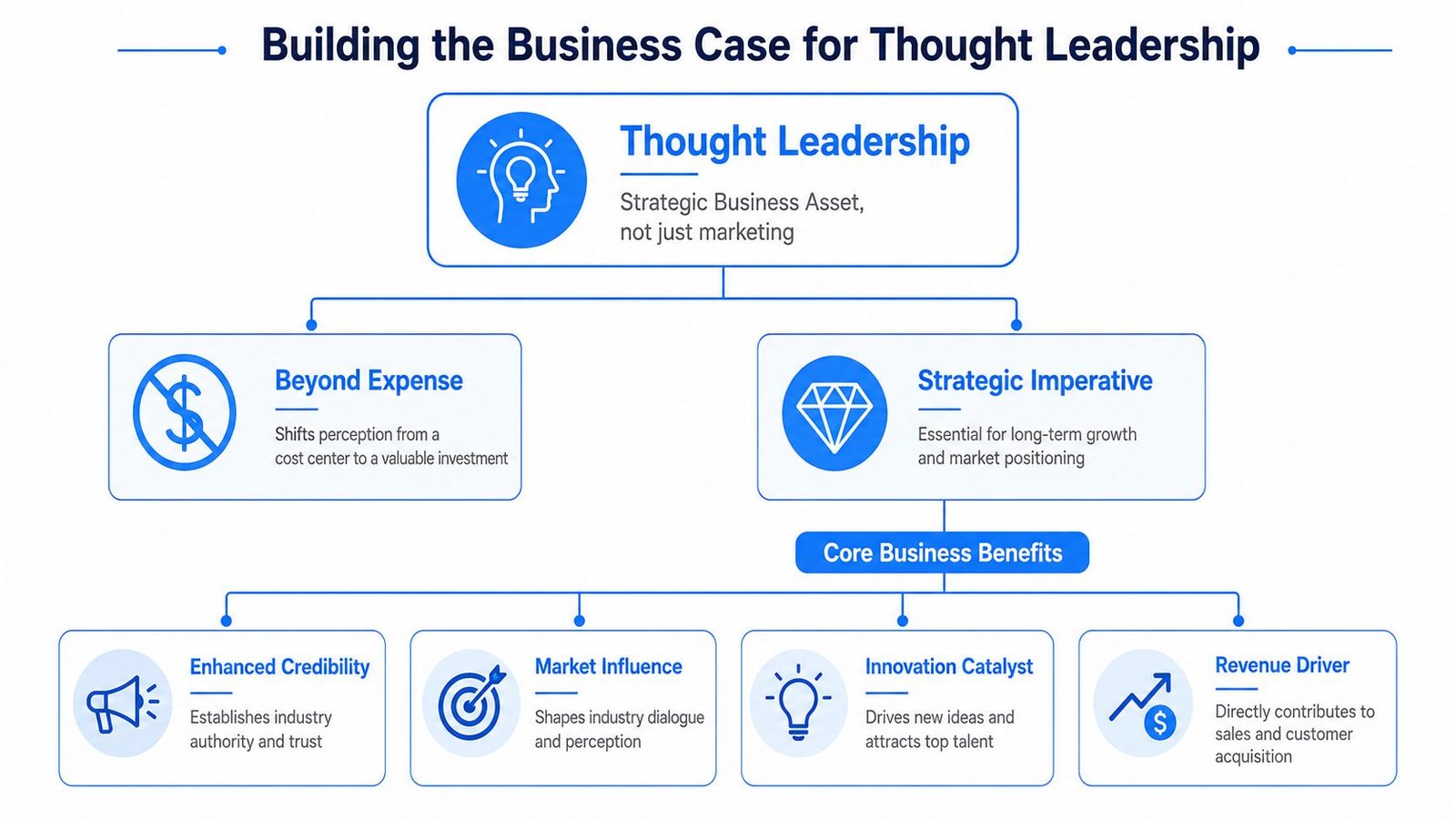
Thought leadership usually gets underfunded for one reason. Teams pitch it as awareness.
That framing creates predictable objections. Finance hears soft value. Sales hears content that will sit unused. Leadership hears a long payback period with fuzzy attribution. If you want budget, headcount, and executive participation, build the case around pipeline influence and deal support from day one.
The standard for approval should be simple. Every asset needs to help create demand, strengthen deal conviction, or defend price. Content that does none of the three belongs in a publishing calendar, not a revenue plan.
Stop calling it brand content
The strongest argument for thought leadership is buyer behavior, not marketing theory. The Edelman and LinkedIn data cited earlier shows that 70% of C-suite executives have reconsidered vendor relationships because of thought leadership, and 54% say they spend more than an hour each week consuming it, according to this summary of the research. That matters because buyers give serious time to material that helps them make a decision. Few teams can say the same about product pages or campaign copy.
In B2B SaaS, that translates into three practical uses:
- Create entry points before intent shows up: Good content gives outbound reps, partners, and executives a credible reason to start a conversation.
- Arm sellers with something worth sending: AEs need material that explains a market shift, a cost trade-off, or an implementation risk better than your competitors do.
- Support premium pricing: Buyers pay more when they believe your team understands the problem at an operating level, not just at the feature level.
I use one filter in planning reviews. If a rep would hesitate to send the piece to a live opportunity, it is not helping revenue.
That rule cuts a lot of waste.
A strong business case also depends on who is speaking. Buyers trust operator insight more than committee copy. The best assets usually pull from product leaders, customer success teams, implementation specialists, and executives who can explain what changes in the buyer's business if they get the decision wrong.
Pick a point of view your market actually needs
The failure mode is rarely lack of ideas. It is false demand. Teams publish content they find interesting, then wonder why it gets polite engagement and no sales follow-through.
Amber Naslund's point on creator-defined value is the correction. Relevance has to be defined by the audience, not by the people making the content. That means angle selection needs evidence before drafting starts.
A useful process looks like this:
- Start with deal friction: Pull recurring objections from Gong, Chorus, Salesforce notes, support tickets, and onboarding calls.
- Run a real content gap review: A structured content gap analysis for your market and competitors will show where everyone is repeating safe takes and where buyers still lack clear answers.
- Pressure-test claims with customers: Put topic angles in front of advisory boards or a small group of trusted accounts and ask what feels generic, risky, or decision-useful.
- Write the belief shift first: Finish this sentence before approving a topic. "After reading this, the buyer should believe we understand X better than other vendors."
Trade-offs matter. The safest topic usually gets the weakest commercial result. Strong thought leadership often makes a clear claim, narrows to a specific operational problem, and says something competitors avoid because legal, product, or executive teams prefer softer language.
That does not mean publishing hot takes for attention. It means choosing a position with commercial value. The best themes sit where buyer confusion, internal expertise, and market hesitation overlap. That is the point where content stops being filler and starts helping sales create and win deals.
Developing Your Content Themes and Formats

A content calendar shouldn't start with channels. It should start with one strategic decision: what idea deserves to become your anchor asset this quarter.
The best operating model I've seen is simple. Build one substantial asset around a sharp market claim, then break it into smaller assets built for specific contexts. That keeps your message coherent and stops the team from inventing disconnected content every week.
Use the anchor and atomize model
A scalable strategy can generate a full quarter's content from a single anchor asset, using one high-value expert input session, a targeted accuracy review, and then a breakdown into channel-ready pieces, according to this repeatable thought leadership process. That model works because expert time is scarce and expensive.
An anchor asset can be a research-backed guide, webinar, benchmark teardown, category memo, executive briefing, or customer pattern report. What matters is that it contains an original argument, real operating insight, and enough depth to support reuse.
A workable planning stack looks like this:
- Choose one market tension. Example: rising CAC pressure, retention risk in a saturated category, or margin erosion from discounting.
- Define one sharp claim. Not “AI is changing commerce.” More like “Most AI merchandising rollouts fail because teams optimize for recommendations before fixing feed quality.”
- Capture expert input once. Record a structured interview with your operator, founder, product lead, or solutions consultant.
- Turn the recording into the anchor. Write the flagship piece first.
- Atomize it. Pull out blog posts, founder LinkedIn posts, webinar clips, email sequences, sales one-pagers, and media pitches.
If your team struggles to find worthwhile themes, a structured content gap analysis helps identify where buyer questions, search demand, and competitor coverage don't line up.
Good themes aren't broad. They're useful under pressure. A buyer should be able to read the piece and make a better decision this quarter, not just admire your perspective.
Match format to buying context
Format choice isn't creative preference. It's distribution strategy.
If your audience is analytical and risk-sensitive, use formats that feel inspectable. Benchmark reports, teardown articles, expert Q&As, and narrative guides tend to perform better because buyers can reference them internally. If your audience consumes ideas between meetings or while commuting, audio and short-form video can carry the opinion layer better, but they still need a written home base for search, sharing, and sales follow-up.
Use this simple matching logic:
| Buying context | Best primary format | Why it works |
|---|---|---|
| Complex evaluation | Long-form guide or research memo | Easy to circulate in buying groups |
| Executive alignment | Briefing note or webinar | Condenses a strategic point of view |
| Category education | Blog series from one anchor | Builds familiarity over time |
| Sales enablement | Short PDF, article, or clip | Easy for reps to send during deals |
A common mistake is spreading effort evenly across formats. Don't. Pick one anchor, two distribution formats, and one sales enablement adaptation. Depth beats channel sprawl.
Establishing a Scalable Production Workflow
Most content operations break at the same point. The strategist needs insight from an executive. The executive is busy. Drafts stall. Reviews multiply. Launch slips. By the time the piece goes live, the topic has lost urgency.
You fix that by designing the workflow around the bottleneck, which is expert availability, not writer capacity.
Design around expert scarcity
Thought leadership content succeeds when it includes four elements: Innovation, Education, Credibility, and Visibility, as outlined in LinkedIn's thought leadership marketing guidance. Most weak assets fail on at least two of those. They either sound fresh but unsupported, or accurate but forgettable.
A workflow that protects those four elements usually looks like this:
- Briefing stage: The strategist gathers market context, buyer questions, objections from sales calls, and product context before speaking to the expert.
- Interview stage: The expert joins one focused session with a clear agenda. Ask for stories, judgments, examples, disagreements, and implications. Don't ask, “What should we write about?”
- Draft stage: The writer builds the piece around the expert's claim, not around keyword fragments or generic intro copy.
- Evidence stage: The team verifies every factual statement, product detail, and external reference.
- Activation stage: Design, social, email, and sales adapt the same core message for their channels.
Quantity pressure destroys quality fast. LinkedIn's guidance also flags the common pitfalls: prioritizing quantity over quality and failing to activate content creatively. Both usually come from rushing assets through a loose process.
Use stage gates or reviews will never end
Review chaos usually comes from mixing different types of feedback in the same round. Legal comments on one pass. Product comments on another. Founder rewrites on the third. Design requests on the fourth. Nobody owns the final call.
Set stage gates with one decision-maker per gate.
| Stage | Owner | What gets reviewed |
|---|---|---|
| Angle approval | Marketing lead | Thesis, audience, business purpose |
| Source review | Subject matter expert | Accuracy, nuance, examples |
| Message review | Executive sponsor | Strategic fit and risk level |
| Final production review | Content owner | Copy, design, links, CTA path |
Use simple rules to keep the system moving:
- Limit expert review to accuracy. Don't invite line edits on tone if someone already approved the voice.
- Collect comments in one tool. Google Docs, Notion, Asana, or ClickUp all work. Scattered Slack feedback doesn't.
- Set response windows. If a reviewer misses the deadline, the draft moves forward with the latest approved version.
- Preserve the spine of the argument. New examples are welcome. Last-minute thesis changes are not.
The production system should protect the point of view, not flatten it into stakeholder-safe mush.
When teams do this well, they don't need a huge content department. They need one clear operator, one accountable expert, and a workflow that respects both.
Activating Content for Promotion and Link Building
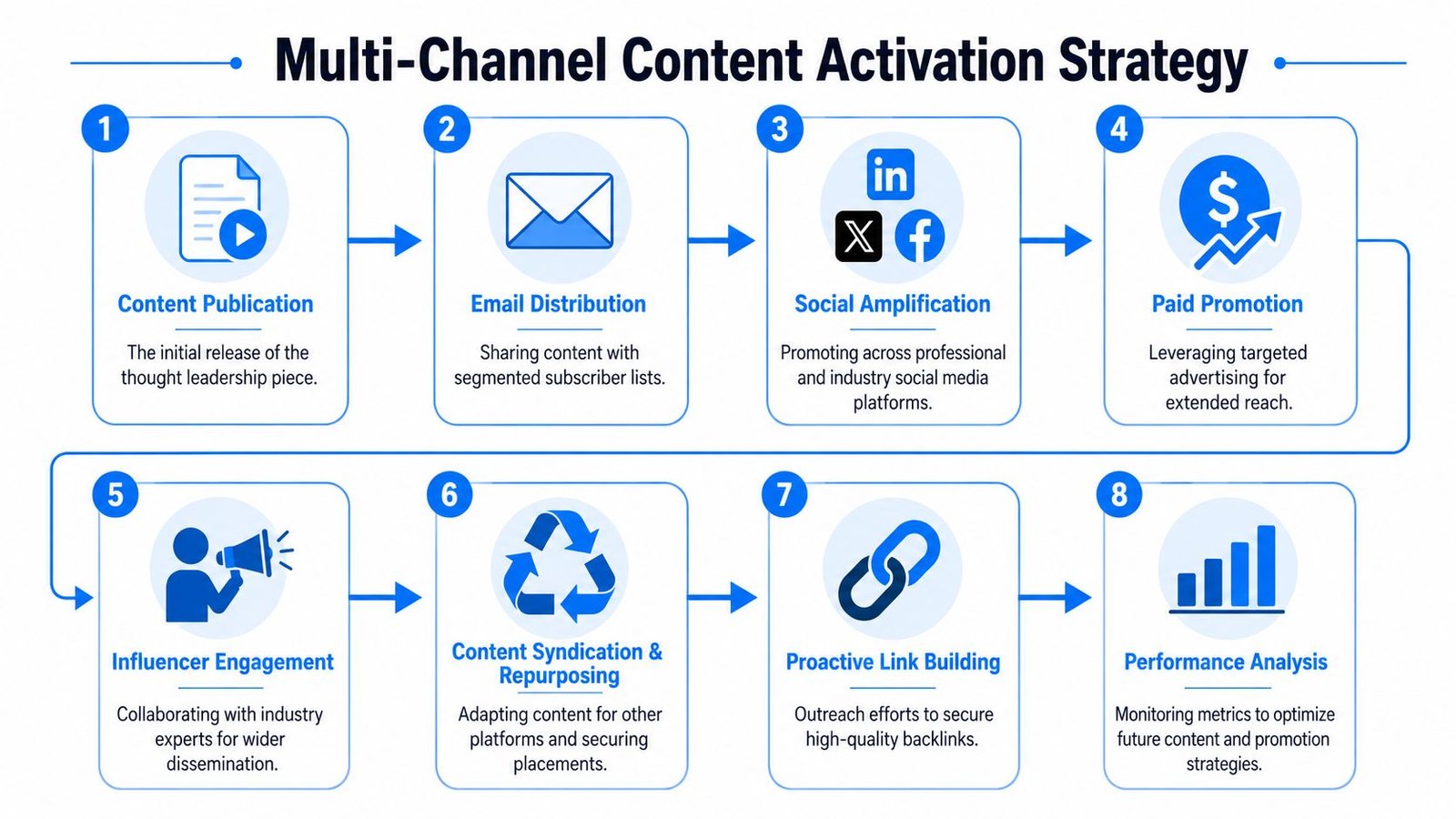
Great thought leadership does not fail because the writing was weak. It fails because nobody built a distribution plan that maps the asset to pipeline.
Activation starts before publish. If the team cannot answer three questions, the piece is not ready to ship: which accounts should see it, which sales motion it supports, and which outside publishers or communities have a credible reason to reference it. That standard cuts a lot of content. It should.
The goal is not broad visibility. The goal is to get the right argument in front of buyers, champions, influencers, and sellers in a format each group will use.
Build an activation brief, not a promo checklist
For each major asset, create a one-page activation brief. Keep it attached to the draft so distribution is planned while the argument is still being shaped.
A useful brief includes:
- Target account set: named accounts, segments, or buying groups that should receive the piece
- Commercial use case: outbound opener, deal acceleration, expansion, renewal defense, or partner co-selling
- Key claim to distribute: the single point worth repeating across channels
- Proof points: proprietary data, operator insight, customer pattern, or framework others can cite
- Channel owners: marketing, founder, AE, partner manager, PR, or community lead
- CTA by audience: book a call, reply for the benchmark, share internally, or use in live deals
Weaker teams lose the plot at this point. They publish one long article, post it on LinkedIn twice, email the full piece to the list, and call it distribution. Strong teams break the asset into channel-specific units and assign an owner to each one.
A report on implementation mistakes in mid-market SaaS, for example, can do four different jobs at once. Demand gen turns it into an email for dormant opportunities. Sales uses two charts in follow-ups after discovery calls. The founder pulls out one contrarian claim for LinkedIn and podcast outreach. PR packages one data point for trade editors covering software spend and buyer risk.
Give sales a use case, not just a link
Sales enablement is where content either starts influencing revenue or becomes a branding exercise.
Do not hand AEs a 2,000-word article and hope they figure out when to send it. Give them a short usage note: who should get it, at what stage, which objection it addresses, and the two lines to use in the email. That is what gets adoption.
I usually want three sales-ready versions of the same asset:
| Version | Used by | Best timing |
|---|---|---|
| 2-sentence summary | SDRs and AEs | First touch or follow-up after no reply |
| Buyer-specific excerpt | AEs | Active opportunities with a clear objection |
| Visual proof point | AEs and CSMs | Late-stage deals, renewals, and expansion |
That extra packaging work takes time. It also makes the content usable in revenue conversations instead of sitting in a resource hub.
Treat link building like evidence distribution
Link building works best when the asset gives publishers something useful to cite. Original framing, a sharp operator point of view, and specific evidence all travel better than generic educational content. Teams that want search authority without spammy outreach should use a white hat link building approach tied to assets that already have a reason to earn references.
The outreach angle matters more than the article title. Editors, newsletter writers, and community operators do not need your full post. They need one claim, one chart, one framework, or one contrarian takeaway their audience will care about.
Use this split:
| Channel | Asset adaptation | What it can produce |
|---|---|---|
| Trade publications | Byline based on one claim | Authority, referral traffic, branded search lift |
| Niche newsletters | Data point or takeaway with context | Reach inside a defined buyer audience |
| Communities and resource hubs | Framework summary or visual | Evergreen links and repeat discovery |
| Partner ecosystems | Co-branded excerpt or benchmark | Trust transfer and shared pipeline access |
One rule is easy to miss. Outreach should start from the strongest external angle, not the importance of your brand. "We analyzed why implementation timelines slip after handoff" is pitchable. "We published a new blog post on customer onboarding" is forgettable.
The teams that get paid back from thought leadership treat promotion as distribution engineering. Every asset needs a route into pipeline, a route into trusted third-party references, and a route into live sales conversations. If one of those routes is missing, the content is not finished.
Measuring Performance and Proving ROI
The hardest part of thought leadership content isn't creation. It's proving that the work changed pipeline, revenue quality, or deal movement. That's where many teams lose internal support.
The gap is real. Only 29% of organizations can link sales leads back to specific pieces of content, according to Edelman's analysis of thought leadership impact and sales linkage. If you can't connect content to commercial outcomes, the budget conversation gets ugly fast.
Track influence not applause
Pageviews, social impressions, and time on page can tell you whether distribution worked. They can't tell you whether the asset influenced revenue.
A better model is to separate attention metrics from business impact metrics, then report both without confusing them.
| Outdated Metric (Vanity) | Business Impact Metric (ROI) | Why It Matters |
|---|---|---|
| Pageviews | Content-influenced opportunities | Ties readership to real pipeline creation |
| Social engagement | Meetings booked after content touchpoints | Shows movement from awareness to conversation |
| Downloads | Qualified account engagement | Filters weak leads from target buying groups |
| Average time on page | Sales cycle velocity with content usage | Reveals whether content helps deals move faster |
| Backlinks alone | Pipeline from authority topics | Connects SEO value to commercial themes |
This shift is especially important if thought leadership sits inside a broader SaaS SEO strategy. Search visibility matters, but leadership teams still want to know which topics influenced qualified demand and which ones only attracted broad, low-intent traffic.
Build attribution before the campaign launches
Organizations frequently attempt to bolt attribution on after publishing. That almost never works. By then, UTMs are inconsistent, CRM fields weren't set up, and sales has no habit of logging content usage.
A cleaner system starts before launch:
- Name the asset consistently across your CMS, CRM, marketing automation platform, and sales enablement tool.
- Create campaign tracking in HubSpot, Salesforce, Marketo, or your stack of choice.
- Tag touchpoints across email sends, paid promotion, sales sequences, webinar follow-ups, and retargeting.
- Give sales a simple logging method for content used in active opportunities.
- Review influenced pipeline monthly instead of waiting for a quarterly narrative debate.
You also need a practical definition of influence. I'd keep it narrow. If a target account consumed the asset and then entered a measurable commercial stage, log that relationship. If the content was sent by an AE during evaluation and the opportunity advanced, log that too. Don't pretend perfect attribution exists. Build disciplined directional attribution instead.
If you wait for perfect attribution, you'll never defend the budget. If you define influence clearly and track it consistently, you can make sound investment decisions.
The key is credibility. Finance doesn't need fantasy precision. It needs a measurement model that is stable, explainable, and tied to pipeline movement.
Your Playbook for Revenue-Driven Content
Thought leadership content works when it stops behaving like a side project. The teams that win with it treat it like a commercial system with inputs, production standards, distribution paths, and revenue reporting.
That system starts with a market-backed point of view. Not a generic educational calendar. Not a founder's hot takes with no buyer validation. A real stance, built from customer questions, deal friction, and patterns your company sees earlier than the rest of the market.
The operating model that holds up
The durable model is straightforward.
Pick one important market problem. Capture expert insight efficiently. Build one anchor asset strong enough to support a quarter of distribution. Push it through owned channels, sales, and outreach. Measure whether the accounts you care about moved closer to revenue after engaging with it.
That sounds simple because it is. The difficulty is discipline.
Teams drift when they skip one of these constraints:
- No audience validation: You produce creator-defined value and call it strategy.
- No production discipline: Experts become the bottleneck and drafts sit in review forever.
- No activation plan: Good content gets posted once and disappears.
- No ROI model: The program survives only while leadership is being patient.
What good teams do differently
The strongest operators I've seen share a few habits.
They don't chase volume. They publish fewer assets with stronger claims.
They don't let content and sales operate separately. Reps know when to use the asset, why it matters, and which buyer concern it addresses.
They don't confuse brand lift with business impact. They're happy to report reach, but they reserve budget arguments for influenced pipeline, deal progression, and better positioning in competitive evaluations.
They also understand the trade-off at the center of thought leadership content. Strong points of view narrow your audience a bit, but they raise relevance for the buyers who matter. That's a trade worth making. Broad content gets more polite approval. Sharp content gets remembered.
If you want a practical benchmark for whether your program is working, ask three questions every quarter:
- Did this content help sales start or advance meaningful conversations?
- Did it make our company easier to trust at a premium position?
- Did we say something the market needed, or just something we wanted to publish?
If the answer to those is yes, you're not building content for vanity. You're building a growth asset.
If you want help turning thought leadership content into links, authority, and measurable pipeline support, SaasSky works with SaaS and eCommerce teams that care about transparent execution and accountable results.