

You've probably run into the same wall most SaaS and eCommerce teams hit. You have people on the team who can write. You have product insight, customer data, lessons from experiments, and strong opinions worth publishing. But once you start looking for guest posting sites, the process gets messy fast. Half the sites are generic lists. Some are obvious link farms. Others look credible until you read the contributor guidelines and realize they won't accept anything remotely commercial.
That's the problem in 2026. Finding sites that accept contributions isn't hard. Finding placements that help you build authority, reach the right buyers, or support a broader growth motion is hard. The market is also much bigger and more structured than it used to be. In a 2026 worldwide rating, Xamsor analyzed 121 guest posting platforms and ranked the top 18 marketplaces, with reported traffic figures ranging from 1,252,497 total traffic TTM for prnews.io to 3,910,848 for whitepress.com, plus inventories ranging from 1K to 150K listings across the market, which shows how scaled this ecosystem has become (Xamsor's worldwide guest posting marketplace rating).
That scale is useful, but it also creates more junk, more middlemen, and more bad decisions disguised as efficiency.
This guide is built for SaaS and eCommerce brands that need more than a directory. You'll get a vetted list of guest posting sites, split mentally by what they're best for: authority, technical reach, and scalable placement sourcing. I'm also layering in the way experienced link builders qualify these opportunities. That means growth-stage prioritization, a simple 3-point vetting lens, and clear trade-offs on where each site fits and where it doesn't.
Table of Contents
- 1. Search Engine Journal (SEJ)
- 2. G2 Learning Hub Contributor Network
- 3. HackerNoon
- 4. DZone
- 5. SitePoint
- 6. Smashing Magazine
- 7. DEV Community (dev.to)
- 8. Business 2 Community (B2C)
- 9. Search Engine World
- 10. Accessily
- Top 10 Guest Posting Sites: Quick Comparison
- Turn This List Into a Link Building System
1. Search Engine Journal (SEJ)
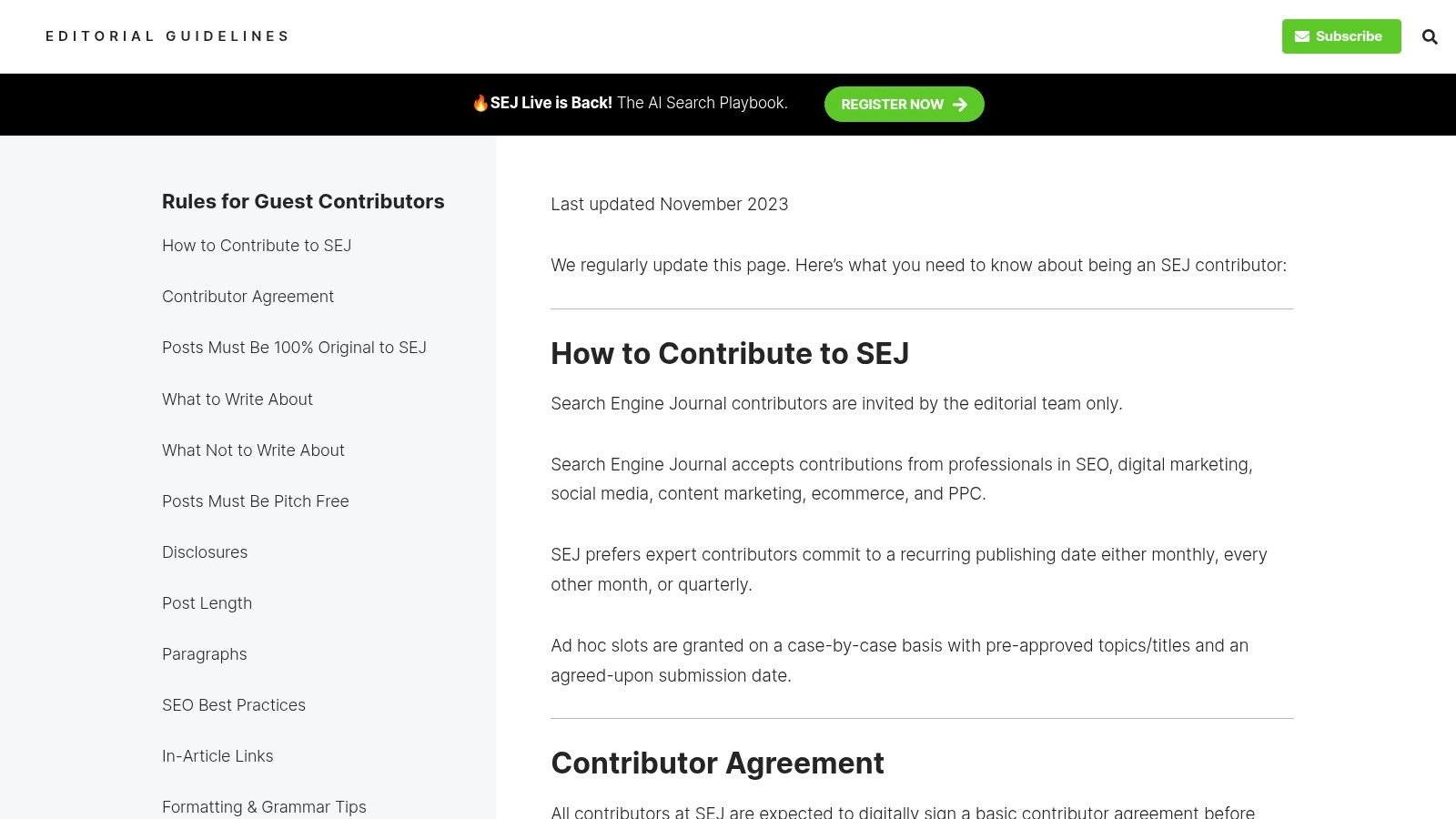
SEJ is one of the clearest authority plays on this list. If you sell SEO software, content tools, analytics products, commerce infrastructure, or services to marketers, the audience fit is obvious. The catch is that SEJ isn't useful if your only goal is dropping a link into a post and moving on.
Its writer guidelines for Search Engine Journal make the editorial expectations clear. You need a real topic fit, original thinking, and a draft that can survive editing without reading like product marketing.
Best when authority matters more than link control
SEJ works best for teams that already know how to separate brand authority from direct response. That usually means growth-stage SaaS companies, agencies with named experts, and eCommerce brands with genuine channel expertise.
What tends to work:
- Operator-led pieces: SEO leads, content directors, and ecommerce growth managers usually outperform ghostwritten generic thought leadership.
- Specific practitioner angles: A tight piece on feed optimization, site migration mistakes, or PPC reporting logic is stronger than broad trend commentary.
- Evergreen relevance: SEJ's archive gives good topics a long shelf life, especially if the article solves a recurring marketing problem.
How to pitch SEJ without wasting a month
A common mistake is pitching topics they'd publish on their own blog. SEJ doesn't need your version of “top trends” or a disguised product tutorial. It needs an angle its readership would bookmark.
Practical rule: If you can remove your company name from the pitch and the idea still feels strong, you're closer to what SEJ wants.
For SaaS, I'd prioritize SEJ when you're past the early “just get placements” stage and need market-facing credibility. For eCommerce, it's strongest when you have channel-specific expertise, not just a storefront and a content calendar.
2. G2 Learning Hub Contributor Network
G2's Learning Hub sits in a useful middle ground. It's not an open guest blogging environment, and that's part of why it matters. The G2 Contributor Network guidelines show a formal process, originality expectations, and tighter control over what gets published and maintained.
For SaaS companies, this is one of the more practical guest posting sites if your buyer is already evaluating categories, workflows, or software stacks. You're reaching readers who are closer to software consideration than the audience on a broad marketing publication.
Best for SaaS brands selling into informed buyers
G2 is strongest for pieces that help a buyer think better, not just buy faster. Good examples include implementation advice, process design, reporting frameworks, or lessons from tool adoption.
Early-stage founders often make an error. They want category comparisons, pricing commentary, or product-led positioning too early in the article. G2 is more useful when you teach the problem thoroughly enough that your expertise becomes obvious.
A few good fits:
- B2B workflow explainers: CRM cleanup, lead routing, onboarding systems, support operations.
- Operational playbooks: How teams run a process, where it breaks, and what changes help.
- Category education: Not “why our tool wins,” but “how buyers should evaluate this category.”
What gets rejected fast
Vendor bias is the main trap. If the piece reads like it was written to steer the reader into one product choice, it won't age well and usually won't pass editorial scrutiny.
G2 is a strong destination when you want credibility with buyers who are already in research mode. It's a poor fit for chest-thumping brand content.
I'd put G2 in the “authority with commercial adjacency” bucket. It's especially valuable for SaaS companies with a few customer patterns worth turning into educational content.
3. HackerNoon
A SaaS founder has a story that is too opinionated for a trade publication and too technical for a broad business site. HackerNoon is often the right place for that draft.
The main HackerNoon platform gives brands and individuals room to publish ideas that sit between editorial content and firsthand experience. That matters if your company learns through shipping, testing, and fixing real product problems. On this list, I'd classify HackerNoon as a technical-reach publication with brand-building upside, not a pure authority play.
Best for founder stories and product-led narratives
HackerNoon rewards specificity. The posts that perform best usually come from an actual decision, mistake, experiment, or constraint. Good examples include launch retrospectives, engineering trade-offs, failed onboarding assumptions, pricing tests, and product bets that changed after customer feedback.
That makes it especially useful for earlier-stage SaaS companies. If you do not yet have the brand authority to win placements on stricter publications, you can still publish something credible here by telling the truth about what happened and what changed.
For our agency, that changes how we prioritize it. We push HackerNoon higher for seed to Series A SaaS brands that need technical relevance and a visible founder or product voice. We rank it lower for mature companies that need polished category authority more than narrative reach.
Where HackerNoon works and where it doesnt
HackerNoon is a strong fit when the company can publish with some candor. It weakens fast if every sentence has to survive heavy legal review, rigid brand messaging, or internal politics.
What usually works well here:
- Founder or operator voice: First-person writing fits the platform if the insight is real.
- Clear narrative arc: A practical sequence works well. Problem, decision, result, lesson.
- Technical-commercial overlap: Product architecture, onboarding logic, activation friction, and usage patterns all fit.
What tends to underperform:
- Polished brand essays: They read like content marketing and get ignored.
- Soft sales pitches: Readers spot them quickly.
- Generic advice: If the article could be published under any company name, it is not strong enough.
One practical note. HackerNoon is useful because it gives you repeatable publishing surface area for stories your team is already sitting on. Use it as part of a system. Put honest product and founder narratives here, save stricter authority pieces for higher-friction publications, and do not treat every site on this list as if it serves the same goal.
4. DZone
DZone is where you go when your content needs technical credibility, not just marketing relevance. Its contributor program is built around in-depth technical writing, and that immediately filters out a lot of weak SaaS content.
For developer tools, infrastructure products, security software, data platforms, and technical B2B products, DZone can be a much better fit than broad business publications.
Best for technical reach
A lot of guest posting sites look attractive because the metric screenshots look good. That's not enough. For technical audiences, relevance and editorial standards matter more than raw vanity metrics.
Recent guidance around guest posting also points in that direction. The stronger framing now isn't “find high-DR sites.” It's evaluating safety, relevance, editorial rigor, natural anchors, and compliant link attributes, especially after Google's spam-policy and link-attribute changes (BuzzStream's guide to guest posting sites).
How to make DZone worth the effort
DZone is high effort. That's exactly why it can be worth doing.
To justify the work, the article should do at least one of these well:
- Teach a build process: Tutorials, architecture patterns, implementation walkthroughs.
- Explain a technical decision: Why a team chose one approach over another, and what happened next.
- Document hands-on experience: Screenshots, code snippets, failure points, and practical constraints.
Field note: If your draft could swap product names and still read the same, it's too generic for DZone.
I'd prioritize DZone for growth-stage technical SaaS companies with subject matter experts on staff. Early-stage teams can still use it, but only if someone real can write or heavily shape the article.
5. SitePoint
A SaaS team ships a real frontend improvement, improves page speed, fixes a tracking issue, or rebuilds a checkout component. Then the marketing team tries to turn that work into thought leadership and ends up with a generic trend piece. SitePoint rewards the first version, not the second.
The SitePoint write for us page is clear about the bar. They want practical material that helps developers do something better, faster, or with fewer mistakes.
Strong fit for frontend and product education
SitePoint sits in a useful middle ground for this list. It is more authority-driven than open community platforms, but more execution-focused than broad business publications. For SaaS and eCommerce brands, that makes it a smart target when the goal is qualified technical reach, not just a recognizable logo.
I usually prioritize SitePoint for companies with something concrete to teach. Frontend SaaS, developer tools, product-led platforms, and commerce teams working on performance or instrumentation tend to fit best. If your strongest stories live in implementation details, SitePoint can turn that into both audience trust and a defensible link.
It is also one of the better options for eCommerce brands with real technical depth. Topics like storefront performance, checkout UX, frontend testing, analytics setup, and personalization logic can connect to revenue without reading like sales copy.
The angle that works on SitePoint
The strongest pitches start with shipped work. A migration, a debugging process, a testing framework change, a performance bottleneck, or a lesson learned from rebuilding part of the product.
Useful formats include:
- Step-by-step tutorials: Build flows, debugging walkthroughs, or framework-specific implementation guides.
- Post-implementation lessons: What failed, what the team found, and what changed after the fix.
- Developer explainers: Clear articles that help practitioners apply a concept in production.
SitePoint is rarely the right choice for broad opinion pieces. It works best when the article can answer a practical reader question with specifics.
From a link building standpoint, this is also where prioritization matters. As noted earlier, quality usually beats volume on editorial sites with a real review process. I would rather help a client publish one strong SitePoint article built from actual product work than chase a larger batch of low-signal placements. That trade-off is especially important for growth-stage SaaS teams and established eCommerce brands that need links tied to expertise, not just domain metrics.
6. Smashing Magazine
Smashing Magazine is not a quick-win placement. It's a reputation play. If your audience includes designers, product managers, UX leads, and frontend teams, few guest posting sites carry the same weight in that corner of the market.
Its editorial process reflects that. Expect collaboration, deeper edits, and a higher bar for clarity and usefulness.
Authority play for UX and product teams
Smashing is ideal when your company has genuine product and design insight. That could be a design systems lead, UX researcher, frontend architect, or PM with strong process lessons.
The publication rewards substance. Not “design trends for the year,” but practical thinking about accessibility, workflows, interfaces, user behavior, and implementation trade-offs.
A Smashing article should make a senior practitioner nod, not just a marketer share it.
When to choose Smashing over faster placements
Choose Smashing when the byline itself matters. Founders trying to build product credibility, SaaS companies moving upmarket, and eCommerce brands with strong UX infrastructure all benefit more from this kind of placement than from a larger pile of lower-signal links.
It's also a useful reminder that not every guest post should be evaluated like a link transaction. Some are about trust transfer. Smashing sits firmly in that category.
The downside is obvious. It takes time, the process is selective, and you won't get much flexibility if your main objective is inserting commercial messaging into the body copy.
7. DEV Community (dev.to)
DEV is different from most of the sites on this list because it's less about editorial gatekeeping and more about smart distribution. That's exactly why experienced SaaS content teams keep using it. The DEV writing and scheduling help page includes canonical URL support, which makes it useful for republishing technical content without competing directly with your own site.
If you're building for developers, indie hackers, or technical operators, DEV can extend reach quickly.
Useful for canonical cross-posting and developer visibility
The best use case is simple. Publish the original piece on your own site, then syndicate or adapt it to DEV with canonical handling in place.
That gives you a few advantages:
- Protects the primary version: Your site remains the source asset.
- Expands developer reach: DEV has discovery mechanisms that can surface niche technical content.
- Supports series-based publishing: Useful for product education or multi-part engineering topics.
How to use DEV without diluting your main site
DEV isn't where you send every article. It's where you send the articles that benefit from community discovery and technical readership.
I'd use it for engineering explainers, setup guides, architecture notes, and product tutorials. I wouldn't use it for top-of-funnel fluff or generic startup advice. Quality varies across the platform, so your post needs a sharp hook and useful details to stand out.
This is also a good channel for earlier-stage companies. If you don't yet have access to top-tier editorial placements, DEV gives you a low-friction way to build author presence while keeping your main site as the canonical home.
8. Business 2 Community (B2C)
Business 2 Community is more of a practical contributor network than a prestige publication. That sounds like faint praise, but for certain goals it's exactly what you need. The Business 2 Community contributor application page shows an onboarding model that sits between open publishing and tightly controlled editorial outlets.
For eCommerce and SaaS brands doing top-of-funnel education, B2C can be useful if you treat it as part of a portfolio, not the centerpiece.
Broad reach with moderate editorial friction
B2C works for explainers, thought leadership, and business-facing educational content that doesn't need heavy technical depth. It can support visibility among general professional audiences, especially when your topic intersects with growth, operations, leadership, or commerce.
I like it most for:
- General business education: Content that translates across teams.
- Demand-gen adjacent topics: Customer retention, marketing operations, sales alignment.
- eCommerce growth themes: Merchandising, customer experience, lifecycle messaging.
How to stand out on a mixed-quality platform
The challenge is consistency. Contributor-driven environments naturally vary in quality, so average content disappears.
The fix is straightforward. Bring a sharper point of view than the platform average. One of the more useful guest posting insights for growth teams is to pitch site-specific gaps, use original proof like screenshots or datasets, and pair guest posts with evergreen assets such as tools, benchmarks, or case studies. Guidance summarized by BlueTree also points to finding topics the host already covers poorly, which is exactly how you make a placement commercially useful without making it promotional (BlueTree's guest posting sites article).
B2C is not where I'd send your single best insight of the year. It is where I'd send a well-framed, useful article that expands reach and supports topic breadth.
9. Search Engine World
Search Engine World is narrower, and that's why it can be valuable. It serves a more focused SEO and search marketing audience than a broad business publication, which makes it a strong fit for technical search topics that would be too niche elsewhere.
Its industry contributor invitation page positions contribution as selective rather than open-drop publishing. That's usually a positive signal.
Niche credibility for serious SEO topics
This is the kind of site I'd use for detailed SEO operations content. Think crawl management, analytics interpretation, SERP feature shifts, internationalization issues, or lessons from large-site search performance work.
For B2B SaaS brands selling to marketers, SEOs, or growth teams, the right article here can do more for niche trust than a broader but less relevant mention elsewhere.
Best use case for B2B SaaS teams
Search Engine World is best when your product sits close to search workflows. SEO platforms, content intelligence tools, reporting products, site performance tools, and agencies all fit naturally.
Semrush notes that sites with an Authority Score above 30 may be worth the effort for outreach, and that's a useful baseline when you're deciding whether to pursue more selective niche publications versus easier low-signal options (Semrush guest post guidance).
I wouldn't try to force a general business topic here. Go specific. The more search-native the problem, the better the fit.
10. Accessily
Accessily is the outlier on this list because it's a marketplace, not a publication. That changes how you should use it. It's not about editorial prestige. It's about speed, inventory access, and operational scalability.
The main Accessily platform is useful when your team needs to source placements at a pace that direct editorial pitching can't support on its own.
Marketplace speed with real quality risk
Many link building campaigns go wrong because marketplaces save time, but also hide quality problems behind filters, metrics, and convenience.
That matters because quality-filtered sourcing is more important than sheer volume. BuzzStream's 2025 link-building research found that among 26,000 guest post sites, 19% had only 0 to 100 monthly visits, which means a meaningful slice of available inventory barely had any traffic at all (BuzzStream link building statistics).
How we vet marketplace inventory
For SaaS and eCommerce campaigns, I use a simple 3-point filter before anyone buys or pitches anything through a marketplace:
- Topical reality: The site should publish in your niche consistently, not just accept anything with a budget.
- Traffic stability: Not just traffic existence. Stable patterns matter more than isolated spikes.
- Editorial signs: Real article formatting, author context, internal linking logic, and reasonable outbound link behavior.
Accessily is useful for later-stage execution when your process is already disciplined. It's a poor choice for teams that think filters alone equal vetting.
Agency rule: Marketplaces are sourcing tools, not trust signals.
If you use Accessily, pair it with manual review. That's where most of the campaign quality gets decided.
Top 10 Guest Posting Sites: Quick Comparison
| Publication | Core fit & features | Audience (👥 & ★) | Editorial & Acceptance | Pricing/Value (💰) | USP / Best for (🏆 ✨) |
|---|---|---|---|---|---|
| Search Engine Journal (SEJ) | SEO/PPC/content for marketers; collaborative editing ✨ | 👥 Marketers & growth teams · ★★★★ | Strict non-promotional rules; assigned editor; competitive | 💰 Free to pitch; high authority → long-term SEO value | 🏆 Well-indexed evergreen archive; best for data-driven evergreen pieces |
| G2 Learning Hub, Contributor Network | Buyer-focused SaaS explainers; formal pitch template ✨ | 👥 B2B buyers & category researchers · ★★★★ | Vetting required; strong originality & AI guardrails; editorial control | 💰 Invite-only; high buyer-intent visibility | 🏆 Direct access to software evaluators; best for playbooks & category insights |
| HackerNoon | Community-driven tech stories; Brand-as-Author option ✨ | 👥 Developers & product engineers · ★★★ | Open submissions + editorial refinements; variable depth | 💰 Free submissions or paid brand option; fast reach | 🏆 Fast path to tech audiences; great for founder/PM narratives |
| DZone | Deep technical guides; recurring "Zones" for topics ✨ | 👥 Devs, DevOps, architects · ★★★★ | Structured submission + editorial review; technical bar high | 💰 Free; high credibility for technical content | 🏆 Ideal for tutorials, architecture patterns, recurring contributor programs |
| SitePoint | Frontend/JS tutorials; hands-on example focus ✨ | 👥 Frontend devs & product builders · ★★★ | Requires working code/examples; competitive acceptance | 💰 Free; tutorial format drives practical engagement | 🏆 Strong for code-backed how-tos and product-adjacent education |
| Smashing Magazine | Premium UX/design & front-end research-driven pieces ✨ | 👥 UX leads, designers, PMs · ★★★★★ | Thorough editorial process; deep edits; high bar | 💰 Free pitch; high authority but limited link flexibility | 🏆 Top authority in UX/design; best for rigorous, well-researched pieces |
| DEV Community (dev.to) | Open publishing with canonical URL support ✨ | 👥 Engineers & indie hackers · ★★★ | Low gatekeeping; community-driven quality varies | 💰 Free; preserves main-site SEO via canonical posts | 🏆 Fast developer exposure; great for repurposing technical content |
| Business 2 Community (B2C) | Broad marketing/eCommerce contributor network ✨ | 👥 Mixed professionals & marketers · ★★★ | Application-based onboarding; moderated submissions | 💰 Free; faster acceptance cycles for top-of-funnel content | 🏆 Wide reach for demand-gen and thought leadership |
| Search Engine World | Niche SEO contributor program; forum ties ✨ | 👥 Search practitioners & SEOs · ★★★★ | Selective acceptance; focused editorial expectations | 💰 Free; niche credibility with focused audience | 🏆 Credibility for technical SEO and analytics content |
| Accessily | Marketplace for paid guest placements with filters ✨ | 👥 Agencies & scaling teams · ★★★ | Marketplace quality mixed; managed services available | 💰 Paid per-placement; transparent pricing & scalable inventory | 🏆 Fast, predictable placements with filtering and hosting guarantees |
Turn This List Into a Link Building System
A common scenario looks like this. A SaaS team pulls a guest posting list, sends the same pitch to every site, gets a few articles live, and then struggles to explain what those placements did for pipeline, branded search, or product awareness. The issue is not activity volume. The issue is target selection.
This list works best as a decision framework for SaaS and eCommerce brands. Some of these sites help you build authority with buyers, executives, and category peers. Others put your brand in front of technical readers who shape implementation, integrations, and tooling decisions. Those goals need different topics, different authors, and different expectations for links.
For early-stage SaaS, I would keep the first round narrow. Start with lower-friction outlets such as DEV and HackerNoon to test which ideas earn engagement, then use those learnings to pitch stricter publications like SEJ, G2, or Search Engine World. That sequence reduces wasted effort. It also helps your subject matter expert develop a clearer voice before aiming at editors with a higher bar.
Growth-stage SaaS teams need a cleaner operating model. I usually separate targets into three groups: authority publications, technical reach publications, and paid marketplace inventory like Accessily. Each group serves a different purpose. Authority placements support trust and category position. Technical placements reach practitioners who can influence adoption. Marketplace placements help teams that need more predictable output, but they require tighter quality control because scale can lower standards fast.
eCommerce brands should apply the same framework, but the winning topics are different. Broad retail opinions rarely earn much traction. Editors respond better to operational detail: site speed fixes, merchandising tests, retention mechanics, checkout friction, analytics setup, feed hygiene, and lessons from campaigns that failed before they improved.
Our agency vets guest posting sites with three filters:
- Audience fit. If the readership is too far from your buyers, users, or implementation partners, the placement is usually a branding play with limited downstream value.
- Editorial standards. More editing usually means stronger quality control, better audience trust, and a healthier link environment.
- Goal alignment. A site can be credible and still rank lower if it does not support the current objective, whether that is authority, technical reach, referral traffic, or efficient volume.
The same discipline applies to pitching.
Strong outreach is usually simple. Reference a relevant article they already published, show the angle gap, offer one specific topic, and explain why your team has direct experience. Editors are far more responsive when the pitch includes real proof, such as screenshots, workflows, product data examples, or process details that a generic freelance writer cannot provide.
Then manage guest posting like a channel, not a one-off tactic. Track sites by goal category. Record acceptance rate, edit time, publication date, backlink terms, referral traffic, and byline performance. Save the pitch structures that get replies. Rework internal content into external angles instead of drafting every article from scratch.
That is how this list becomes useful for a serious program. It gives SaaS and eCommerce teams a way to prioritize by company stage, choose between authority and technical reach, and build a guest posting system that supports real growth instead of adding random backlinks.