You publish a strong article, launch a webinar recap, or ship a product comparison page. Then almost nothing happens. A few clicks, a handful of shares, maybe some branded traffic. The content isn't the problem. The distribution is.
Content distribution is still often treated like a checklist after production. Post it on LinkedIn. Send one email. Maybe boost it if the numbers look weak. That approach breaks fast when attribution is incomplete, privacy rules keep shifting, and organic reach changes without warning. Google said it will not deprecate third-party cookies in Chrome and instead let users make a choice, which keeps measurement fragmented rather than simplifying it, as noted in this analysis of content distribution strategy constraints.
That matters because SaaS and eCommerce teams don't need another list of channels. They need a way to decide where the next hour, the next hire, and the next budget slice should go when the data is noisy. Traffic alone won't tell you that. Neither will backlinks or click-through rate in isolation. If you're trying to build predictable growth from organic traffic, you need a distribution model that accounts for intent, channel reliability, and the quality of the signal you can measure.
Table of Contents
- Your Content Is Great But Who Is Seeing It
- The Four Pillars of Content Distribution
- Choosing Channels A SaaS and eCommerce Guide
- A Practical Framework for Prioritizing Channels
- Tactical Playbooks for High-Impact Distribution
- Measuring What Matters KPIs for Distribution Success
- Building Your Sustainable Distribution Engine
Your Content Is Great But Who Is Seeing It
Publishing isn't distribution. It's storage with a timestamp.
A lot of founders learn this the expensive way. They invest in content production, approve polished assets, and assume the market will discover them. But most content doesn't fail because it's low quality. It fails because nobody built a repeatable path between the asset and the buyer.
The usual advice doesn't help much. Most guides still reduce the problem to owned, earned, and paid channels, then stop there. That's useful as a taxonomy, but weak as an operating model. It doesn't tell you how to choose between email, LinkedIn, search, communities, partner amplification, or paid support when attribution is partial and channel performance shifts month to month.
Practical rule: If you can't explain why a channel deserves budget without relying on last-click attribution, you haven't actually prioritized it.
That's the operating environment for SaaS and eCommerce teams now. Measurement is messy. Privacy constraints haven't created a cleaner system. They've made channel comparison harder. Meanwhile, leadership still wants clear answers to simple questions: Where should we distribute this asset first? What gets cut? What gets scaled?
The fix isn't to chase perfect attribution. You won't get it. The fix is to rank content distribution channels by three things that are still knowable even in a noisy environment:
- Audience fit: Are your buyers there, and are they in the right mindset?
- Intent quality: Does the channel capture curiosity, evaluation, or buying behavior?
- Data reliability: Can you trust the feedback loop enough to improve decisions?
Teams that win at distribution don't publish more. They make fewer, sharper bets. They build a channel mix that matches buyer behavior, then they keep testing until each asset has a clear path to discovery, engagement, and action.
The Four Pillars of Content Distribution
You need a simple map before you can make smart trade-offs. The classic model is still useful: owned, earned, and paid. For practical planning, I also separate shared media because it behaves differently from pure earned reach and often becomes the multiplier channel modern teams miss.
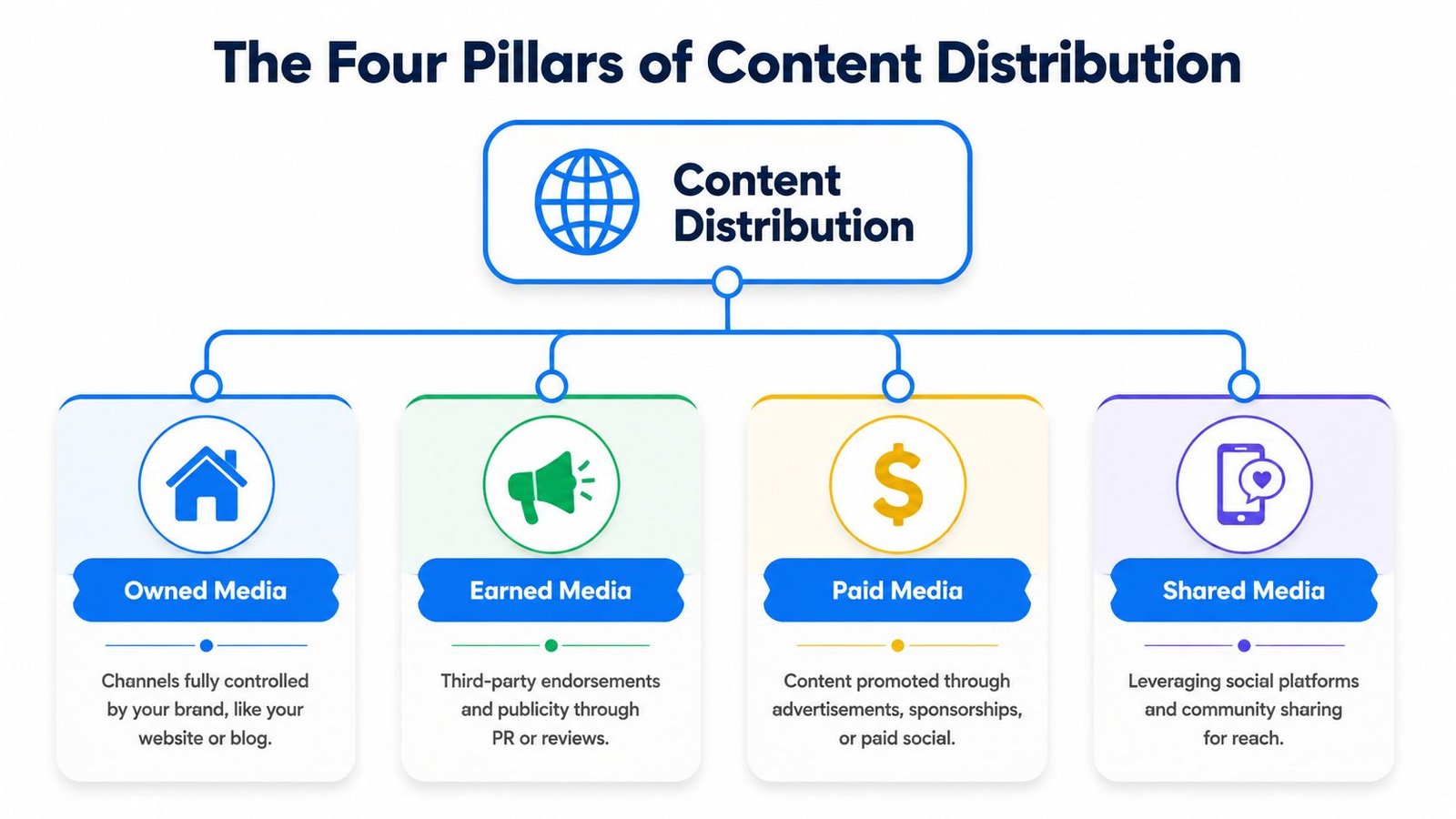
It's comparable to commercial property.
Your owned channels are the building you control. Paid is the rented billboard space. Earned is the local press coverage you didn't buy. Shared is what happens when other people carry your message into rooms you don't control.
Owned media gives you control
Owned channels are your site, blog, email list, resource center, and other assets you directly manage. They matter because they compound. You set the rules, control the experience, and decide how traffic moves toward conversion.
The market still treats owned channels as the foundation. Websites are used by 9 out of 10 marketers, blogs by 78% of organizations, and email newsletters by 69% of marketers, according to Terakeet's breakdown of content distribution channels.
For SaaS, owned usually means comparison pages, solution pages, newsletters, webinars, and product-led education. For eCommerce, it often means category content, product education, email flows, and on-site merchandising.
Earned media gives you credibility
Earned channels include reviews, third-party mentions, organic social shares, SEO-driven mentions, and discussion in communities. You don't control the placement, which is exactly why it can work so well. Buyers trust what feels discovered more than what feels pushed.
In B2B, earned can outperform flashy promotion because the context is stronger. A mention in an industry newsletter, a thoughtful Reddit thread, or a trusted expert linking to your research often carries more persuasive weight than a polished brand post.
Earned reach usually arrives later than teams want, but when it lands, it often brings higher-intent attention.
Paid media gives you speed
Paid channels include sponsored content, paid social, search ads, and other promotion formats that buy distribution directly. Use paid for acceleration, not as a substitute for weak messaging.
Paid works best when you already know three things: who the audience is, what offer matches their intent, and which message angle gets attention. Without that, you just pay to learn slowly.
Shared media gives you multiplication
Shared media sits in the middle of social distribution, community participation, employee advocacy, and creator-led spread. It overlaps with earned, but it deserves its own lane because the operating model is different. You're not waiting to be mentioned. You're enabling people to share.
That includes:
- Executive distribution: Founders and subject-matter leaders posting from personal accounts
- Employee advocacy: Sales, success, and product teams sharing useful assets in relevant conversations
- Customer sharing: Testimonials, community mentions, implementation stories, and social proof
- Creator collaboration: Partners or niche voices repackaging your idea for their audiences
If owned is the foundation, shared is often the amplifier that gives good content a second life.
Choosing Channels A SaaS and eCommerce Guide
The right channel mix depends on how buyers buy. That's where many distribution plans go off course. They copy a generic B2B playbook or a generic consumer playbook, even though the buying motion is completely different.

SaaS teams should bias toward education and nurture
A SaaS buyer usually doesn't convert from one touch. They compare vendors, loop in teammates, revisit documentation, and need reassurance that the product fits their workflow. That pushes distribution toward channels that support repeated exposure and deeper explanation.
The strongest starting mix often looks like this:
- Owned first: Publish on the site, connect the asset to product pages, and send it to segmented email lists.
- Earned second: Pitch data, insights, or contrarian takes to industry publications, partners, and communities.
- Paid third: Use LinkedIn, search, or retargeting to extend reach once the message already resonates.
What usually doesn't work is relying on a single social post from the company page and calling that distribution. Brand accounts rarely carry enough trust or reach on their own, especially for technical or high-consideration products.
eCommerce brands should bias toward velocity and proof
eCommerce is usually less patient. The buying cycle is shorter, the creative has to land fast, and proof matters immediately. Buyers want to see the product, understand the use case, and trust that other people already like it.
That changes the mix:
| Business model | Best early distribution bets | Weak early bets |
|---|---|---|
| SaaS | Blog, newsletter, founder posts, partner mentions, search-driven education | Broad paid awareness without a clear offer |
| eCommerce | Paid social, creator seeding, UGC, on-site promotion, email/SMS flows | Long-form educational assets with no product tie-in |
For eCommerce, shared and paid channels often deserve more budget earlier because they compress discovery and social proof into the same experience. A creator demo, customer video, or community recommendation can do more than a polished brand explainer because it answers the buyer's real question: does this fit my life?
How to decide when budget is tight
Not every team can fund every channel. They shouldn't try.
Use a decision filter based on the goal in front of you:
- Book demos: Prioritize channels where problem-aware buyers already look for solutions, such as search, email nurture, partner mentions, and targeted paid support.
- Reduce churn: Push educational content through owned channels customers already use. Help docs, lifecycle email, in-app education, and customer communities usually beat broad promotion.
- Launch a new product line: Combine paid reach with shared proof. Creative, UGC, and creator distribution usually matter more than publishing another blog post.
- Increase average order value: Use on-site recommendations, bundles, post-purchase email, and remarketing tied to product context.
If the goal is immediate action, choose channels that carry intent. If the goal is trust, choose channels that carry context.
Founders often ask for the best content distribution channels as if there's a universal ranking. There isn't. There are only channels that fit your buying motion, your asset type, and the level of certainty your team has about message-market fit.
A Practical Framework for Prioritizing Channels
When attribution is messy, a common default is opinion. The loudest person in the room says, "We need more LinkedIn," or "SEO is the long-term play," and the budget follows. That's not strategy. That's internal politics with a spreadsheet.
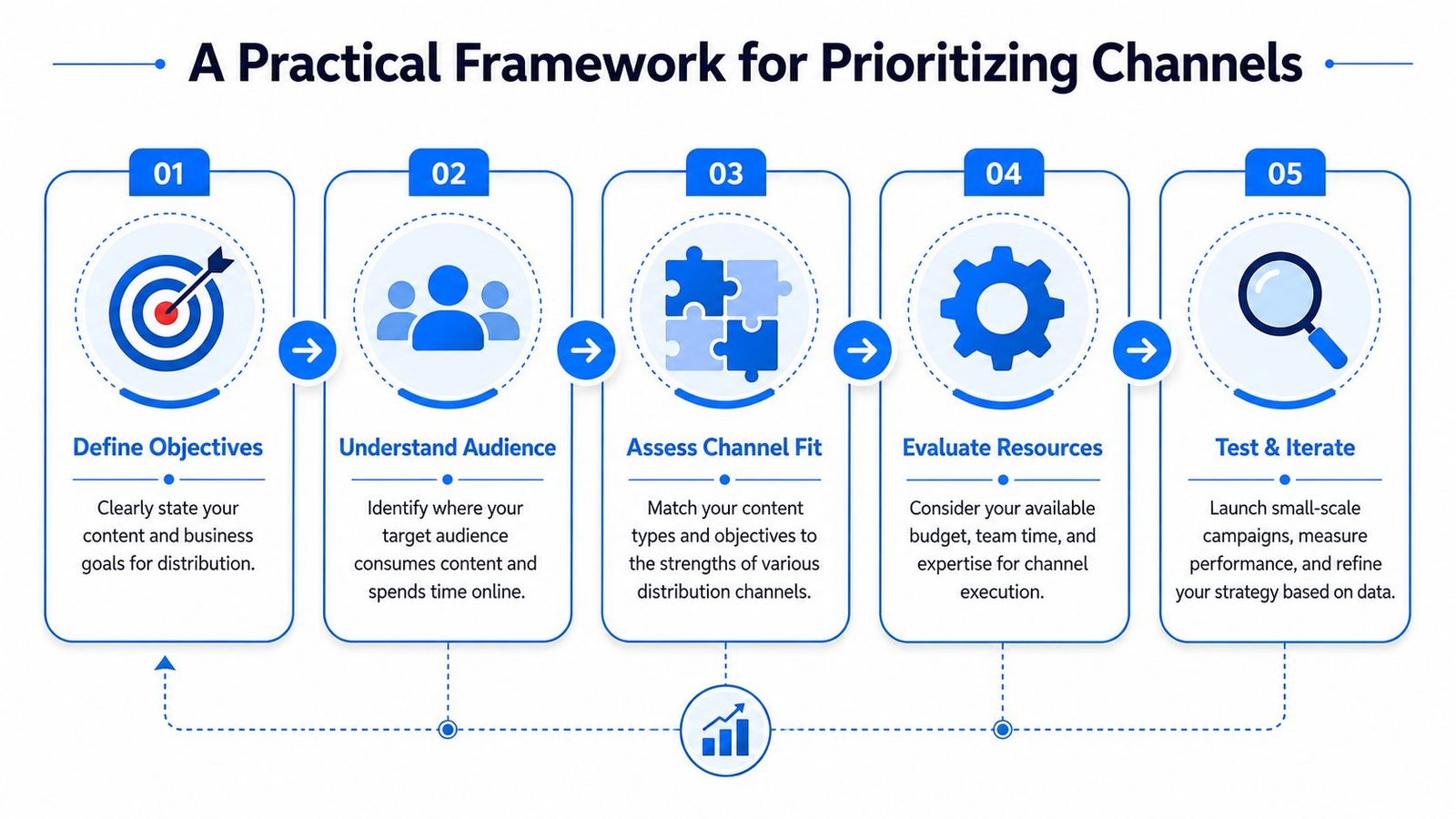
Use the AIR score
A simple model works better. I use AIR:
Audience fit
Where does the target buyer already spend attention? Not where your team likes posting. Not where your competitor is loud. Where does your buyer go to learn, compare, and ask questions?Intent level
Is the audience in passive browsing mode, active research mode, or buying mode? A Reddit thread about a category problem has different intent than a cold social feed scroll. A newsletter subscriber behaves differently from someone who saw a boosted post once.Resource cost
What does the channel require from your team? Money matters, but time matters just as much. Some channels look cheap until you price in design cycles, founder involvement, moderation, or creative refresh.
Use a simple low-medium-high score for each factor. You don't need fake precision. You need a defensible way to compare trade-offs.
For early-stage teams trying to build a coherent growth system, this is the same discipline that matters across digital marketing for startups. Pick the channel mix you can execute well, not the one that appears all-encompassing in a planning doc.
How to compare two real options
Say you're deciding between publishing more SEO-led content and putting budget into a targeted LinkedIn campaign for a SaaS asset.
Score them like this:
SEO-led distribution
- Audience fit: high if buyers research problems in search
- Intent: medium to high depending on topic
- Resource cost: medium because production and distribution take time
Targeted LinkedIn amplification
- Audience fit: high if the role targeting is sharp
- Intent: medium because many users are browsing, not actively evaluating
- Resource cost: medium to high because paid support and creative testing add cost
That won't hand you a universal answer. It will reveal what kind of bet you're making. SEO is slower, but often stronger for compounding discovery. LinkedIn is faster, but usually needs stronger creative and tighter targeting to avoid waste.
A few practical rules help:
- Choose owned-first when the asset has lasting value and can support multiple journeys.
- Choose paid-first when speed matters and the message is already validated.
- Choose earned or shared-first when trust is the main bottleneck.
- Cut channels quickly when the team can't sustain quality execution.
The best channel isn't the one with the cleanest dashboard. It's the one that reliably reaches the right buyer and gives your team enough signal to improve.
Tactical Playbooks for High-Impact Distribution
The strongest distribution plans don't spray content everywhere. They build an asset-specific route to the audience. Here are two practical examples.
A SaaS launch playbook for a flagship report
A B2B SaaS company publishes original research tied to a painful operational problem. The wrong move is to post the report link once from the company account, send a generic email blast, and hope journalists care.
A better sequence looks like this:
- Start with owned distribution: Build a landing page, a short summary post, an email sequence for prospects, and sales enablement snippets for outbound follow-up.
- Add executive and team distribution: Give the founder, product lead, and customer-facing team members short, opinionated angles they can post from their own profiles.
- Target earned opportunities: Reach out to niche newsletters, podcast hosts, analysts, and trade writers with a clear angle. Don't pitch "our company released a report." Pitch the most surprising finding or the strongest operational takeaway.
- Support with paid amplification: Use paid social or search to put the report in front of specific decision-makers once the message has already proven it gets engagement.
Modern distribution has evolved. Standard brand posting is weaker on many platforms. Meanwhile, creator-led and community-led discovery has become more important. LinkedIn reported strong growth in video engagement and continued emphasis on professional content formats, while Reddit and niche communities remain high-intent discovery surfaces, as discussed in this piece on changing content distribution tactics.
That means SaaS teams should stop thinking only in terms of "Where do we post this?" and start asking, "Who can credibly carry this into the right conversation?"
An eCommerce launch playbook for a new product line
An eCommerce brand launching a new collection needs momentum faster. The asset isn't a report. It's the product experience itself.
A stronger rollout often includes:
- Paid creative first: Short-form demos, comparison clips, and use-case visuals distributed through paid social.
- Shared proof second: Seed products to relevant creators, encourage customer footage, and make remixing easy.
- Owned reinforcement: Feature the line on collection pages, homepage modules, cart cross-sells, and post-click landing pages.
- Community participation: Join the places where real product questions happen. That's often more useful than producing another polished awareness ad.
If organic search supports the category, pair launch activity with evergreen product education and comparison content. That's where a strong understanding of eCommerce SEO strategies helps bridge short-term demand capture and longer-term discovery.
The practical lesson in both examples is simple. High-impact distribution doesn't come from adding more channels. It comes from matching the asset to the people, format, and context most likely to move it.
Measuring What Matters KPIs for Distribution Success
A weak measurement setup makes bad channels look good and good channels look slow. The fix isn't to track everything. It's to separate leading indicators from lagging indicators and judge each channel by the role it's supposed to play.
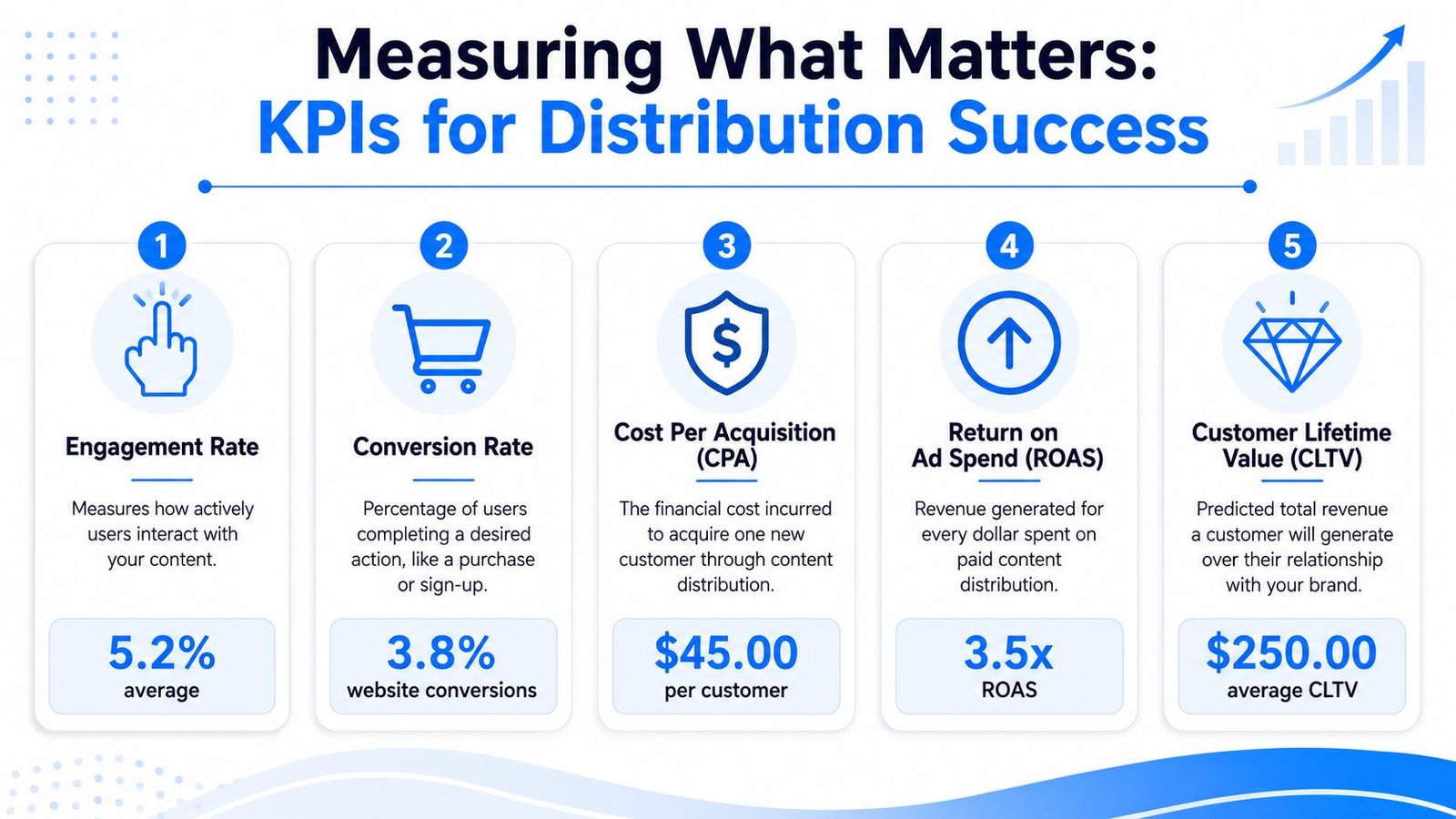
Leading indicators tell you if the channel is working
These metrics help you see whether distribution is earning attention and interaction before revenue shows up.
Track signals like:
- Email engagement quality: Opens alone are weak. Click patterns, replies, and downstream visits say more.
- On-page behavior: Scroll depth, time on page, and CTA interaction tell you whether the content matched the promise of the channel.
- Share behavior: Saves, reposts, comments, direct shares, and discussion quality matter more than vanity impressions.
- Referral quality: Look at what visitors from partner mentions, communities, or creator links do after arrival.
These indicators are especially useful in channels where last-click measurement misses influence. If a community mention doesn't convert on the spot but drives branded search later, the leading indicators will show that something valuable happened upstream.
Lagging indicators tell you if the business benefited
Lagging indicators are slower but more important. They answer whether the channel contributed to a real business outcome.
For SaaS, that usually means:
- Demo requests
- Qualified pipeline
- Sales conversations influenced by content
- Customer expansion or retention activity
For eCommerce, that usually means:
- Revenue from assisted sessions
- Add-to-cart and checkout completion trends
- Repeat purchase behavior
- Product attach or bundle uptake
Don't judge an awareness channel by last-click revenue alone. Judge it by whether it creates the conditions for lower-friction conversion later.
A simple channel measurement table
| Channel type | Leading indicators | Lagging indicators |
|---|---|---|
| Owned | Email clicks, page engagement, return visits | Demo requests, purchases, retention actions |
| Earned | Referral engagement, mention quality, branded search lift | Assisted conversions, pipeline influence, revenue contribution |
| Paid | CTR quality, landing page behavior, audience match | CPA, ROAS, qualified acquisition |
| Shared | Reposts, saves, comments, creator traffic quality | Assisted revenue, community-sourced leads, repeat engagement |
Keep the dashboard simple. If a metric doesn't help you decide whether to scale, fix, or cut a channel, it doesn't belong in the core view.
Building Your Sustainable Distribution Engine
Good distribution isn't a campaign task. It's an operating system.
The teams that get consistent results build from owned foundations, add earned trust, use paid selectively, and create shared momentum through people, not just brand accounts. They don't ask whether a channel is good in general. They ask whether it fits the audience, the intent, and the resources they have.
That's the part many companies skip. They create content in batches and distribute it as an afterthought. A better approach is to plan the route before production starts. Decide who should see the asset, who can credibly share it, what signal will tell you it's working, and what fallback move you'll make if it stalls.
If you do that consistently, content distribution channels stop feeling random. They become a repeatable engine. That's what founders need. Not more posting. Better allocation.
If you're building a distribution strategy for a SaaS or eCommerce brand and want a team that treats links, visibility, and channel fit like growth levers instead of vanity metrics, SaasSky is worth a look. Their focus on transparent pricing, practitioner-led execution, and real case studies makes them a practical partner for teams that need accountable growth support.