You published the asset. The brief was strong, the design looked sharp, and the topic matched what your market cares about. Then nothing happened. No meaningful links, no pickup from editors, and no lift beyond the traffic your brand could generate on its own.
That's where organizations often get stuck with outreach for SEO. They treat promotion as a final checkbox after content production, or they blast a generic template to a scraped list and call it distribution. Neither approach works for long.
Agency-grade outreach looks different. It starts before the first email. It depends on strict prospect qualification, clear offer design, disciplined follow-up, and a working understanding of why a publisher would say yes. If you run outreach for SaaS or eCommerce, the job isn't to “send more emails.” The job is to build a system that consistently matches strong assets to publishers with a reason to care.
Table of Contents
- The Best Content No One Ever Sees
- A Modern Framework for Smart Prospecting
- Crafting Pitches That Actually Get Replies
- Executing the Campaign Cadence
- From Ad Hoc Emails to a Scalable System
- Outreach in Action for SaaS and eCommerce
The Best Content No One Ever Sees
A familiar pattern shows up on client accounts. The team spends weeks creating a feature page, a benchmark post, or a data-backed guide. It's better than what's already ranking. It's cleaner, more current, and more useful. But because no one actively promotes it, the page sits there with little to no earned visibility.
That outcome isn't surprising. Search is too important to leave distribution to chance. Ahrefs reports that 68% of online experiences begin with a search engine and 63.41% of all US web traffic referrals come from Google in its SEO statistics roundup. If search drives that much discovery, then link acquisition isn't a side activity. It's part of getting the asset seen at all.
The mistake isn't making good content. The mistake is assuming quality alone creates awareness. In practice, outreach for SEO is the mechanism that puts a strong asset in front of editors, bloggers, reviewers, and resource page owners who can cite it.
Why good content stalls without promotion
Most strong pages fail for ordinary reasons:
- No identified audience beyond searchers: The team knows the keyword, but not which publishers already cover the topic.
- No citation angle: The page may be useful to buyers, yet still give writers no clear reason to reference it.
- No distribution workflow: Once the post goes live, ownership disappears and outreach never starts.
That's why linkable formats matter. A benchmark, a template, a research-backed explainer, or a stronger replacement for an outdated resource gives people something concrete to use. If you're already working from a content-upgrade model like the Skyscraper SEO technique, outreach becomes the bridge between “better asset” and “earned mention.”
Practical rule: Publishing is the midpoint, not the finish line.
For SaaS teams, that often means promoting comparison pages, integration content, and original research. For eCommerce brands, it usually means category explainers, product education assets, gift-guide angles, and resource replacements. The content has to be good. But it also has to be introduced to the people who maintain pages that can link to it.
A Modern Framework for Smart Prospecting
Most outreach problems start before the pitch. The list is weak, the fit is poor, and the team is reaching out to websites that were never likely to care. Smart prospecting fixes that by filtering opportunities through more than one lens.
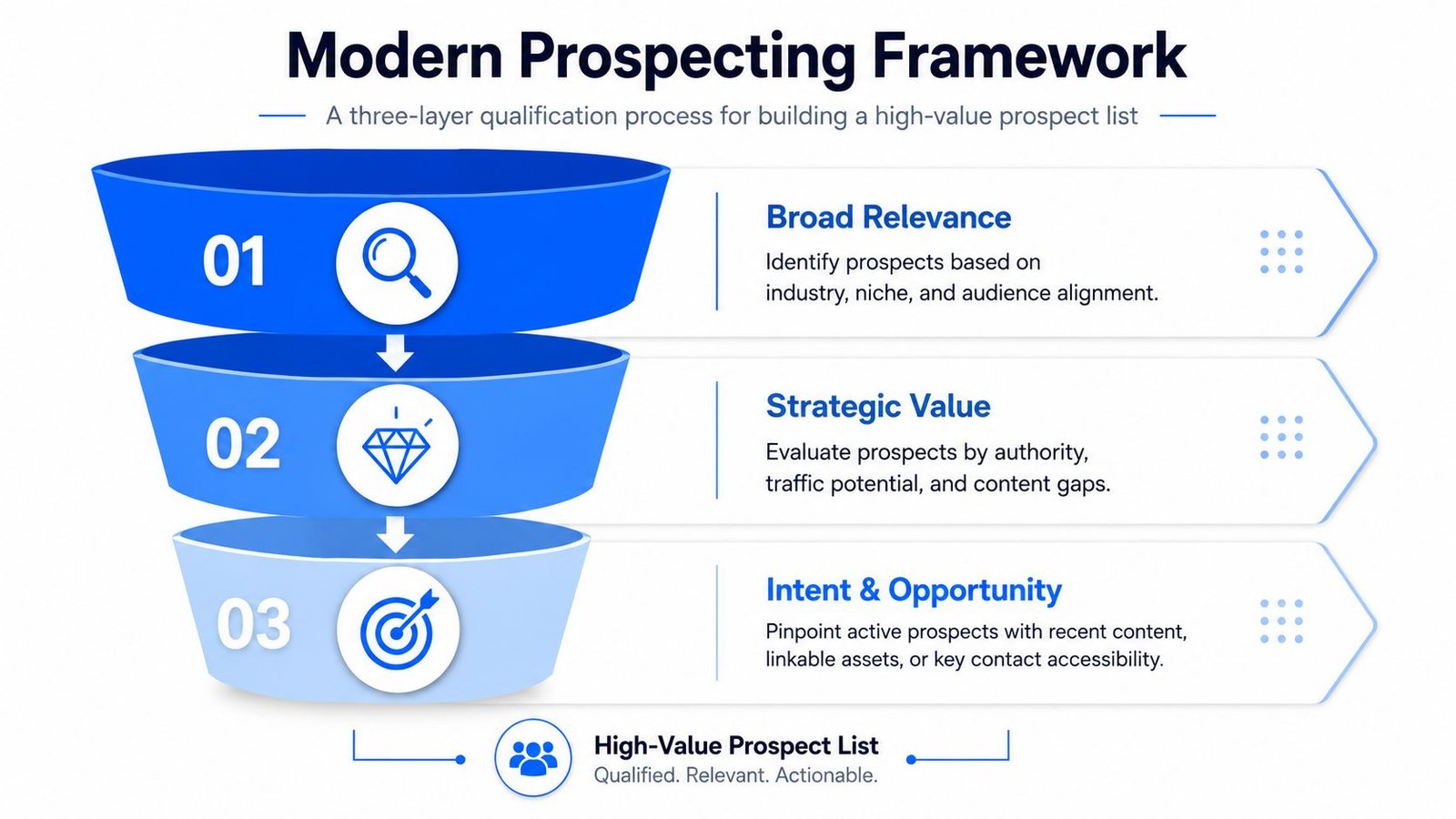
Start with topical fit, not vanity metrics
The first pass should be broad but disciplined. Build a list around audience overlap, topic relevance, and content format compatibility. If you're promoting a SaaS benchmark report, the right targets might include software review blogs, ops publications, niche consultants, and curated resource pages. If you're promoting an eCommerce buying guide, lifestyle publishers and category-specific blogs may be a better fit.
At this stage, simple qualification questions work better than obsessing over a single authority metric:
- Would their audience care about this asset right now?
- Does this site link out to external resources in similar articles?
- Do they publish the kind of page where your asset naturally belongs?
A big list with weak alignment wastes time. A smaller list with obvious fit produces better conversations.
Check whether the site is actually edited
The second layer is qualitative. Some sites have traffic and still aren't worth contacting. Others look modest on paper but are tightly curated and trusted within a niche.
Review the site like an editor would:
- Read recent posts: Are they coherent, updated, and written for readers instead of search engines alone?
- Check outbound linking behavior: Do authors cite external sources naturally, or does every post avoid linking out?
- Look for signs of active maintenance: Fresh content, updated statistics, named authors, and consistent formatting are good signs.
- Avoid generic inbox dependence: If the only contact option is a catch-all address with no visible editor or author trail, response quality usually drops.
This is also where vertical-specific opportunity matters. Lists of guest posting sites can help with discovery, but they shouldn't replace manual review. Prospecting is a qualification job, not a scraping job.
A site can be relevant and still be a bad prospect if nobody appears to own the page you want updated.
Understand the publisher's economics
This is the layer often omitted. Straight North's outreach white paper argues that effective outreach should account for link quality, target markets, credible publishers, content development, publisher communication, and review of traffic, lead, and revenue impact, not just backlinks, in its outreach white paper. That point matters because a publisher doesn't accept a pitch just because your page is “good.”
They accept when your suggestion helps them do one of these things better:
Improve article quality
Your asset updates an outdated claim, fills a missing step, or supports a stronger recommendation.Serve their audience more accurately
The page helps readers make a better decision, understand a topic faster, or access a more current resource.Support the publisher's business model
The update strengthens a comparison piece, a resource page, a buying guide, or a tutorial that already matters to their traffic and editorial goals.
When outreach teams start thinking this way, the message changes. You stop asking for a favor and start presenting a useful editorial improvement. That shift alone filters out a lot of wasted outreach.
Crafting Pitches That Actually Get Replies
A solid prospect list still fails if the email reads like a generic request copied into 200 inboxes. Editors and content managers respond when the pitch helps them improve a page they already care about. If your message creates review work, adds risk, or smells promotional, it gets ignored.
SEOptimer's outreach guidance points out that original research, industry insights, data studies, infographics, templates, and case studies attract links because they give publishers something worth citing in its SEO outreach guide. That is the standard to write against. The pitch should show why your asset makes their page stronger, more current, or more useful to readers.
Lead with the page, not your brand
Agency teams lose replies when they write as if the recipient should care about the sender first. They do not. They care about whether the suggested update improves an article, resource page, or guide that already brings them traffic.
Strong outreach emails handle three jobs fast:
- identify the exact page
- show that you noticed a gap, outdated point, or missing resource
- explain how your asset improves the page for readers
That sounds simple, but it's at this stage that outreach systems typically fail. Reps are given a template, a target list, and a volume goal. The result is a polished email with no editorial judgment behind it. Good outreach needs both. The template creates consistency. The research layer gives the message a reason to exist.
If you are pitching a SaaS blog that cites an old market definition, skip the long introduction. Point to the stale section, explain that you published a newer resource, and state what it adds. If you are pitching an eCommerce resource page with a broken recommendation or thin comparison, show the missing piece and offer the replacement in plain terms.
Build templates that still feel human
Template-free outreach does not scale across dozens of campaigns. Fully automated outreach creates a deliverability problem, a trust problem, and eventually a quality problem. The workable middle ground is a structured template with controlled fields for manual input.
In practice, the repeatable parts are:
- the core offer
- the CTA
- the signature
- the follow-up trigger rules
The manual parts are:
- the target page reference
- the exact reason the page needs an update
- the angle that fits the publisher's audience and content model
That distinction matters. Personalization is not pulling a first name, company name, and article title into a mail merge. Personalization is showing clear editorial relevance without forcing the recipient to figure it out.
Short beats clever. Specific beats flattering.
Outreach Messaging Templates Before and After
| Scenario | Bad Template (Low Response) | Good Template (High Response) |
|---|---|---|
| Resource page inclusion | Hi, we recently published a great article on this topic and thought it would be perfect for your site. Can you add our link? | Hi [Name], I was reading your resource page on [topic] and noticed the section on [specific item] links to an older reference. We published a current guide covering [specific gap]. If you're updating that section, this may be a useful addition for readers. |
| Link insertion on blog post | Hello, I'm reaching out because we have content that's relevant to your article. Please consider linking to our page. | Hi [Name], in your post on [topic], the point about [specific sentence or stat] stood out. We recently published a data-backed asset on the same area that expands that section with [specific utility]. It could strengthen that part of the article if you're refreshing it. |
| Broken link replacement | Dear webmaster, you have a broken link on your website. Replace it with ours. | Hi [Name], I noticed a dead link in your [page title] article pointing to [context of old resource]. We have a live resource that covers the same topic in a current format. If helpful, I can send the exact page so your readers don't hit an error. |
| Guest contribution pitch | We write high-quality guest posts and would love to contribute to your blog. Let me know. | Hi [Name], I've been reading your recent posts on [subtopic]. I think your audience would respond well to a contribution on [specific angle] because it complements your pieces on [related article titles or themes]. Happy to send a focused outline if that's useful. |
A few writing rules improve reply rates and make campaigns easier to manage at scale.
Subject lines
Subject lines should be direct, plain, and tied to the page. If the subject line looks like cold sales outreach, many editors will not open the email, even if the pitch itself is solid.
Use simple formats such as:
- Update for your [topic] page
- Broken link on [page title]
- Resource suggestion for [topic]
- Quick note on [article title]
Keep subject lines short enough to scan on mobile and specific enough to signal relevance. Across agency campaigns, this usually beats clever wording, vague curiosity hooks, and anything that sounds promotional.
Body copy
Keep the note lean. The best-performing structure is usually four lines:
- one line proving relevance
- one line explaining the gap or issue
- one line presenting the asset
- one simple CTA
The CTA should be easy to answer. “Would this be useful if you update that section?” works better than a request with multiple asks, extra context, and a calendar link. Editors want low-friction decisions.
One more operational point matters here. If you want a system that scales, separate message quality control from prospecting quality control. Outreach managers should review live sends for clarity, relevance, and tone before a campaign ramps up. That catches the common failure point early. A good list paired with weak messaging still underperforms, and weak messaging sent at scale burns future opportunities with the same publishers.
Executing the Campaign Cadence
One message almost never reflects the true value of the opportunity. People miss emails, defer decisions, or intend to respond later and forget. That's why campaign cadence matters. Not because persistence magically creates interest, but because professional follow-up gives a good pitch more than one chance to be seen.
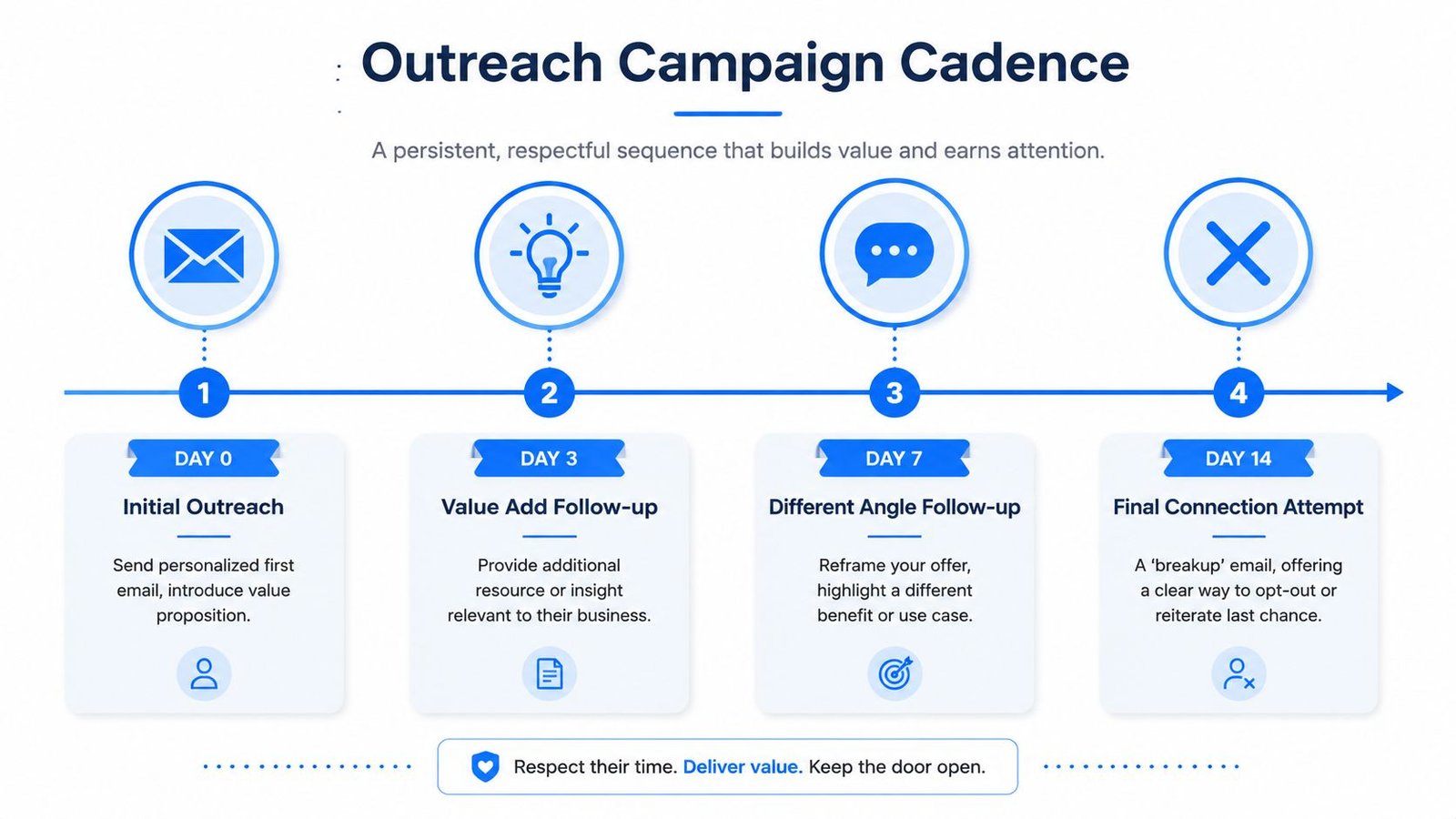
What a professional follow-up sequence looks like
Skrapp's outreach guidance describes a standard workflow with an initial email, then a first follow-up after 3 to 5 days, followed by another 7 to 10 days later in its SEO outreach workflow guide. That timing is sensible because it gives enough space between touches without letting the conversation go cold.
A clean sequence looks like this:
Initial outreach
Make the core value proposition clear. One target page. One issue or opportunity. One CTA.First follow-up
Don't resend the same note. Add something. That could be a clearer explanation, a different angle, or a simpler summary of why the resource fits.Second follow-up
Reframe the benefit. If the first email focused on updated information, the second might focus on reader utility or page maintenance.Final closeout
End the thread politely. Keep the door open without continuing to chase.
Teams usually get into trouble when they confuse follow-up with repetition. If every email says the same thing, the sequence feels automated and unnecessary.
Where multi-channel sequencing helps
Email should stay the primary channel, but a light-touch secondary channel can help when used with restraint. For some prospects, that means connecting on LinkedIn after the first email. For others, it means engaging with a recent post before reaching out, especially when the publisher is a named editor, consultant, or founder.
The key is subtlety. Don't comment publicly and then immediately demand attention in private. Use secondary channels to establish recognition, not pressure.
A workable agency process often looks like this:
- Before contact: Save the prospect's recent article and identify the actual author or editor.
- After first email: If relevant, send a simple LinkedIn connection request tied to their work, not your ask.
- After silence continues: Use one alternative touchpoint only if it feels natural for that publisher.
If the sequence starts to feel like pursuit, it's already gone too far.
Cadence should protect the brand as much as it protects performance. The right number of follow-ups is the number that preserves credibility.
From Ad Hoc Emails to a Scalable System
A campaign starts with good intent. One strategist knows the target list, remembers who replied last week, and keeps the process alive through sheer effort. Then volume rises, another client gets added, inboxes split across teammates, and reply history lives in three different places. Performance drops fast at that point, not because the pitch angle failed, but because the operation has no control layer.
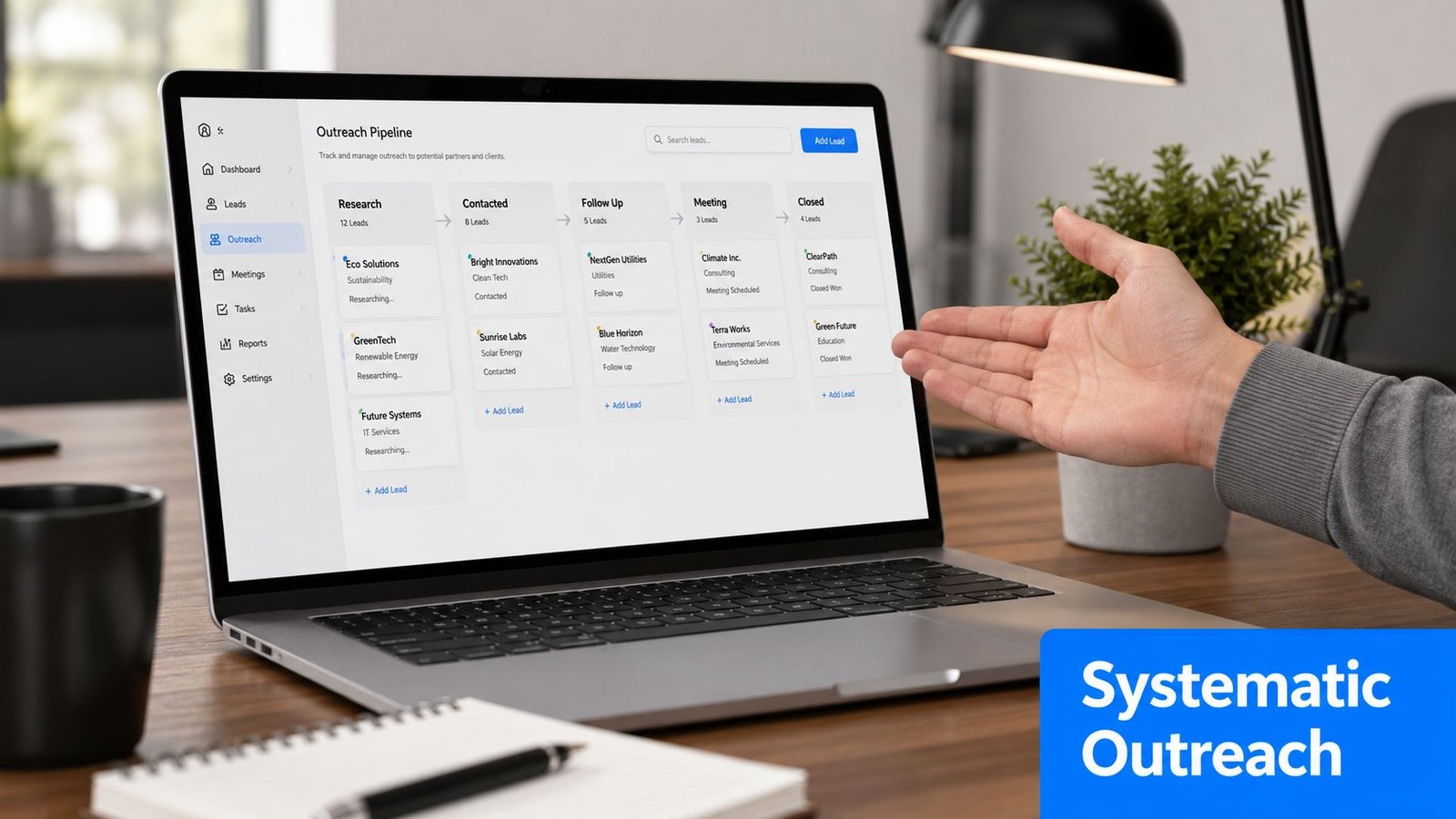
Track the pipeline like an acquisition channel
Agency-grade outreach needs the same discipline as paid acquisition or outbound sales. Every prospect needs a clear status, a next action, an owner, and a record of what the publisher cared about. If that information lives only in one person's head, the campaign is fragile.
A spreadsheet is enough to start. The tool matters less than the operating standard behind it.
At minimum, track:
- Prospect status: not contacted, contacted, replied, negotiated, won, closed
- Target page: the exact URL you pitched
- Pitch type: guest contribution, resource inclusion, broken link replacement, link insertion, partnership
- Owner: who on your team is responsible
- Outcome notes: objections, accepted angles, content requirements, and relationship history
That baseline gives the team visibility into what is happening and what should happen next. It also exposes weak points early. If open rates are healthy but replies are thin, the issue is usually angle or targeting. If replies come in but placements stall, the problem often sits with asset quality, publisher fit, or unclear handoff after interest is shown.
For agencies, this matters even more because outreach is rarely a single campaign. It is a portfolio of campaigns running at once, across different offers, asset types, and client goals. A documented system is what lets a team protect quality while increasing output. If you're building a more formal link building program, this is the point where outreach becomes a managed channel with reporting, QA, and predictable throughput.
Scale without turning spammy
Scale creates a judgment problem before it creates a capacity win.
As soon as junior specialists, freelancers, or automation tools touch the workflow, weak standards show up in the inbox. Contacts get pulled from the wrong pages. Editors get pitched with contributor language. Templates start sounding interchangeable. The result is not just lower reply rates. It is brand drag, wasted list building, and more publishers marking future emails as noise.
The fix is process discipline tied to publisher-side economics. Teams need to know which sites are worth the effort, what type of ask fits each publisher model, and when the likely return is too low to justify another touch. That filter matters more than sending volume.
Every campaign should have a written operating standard that covers:
- which types of sites qualify
- which types of pages are worth pitching
- what counts as real personalization
- what language is off-limits
- when a prospect should be excluded
The review process should be concrete. Broad advice like “personalize more” does not help a growing team. A usable QA checklist does.
- Before sending: confirm the page exists, the article is relevant, and the contact is the likely decision-maker
- Before escalation: confirm the prospect has editorial reason to care, not just domain metrics
- Before scaling a template: verify that early replies show the angle is credible and easy to understand
- Before marking a prospect dead: record why the pitch failed so the list or offer can be improved
Strong systems do not remove judgment. They preserve it across people, clients, and campaign cycles.
That is the shift from ad hoc outreach to a scalable agency model. The team stops relying on memory and individual instinct alone. It builds a repeatable process that keeps context, protects brand quality, and makes each campaign easier to improve than the last.
Outreach in Action for SaaS and eCommerce
The playbook changes by business model, but the structure stays consistent. Strong asset. Tight prospecting. Clear editorial fit. Measured follow-up. Here's what that looks like in practice.
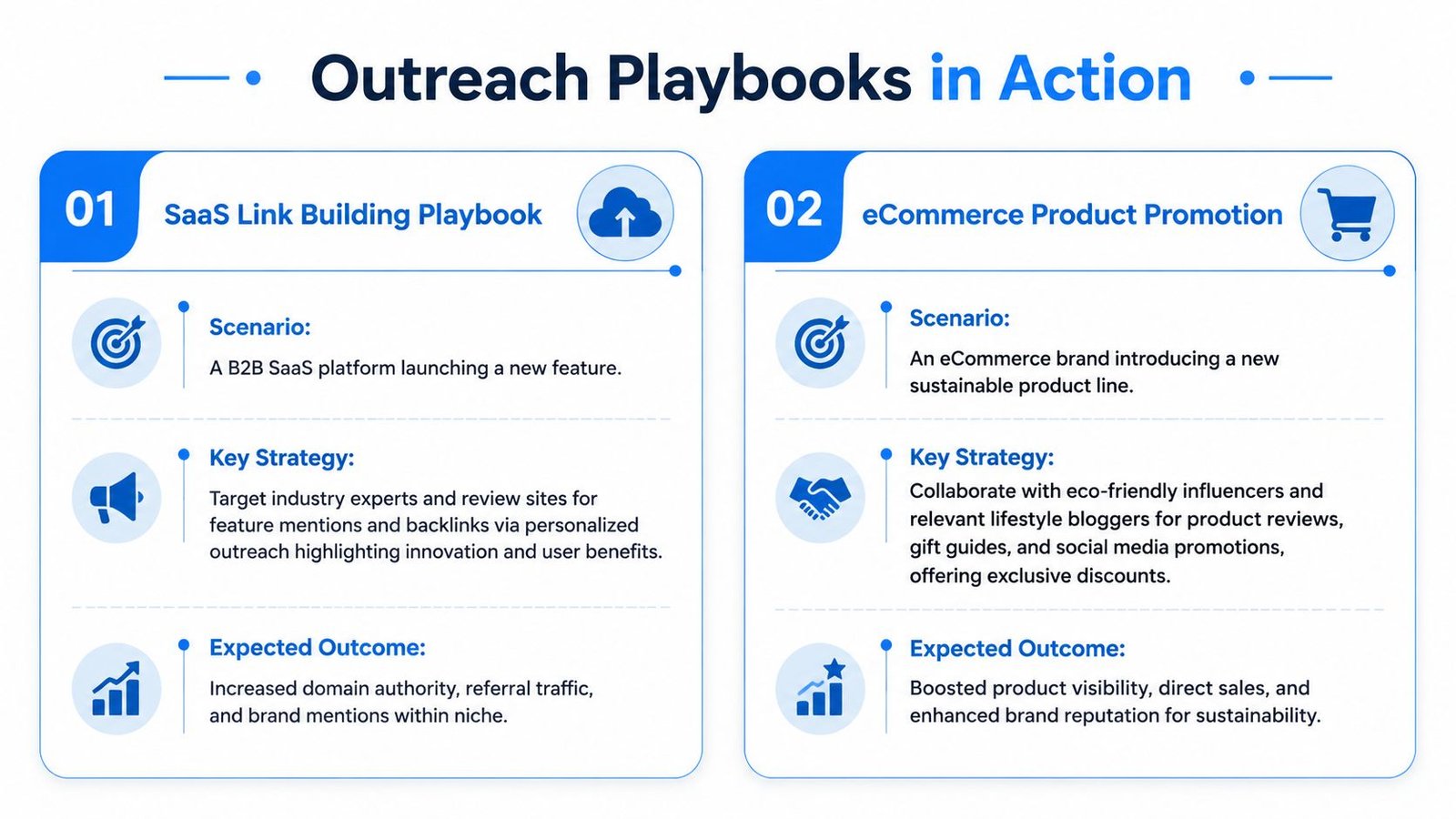
A SaaS playbook built around original research
A B2B SaaS company usually has one advantage many brands underuse. It sits on product-adjacent knowledge that can be turned into original research, benchmark commentary, or implementation insight. Those assets travel well in outreach because they give publishers something to cite.
A practical SaaS campaign often follows this pattern:
- publish an original research or benchmark asset tied to a live industry question
- segment prospects into analysts, niche publishers, consultants, software blogs, and resource curators
- pitch each segment with a different reason to care
- point to a specific article section where the new asset strengthens the page
The strongest angles aren't self-promotional. They usually sound editorial. “You're covering this category already, and this newer source improves the section on X.” That works because it respects how the publisher thinks.
Good SaaS outreach sells usefulness, not product features.
An eCommerce play built around broken link replacement
For eCommerce, category pages rarely earn links on their own unless the team creates supporting assets around them. A practical route is to build category-adjacent content that can replace outdated or broken resources on blogs, resource pages, and gift-guide style posts.
A repeatable eCommerce sequence looks like this:
- identify resource pages or blog posts with outdated product references or broken links
- create or map a useful supporting page that matches the original intent
- contact the page owner with a concise note explaining the issue
- offer the replacement as a reader-friendly fix, not a hard sell
This works best when the replacement isn't a thin commercial page. A category guide, material comparison, care guide, sizing explainer, or curated product education page gives the publisher a stronger reason to update the link.
Both SaaS and eCommerce teams make the same mistake when campaigns fail. They focus too much on what they want placed and not enough on what the publisher is trying to maintain. Once you build around that reality, outreach for SEO stops feeling random and starts behaving like a managed growth channel.
If you want a team that already runs this kind of outreach system for SaaS and eCommerce brands, SaasSky is worth a look. They focus on practitioner-led link building, transparent delivery, and repeatable playbooks built for companies that need more than one-off placements.