

You're probably looking at a listing right now that sounds better than it is.
The headline says the agency has loyal clients, strong margins, and room to grow. The seller says the team is solid, the systems are in place, and the founder is ready to step back. On paper, that sounds like a shortcut to revenue, talent, and channel expertise.
But most buyers don't lose money because they bought an agency. They lose money because they bought a client list wearing the clothes of a business.
That distinction matters more in a fragmented market. The U.S. digital advertising agencies industry is projected to include about 100,000 businesses in 2026, with revenue reaching roughly $56.9 billion after growing at a 7.5% CAGR from 2021 to 2026, according to IBISWorld's digital advertising agencies industry outlook. There's no shortage of agencies to evaluate. The hard part is separating the transferable operators from the founder-dependent shops that start leaking value the moment a deal closes.
If you're considering a digital marketing agency for sale, start there. Ask whether you're buying a repeatable operating system or just renting relationships that might not survive a transition.
Table of Contents
- Why Buy a Marketing Agency Instead of Building One
- How to Find and Screen Agencies for Sale
- A Practical Guide to Agency Valuation
- The Due Diligence Checklist Every Buyer Needs
- Negotiating and Structuring the Acquisition Deal
- Your First 100 Days The Post-Acquisition Plan
Why Buy a Marketing Agency Instead of Building One
A lot of founders default to building because it feels cheaper and more controllable. Hire a head of growth, add a paid media specialist, bring in content, then layer on SEO, lifecycle, analytics, and design. In practice, that usually creates a coordination problem before it creates a growth engine.
Buying can make more sense when you need a functioning delivery team now, not after months of hiring, onboarding, and process cleanup. That's especially true if you want access to channel-specific operators, established account management habits, and client service muscle that doesn't exist inside your company today.

Buying works when you need a system, not just talent
One experienced media buyer is useful. A working agency can be far more useful if it already has briefing templates, QA checks, client communication rhythms, reporting standards, and managers who know how to keep delivery moving without daily founder intervention.
That's the part most listings blur. Buyers often focus on service mix and revenue mix, but the practical question is simpler. Can the business keep operating if the founder disappears after the transition window?
Marketplace guidance on a digital marketing agency for sale points buyers toward retention, revenue per client, and fulfillment structure such as employees versus contractors, which is a useful clue that operational concentration matters as much as revenue itself, as noted by Acquire.com's agency acquisition guidance.
A real agency has process memory. A fragile agency has founder memory.
Building is slower than most founders expect
Internal teams usually start with role definitions and end with workflow debt. You hire specialists before you have management layers. You create new offers before you know whether fulfillment is repeatable. You put client communication in Slack, delivery in Asana, reporting in Looker Studio, and tribal knowledge in someone's head.
That can work inside one business unit. It doesn't translate well into a scalable service operation.
A good acquisition changes the sequence. You buy proven delivery, then improve it. You inherit a client service model, then tighten pricing and reporting. You step into an engine that already produces cash flow, then remove bottlenecks.
When acquisition is the smarter move
Three situations usually justify buying instead of building:
- You need channel capability fast: Your company can't wait for a full in-house buildout in SEO, paid search, paid social, or lifecycle.
- You want embedded operators: The value isn't only in leads or contracts. It's in account managers, strategists, and production staff who already know how to execute together.
- You can improve operations: The best buyers see where an agency is underpriced because the founder never cleaned up reporting, specialization, packaging, or team structure.
If none of that is true, building may still be the better path. But if speed, execution continuity, and operational efficiency matter, a digital marketing agency for sale can be a strategic asset. Just don't confuse activity with transferability.
How to Find and Screen Agencies for Sale
Most buyers waste time too late in the process. They sign the NDA, read the teaser, take the seller call, and only then start asking whether the business is durable. You want to reverse that.
The first screen should happen before you get emotionally attached to the story. Listings are marketing documents. Treat them that way.
What to look for in the first pass
A strong listing usually hints at operating discipline even before diligence starts. You won't get every answer up front, but you can still spot patterns.
Look for these signals:
- Revenue model clarity: If the listing can explain whether revenue is retainer-based, project-based, or mixed, that's useful. If it hides behind broad phrases like “diverse services,” assume you'll need to probe harder.
- Team structure detail: A seller who can explain who manages accounts, who owns delivery, and who handles strategy usually runs a tighter operation than one who says the founder “oversees quality.”
- Service focus: Narrower agencies are often easier to evaluate. Broad shops can be excellent, but broad can also mean unfocused.
- Reporting maturity: If the business can describe how it tracks channel performance to actual client outcomes, that's a good sign.
If you're looking at an SEO-heavy shop, it helps to understand how the seller talks about acquisition channels and sustainable demand. A lot of agencies claim growth without distinguishing between paid visibility and organic traffic that compounds over time. That difference matters because buyers should care about repeatability, not just lead volume.
The fastest disqualifiers
Some red flags should move a listing to the bottom of your pile quickly.
Agency value is tied to predictable revenue. If 20% or more of revenue comes from a single client, buyers become more cautious, and keeping any one client below 10% of total revenue is a key way to improve valuation multiples, according to Raincatcher's guidance on selling a digital marketing agency.
That's one of the easiest early filters because it tells you whether you're buying a business or underwriting a churn event.
Other practical disqualifiers include:
- Founder as rainmaker: If every key client came in through the owner's personal network, transition risk is high.
- Project-heavy revenue: Project work isn't bad. It's just less predictable, and buyers know it.
- Undocumented fulfillment: If delivery depends on a few freelancers with no written SOPs, continuity can break fast.
- Messy pricing: Too many custom scopes usually means margin inconsistency and difficult handoffs.
Practical rule: If you can't explain in one page how the agency wins, delivers, and retains work, the business probably isn't as transferable as the seller thinks.
Build a shortlist with a buyer's lens
A good shortlist isn't just a list of interesting agencies. It's a list of agencies that can survive a change in ownership.
When I screen opportunities, I'm looking for boring strengths. Clean revenue composition. Stable service lines. Mid-level team members with real client responsibility. A seller who can answer basic questions directly instead of selling ambition.
That approach eliminates a lot of noise. It also keeps you from overpaying for charisma, founder reputation, or a polished CIM that hides weak operations.
A Practical Guide to Agency Valuation
A seller shows you two agencies with similar profit. One has a founder who still approves strategy, writes proposals, and calms every nervous client. The other has account directors running delivery, clean reporting by service line, and clients who stay because the system works, not because the owner is in every thread. They should not trade at the same multiple.
That is the core valuation mistake buyers make. They treat agency pricing like a spreadsheet exercise, then realize too late they bought earnings tied to one person's relationships and stamina.
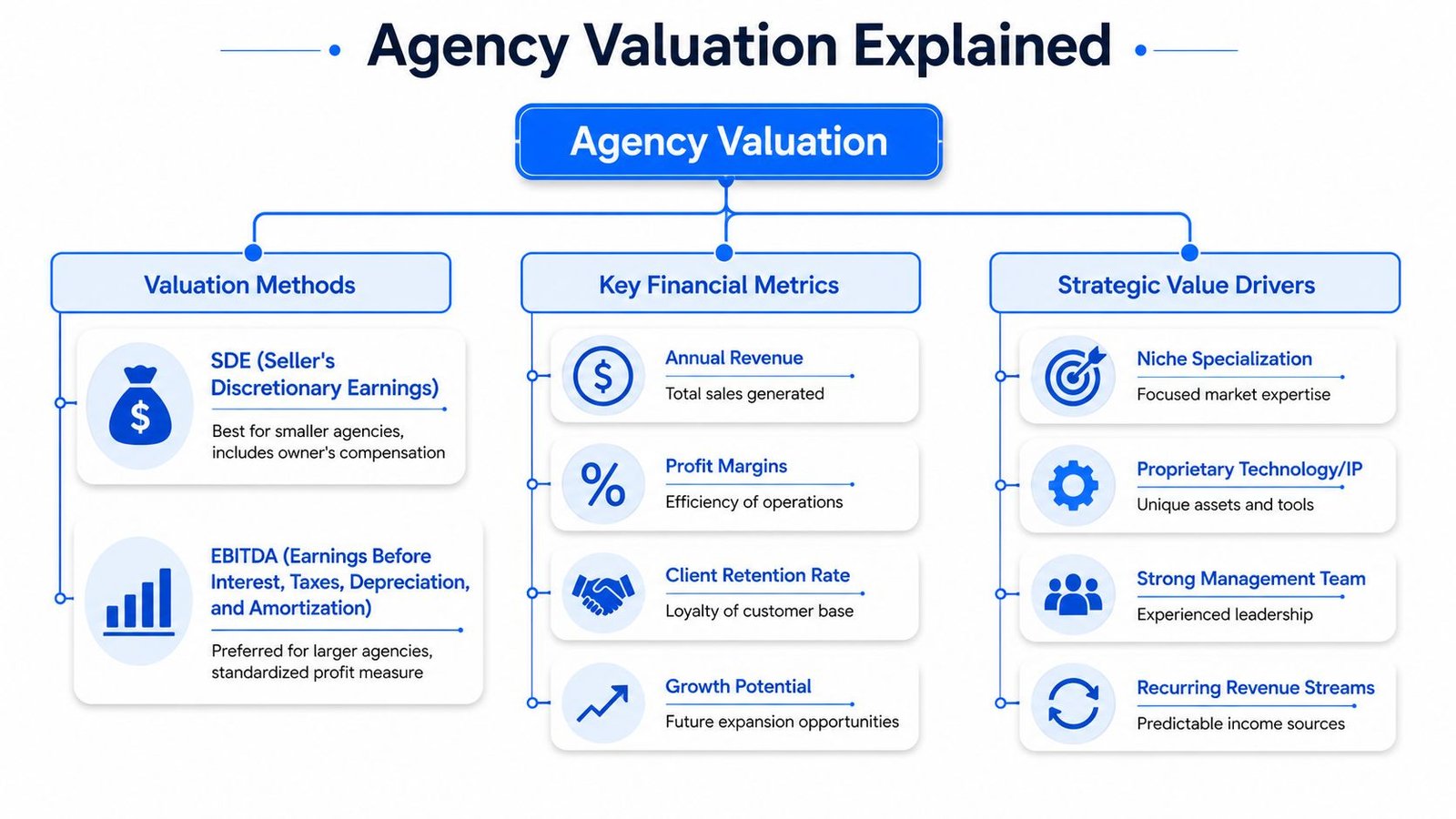
SDE and EBITDA are starting points, not answers
Smaller agencies are often priced on Seller's Discretionary Earnings, because the owner's compensation, personal expenses, and hands-on delivery role usually need to be normalized before the earnings mean anything.
Larger agencies are more often valued on adjusted EBITDA, which gives a cleaner view of operating performance once financing, taxes, and unusual items are stripped out.
The metric matters less than the quality of what sits underneath it.
I have seen agencies with respectable SDE that were barely transferable because the owner was still the sales engine, senior strategist, and retention manager. On paper, the earnings were there. In practice, a buyer was inheriting a job with payroll attached.
What actually moves the multiple
Two agencies can post the same adjusted earnings and deserve very different prices. The spread usually comes from one question: will the earnings hold after the founder steps back?
Higher valuations tend to show a few patterns:
- Retainer revenue with real tenure: Not just recurring invoices, but clients who have stayed through staff changes and normal campaign volatility.
- Delivery that runs through the team: Account managers, media buyers, SEO leads, or strategists own the day-to-day client relationship.
- Clear service-line economics: The agency knows which offers produce margin and which ones only create busy work.
- Documented operating process: SOPs, QA steps, onboarding workflows, and reporting cadences exist outside the founder's head.
- Commercial discipline: Pricing follows a logic the next owner can keep using.
Lower valuations usually show the opposite. Revenue may still look healthy, but the business depends on founder intervention, custom scopes, soft client commitments, or fulfillment habits that break during transition.
That is the difference between a transferable business and a fragile client list.
Earnings quality matters more than growth headlines
Top-line growth can hide a lot. I care more about whether the revenue is durable, visible, and operable by the team that will remain after closing.
Here is a practical way to assess it:
| Quality signal | Why it matters in valuation | What weakens it |
|---|---|---|
| Recurring contracts | Supports forecast confidence and cash flow visibility | Project-heavy revenue or short-term retainers |
| Team-owned client relationships | Reduces transition and retention risk | Founder joins every strategy call and renewal |
| Defined service lines | Makes margin and staffing easier to assess | Blended scopes with unclear labor allocation |
| Clean financial reporting | Speeds buyer confidence and reduces repricing risk | Add-backs that blur operating reality |
Buyers pay for earnings they believe will survive a handoff.
That handoff test is where many agency valuations fall apart. A founder may say clients are loyal, but if loyalty sits with the founder rather than the delivery structure, the buyer is underwriting churn risk.
How to turn valuation into an offer
Start with normalized earnings. Then adjust for concentration, client tenure, management depth, pricing consistency, and how much institutional knowledge is documented.
I would pay more for a smaller agency with fewer surprises. If the team owns delivery, margins are understandable, and clients buy a repeatable service instead of custom heroics, the business is easier to finance, integrate, and grow. That reliability deserves a stronger multiple.
I would discount an agency that looks bigger but still revolves around the founder. In that case, the smarter move is usually a lower price, an earnout, seller rollover, or another structure that shifts transition risk back where it belongs.
Valuation is not about giving every agency the market multiple. It is about deciding how much of the earnings belong to the business, and how much still belongs to the founder.
The Due Diligence Checklist Every Buyer Needs
Due diligence is where the story meets the operating evidence. Don't treat it like a finance-only exercise. In agencies, a key question is whether growth is measurable, repeatable, and transferable.
That standard matters because transaction quality is judged by how measurable and transferable the growth engine is. In a related business context, BCG reports that getting key transformation factors right can move success odds from 30% to 80%, and disciplined measurement is part of that framework, according to BCG's research on digital transformation success. For an agency buyer, that means weak attribution, inconsistent dashboards, and fuzzy reporting aren't minor issues. They're deal quality issues.
Financial diligence
The books need to do more than reconcile. They need to tell you how the business makes money.
Ask for monthly P&L statements, client-level revenue history, service-line margin views, and a clear list of owner add-backs. Then test whether revenue concentration, gross margin, and labor allocation make operational sense.
Focus on specifics:
- Revenue composition: Separate retainer, project, and any pass-through media or contractor billing.
- Margin consistency: Compare margin by service line, not just at the company level.
- Expense normalization: Remove personal or one-time items, but challenge every adjustment.
- Cash conversion: Understand billing terms, collections rhythm, and whether AR quality is stable.
Operational diligence
Most buyers underwrite team and process too lightly. That's a mistake.
You need to know who owns delivery, how work gets reviewed, where SOPs live, and whether managers can maintain standards without founder intervention. Ask for org charts, meeting cadences, onboarding docs, QA checklists, and examples of how accounts move from sales to fulfillment.
A healthy operation usually leaves evidence. Strong agencies can show process in tools like Asana, ClickUp, Monday.com, Notion, Google Drive, or HubSpot. Fragile agencies explain process verbally and hope that's enough.
If the seller says “the team knows what to do,” ask them to show where that knowledge lives.
Client diligence
Client quality isn't just about logos. It's about continuity.
You want to understand why clients stay, who they trust, how often they renew, and whether results reporting connects activity to business outcomes. If the seller allows customer calls, listen for one thing above all. Are clients loyal to the agency, or loyal to the founder?
Use this checklist as a working tool:
| Diligence Area | Key Items to Verify | Red Flag Example |
|---|---|---|
| Financial | Monthly P&L, normalized add-backs, revenue by client, margin by service line | Revenue looks healthy, but owner expenses and pass-through costs distort profitability |
| Operational | SOPs, org chart, account ownership, delivery workflow, QA process | Founder approves strategy, pricing, and client comms across most accounts |
| Client | Contract terms, retention pattern, reporting quality, renewal motion, relationship depth | Clients stay because of the founder personally, not because of team continuity |
| Sales and pipeline | Lead sources, proposal templates, close process, CRM hygiene | New business depends on ad hoc referrals with little repeatability |
| Reporting and analytics | Attribution logic, dashboard consistency, source-of-truth systems | Metrics don't tie channel activity to closed revenue or client outcomes |
The hidden risks buyers miss
Buyers often spend too much time validating top-line revenue and not enough time pressure-testing transferability. A polished deck can hide weak account management. Clean branding can hide sloppy fulfillment. Strong case studies can hide client relationships that are one conversation away from churn.
You're not just verifying the past. You're asking whether the business still works after ownership changes hands.
Negotiating and Structuring the Acquisition Deal
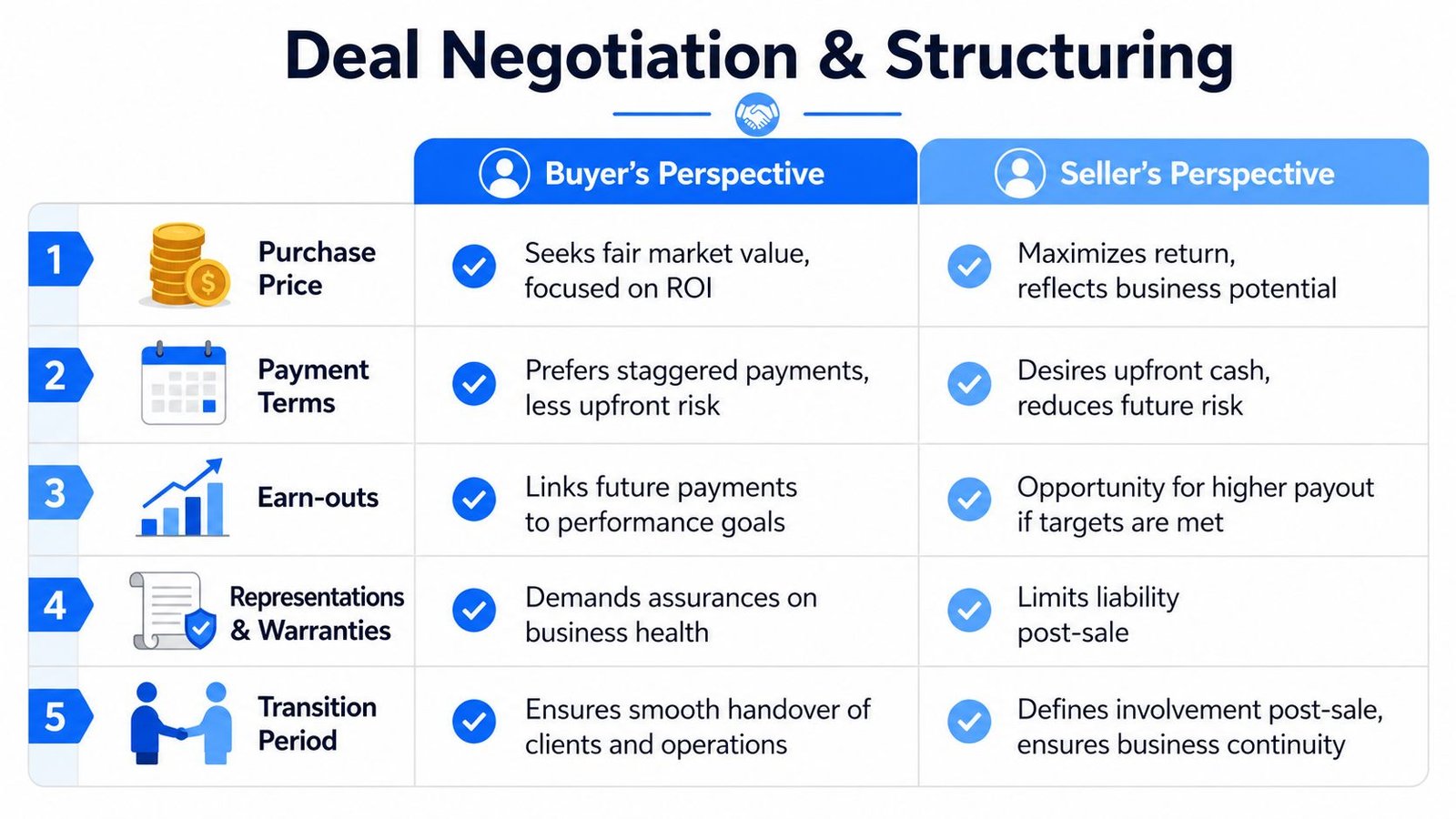
Price gets the attention. Structure decides whether the deal protects you.
A seller may ask for a premium because the business looks stable. That may be fair. But if continuity depends on a small number of clients, senior employees, or the founder's involvement, you shouldn't absorb all that risk in cash at close.
Buyers tend to get better terms when the agency already presents as transferable. OffDeal highlights clean financial records, diversified revenue, and reduced owner dependence as key value drivers, and agencies with retainer-based revenue and documented SOPs usually face smoother diligence and stronger terms, as noted in OffDeal's guide to selling a digital marketing agency.
Structure around the risk you found
If diligence uncovered founder dependency, don't just lower the price. Change the terms.
That can mean using seller financing, holdbacks, or earn-outs tied to retention and handoff performance. Those tools aren't just negotiation tactics. They're a way to align the seller with what matters after close.
A few common approaches work well:
- Seller financing: Useful when you believe in the business but want the seller economically tied to post-close stability.
- Earn-out: Best when there's a real disagreement about future continuity or growth.
- Transition payments: Helpful when the founder needs to stay involved for a defined handover period.
- Holdback against claims: Sensible when financial cleanup or client concentration created uncertainty.
Asset deal or stock deal
The legal structure depends on the facts, but buyers often prefer asset purchases because they can define exactly what they're acquiring and reduce exposure to unknown liabilities. Sellers may prefer stock sales for simplicity and tax reasons.
The right answer depends on contracts, liabilities, licenses, tax considerations, and how the agency is set up. What matters commercially is making sure the structure matches the risk profile you uncovered in diligence.
Don't negotiate from vanity metrics
A seller may justify price by pointing to service breadth, logo count, or a broad statement about market demand. Keep coming back to what drives cash flow durability.
If the business has a strong SEO practice, for example, that doesn't automatically justify a premium. You still need to understand delivery quality, renewal behavior, and how realistic future client economics are. If you need a frame for the economics buyers often compare in search-led service lines, average SEO service cost benchmarks can help you sanity-check positioning, though they're no substitute for actual client-level profitability.
Deal advice: Use price to reflect known value. Use structure to protect against what you can't fully know before closing.
The cleanest deals aren't always the ones with the highest cash number. They're the ones where both sides stay aligned through the handoff and the buyer doesn't inherit avoidable downside.
Your First 100 Days The Post-Acquisition Plan
A post-close plan gets tested fast. On Monday morning, clients want their reports, the team wants direction, and the seller is no longer covering every gap by instinct. That is where buyers find out whether they acquired a business that can run on documented processes and clear ownership, or a client list that depended on one person holding everything together.
The first hundred days shape client retention, team confidence, and how quickly you can see problems before they turn into churn. Buyers who force change too early often disrupt delivery. Buyers who postpone every hard decision inherit blurred roles, inconsistent reporting, and avoidable staff turnover.
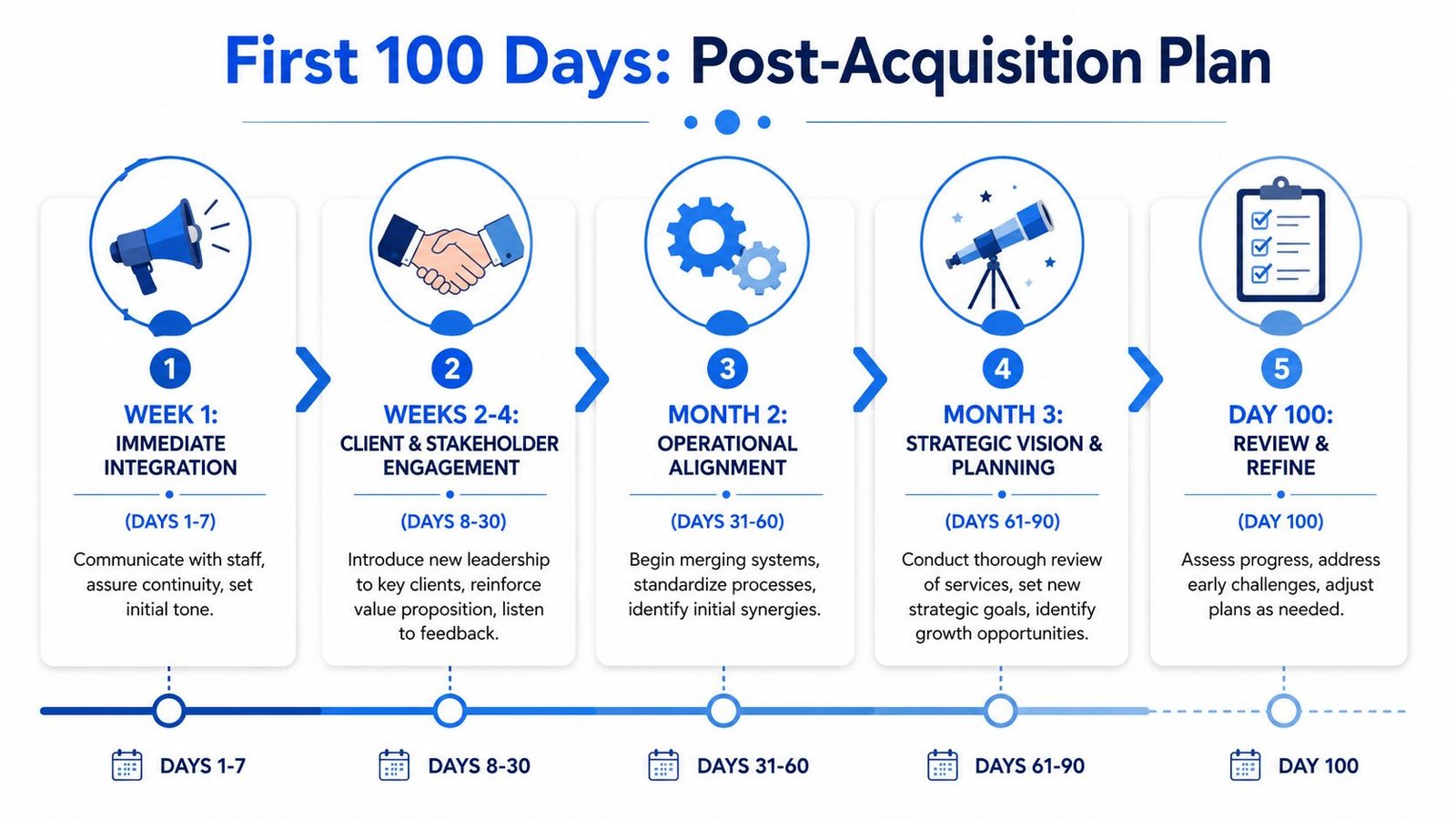
Days 1 through 30 stabilize trust
Start with continuity. Founders often want to prove they have a plan. Clients and staff usually want proof that delivery will stay reliable this week.
Meet the team early and in person if possible. Explain reporting lines, approval authority, and what stays the same for now. Then join the seller in conversations with key clients before any uncertainty fills the gap. Those meetings should answer practical questions: who owns strategy, who handles day-to-day communication, how escalation works, and what clients should expect over the next quarter.
Use the first month to confirm four things:
- Decision ownership: Everyone should know who approves scope changes, staffing decisions, and client escalations.
- Client reassurance: Key accounts need a clear message about continuity, accountability, and response times.
- Workflow stability: Keep the current delivery motion in place unless a process is clearly causing errors, missed deadlines, or margin leakage.
- Knowledge transfer: Record seller walkthroughs for live accounts, renewal risks, informal client preferences, and exceptions that never made it into the SOPs.
This stage also reveals how transferable the agency really is. If account managers can explain client goals, next steps, and reporting logic without the founder translating everything, that is a strong sign. If every important answer starts with "ask the seller," you are still buying yourself time, not control.
If the agency's public presence is dated, leave it alone for now. A site refresh can wait until delivery is steady, and reviewing examples of strong digital marketing agency website design is more useful later than in week one.
Days 31 through 60 tighten the operating model
Once trust is stable, get visibility into how the business runs.
Review dashboards, reporting definitions, account review cadences, and margin by client. Agencies often look organized from the outside and operate on tribal knowledge internally. A transferable business has shared definitions, recurring check-ins, and documentation that survives employee turnover. A fragile one has smart people covering for missing systems.
Be careful with tool changes. I have seen buyers replace project management, reporting, and communication tools in the first month because the stack looked messy. That usually creates confusion before it creates improvement. First understand why the current setup exists. Some odd processes are there because a few large clients expect them, and changing them too fast can put revenue at risk.
This is also the point where hidden operators become obvious. Sometimes the agency runs through a founder. Sometimes it runs through an operations lead, senior strategist, or account director who was underplayed during the sale process. Identify those people, reduce friction around their work, and make sure they see a future inside the business.
Days 61 through 100 build a business you can manage
By now, you should have a clearer view of which services are delivered well, which accounts are vulnerable, and where profitability is stronger or weaker than it looked during diligence.
Now make targeted changes:
- Shift account ownership carefully: Move strategic relationships away from any remaining seller dependency, but do it with a visible handoff plan.
- Refine the offer mix: Put more focus on services the team can deliver consistently and clients renew without heavy founder involvement.
- Standardize reporting: Create one operating view for pipeline, account health, utilization, and delivery status.
- Set management rhythm: Weekly delivery reviews and regular leadership meetings surface problems while they are still fixable.
- Protect retention before expansion: Cross-sells can wait until client confidence and internal accountability are stable.
A good hundred-day plan makes the agency easier to run than it was on the day you bought it.
That means fewer founder bottlenecks, clearer service ownership, better visibility into account health, and a team that knows how work moves from sale to delivery to renewal. If those pieces are in place, you have something durable. If they are not, the business may still produce revenue, but it will remain more fragile than the headline numbers suggested.
If you're evaluating a digital marketing agency for sale and want a team that understands how buyers assess transferability, reporting quality, and sustainable growth, SaasSky is worth a look. Their work is built for SaaS and eCommerce teams that care about transparent execution, clear pricing, and measurable outcomes rather than vague agency promises.