You've probably seen this happen in a Slack channel or a founder group chat.
A competitor lands a mention on a site everyone recognizes. The team celebrates. Someone assumes rankings will jump. A few weeks later, nothing meaningful changes in search. Traffic from that placement may show up. Brand searches may tick upward. But the product page you care about still sits where it was.
That disconnect is why so many SaaS and eCommerce teams misunderstand follow and nofollow links. They treat every backlink as equal, or they write off nofollow links as useless. Both views are wrong. Some links act like direct authority transfers. Others work more like distribution, discovery, and demand generation. If you don't separate those jobs, your link strategy gets noisy fast.
The practical question isn't “is this link good?” It's “good for what?” Rankings, referral traffic, brand trust, assisted conversions, crawling signals, compliance, or future link earning all sit in different buckets. If you want a simpler way to think about that, start with this guide to Google PageRank factors, then use the framework below to decide which links deserve budget, outreach effort, and reporting time.
Table of Contents
- Your Competitor Got a Forbes Link So Why Didnt Their Rank Budge
- The Foundational Difference Between Follow and Nofollow
- Meet the Modern Link Family rel sponsored and rel ugc
- How to Implement Link Attributes Correctly
- A Link Building Playbook for SaaS and eCommerce
- Auditing and Measuring the Value of Your Links
- Answering Your Lingering Questions
Your Competitor Got a Forbes Link So Why Didnt Their Rank Budge
A founder sees the headline. Their competitor got featured on Forbes. The natural reaction is panic mixed with envy. If you've spent months trying to earn backlinks, that kind of logo looks like game over.
Then rankings barely move.
That doesn't mean the placement had no value. It means the value may not have been the one you assumed. A link from a major publisher can be excellent for visibility, credibility, direct clicks, and later earned mentions. But if that link doesn't pass authority in the way your SEO team hoped, it won't behave like a clean ranking lever.
The mismatch between link prestige and SEO impact
Founders often get trapped by surface-level thinking. They judge links by logo recognition, not by link type, page context, relevance, and the actual business outcome attached to the placement.
A high-visibility link can do three very different jobs:
- Authority transfer if it's a followed editorial link from a relevant page
- Audience access if it sends qualified referral traffic
- Brand validation if buyers keep seeing your company in trusted places
Only the first one is the classic ranking play.
A famous publication can be a strong marketing win and still be a weak SEO asset for rankings.
What to ask instead
When a competitor lands a press mention, ask better questions:
- Was the link followed or nofollowed
- Did the article link to a homepage, product page, or a founder bio
- Was the publisher relevant to the buyer, or just prestigious
- Did the mention create referral traffic or later editorial links
- Was the ranking expectation tied to one link that was never built for that purpose
That's the fundamental frame. Smart teams don't ask whether a link is “good.” They ask whether it helps rankings, pipeline, or both.
The Foundational Difference Between Follow and Nofollow
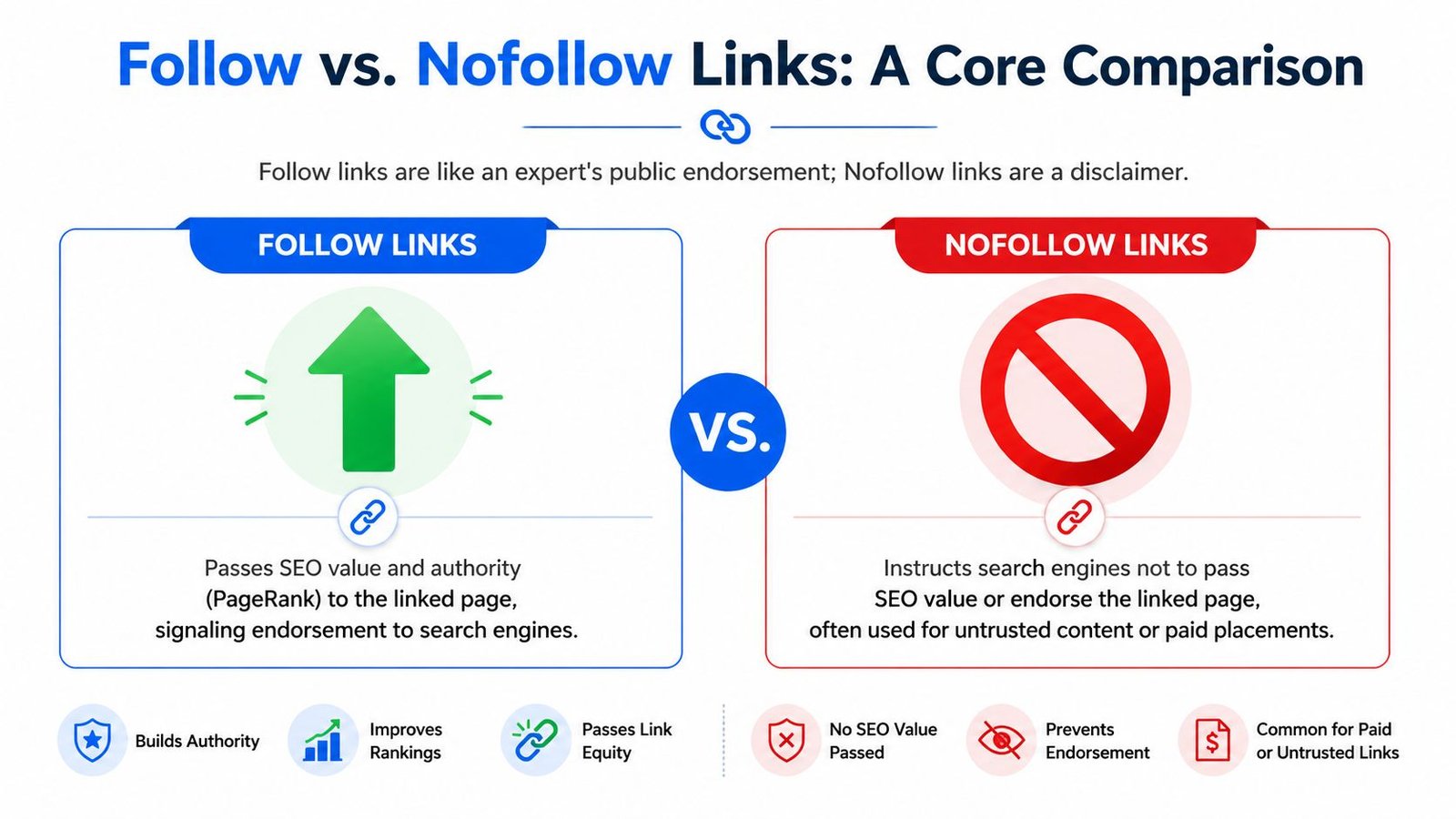
A follow link is a standard crawlable link that can pass authority signals to the destination page. A nofollow link still points readers to the page, but it adds a rel="nofollow" attribute that tells search engines not to treat it as a normal editorial vote.
That distinction affects rankings, but it also affects how you value a placement.
What changes in practice
If your SaaS company gets a followed link from a relevant article, that link can support the ranking ability of the page it points to. If the same mention is nofollowed, the SEO effect is usually weaker, but the placement can still create value through referral traffic, brand exposure, and secondary links earned later when other writers discover your brand.
That is why serious link building does not stop at asking, “Is the link followed?” The better question is, “What job is this link supposed to do?”
For rankings, followed links are still the stronger asset because search engines have historically used them to pass PageRank and other authority signals. For distribution, PR, partnerships, community activity, and paid visibility, nofollow links often make perfect sense.
Why nofollow exists
Google introduced nofollow so publishers could link out without passing a full editorial endorsement. Orbit Media's summary of Google's original guidance explains that the attribute was created to handle cases like blog comments, forums, and other links a site owner did not want to vouch for with ranking credit in its history of nofollow links.
That solved a real problem on the web. Publishers needed a way to separate genuine citations from links created by ads, user submissions, or spam-prone areas of a site.
Common examples include:
- Comment sections
- Forums and community posts
- Paid placements
- Links a publisher wants readers to access without endorsing for SEO
For founders, the practical takeaway is simple. A followed link is usually an authority play. A nofollow link is usually a visibility, compliance, or risk-control play.
Both matter. They just serve different growth functions.
A lot of weak campaigns fail because they treat every backlink as interchangeable. That is how teams end up overpaying for links that look impressive in a report but do little for rankings, or ignoring nofollow placements that send qualified buyers and lead to future editorial mentions. The right framework is not follow good, nofollow bad. It is matching the link type to the business outcome you want.
Meet the Modern Link Family rel sponsored and rel ugc
The old follow-versus-nofollow conversation is still useful, but it's incomplete.
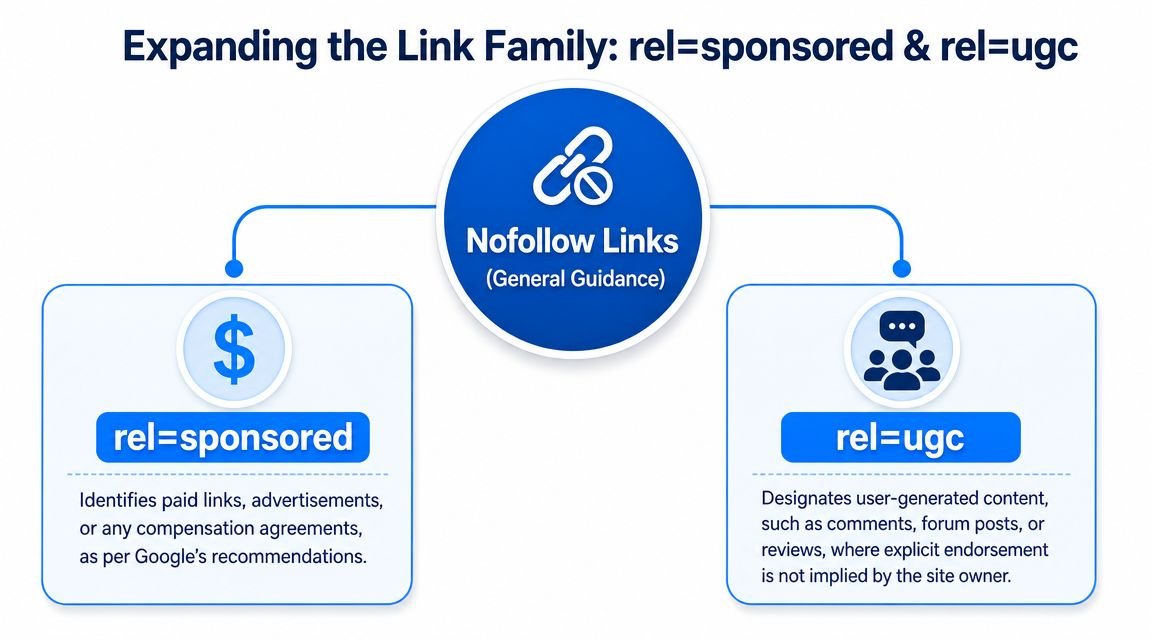
Today, link attributes work more like a family of labels. Instead of using nofollow as a blanket answer for every non-editorial situation, search engines now recognize more specific relationship signals. That matters if your SaaS brand runs partnerships, creator campaigns, affiliate programs, community forums, or customer review sections.
The old binary is too simple
A lot of teams still ask the wrong question. They ask, “Should every paid link be nofollow?” The better question is, “Which rel value correctly describes the relationship behind this link?”
That distinction matters because newer SEO guidance increasingly treats nofollow, sponsored, and ugc as separate signals, and search engines may evaluate them differently when deciding whether to crawl or interpret a link. That shift is described in this discussion of modern rel attributes.
How to choose the right attribute
Use the attribute that matches reality.
| Situation | Best-fit attribute | Why |
|---|---|---|
| Editorial citation you trust | none added, so it remains follow | You're making a normal endorsement |
| Paid article, ad, or affiliate placement | rel="sponsored" |
The link exists because of compensation or commercial arrangement |
| Comment section, forum post, community submission | rel="ugc" |
The link was created by users, not as your editorial recommendation |
| Link you want to reference without endorsing | rel="nofollow" |
You're giving context, not authority |
This matters more in 2026 because compliance and disclosure now sit right next to SEO strategy. A founder who buys placements and labels them carelessly is creating risk, not growth.
If the link relationship is commercial, label it as commercial. If it's user-generated, label it as user-generated. Don't use a vague tag when a precise one exists.
That precision also helps internal teams. Your content lead, PR lead, SEO manager, and partnerships manager should all use the same labeling logic. Otherwise link audits turn into cleanup projects.
How to Implement Link Attributes Correctly
Getting the theory right is easy. The mistakes usually happen in publishing workflows, where editors, marketers, and developers make different assumptions about the same link.
I see this a lot on SaaS sites. The content team adds nofollow to every external link to “be safe,” the partnerships team publishes paid placements without sponsored, and the product team leaves community links untreated because no one owned the template logic. The result is a link profile that is harder to audit, harder to trust, and harder to scale.

HTML examples you can copy
A standard followed link usually looks like this:
<a href="https://example.com">Example</a>
A nofollow link looks like this:
<a href="https://example.com" rel="nofollow">Example</a>
A sponsored link looks like this:
<a href="https://example.com" rel="sponsored">Example</a>
A user-generated content link looks like this:
<a href="https://example.com" rel="ugc">Example</a>
Those tags describe the relationship behind the link. For a SaaS founder, that matters for two reasons. First, it keeps your SEO signals clean. Second, it keeps your disclosure logic aligned with how the link was placed.
How to handle this in WordPress and other CMS tools
The right setup removes judgment calls at the point of publishing.
In WordPress, editors can usually choose link attributes from the block editor or through SEO and link plugins. Shopify, Webflow, Ghost, and headless CMS setups often need a small amount of template work so editors are not editing HTML every time they publish. That work pays off quickly if your team ships content weekly, runs affiliate partnerships, or manages any kind of user-submitted content.
Use rules that match your business model:
- Editorial links in articles and resource pages stay followed unless your team explicitly does not want to endorse the destination.
- Affiliate links, paid placements, and sponsorships get
rel="sponsored"during publishing. - Comments, reviews, forum posts, and community submissions get
rel="ugc"automatically at the template level when possible. - Reference links to pages you mention without backing can use
rel="nofollow".
If your team is still building that process, a white hat link building workflow for SaaS teams helps keep outreach, partnerships, and publishing standards from drifting apart.
Where teams usually get implementation wrong
The common failure is using one attribute as a catch-all.
nofollow is not a substitute for sponsored. It is not a substitute for ugc. It is also not a cleanup tool for weak internal architecture. Using the wrong tag does not make a risky setup safer. It just makes your intent less clear to search engines and less clear to your own team during audits.
Another mistake is handling this manually forever. If your site has a marketplace, a directory, a customer community, or public profiles, hard-code the logic where you can. Manual review works for a handful of articles. It breaks once links are created across dozens of pages by users, freelancers, or partner managers.
When page-level directives make more sense
Link attributes solve link-level problems. They do not solve every indexing or crawl issue.
If the problem is a login page, internal search result, post-purchase page, staging URL, or another low-value destination, handle that with page-level controls and template rules. Do not try to use link attributes to manage URLs that should be controlled at the page level.
That distinction matters because good implementation is not about treating every outbound link as a threat. It is about assigning the right signal to the right relationship, then making that logic repeatable. That is how technical SEO supports business goals. You preserve authority where endorsement is real, disclose commercial links correctly, and still get value from links that drive awareness, clicks, and partnerships even when they are not followed.
A Link Building Playbook for SaaS and eCommerce
A SaaS founder sees a competitor land a flashy media mention and assumes the win was SEO. Then nothing happens to rankings. The mistake is treating every backlink as if it should do the same job.
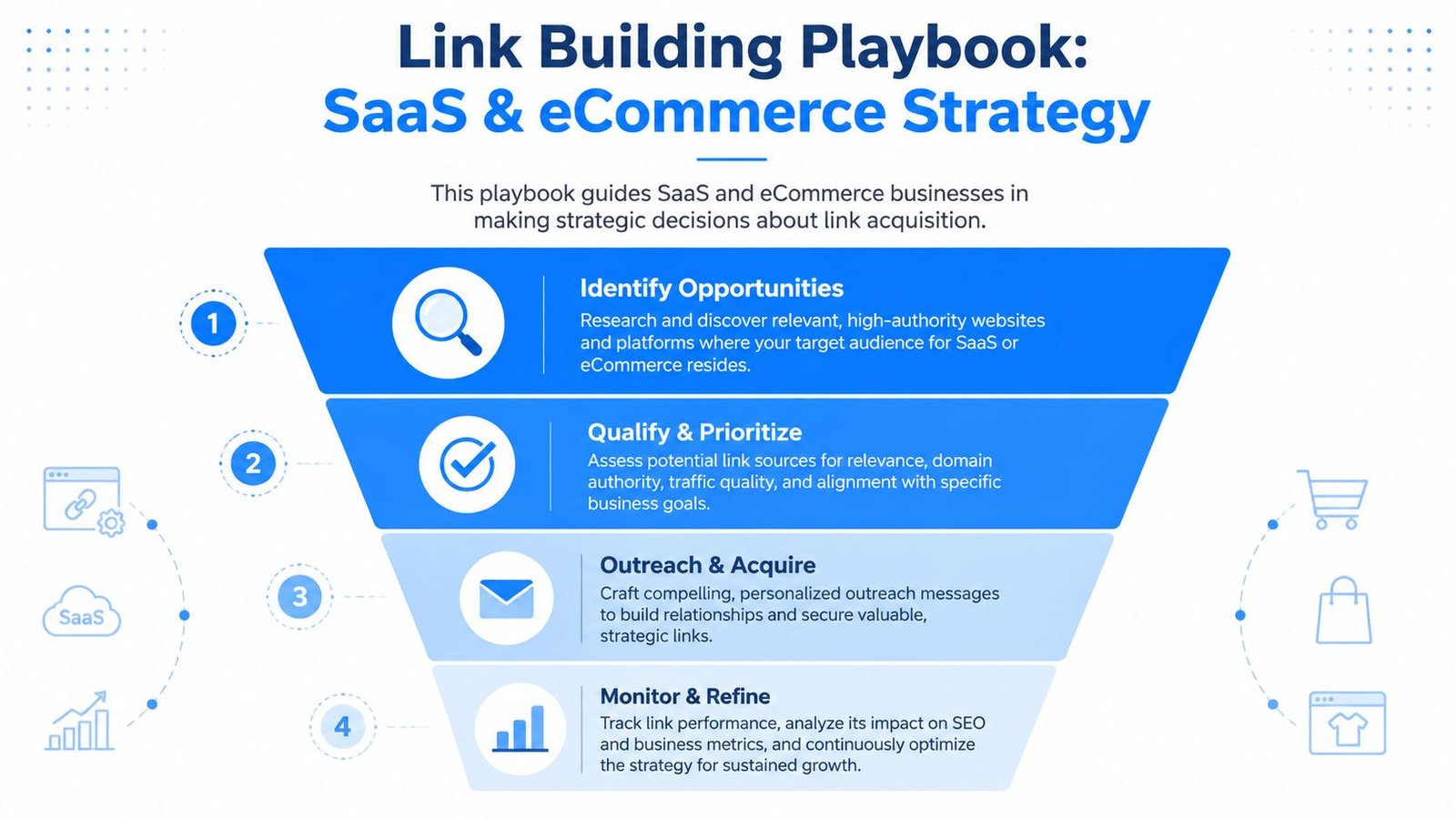
For SaaS and eCommerce, link building works better as a portfolio than a single tactic. Some links strengthen pages you want to rank. Others put your product in front of the right buyers, spark branded search, and send referral traffic that can convert. Good strategy assigns each link type a role, then measures it against business outcomes.
Use follow links for authority goals
Followed links should support pages with clear revenue potential. For SaaS, that usually means feature pages, solution pages, comparison pages, integration pages, and bottom-funnel content. For eCommerce, it often means category pages, key collections, high-margin product lines, and buying guides that influence purchase decisions.
The best followed links have a few things in common:
- They come from relevant sites and relevant pages
- They fit the article naturally and help the reader
- They point to a page with a realistic ranking opportunity
- They are earned through editorial judgment, partnerships, digital PR, or expert contribution
Discipline is essential. A followed link to the wrong page wastes authority. A homepage link from a broad publication can look impressive in a report and still do less for revenue than a contextual link to a comparison page that closes demos.
If you want a repeatable system, start with a white hat link building process for SaaS brands that separates real editorial opportunities from placements that only inflate backlink counts.
Use nofollow links for reach, demand, and assisted conversions
Nofollow links belong in the plan because buyers do not care how a link is tagged. They care whether they saw your brand in a credible place at the right moment.
A mention in a respected publication, a useful Reddit thread, a founder interview, a community resource page, or a high-intent forum discussion can send qualified traffic even when it does not pass authority in the classic sense. That traffic can turn into demos, trials, email signups, branded searches, and later editorial links from people who discovered you there first.
For SaaS, nofollow often supports category education and buyer research. For eCommerce, it can be strong in gift guides, creator mentions, deal communities, and product discussion threads where shoppers are already comparing options.
Measure these links like demand channels, not like pure SEO assets.
Build two link tracks, then budget for both
The cleanest operating model is simple. Run one track for authority and one for distribution.
The authority track focuses on followed editorial placements to pages that can rank and produce revenue. The distribution track focuses on visibility in the publications, communities, and platforms your buyers already use. Some placements will do both. Many will not, and that is fine.
This split fixes a common reporting problem. Teams stop arguing over whether a nofollow placement was "worth it" and start asking the right question. Did it help rankings, traffic, pipeline, or assisted revenue?
What usually fails
Weak link programs break for predictable reasons.
Some SaaS teams overpay for followed links on sites with no audience and weak topical fit. Some eCommerce brands ignore nofollow placements and miss the channels where product discovery happens. Others send every link to the homepage, then wonder why commercial pages stay stuck.
A nofollow mention on a page your buyers trust can produce more revenue than a followed link on a site built only to sell placements.
Use follow links to strengthen pages that need authority. Use nofollow links to earn attention, clicks, and brand demand. The win comes from matching the link type to the job, then judging performance by business impact rather than backlink vanity.
Auditing and Measuring the Value of Your Links
A founder opens Ahrefs, sees 40 new backlinks, and assumes the quarter's link building worked. Then pipeline stays flat, target pages do not move, and nobody can explain why. The problem is not link volume. The problem is measurement.
A useful audit ties each link to a job and then checks whether it did that job. Some links support rankings. Some send qualified visitors. Some put your brand in front of buyers, journalists, and partners who influence later revenue. If you audit every link with one SEO score, you miss the actual return.
Nofollow links sit at the center of that mistake. Gary Illyes said in 2019 that over half of links he saw across the web carried the nofollow attribute, a point often cited in Fractl's write-up on nofollow link prevalence. For a 2026 playbook, treat that as a historical marker, not a current benchmark. It showed the direction of travel. Link attributes became normal web plumbing, which means your audit process has to account for follow, nofollow, sponsored, and UGC links without forcing them into a good versus bad bucket.
Start with a simple link audit
Export recent backlinks from Ahrefs, Semrush, Moz, or Google Search Console. Then classify them by attribute and by destination page.
That second step matters more than many teams expect.
If 80 percent of earned links hit the homepage while your money pages have no support, you do not have a reporting problem. You have a distribution problem inside the link strategy.
Use four buckets first:
| Bucket | What to review |
|---|---|
| Follow | Topical fit, target page, anchor context, indexation, ranking movement |
| Nofollow | Referral sessions, engagement quality, assisted conversions, brand reach |
| Sponsored | Correct disclosure, campaign source, landing-page intent |
| UGC | Platform quality, moderation risk, context of the mention |
Then review the destination pages. Check whether links are strengthening pages that can rank, convert, or assist a sale. For broader context, compare backlink performance with your organic traffic growth patterns. Links rarely act alone. They usually work with existing demand, content quality, and site structure.
Measure each link type by its actual job
Follow links should be judged like authority inputs. Track whether the linked page gains rankings, impressions, organic visits, and crawl activity after the placement goes live. If nothing moves, inspect the basics. Was the linking page indexed? Was the placement topically relevant? Did the link point to a page with real ranking potential, or to a generic homepage that cannot convert the added authority into revenue?
Nofollow links need a different scorecard. Look at referral traffic, time on site, assisted conversions, demo requests, email signups, and product page views after the click. A nofollow mention on an industry publication can outperform a followed link on a weak site if it puts your product in front of buyers who are already comparing vendors.
Sponsored and UGC links deserve their own checks. Sponsored links should be reviewed for disclosure accuracy and post-click performance. UGC links should be reviewed for context, moderation quality, and whether the platform sends traffic that behaves like a real prospect rather than low-intent noise.
One question makes audits sharper. What was this link supposed to do?
That framing stops two common mistakes. SaaS teams stop overvaluing followed links that never influence rankings or pipeline. eCommerce teams stop dismissing nofollow placements that repeatedly drive product discovery, branded search, and assisted revenue.
Answering Your Lingering Questions
A few questions always come up once teams move past the basics.
They usually sound simple, but the wrong answer can distort your whole link policy.
If nofollow links do not pass authority why do big placements still matter
Because buyers aren't crawlers.
A nofollow link on a high-visibility site can still create brand discovery, referral visits, and the kind of familiarity that makes later conversion easier. It can also put your company in front of writers, creators, newsletter operators, and partners who later cite you with editorial followed links. That's why the value of some nofollow placements comes from click potential, audience relevance, and earned attention, as explained in Ubersuggest's discussion of why high-visibility nofollow placements still matter.
So yes, a nofollow media mention can matter a lot. Just don't evaluate it like a direct PageRank asset.
Should you nofollow every external link
No.
That's an outdated attempt to hoard value, and it usually makes your content worse. Good editorial content should cite relevant, trustworthy sources normally. If you trust a source and the link is editorial, treat it like one.
Reserve special attributes for cases where the relationship requires them. Paid gets sponsored. User-generated gets UGC. Reference without endorsement gets nofollow.
Here's the practical split:
- Use follow for trusted editorial citations
- Use sponsored for paid and affiliate relationships
- Use UGC for comments, community posts, and other user submissions
- Use nofollow when you want to mention without endorsing
Should you use nofollow on internal links
Usually, no.
For most SaaS and eCommerce sites, internal links help search engines understand structure, priority, and relationships between pages. Adding nofollow to internal links often creates confusion without solving the underlying issue.
If your goal is crawl management on a large site, use more appropriate controls. If your goal is to stop low-value pages from being treated as important, fix your architecture, internal linking patterns, or page-level directives. Don't use nofollow as duct tape.
Internal nofollow is usually a sign that the real problem sits in site structure, index control, or template logic.
A healthy site doesn't need defensive link attributes scattered across its own navigation.
If you want a team that treats follow and nofollow links as part of a measurable growth system, not a vanity metric game, SaasSky is built for that. They help SaaS and eCommerce brands earn authority where it affects rankings, use visibility placements where they affect pipeline, and keep the process transparent enough that founders can see what they're paying for and why it matters.