You open GA4, click Acquisition, and see a line item called Organic Search. Traffic is coming in, but the bigger question is harder: does that number represent real business growth, or just activity?
For SaaS founders and eCommerce operators, that distinction matters. A lot. Paid campaigns can spike sessions fast, branded search can blur attribution, and social traffic can look exciting for a week and disappear the next. Organic traffic behaves differently. When it's built on the right pages, the right queries, and the right technical foundation, it doesn't act like a campaign. It acts like an asset.
That's why understanding what is organic traffic isn't a beginner SEO exercise. It's a revenue question, a demand capture question, and in many cases a market visibility question.
Table of Contents
- Why Organic Traffic Is Your Most Valuable Growth Asset
- Defining Organic Traffic and How It Really Works
- The Primary Sources of Website Traffic
- The Business Case for Organic Traffic in 2026
- Three Pillars for Growing Your Organic Traffic
- How to Measure and Report on Organic Traffic Quality
- Common Questions About Organic Traffic
Why Organic Traffic Is Your Most Valuable Growth Asset
Most founders first notice organic traffic when they're trying to explain uneven growth. Paid search is easy to map to spend. Outbound has a clear owner. Organic often sits in the dashboard looking passive, even though it may be carrying the acquisition model.
The market reality is simple. Organic search accounts for about 53% of all website traffic, making it the largest single traffic source for most businesses, and the first page of Google captures 71% of search traffic clicks, according to SEO Inc's organic search benchmarks. If your company isn't visible where buyers search, someone else is collecting that demand.
It compounds differently than paid channels
Paid media rents access. Organic earns placement.
That difference changes how a business grows. A useful comparison is this: paid search gives you distribution as long as you keep buying it, while organic traffic can keep delivering visits after the page is published and improved. For SaaS, that might mean comparison pages, integration pages, and problem-aware blog content. For eCommerce, it might mean collection pages, product detail pages, and buying guides.
Practical rule: Treat strong organic pages like assets on your balance sheet of attention. They can keep producing demand long after the initial work is done.
This is also why experienced operators don't treat SEO as "blog posts" alone. Organic growth usually comes from a combination of content quality, technical accessibility, and authority. If one of those breaks, traffic stalls. If all three improve together, performance compounds.
It aligns with how people actually buy
Buyers don't start every journey by typing your brand name into a browser. They search categories, alternatives, use cases, integrations, and pricing questions. Organic traffic captures those moments before a prospect has chosen a vendor.
That makes it especially valuable for younger brands that still need to earn recognition. A startup without deep brand demand can still win search visibility if its pages match intent better than larger competitors.
For teams that want a real-world example of how clients evaluate partners and outcomes before committing, client feedback from SaasSky engagements shows the kind of accountability buyers look for when organic growth becomes a strategic channel instead of a side project.
Defining Organic Traffic and How It Really Works
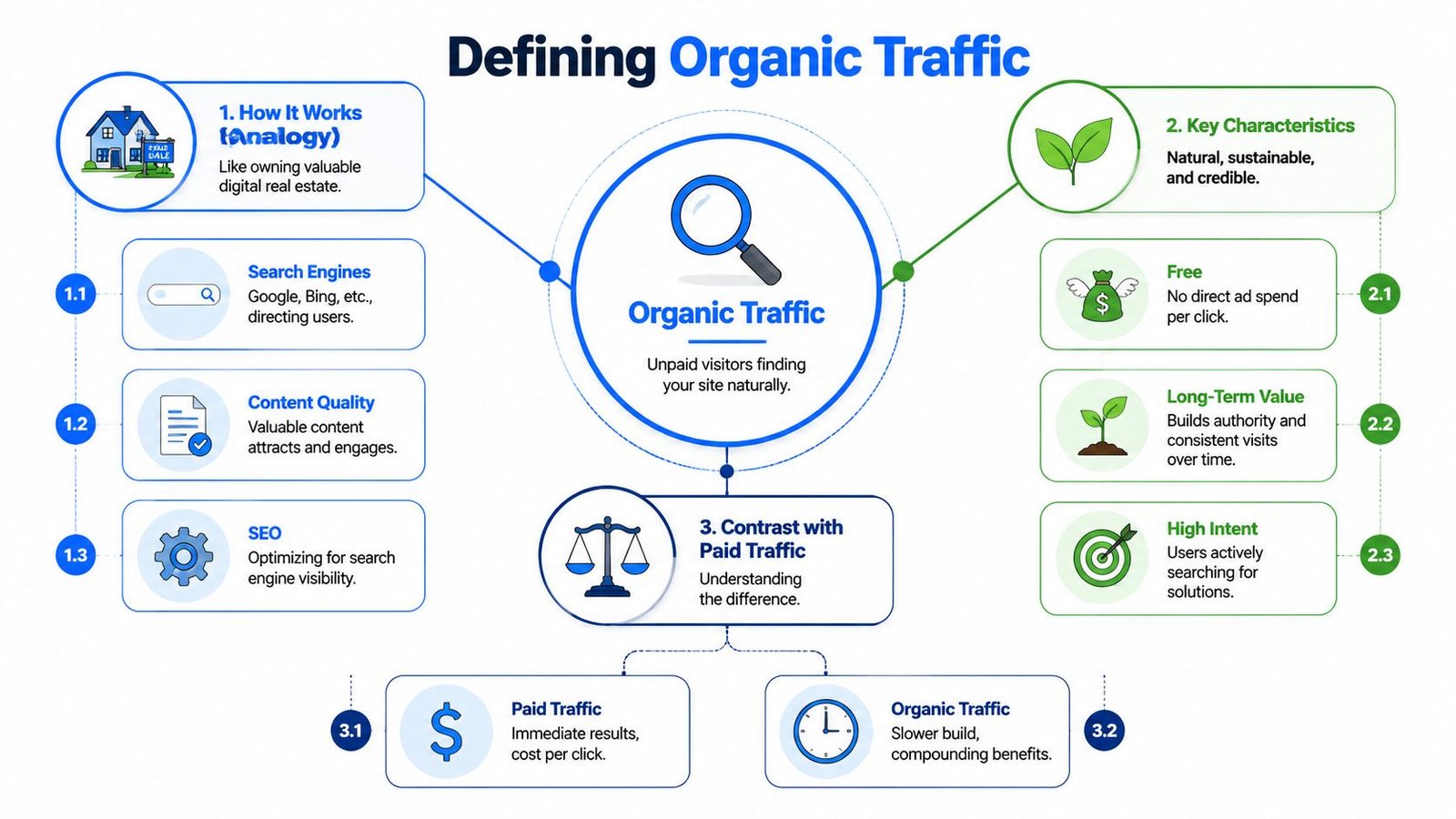
At the technical level, organic traffic means visits that come from unpaid search engine results. In analytics, those visits are separated so teams can measure SEO performance independently from paid campaigns, direct visits, and other channels. Semrush's definition of organic traffic also makes the key business point: it's a compounding channel because a well-optimized page can continue generating visits after the initial work is done.
Think of it as owned visibility
The easiest way to explain what is organic traffic is to compare it with property.
Paid traffic is like renting a storefront. You get exposure immediately, but once you stop paying, the location is gone. Organic traffic is closer to owning digital real estate. You still have to invest in the property, improve it, and keep it competitive, but the value can persist.
That analogy matters because it changes expectations. Organic traffic usually builds slower than paid traffic. It also tends to be more durable when the page is useful, crawlable, and matched to a real search need.
What search engines actually do
Search engines follow a basic sequence.
- They crawl pages using bots that discover URLs and revisit known ones.
- They index content by storing and organizing pages they believe are useful enough to show in results.
- They rank pages when someone searches, based on how relevant and trustworthy a page appears for that query.
If a page can't be crawled, it won't compete. If it's crawled but not indexable, it won't show. If it's indexed but weak, thin, or mismatched to intent, it may rank too low to matter.
A lot of SEO problems aren't ranking problems first. They're visibility problems caused by pages that search engines can't access or can't trust.
For a SaaS site, that often shows up in feature pages that say too little, docs pages that aren't connected internally, or comparison pages that never get indexed properly. For eCommerce, it often appears in faceted navigation issues, duplicate category pages, or product pages with thin copy.
Why the source definition matters
Organic traffic does not mean "all free traffic." It means unpaid visits from search engines. That distinction matters in GA4, where channel grouping affects how teams judge performance. If you mix organic search with referral or social in internal reporting, you'll make poor decisions about where growth is coming from.
The practical test is straightforward. If someone searched on Google or Bing, clicked your unpaid listing, and landed on your site, that visit belongs in organic search. If they came from a paid ad, social post, or a link on another site, it belongs somewhere else.
The Primary Sources of Website Traffic
Organic traffic matters more when you compare it against the alternatives. Founders often group all visits together and then wonder why top-line traffic grows while qualified pipeline doesn't. The problem isn't just volume. It's that different traffic sources bring very different levels of intent and durability.
Here's a simple operating view.
Website traffic sources compared
| Traffic Source | User Intent | Cost Model | Sustainability |
|---|---|---|---|
| Organic Search | Usually high intent because users are actively searching for a problem, product, or answer | No direct cost per click, but ongoing investment in SEO, content, and site quality | High when pages keep ranking and remain useful |
| Direct | Often brand-aware or returning visitors | No media cost per visit | Strong, but heavily influenced by existing brand demand |
| Paid Search | Can be high intent, especially on commercial keywords | Pay for clicks and visibility | Stops when spend stops |
| Referral | Depends on the source sending traffic | Usually earned through partnerships, PR, affiliates, mentions, or links | Mixed. Good referrals can persist, weak ones fade fast |
| Social | Often lower or more variable intent, though it can support discovery well | Organic social requires time; paid social requires budget | Usually less durable than search unless supported by a strong community or repeat content engine |
What organic does better than other channels
Organic search sits in a valuable middle ground. It can capture active demand like paid search, but it has more staying power once rankings are established. That's why operators who care about efficient acquisition rarely treat SEO as optional.
Direct traffic has value, but it often reflects brand strength you already earned elsewhere. Referral traffic can produce excellent visits, especially from trusted publications or partner ecosystems, but it's less predictable. Social can create awareness and assist the journey, yet it usually doesn't replace search when a buyer is comparing options or looking for a precise solution.
What organic does worse
Organic is slower to build. It's less controllable day to day. You can't force rankings the way you can launch a paid campaign this afternoon. Teams that need immediate demand capture still need paid search, outbound, partnerships, or existing brand distribution.
That trade-off is where many companies go wrong. They either expect SEO to work like ads, or they dismiss it because it doesn't. The better approach is to assign each channel the role it's good at.
- Use organic search for durable demand capture.
- Use paid search for immediacy, testing, and coverage where ranking is weak.
- Use direct traffic as a read on brand strength and returning interest.
- Use referral to build authority, visibility, and qualified pathways from adjacent audiences.
- Use social to distribute ideas, support community, and create assisted discovery.
When you look at the mix this way, organic stops being "traffic from Google" and becomes the channel that turns search behavior into a long-term acquisition base.
The Business Case for Organic Traffic in 2026
SaaS and eCommerce teams don't need more traffic in the abstract. They need traffic that matches buying intent, works on mobile, and still earns clicks in a search results page that keeps getting more crowded.
That's why the business case for organic traffic has sharpened. 61% of organic search visits come from mobile devices, long-tail keywords drive 70% of all search traffic, and one 2025 benchmark reported a 17.92% decline in organic CTRs across positions #1 to #5 from 2024 to 2025, according to Fire Us Marketing's industry benchmarks on organic traffic growth. Search is still massive, but earning the click now takes more precision.

Mobile changed what a good page looks like
A page that works on desktop and frustrates users on mobile isn't competitive anymore. Mobile users scan faster, compare faster, and abandon faster. They need pages that load cleanly, answer the question quickly, and make the next action obvious.
For SaaS, that often means simplifying feature pages, reducing clutter above the fold, and making demo or signup paths easy to find. For eCommerce, it usually means cleaner collection pages, clearer product information, and less friction between discovery and purchase.
Long-tail demand is where intent gets clearer
Broad keywords attract attention. Long-tail queries reveal context.
When someone searches a specific use case, alternative, integration, or product detail, they're telling you more about where they are in the journey. Those are often the terms that separate vanity traffic from commercially useful traffic. A SaaS company may get more value from a product-comparison query than from a broad informational term. An online store may get more value from a highly specific category or product modifier than from a generic head term.
Strong SEO teams don't chase every high-volume term. They build pages for the questions that signal intent.
AI Overviews changed click economics
Search results now include more SERP features competing for attention. That doesn't make SEO less important. It makes shallow SEO less effective.
If AI Overviews reduce clicks from top positions, then ranking alone isn't enough. Your result still needs to earn the click with strong titles, clear relevance, and a page experience that satisfies the visit once it lands. This is why many teams are shifting from "more content" to "better query coverage."
If you're evaluating what that looks like in practice across different markets and site types, reviewing SaaS and eCommerce SEO case studies from SaasSky can help you see how teams structure organic growth around real business outcomes rather than publishing volume.
Three Pillars for Growing Your Organic Traffic
Organic traffic grows when three systems reinforce each other. Content gives search engines something to rank. Technical SEO makes that content accessible. Authority helps the site compete when multiple pages look relevant.
Miss one pillar and growth usually stalls.
Pillar one is content that matches intent
Most weak SEO programs don't fail because they publish too little. They fail because they publish pages nobody needed, or pages that don't match what the searcher wanted.
For SaaS, useful content often includes:
- Comparison pages that help buyers evaluate options clearly
- Use-case pages tied to specific jobs to be done
- Integration pages that capture ecosystem demand
- Problem-aware educational content that leads naturally to product relevance
For eCommerce, the mix usually looks different:
- Collection pages built around real category intent
- Product pages with helpful copy, not just manufacturer text
- Buying guides that support product discovery and reduce hesitation
- Support content that answers pre-purchase questions
The best content strategies use topic clusters, but the cluster itself isn't the goal. The goal is coverage of the queries that matter most to pipeline or revenue.
Pillar two is technical SEO that removes friction
You can publish excellent pages and still get weak results if search engines struggle to crawl, index, or understand the site.
Technical SEO for most growth-stage teams comes down to disciplined basics:
- Crawlability: Search bots need clean internal pathways to important pages.
- Indexability: Pages that should rank must be available for indexing, without avoidable duplication or accidental exclusion.
- Site performance: Slow pages damage both user experience and search performance.
- Structure: Internal linking, page hierarchy, canonicals, and templates need to support visibility, not dilute it.
A common mistake is treating technical SEO as a one-time audit. In reality, every redesign, template rollout, faceted navigation update, or CMS change can create new issues.
The pages that make money should be the easiest pages for both users and search engines to reach.
Pillar three is authority that supports rankings
Search engines don't judge pages in isolation. They also judge whether the site deserves trust.
Authority comes from signals such as relevant backlinks, brand mentions, editorial references, and a site architecture that concentrates value in the right places. For most SaaS and eCommerce brands, link building transitions from theoretical discussion to practical implementation. A good link isn't just "SEO juice." It can help a key commercial page compete in a crowded results page.
What doesn't work well:
- Low-quality link blasts
- Irrelevant placements
- Publishing content solely to host backlinks
- Building links to pages with weak on-page intent match
What tends to work better:
- Linkable assets with a purpose, such as original tools, comparison resources, or strong educational content
- Editorial outreach tied to relevance, not raw domain metrics
- Internal linking that routes authority toward product, category, and conversion-oriented pages
If you're comparing service models or trying to understand how link building fits into a wider SEO program, SaasSky's service and pricing options give a practical reference point for how some brands structure this work.
How to Measure and Report on Organic Traffic Quality
A traffic graph going up is nice. It isn't enough.
The key question is whether organic traffic is landing on the right pages, engaging with the site, and turning into signups, demos, purchases, or qualified assisted conversions. If you only report sessions, you can end up celebrating growth that doesn't move the business.
Start with baselines, not generic goals
Organic traffic should be benchmarked against your own history, not against a universal standard. AgencyAnalytics notes that teams often use historical performance as the benchmark, and that a 10% month-over-month increase can be a realistic target for a growing site. The same benchmark notes that the top organic result has a 39.8% CTR versus 2.1% for paid ads, which is why ranking improvements can materially change both volume and traffic quality.
That gives you a useful reporting lens. Don't ask whether traffic is "good" in general. Ask whether organic is improving relative to your current baseline, your page set, and your commercial goals.
What to track in GA4 and search reporting
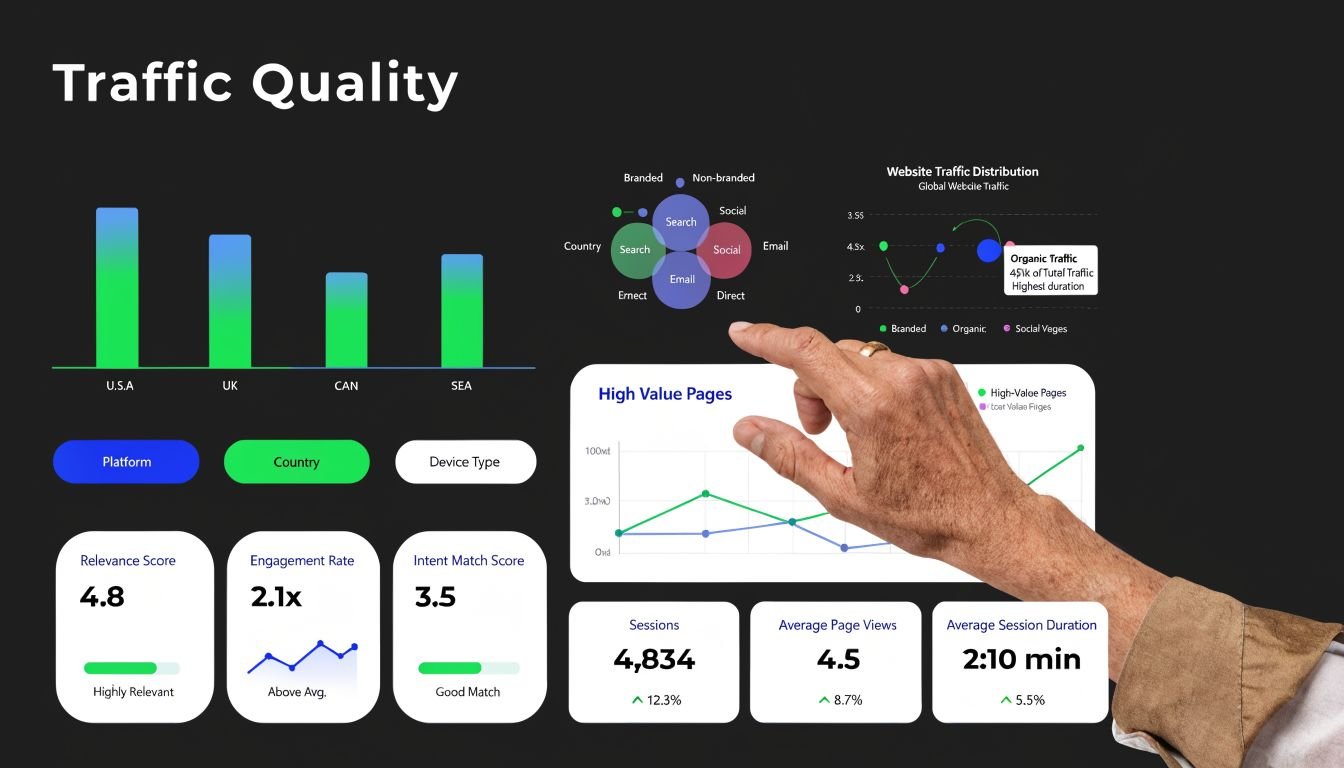
For most SaaS and eCommerce teams, these are the metrics that matter most:
- Organic sessions by landing page: Which pages attract search demand.
- Conversions from organic traffic: Demo requests, trials, purchases, or lead submissions.
- Engagement signals: Time on page, pages per session, and meaningful interactions.
- Device split: Whether mobile visitors behave differently from desktop visitors.
- Geography: Whether the traffic matches your target markets.
- Source and medium integrity: Whether visits are being categorized correctly.
In GA4, start in Traffic acquisition and Landing page reports. Then compare organic landing pages against conversions and engagement events. In Google Search Console, look at query and page relationships to see whether impressions are turning into clicks, and whether clicks are landing on pages built for the right intent.
Report like an operator, not a publisher
A good monthly organic report doesn't just say "blog traffic increased." It answers questions like these:
| Reporting question | Why it matters |
|---|---|
| Which landing pages drove the most qualified organic visits? | Shows where search intent matches business value |
| Which queries are gaining impressions but weak on clicks? | Flags title, snippet, or relevance problems |
| Which pages attract traffic but fail to convert? | Identifies gaps in offer, UX, or intent alignment |
| Which commercial pages improved ranking visibility? | Connects SEO work to revenue-facing assets |
If a page brings visits but no business signal, it may still be useful. But it shouldn't dominate your SEO roadmap.
The strongest teams report organic traffic as part of a demand system. They connect rankings to landing pages, landing pages to conversions, and conversions to revenue impact.
Common Questions About Organic Traffic
Does organic traffic include social media
No. In standard analytics, organic traffic refers to unpaid visits from search engines, while organic social is tracked separately. Klipfolio's explanation of organic search traffic makes this distinction clearly. That separation matters because SEO and social play different roles, and combining them hides ROI.
How long does SEO take to increase organic traffic
It depends on site age, competition, authority, technical health, and the type of pages you're trying to rank. Some improvements show up quickly, especially when you fix indexation or upgrade existing pages with clear demand. New content and new authority usually take longer. The wrong expectation is immediate lift on every page. The right expectation is steady progress once the underlying system is sound.
Is organic traffic the same as direct traffic
No. Organic traffic comes from unpaid search results. Direct traffic usually means someone arrived without a referring source being attributed, often by typing in the URL, using a bookmark, or coming through tracking gaps. Direct often reflects brand familiarity. Organic often reflects demand capture before brand selection.
Is more organic traffic always better
Not by itself. If the traffic lands on irrelevant informational pages and never leads to signups or sales, it can inflate reporting without improving the business. Good organic traffic is qualified, aligned with intent, and connected to pages that support conversion.
If organic search is becoming a meaningful acquisition channel for your SaaS or eCommerce brand, SaasSky can help you build it like a durable growth asset, with transparent execution, clear link building strategy, and a focus on measurable business impact rather than vanity traffic.
Generated with Outrank app