You're probably hearing two opposite takes right now.
One camp says backlinks are old SEO thinking, and that product-led content, topical authority, and AI-assisted publishing are enough. The other camp is still pitching bulk outreach, guest post packages, and “guaranteed” links as if search hasn't changed in years. If you're a SaaS or eCommerce founder, both extremes are expensive in different ways. One wastes time. The other creates risk.
The practical answer sits in the middle. White hat link building still matters, but only when it's treated like an investment decision. The question isn't whether to build links. The question is which links are worth the cost, which tactics support customer acquisition, and which plays create durable authority instead of a temporary bump.
That's the lens founders need in 2026. Not “more links.” Better assets, better targets, better judgment.
Table of Contents
- Do Backlinks Still Matter in 2026
- The Link Building Spectrum White Hat vs Black Hat
- The Modern White Hat Link Building Toolkit
- A Link Building Playbook for SaaS Companies
- A Link Building Playbook for eCommerce Brands
- Measuring Real Link Building Impact
- Building Your Authority Brick by Brick
- Frequently Asked Questions About White Hat Link Building
- Is white hat link building still worth it for an early-stage company
- What's the best first asset to build
- Should founders approve guest posting
- How long does white hat link building take
- What should I ask an agency or consultant before hiring them
- Do I need expensive tools to start
- What usually fails
Do Backlinks Still Matter in 2026
Yes. But the market for links is harsher, slower, and far less forgiving than it used to be.
A lot of founders assume links must matter less because search is flooded with AI content and Google keeps tightening quality controls. That sounds plausible until you look at what ranks. According to a roundup citing Ahrefs' 2024 crawl, only 2.2% of pages received at least one backlink from a referring page in the last year, while only about 5.8% of pages ranking in the top 10 had no backlinks. That's a strong signal that links still correlate with visibility, even though most pages never earn them at all, as noted in this white hat link building analysis.
That changes the conversation.
The issue isn't “Are backlinks dead?” It's this: if earning links is rare, then the brands that earn the right links keep compounding while everyone else publishes into a void. For a SaaS company, that can mean comparison pages, feature pages, and educational content never getting enough authority to rank. For eCommerce, it can mean category pages and buying guides staying invisible while marketplaces and publishers take the clicks.
Why founders get this wrong
Many teams still evaluate white hat link building like a checklist item under SEO. They ask for a monthly link count, review domain metrics, and move on.
That's not how a good program works. You should evaluate links the same way you evaluate paid acquisition or content production:
- Will this support revenue pages by helping product, category, or commercial-intent content rank?
- Will this improve credibility in front of buyers who research vendors before converting?
- Will this still make sense a year from now if Google gets stricter again?
Links still matter. Weak link tactics matter less.
What deserves investment now
White hat link building justifies cost when it does one of three things:
- Strengthens high-intent pages that can influence pipeline or sales.
- Builds reusable authority assets such as data pages, tools, or cited resources.
- Improves brand trust through placements on relevant sites your buyers already know.
If a tactic produces links nobody clicks, nobody trusts, and no target page benefits from, it isn't white hat growth. It's just activity.
The Link Building Spectrum White Hat vs Black Hat
Most founders don't need a philosophical debate about SEO ethics. They need a way to judge risk before approving budget.
The simplest framework is this. White hat link building builds authority on solid ground. Grey hat uses shortcuts that may work until they don't. Black hat tries to manufacture authority with tactics designed to manipulate rankings directly.
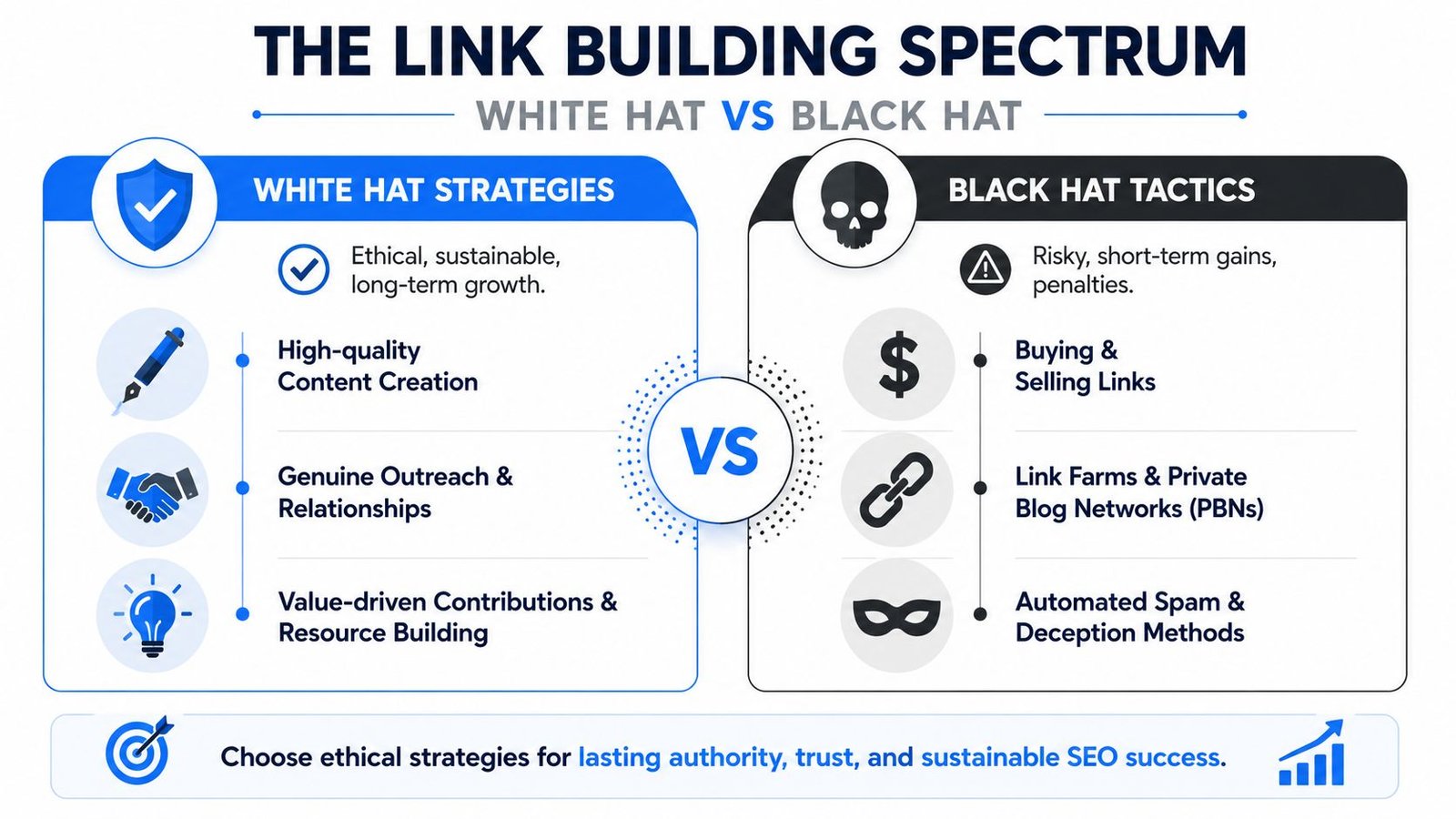
Pages ranking in Google's top 10 have 3.8x more backlinks than lower-ranking competitors, and 94% of link builders believe quality matters more than quantity, according to this link building statistics roundup. That's why the distinction matters. The upside comes from authority and relevance, not raw volume.
What white hat actually means in practice
White hat link building follows search-engine guidelines and focuses on earning links through value instead of manipulation. In practice, that means:
- Original research: You publish something worth citing.
- Digital PR: You create a story, dataset, or expert angle publishers want.
- Guest contributions on real sites: You contribute expertise where it helps the audience.
- Resource page outreach: You place useful assets where curators already collect them.
Black hat moves in the opposite direction. It tries to create ranking signals without creating editorial value. That includes link farms, private blog networks, automated spam, and placements made only to pass authority.
Grey hat is where founders get trapped. The pitch sounds clean. The actual placement exists only because someone paid for it, traded for it, or inserted it into a page that has no real editorial reason to link.
How to classify a tactic before you approve it
Ask one blunt question. If the SEO value disappeared, would this link still make business sense?
If the answer is yes, you're usually in safer territory. If the answer is no, your team is probably buying a signal, not earning an endorsement.
Here's the quick comparison.
| Approach | Core Principle | Example Tactics | Risk Level |
|---|---|---|---|
| White hat | Earn links by improving the web page or publication linking to you | Data studies, digital PR, guest posting on reputable sites, resource page outreach | Low |
| Grey hat | Use commercial or tactical shortcuts that may appear editorial | Paid guest placements, negotiated insertions, loosely relevant partner pages | Medium |
| Black hat | Manipulate rankings with artificial link signals | PBNs, link farms, automated spam, deceptive link schemes | High |
Practical rule: Don't evaluate a link by the tactic name alone. Evaluate intent, editorial value, and whether a real person would add that link without ranking pressure.
A partner page can be clean. A guest post can be manipulative. A sponsorship can be compliant or risky. The label doesn't protect you. The execution does.
The Modern White Hat Link Building Toolkit
The best white hat link building campaigns don't start with outreach. They start with an asset worth linking to.
That matters because cold outreach has a low hit rate. One industry roundup reports that only 8.5% of cold outreach emails result in a backlink, while interactive tools, data studies, and whitepapers are among the strongest white-hat assets, with whitepapers used by 50% of B2B brands to earn backlinks, according to this BuzzStream roundup on white hat link building.
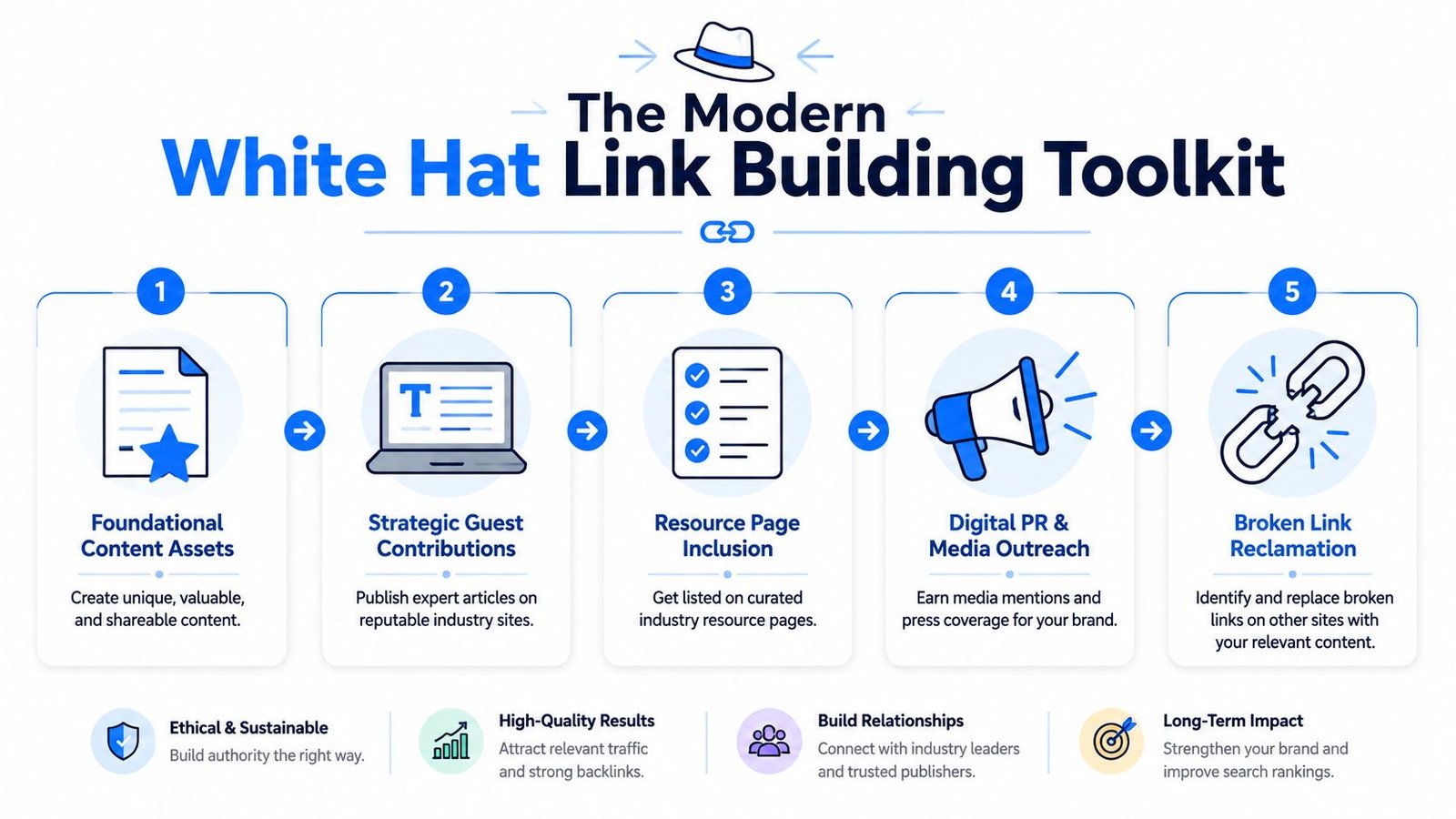
If your team only sends emails asking for links to ordinary blog posts, you're forcing publishers to do extra editorial work for little gain. Strong white hat campaigns reverse that dynamic. They make the link helpful.
Assets that earn links without begging for them
A useful publisher asks, “Does this improve my page?” Your asset needs a clear yes.
Three formats keep outperforming because they reduce effort for the site linking to you:
Statistics pages and data studies
These work because writers need current numbers and a source they can cite. A SaaS company can publish benchmark data from product usage patterns, survey results, or curated industry statistics. An eCommerce brand can publish trend reports, sizing research, or category-specific buying data.Interactive tools
Calculators, graders, generators, and self-assessment tools pull links because they do something static content can't. They help the publisher solve a problem for their audience without building the tool themselves.Skyscraper rebuilds
This still works when done properly. Find content with 20+ referring domains, audit where it's outdated or thin, and rebuild it with newer data, stronger design, and custom visuals, as recommended in this guide to white hat link building tactics.
Outreach that still deserves a team's time
Outreach isn't dead. Bad outreach is.
The strongest emails usually do one of two things:
- Show a precise fit
You point to the exact section where your asset improves the page. - Reduce editorial effort
You make the update easy. Better visual. Better stat. Better explanation.
What doesn't work well anymore:
- Generic “we noticed your article” emails
- Mass pitches to irrelevant blogs
- Asking for links to thin thought-leadership posts
- Treating every domain like it has equal value
A founder should expect a team to prioritize fewer, better targets. Relevance beats scale when the goal is durable authority.
Where digital PR fits
Digital PR is the multiplier inside white hat link building. It turns a useful asset into a story.
For SaaS, that might be a benchmark report, category map, integration trend piece, or expert commentary tied to a market shift. For eCommerce, it might be seasonal shopping data, product trend insights, or a consumer behavior angle that publications can cover.
The best white hat campaigns are engineered around publisher usefulness, not link volume.
That's the core shift in 2026. You're not buying attention. You're packaging something useful enough that the right sites want to reference it.
A Link Building Playbook for SaaS Companies
SaaS link building works best when it starts from the product, not from a generic content calendar.
A new founder often makes the same mistake. They publish educational blog posts for broad keywords, then wonder why none of the money pages move. The missing piece is usually authority flowing into the parts of the site that support pipeline. In SaaS, that means feature pages, integration pages, comparison content, category pages, and high-value educational assets that pre-sell the product.

A practical SaaS scenario
Take a B2B SaaS company selling workflow automation for security teams. The founder wants more demo requests, but the site has little authority outside branded searches.
A sensible white hat plan would split links across three layers:
Top of funnel authority assets
Publish a benchmark report, statistics page, or industry explainer that journalists and bloggers can cite. This is the easiest entry point for earning links at scale because it gives other sites something reusable.Middle of funnel comparison content
Build product comparison pages, implementation guides, and use-case pages that help buyers shortlist vendors. These pages often influence revenue more directly than generic blog posts.Bottom of funnel trust pages
Strengthen integration pages, partner pages, and customer proof. A founder can study how mature teams present operational credibility by reviewing examples such as this SaaS case study.
The SaaS pages worth promoting
Not every page deserves outreach. The strongest candidates usually look like this:
Statistics and benchmark pages
A page built from customer usage patterns, industry surveys, or consolidated category data can earn recurring citations over time.Integration pages
These are underrated. If your product connects with established platforms, your integration ecosystem can create natural co-marketing and partner-link opportunities when handled carefully.Original frameworks and educational assets
Founders and product marketers often underestimate how linkable a well-structured framework can be if it helps practitioners explain a process internally.
A SaaS backlink isn't valuable just because it comes from a tech site. It's valuable when it helps the right commercial page earn trust and visibility.
What usually underperforms for SaaS founders is random guest posting about broad startup topics. It creates motion, not advantage. Better results come from assets your category already needs, then outreach to people who would naturally cite them. When the product creates the angle, the links support MRR growth more directly.
A Link Building Playbook for eCommerce Brands
eCommerce link building is different because the buyer journey is shorter, more visual, and more influenced by trust. A link can help rankings, but it can also drive direct product discovery and shape whether a shopper believes your brand is credible enough to buy from.
That changes what “good” looks like.
A home goods brand, for example, shouldn't approach white hat link building like a SaaS company publishing category theory. It needs placements and assets tied to buying behavior. Gift guides, category explainers, care guides, styling content, and product-led editorial all have more commercial relevance.
A practical eCommerce scenario
Take a premium coffee equipment brand trying to grow non-branded search and repeat purchases.
A smart plan would mix three types of links:
First, editorial product discovery links. These come from niche blogs, publication roundups, holiday guides, and category resource pages. The right placements put products in front of buyers who are already comparing options.
Second, education-led links. Instead of pushing product pages directly, the brand creates brew guides, maintenance resources, grinder comparison content, and visual explainers that publishers can cite. These pages earn trust at the top and middle of the funnel.
Third, brand authority links. Collaborations with creators, experts, and adjacent publishers can support both search visibility and conversion confidence. A mention on a respected niche site often does more for purchase intent than a technically strong but irrelevant link.
The eCommerce assets that pull commercial value
Not every eCommerce asset attracts links. Product pages alone rarely do unless the brand is already famous.
Better candidates include:
Buying guides
“How to choose” content works when it helps shoppers narrow options. This can support category pages later through internal linking.Seasonal or event-driven campaigns
Gift guides, trend roundups, and editorial hooks give publishers a reason to feature products in context.Visual resources
Infographics, comparison charts, care instructions, and sizing explainers often outperform generic blog content because they improve the publisher's page directly.Founder or maker stories
These won't always drive rankings alone, but they can open doors with niche publications and communities where authenticity matters.
A lot of eCommerce brands waste time chasing placements on high-metric sites with weak audience fit. That link may look good in a report and do very little for sales. The better approach is to ask whether the placement reaches likely buyers, supports category relevance, and increases confidence at the moment someone is deciding what to purchase.
Measuring Real Link Building Impact
Founders shouldn't judge white hat link building by link count alone. That's one of the fastest ways to reward the wrong behavior.
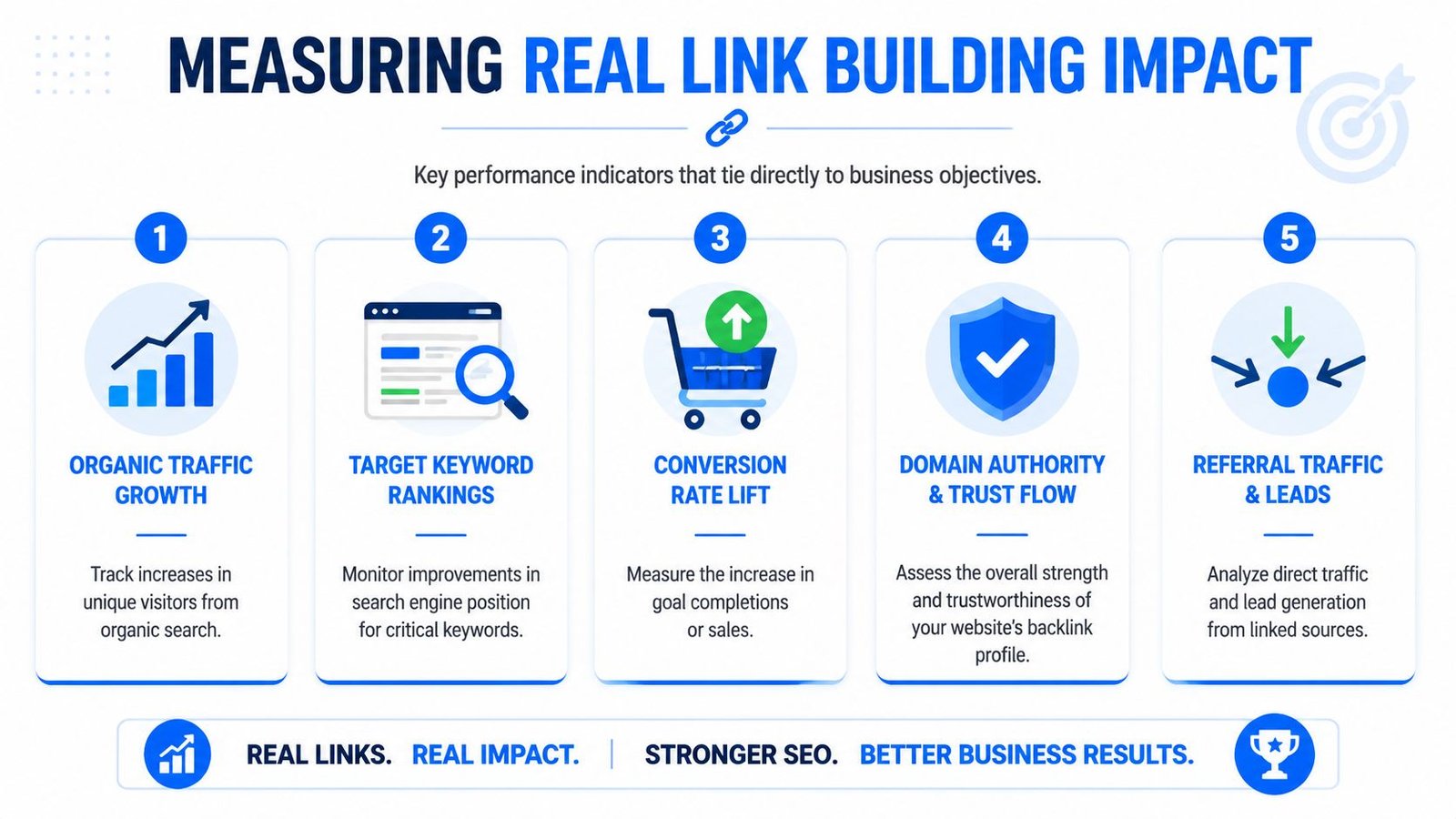
A useful program should show movement in business-relevant outcomes. Rankings for target pages. Qualified organic traffic. Referral visits from relevant sites. Leads, trials, or purchases influenced by the pages receiving authority. If a team keeps reporting “we built links” without showing page-level impact, they're reporting production, not results.
Metrics founders should care about
Look at white hat link building through a page portfolio lens.
Target page ranking movement
Did the specific feature page, comparison page, category page, or resource asset improve in search visibility after links were earned?Organic traffic quality
More sessions matter only if they land on pages that can move a user closer to sign-up or purchase.Referral traffic from earned placements
Some links send little direct traffic and still help SEO. Others do both. You want to know which publications and partners deliver visitors who engage.Conversion influence
For SaaS, that may mean demo requests, free trials, or assisted conversions. For eCommerce, it may mean product page visits, add-to-cart behavior, or purchases from referred visitors.Link-to-page fit
Was the earned link pointed at the page that needed authority most, or did it land on a random blog post that can't pass much business value downstream?
A leadership team should review these metrics the same way they review channel performance. At the page level. Over time. Against revenue intent.
The compliance issue most teams overlook
A lot of “white hat” programs run into trouble on partner pages, sponsorships, affiliate relationships, and commercial placements.
Google's guidance is explicit. When a business relationship or compensation is involved, links should use rel='nofollow' or rel='sponsored', as explained in this discussion of white hat link building and compliance. That matters for SaaS ecosystems, co-marketing deals, vendor listings, and event sponsorships.
Here's the practical rule set:
- If money or value changed hands, treat the link as sponsored or nofollow.
- If it's a genuine editorial mention, normal linking can make sense.
- If you can't explain the intent clearly, the placement is probably riskier than it looks.
The difference between a legitimate business mention and a manipulative SEO placement is often disclosure, not the page type.
Teams that want cleaner reporting should also compare patterns across campaigns. A broad portfolio of relevant, editorial links looks different from a footprint of transactional placements. If you want examples of what mature reporting can look like across client work, browse published case study collections. The lesson isn't the format. It's the accountability.
Building Your Authority Brick by Brick
White hat link building isn't a side task for the SEO team. It's a way to build authority that compounds across content, product pages, brand perception, and customer acquisition.
That's why the strongest programs don't chase links in isolation. They create assets publishers want, direct authority toward commercial pages, and measure impact where founders care. Pipeline. Revenue influence. Category visibility. Trust.
For SaaS, that usually means turning product knowledge, integrations, and proprietary data into linkable resources. For eCommerce, it means building editorial and visual assets that help people discover and trust the brand before they buy.
The trade-off is simple. White hat link building is slower than manipulative shortcuts, but it creates an asset you can keep using. A solid statistics page can earn citations for months. A useful tool can attract mentions repeatedly. A respected brand mention can support both rankings and conversion confidence.
That's the right mental model. Each earned link is another layer of authority attached to the business, not just another line in a monthly report.
If you want to see how buyers talk about the value of a transparent, practitioner-led link building partner, reviews like this client feedback example show what founders usually care about most. Clear communication, realistic execution, and work that maps back to growth.
Frequently Asked Questions About White Hat Link Building
Is white hat link building still worth it for an early-stage company
Yes, if you focus on a small number of high-impact assets. Early-stage teams usually get more value from one strong statistics page, one useful tool, or one differentiated guide than from a large batch of low-value outreach.
What's the best first asset to build
For most SaaS companies, a statistics page, benchmark report, or practical tool is a strong starting point. For eCommerce, a buying guide, visual resource, or seasonal editorial asset often has a better chance of earning links than product pages.
Should founders approve guest posting
Sometimes. Guest posting works when the site is relevant, the audience overlap is real, and the article contributes expertise rather than existing only to host a link. It's weaker when used as a scaled publishing routine with little editorial fit.
How long does white hat link building take
Long enough that you should treat it like compounding work, not a quick fix. Some tactics produce wins faster than others, but the durable value usually comes from assets that continue attracting links after the initial promotion.
What should I ask an agency or consultant before hiring them
Use questions that reveal judgment, not just production capacity.
| Common Questions | |
|---|---|
| How do you choose target pages? | Look for an answer tied to commercial goals, not just domain metrics. |
| What assets do you recommend we build first? | Strong answers usually mention data pages, tools, or linkable resources with business relevance. |
| How do you handle partner and sponsored links? | They should explain disclosure and link attributes clearly. |
| How do you report impact? | Expect page-level ranking, traffic, referral, and conversion discussion. |
| What tactics do you avoid? | Good practitioners can explain where risk begins and why. |
Do I need expensive tools to start
No. Tools help with prospecting, backlink analysis, and monitoring, but they don't replace strategy. Most failures in white hat link building come from weak assets, poor targeting, and unclear business priorities.
What usually fails
A few patterns show up constantly:
- Thin content pitched as link-worthy
- Mass outreach with no publisher fit
- Links pointed at pages with no revenue relevance
- Reporting based on counts instead of outcomes
- Treating every placement as equally valuable
White hat link building works best when it solves a real editorial need and supports a real business objective.
If you want a partner that treats white hat link building like a growth investment instead of a volume game, SaasSky is built for SaaS and eCommerce teams that care about transparency, measurable impact, and execution grounded in real-world link acquisition.